Hire Go Developers for Your Software Team
Hire Go developers through Siblings Software when you need senior Golang engineers embedded in your squad without running a full recruiting cycle. We help CTOs, engineering managers, and platform leads add capacity for high-throughput APIs, Kafka consumers, gRPC services, and observability-heavy binaries, with vetting focused on concurrency, failure modes, and production operability.
Siblings is a Miami-led staff augmentation partner since 2014. Engineers work from Latin America with four to six hours of overlap with US Eastern and Central business hours on most engagements. On this page you can evaluate what embedded Go developers do, when augmentation fits, how we vet candidates, engagement models, timelines, pricing factors, risks, and how we compare to freelancers and in-house hiring. If you need a vendor-owned squad instead, see our dedicated Go development team page.
- One to three vetted profiles in 3-5 business days after a brief; embedded in about two weeks when security onboarding runs in parallel.
- 2-week satisfaction guarantee on placements and 30-day notice to scale down monthly engagements.
- Published staff augmentation band: USD 4k-9k per month per developer, with senior Go platform work often above the midpoint.
Reviewed by Javier Uanini, Founder and CEO, Siblings Software. Last reviewed 19 September 2026.
What Go developers do in real client teams
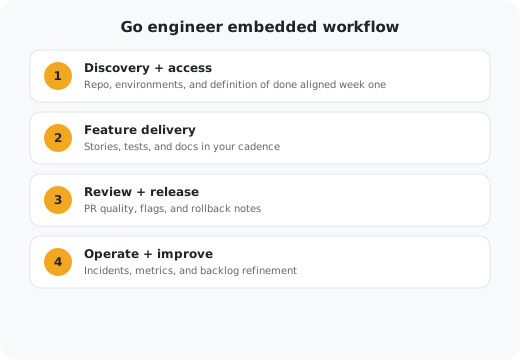
Embedded Go developers join your standups, refine tickets with product and platform peers, and ship in the same repositories as your employees. They implement and harden HTTP and gRPC handlers, Kafka or NATS consumers, cron workers, and CLI tools your SRE team can operate without a vendor-specific fork.
Day to day that means profiling hot paths, designing graceful shutdown and context cancellation, writing table-driven tests around concurrency seams, instrumenting services with structured logs and OpenTelemetry traces, and documenting trade-offs in pull requests your next hire will read. They use your CI pipelines, code review rules, and on-call rotation rather than a shadow codebase.
This role differs from a generic back-end developer hire because Go work is judged on latency, goroutine safety, and operability under load. It differs from DevOps hiring because they own application logic and service boundaries, not cluster baselines alone. For contract-first public APIs, compare with hire API developers.
When companies hire Go developers through staff augmentation
Most discovery calls fall into a handful of situations. Augmentation works when you already have an engineering lead and a defined backlog; it is a poor fit when nobody owns priorities or you need a vendor-owned pod for a full program.
Common scenarios
- Platform or data-plane backlog after a funding round or enterprise launch, with internal hiring lagging roadmap pressure.
- Strangler migration extracting ingestion or edge services from a Node or Java monolith without pausing feature work on the core.
- On-call pain from goroutine leaks, retry storms, or missing backpressure on existing Go binaries.
- Attrition on a small platform team while you recruit permanent senior Go hires.
- Seasonal or compliance-driven scope that needs senior depth without a new FTE requisition.
Usually a different model
- No engineering manager or platform lead to prioritize work and review design.
- A one-week cosmetic change where a freelancer is faster to engage.
- A multi-quarter program where you want Siblings to own delivery end to end. See a dedicated Go development team or Go development outsourcing.
Delivery model context: hire nearshore developers, hire software developers (routing hub), and hire Kubernetes developers when cluster work parallels your Go services.
How Siblings vets Go developers
We screen Go candidates with a live exercise shaped like your backlog, not generic puzzle questions. Every candidate passes a five-stage pipeline before you interview: technical filter, timed implementation, pair session with our engineering lead, reference checks, then your team conversation.
- Concurrency and production debugging: pprof, trace, channel backpressure, and realistic incident logs.
- Testing discipline: Table-driven tests on the slice they ship, including failure and cancellation paths.
- Communication: Pull requests that explain trade-offs and operational impact, not only diffs.
- Stack match: gRPC/protobuf, Kafka, PostgreSQL, Redis, Kubernetes, and observability tooling from your brief.
- Red flags: Resume-only Golang keywords, no examples of owned on-call or performance work, or unwillingness to work inside an existing module layout.
The Concurrency Readiness Test
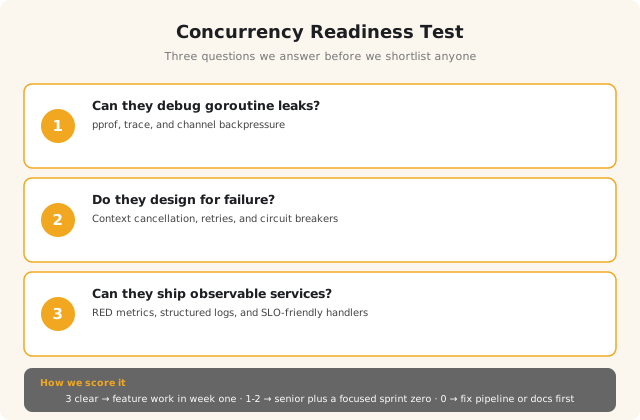
Three questions decide whether sprint zero is environment setup or feature delivery. We use this in discovery and again during live vetting so shortlists match how your services actually fail under load.
Q1. Can they debug goroutine leaks?
pprof, trace, and channel backpressure
Q2. Do they design for failure?
Context cancellation, retries, and circuit breakers
Q3. Can they ship observable services?
RED metrics, structured logs, and SLO-friendly handlers
For language-level expectations we align with the idioms in the official Effective Go guide, applied to your module layout and error-handling conventions.
Engagement models for Go staff augmentation
Clients usually choose one of these shapes. All are monthly staff augmentation unless we agree a fixed bridge timeline in the statement of work.
One embedded engineer
Best when you have a platform or backend lead and need one senior Go developer inside your sprint cadence to own a stream of stories.
Pair
Two engineers for parallel tracks, such as a strangler extraction plus feature work on the legacy core, or ingester rewrite plus API hardening.
Bridge
Six to twelve months of augmentation while internal recruiting catches up, with explicit handover milestones for your next FTE.
When you need a self-contained pod with a delivery lead, compare our dedicated Go development team model. When you want project-based delivery with a fixed scope, see Go development services.
Timelines and pricing context
Discovery on a Go brief usually takes three to five days. Team assembly runs five to ten days once you approve profiles. First meaningful deliverables often land in week three or four when environment access and security reviews finish on schedule. Senior Go engineers for platform, high-concurrency, or regulated work typically sit at or above the midpoint of our published staff augmentation band.
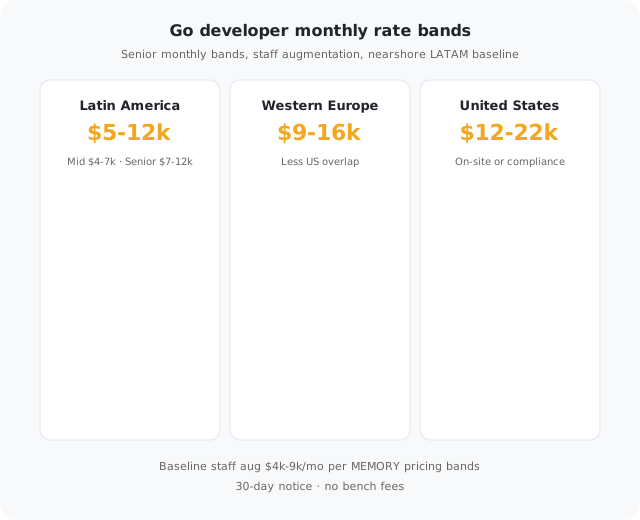
| Region | Mid-level | Senior | Notes |
|---|---|---|---|
| Latin America | $4-7k / month | $7-12k / month | Strongest value with US overlap. |
| United States | $12-16k / month | $14-22k / month | On-site or niche compliance. |
| Western Europe | $9-12k / month | $11-16k / month | Less daily US East overlap. |
What moves the rate
Regulated environments, on-call expectations, niche data stores, and hard overlap requirements with US Pacific hours can push quotes above the baseline band. We confirm numbers after a brief, not from a generic rate card.
Staff augmentation baseline: USD 4k-9k per month per developer for typical nearshore engagements (see our published brackets on the staff augmentation hub).
Staff augmentation vs freelancers vs in-house hiring
None of these options wins every situation. The table below is how buyers usually decide after a short brief.
| Model | Time to start | Best for | Tradeoff |
|---|---|---|---|
| Staff augmentation (Siblings) | About 1-2 weeks | Teams with backlog, an engineering lead, and existing Go or polyglot services. | You retain product and architecture ownership. |
| Freelance marketplaces | Days to weeks | Isolated tasks under four weeks with minimal onboarding. | Inconsistent vetting and weak continuity when the freelancer rotates off. |
| In-house hire | Often 8-16 weeks | Long-term culture carriers and institutional knowledge roles. | Recruiting lag and competitive compensation in tight Go labor markets. |
Example engagements
NetApp platform engineering (published)
NetApp engaged eight senior Go engineers through staff augmentation to scale delivery of REST and gRPC services, background workers, and observability for hybrid data-infrastructure SLOs. Read the full story on our NetApp case study page and compare with platform engineering services when the charter is broader than individual Go hires.
Redstone Telemetry Co. (composite illustrative)
Fictional name; scenario reflects engagements we optimize for.
A US industrial equipment monitoring SaaS ran a Node monolith with a Go ingester prototype that leaked goroutines under peak sensor traffic. Two senior Go engineers embedded alongside three internal backend developers, rebuilt the Kafka consumer and gRPC edge behind the existing gateway, and left runbooks plus dashboards the internal team could operate after roll-off. We do not publish fabricated latency or incident-rate metrics for this composite.
More references: case studies index and DevOps engineering when pipeline and on-call work sits beside application Go services.
Risks of hiring Go developers externally, and how we mitigate them
Parallel vendor codebase
Mitigation: Engineers use your GitHub or GitLab org, your CI, and your review rules from the first sprint. We do not maintain a separate fork you must merge later.
Resume keyword mismatch
Mitigation: The Concurrency Readiness Test and live backlog exercise filter candidates who list Golang but cannot debug production concurrency issues.
Knowledge loss at roll-off
Mitigation: Documentation, walkthroughs, and optional shadowing.
Security gaps
Mitigation: NDA and least-privilege access before repository clones.
Frequently Asked Questions
After a short brief we usually present one to three vetted profiles within three to five business days. Security onboarding runs in parallel so an embedded Go engineer can merge a first production pull request in roughly two weeks, with meaningful delivery often landing in week three or four on our standard cadence.
We run a five-stage process: stack filter, live exercise shaped like your backlog, pair session with our engineering lead, reference checks, then your interview. The Concurrency Readiness Test checks goroutine lifecycle debugging, context cancellation, failure-mode design, and observable handlers with RED metrics and structured logs.
Yes. Embedded Go engineers commit to your organization, follow your branching model, and ship in the same repositories as your team. We match gRPC, REST, Kafka, PostgreSQL, Kubernetes, and observability patterns from your brief rather than imposing a greenfield stack.
Nearshore Latin America typically falls in the USD 4,000 to 9,000 per month staff augmentation band for mid-level engineers, with senior Go specialists for platform or high-concurrency work often between USD 7,000 and 12,000 per month. United States and Western Europe bands run higher.
Choose staff augmentation when you have an engineering lead, backlog, and rituals, and you need one or two senior Go engineers inside your squad. Choose a dedicated Go development team when you want Siblings to own a workstream end to end with its own delivery lead and parallel tracks.
Yes, with NDAs and least-privilege access before repository clones. We route credentials through your secret manager, document pipelines for audit review, and staff engineers who have shipped in fintech, healthcare, and payments codebases when your brief requires it.
We run a structured handover: architecture notes, runbooks for services they touched, optional shadowing for your next hire, and pull requests left in a mergeable state. Engagements scale with 30-day notice per our standard staff augmentation terms.
OUR STANDARDS
Production Go work with clear handover.
We hold embedded Go engineers to the same bar we expect from internal seniors: peer review, tests on concurrency-sensitive paths, and honest release guidance when a shortcut will cost on-call time later.
See our NetApp case study for a published delivery reference.
CONTACT US
Tell us about your Go stack, backlog, and timeline.