Careers
Build a software career working with US clients from Latin America
Siblings Software is a US-based software outsourcing company headquartered in Miami, Florida, with engineering teams running out of Latin America since 2014. We hire senior engineers, AI and cloud specialists, QA and release engineers, and delivery leads to ship long-running projects for clients in the US, Canada, and Europe across fintech, healthcare, eCommerce, logistics, and SaaS.
This is a working career page, not a recruiter pitch. If you are a developer who wants to write reviewed pull requests on a two-week cadence, sit in a small squad with senior peers, and own real product code that ships to paying users, this is a real fit. If you want a 200-person platform org, free meals, or a stack-rank ladder, this is not the right shop.
Written and reviewed by Javier Uanini, founder and CEO of Siblings Software, with input from the recruiting team. Updated 20 October 2026.
By the numbers, honestly
Most career pages dodge the actual operating numbers. Here are ours, with caveats where caveats belong.
10+
YEARS
Operating since 2014 out of Miami, with engineering teams across LATAM the whole time.
250+
CLIENT ENGAGEMENTS
Across fintech, healthcare, eCommerce, logistics, travel, payments, and B2B SaaS. About 40 percent venture-backed.
3–8
ENGINEERS PER SQUAD
Including the client's own engineers. Small enough that a standup fits in fifteen minutes.
2–24+
MONTHS PER ENGAGEMENT
Some postings are fixed-length engagements of two to five months; many squads sit on the same client for one to three years. Each posting says which.
6–8 h
EST OVERLAP TYPICAL
From Mexico, Colombia, Peru, and most of Central America. Argentina, Uruguay, and Chile shift the local day a couple of hours later.
1–2 wk
TYPICAL CV-TO-OFFER
CV review in three to five business days, then one or two interviews. We tell you which round is the decision round.
These are operational ranges drawn from how the company actually runs, not audited statistics. The first two are published facts about Siblings Software. The rest are typical of recent engagements and can move on a specific role; the interview is where we give you the number that actually applies to you.
Hiring snapshot — what we are staffing against in late 2026
The mix shifts with the client roadmap, but the shape has been steady since 2024. This is what a real screening week looks like right now.
OPEN-POSTING MIX, OCTOBER 2026
What recruiting is screening for this quarter
- Cloud, security, and infrastructure ~30%. GCP security engineering, AWS cost optimization (FinOps), and a lead infrastructure seat spanning on-prem data centers and public cloud. Terraform, Kubernetes, and IAM are table stakes; we screen for production ownership, not certificates alone.
- AI and agentic systems ~20%. Production LLM, RAG, and agent work in Python, from document-heavy workflow automation to agentic AI consulting on Vertex AI with LangGraph, ADK, and MCP.
- Mobile QA and release ~20%. Senior mobile quality engineering on Espresso and XCUITest, plus release engineering for native iOS and Android apps with feature flags and CI/CD.
- Delivery and business analysis ~20%. A Scrum-savvy project manager and a Salesforce business analyst, both on fixed-length engagements.
- Backend and distributed systems ~10%. Rust services on top of distributed storage, with gRPC, service mesh, and real replication and consistency trade-offs.
Percentages are the share of the ten postings open today. The mix is lumpy: a single new dedicated team can move one row 10–15 points in a month.
WHAT WE SCREEN FOR IN 2026
The signals that move a CV from review to interview
- Real PR review history. A link to a public repo where you have given non-trivial review on someone else's pull request — not just merged your own — weighs more than another certification.
- One decision you owned and would defend in writing. An ADR, a postmortem you wrote, a design note that made the call between two options. We will ask about it in the first interview.
- Judgment with AI tooling, not raw output. We assume Cursor, Claude Code, or Copilot are in your loop. The screen is whether you reject a model's diff when the trade-off is wrong, and whether you write the test that proves it.
- Production on-call experience. If you have been paged at 3am on a system you wrote, you understand observability differently. That experience is worth more than a Kubernetes certificate.
- One stack we can put you on the bench against. Generalists get hired; we just need to know which engagement to slot you into next quarter, so a clear primary stack helps.
CVs that read like template lists of every framework you have ever touched get a polite no. CVs with two stacks and a story behind each one make the interview shortlist.
If your stack does not appear in the role-family mix this quarter and you still want to talk to us, send the CV anyway. We keep a small bench warm against engagements that close on a two-week horizon, and a senior engineer in an underrepresented stack is exactly the candidate the next sales call is most likely to ask for.
What working here is actually like
Honest about the cadence, the time zones, and the trade-offs — before you spend an interview hour on it.
Most of what we do is project-based delivery: a small squad — usually three to eight engineers including the client's own — working on one product for somewhere between three months and a few years. You will be in the client's Slack, on their PR review thread, and in their Jira. The work that lands on your screen on Monday morning is the work that goes out to their users.
Small squads, two-week sprints
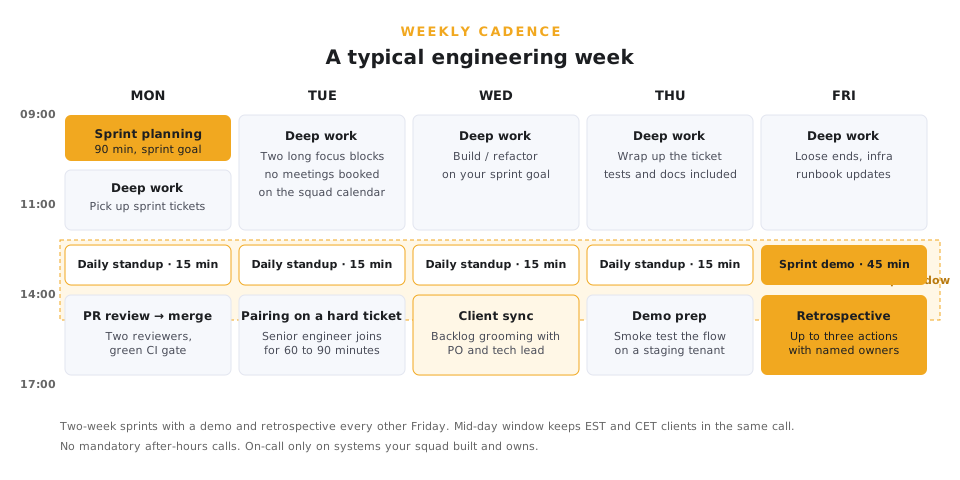
We run two-week sprints with a real sprint goal, daily fifteen-minute standups, a Friday demo, and a retro that closes its action items. Story points stay private to the squad; the headline metric we look at is whether the sprint goal landed.
Time-zone reality
Most of our clients sit on US Eastern Time, with some in the UK and Western Europe. From Argentina, Colombia, Mexico, and most of LATAM that overlaps your normal working day. From the eastern half of South America the start gets pushed a few hours later. This suits some people and not others — ask in the interview if it fits how you work.
Autonomy and ownership
You will own features end to end — from the design note, through review, into staging, and to production. Tech leads keep a veto on premature complexity, but they do not micromanage. You are expected to make your own technical calls and to write down the trade-offs when they matter.
Project variety, real depth
Some engineers stay on a single long-running engagement for years; others rotate as projects wind down. The mix means a senior engineer who joined two years ago has likely shipped on two or three different stacks — React Native one quarter, Go services the next.
The three-question fit check
A short, opinionated framework we ask candidates to run on themselves before the first interview. It saves both sides an hour.
The honest answer to these three questions tells us, and you, whether a Siblings seat will be the best year of your career or the wrong fit by month four. We have run this informally with every senior hire since 2022. None of them are deal-breakers in isolation; two of three pointing the wrong way usually is.
QUESTION 1
Is a US business day a normal day for you?
From Mexico, Colombia, Peru, and most of Central America the answer is yes by default. From Argentina, Uruguay, and Chile you will work roughly 11am to 7pm local. From Brazil it depends on the city. If you would resent the schedule by month two, this is a hard no and we would rather know now.
QUESTION 2
Do you want to make the decision, not just implement it?
The squads are small. Mid and senior engineers are expected to write the design note, surface trade-offs in PR review, and disagree with the tech lead in writing when they think the call is wrong. If you prefer to be handed a Jira ticket with an acceptance criteria, this will be uncomfortable from week one.
QUESTION 3
Can you live on one product for a year or more?
Most of our engagements run six to twenty-four months and many run longer. You will get to know the codebase, the on-call alerts, the head of product, and the legacy decisions you wish someone had documented. Engineers who need a new stack every quarter burn out here. Engineers who like to actually finish things settle in.
We will ask versions of all three in the interview. Honest answers, even "no" answers, score higher than performative ones. We have hired engineers who said no to question three and were the right fit for a six-month engagement; we have turned down people who said yes to all three but could not name a real decision they had owned in their last role.
Open roles
These are the positions open today, updated 20 October 2026. All of them are remote contractor engagements across Latin America: Argentina, Brazil, Colombia, Mexico, and, for some roles, the rest of the region. Each posting states the country, English level, and engagement length. If you do not see your exact title, send a CV anyway — we keep a small bench warm for the engagements that close the next week.
Project Manager (Brazil)
Location: Brazil, remote · English: C1 · Engagement: 5 months, contractor
Lead end-to-end delivery on a digital trade platform built on a modern, composable architecture. The work mixes new product development with digital transformation consulting, so you will act as delivery lead and Scrum Master for a cross-functional, multinational team.
Responsibilities
- Own delivery against the agreed scope, timeline, quality, and business objectives
- Manage scope, risks, issues, dependencies, assumptions, and change requests across the SDLC with a clear risk-management framework
- Coordinate Product, Technology, QA, Architecture, and business stakeholders across countries
- Facilitate Scrum ceremonies: sprint planning, daily standups, sprint reviews, and retrospectives
- Track progress and team capacity, and prepare regular RAG status reports for stakeholders
- Administer the Jira project: boards, sprints, releases, workflows, and capacity planning
- Run releases and go-lives, including cutover plans, hypercare, and the hand-off to business-as-usual
Requirements
- Proven track record leading cross-functional, multinational teams (mandatory)
- Hands-on Scrum experience; able to act as Scrum Master
- Advanced Jira administration and reporting
- Budget and cost management, change management, and strong stakeholder communication
- Solid spoken and written English (C1)
Apply by sending your CV to camila@siblingssoftware.com with the role title in the subject line.
Salesforce Business Analyst
Location: Argentina or Brazil, remote · English: B2+ · Engagement: 2.5 months with possible extension, contractor
Drive a permissions overhaul on an enterprise Salesforce org. You will be the bridge between end users and the core Salesforce team: run discovery, map user personas, and write the user stories that shape a secure, scalable access-management model.
Responsibilities
- Run interviews, workshops, and shadow sessions with business units to understand daily operations and data-access needs
- Turn business processes into clear user stories with solid acceptance criteria
- Document current-state and future-state workflows to expose access gaps and redundancies
- Work with the Salesforce product and admin team to translate needs into permission requirements
- Join grooming sessions so requirements are clear before development starts
- Line up end users for UAT and confirm the delivered permissions match the documented needs
Requirements
- 5+ years as a Salesforce Business Analyst
- Strong grasp of Salesforce objects and fields, and working knowledge of Profiles, Permission Sets, and Permission Set Groups (you should be able to build a permission set)
- Salesforce Sales Cloud experience
- Proven record eliciting requirements from non-technical stakeholders and writing high-quality agile user stories
- Excellent communication and the habit of asking the probing question
- Ability to turn messy operational descriptions into structured, logical requirements
Apply by sending your CV to camila@siblingssoftware.com with the role title in the subject line.
GCP Security – Cloud Engineer
Location: Remote from Argentina, Brazil, Chile, Colombia, Costa Rica, Dominican Republic, Ecuador, El Salvador, Guatemala, Honduras, Mexico, Panama, Paraguay, Peru, or Uruguay · English: B2+ · Spanish: C1+ · Engagement: 3 months with possible extension, contractor
Senior cloud security engineer who designs and implements security policies, guardrails, and foundations on Google Cloud Platform, working with CISOs and security engineering teams in a consulting setting.
Requirements
- 6+ years architecting and implementing secure policies and services, preferably on GCP
- Threat analysis and mitigation with SIEM tools such as Google SecOps (formerly Chronicle), Wiz, or similar
- Experience defining security strategy and governance with CISOs and security engineers
- Enforcing regulatory controls and supporting SOC or SecOps teams on compliance
- Expert IAM: resource hierarchies, boundary protection, secure communications, and Workload Identity Federation
- Network security on GCP: Cloud Firewall, Cloud Armor, VPC design, data protection, and Security Command Center
- Secure landing zones and data and AI foundations, including perimeters for user-to-agent, agent-to-agent, and agent-to-service traffic
- Using AI agents to automate and de-risk security and infrastructure deployment work
- Infrastructure as Code (Terraform) for compliance-driven security foundations, GKE security best practices, and secure CI/CD and DevSecOps pipelines
- Professional services or technical consulting background, with strong communication and negotiation skills
Nice to have
- Google Professional Cloud Security Engineer, Professional Cloud Architect, or Professional Security Operations Engineer certification
Apply by sending your CV to camila@siblingssoftware.com with the role title in the subject line.
AWS Cost Optimization Engineer
Location: Colombia or Mexico, remote · English: B2+ · Engagement: contractor
Give engineering teams visibility into cloud spend and bring it down with a data-driven approach to alerting, reporting, and optimization across a large AWS environment. You come from DevOps or SRE and enjoy turning billing data into decisions.
Responsibilities
- Work with engineering teams to find optimization opportunities and make cloud infrastructure cost-efficient
- Understand how the product is architected and deployed, and what each part of the environment costs
- Advise architects and engineers on resource optimization, waste reduction, capacity management, and KPIs
- Detect cost increases and usage anomalies, and trace them to their source
- Recommend and track commitment purchases: Reserved Instances, Savings Plans, and Spot
- Build and maintain cost and utilization reports, dashboards, alerts, and forecasts
- Help create, automate, and govern cost-optimization policies, and report savings against KPIs
Requirements
- Hands-on DevOps or SRE background
- Deep understanding of AWS infrastructure, cost reporting, and cost optimization at scale
- AWS EKS and containerization experience
- AWS Cost Explorer, Cost and Usage Report, AWS Budgets, and CloudHealth or similar
- Experience building cost dashboards, models, and reports for engineering teams
- Detail-oriented, comfortable working independently and across several projects at once
- Clear written and verbal communication for technical and non-technical audiences
Apply by sending your CV to camila@siblingssoftware.com with the role title in the subject line.
Software Engineer – Backend / Distributed Systems (Rust)
Location: Argentina, Brazil, Colombia, or Mexico, remote · English: B2+ · Engagement: contractor
Design, build, and run high-performance backend services that sit on top of distributed storage systems, and share on-call support for them. This is systems work: concurrency, RPC, replication, and consistency, not CRUD on top of a managed database.
Responsibilities
- Design, develop, and maintain scalable, reliable backend services that interact with several storage systems
- Provide on-call support, troubleshoot production issues, and debug complex failures
- Collaborate with globally distributed teams, with occasional early or late meetings to overlap US West Coast and Asia-Pacific time zones
Requirements
- Strong hands-on Rust with proven backend development experience
- Working knowledge of Go, Java, and Python, and the ability to ship non-trivial features in a new framework within days
- Enough C/C++ to read and reason about complex systems written in it
- Strong data structures and algorithms, and solid design experience with scalable, highly available distributed systems
- Concurrent programming: async, multi-threading, and concurrency models
- RPC services with gRPC or Apache Thrift (REST alone does not count)
- Cloud-native environments: service discovery (Consul, ZooKeeper), service mesh (Envoy, Istio), and IPv6 networking
- Distributed storage concepts you have built or operated: consistency models, partitioning and resharding, replication, and fault tolerance
Every requirement above must be backed by real project experience. Expect to explain, with examples, how data written to one node becomes visible on another.
Apply by sending your CV to camila@siblingssoftware.com with the role title in the subject line.
Senior Quality Engineer (Mobile)
Location: Argentina, remote · English: B2 · Engagement: contractor
Own quality on native iOS and Android apps: test strategy, functional and automated testing, and the UI automation frameworks that keep regression coverage close to 100 percent.
Responsibilities
- Work with Product, Design, and Development to turn requirements into test plans and test cases
- Run functional and automated tests, and integrate automated suites into CI
- Extend UI automation frameworks built on Espresso (Android) and XCUITest (iOS)
- Review and submit pull requests toward full regression automation
- Find, document, and track defects through fix and retest
- Shift testing left with developers through mocking strategies, and improve QA process and best practices
Requirements
- 7+ years of technical experience and a degree in Computer Science, Engineering, or a related field
- Hands-on testing on both iOS and Android
- 3+ years of mobile automation with tools such as Appium, Katalon, or similar
- Functional, integration, regression, exploratory, end-to-end, compatibility, API, and accessibility testing
- Good understanding of Swift or Kotlin, plus solid programming and debugging skills
- API testing with Postman, IntelliJ HTTP Client, or similar
- Debugging tools such as Charles Proxy, Splunk, and Sentry
- Agile delivery experience and strong communication
Apply by sending your CV to camila@siblingssoftware.com with the role title in the subject line.
Lead Infrastructure Engineer
Location: Mexico, remote, working US Pacific or Eastern hours with on-call · English: B2+ · Engagement: contractor
Design, automate, and operate infrastructure across on-prem data centers and public cloud (GCP and AWS). This role suits an engineer who came up through hands-on operations (racking hardware, running networks, bare-metal installs) and now sets technical direction, mentors engineers, and leads the move to modern Infrastructure as Code.
Responsibilities
- Design and operate large, multi-data-center infrastructure spanning on-prem hardware, GCP, and AWS
- Lead deployment and configuration automation, migrating legacy tooling to Terraform, Puppet, and Ansible
- Design and maintain traffic management, load balancing, and DNS at scale
- Build monitoring and observability across on-prem and cloud
- Build tooling for distributed, auditable systems administration, and document processes and policies
Requirements
- 10+ years in infrastructure or systems engineering with direct ownership of production systems
- Remote management of physical hardware in colocation facilities
- Deep Linux administration (Red Hat, Debian, or similar) at scale
- Core networking: Cisco hardware, DNS, load balancing, and traffic management
- Enterprise storage and backup systems
- Infrastructure automation with Ansible, Puppet, or similar, and Python (or similar) for tooling
- Production GCP: Compute Engine, networking, storage, and IAM
- Track record leading infrastructure projects and mentoring engineers
Nice to have
- Migrating on-prem workloads to public cloud
- Grafana, Prometheus, or other distributed monitoring and logging stacks
- Kubernetes and GKE
Apply by sending your CV to camila@siblingssoftware.com with the role title in the subject line.
Experience & Technical Consultant (Agentic AI)
Location: Argentina, Brazil, or Colombia, remote · English: B2+ · Engagement: contractor
Hands-on consultant who leads technical discovery with enterprise clients and then co-develops agentic AI solutions with their engineering teams, from reference architecture and MVP through to production on Google Cloud.
Responsibilities
- Lead technical discovery sessions and turn business pain points into requirements and robust architectures
- Co-develop with client engineering teams: reference implementations, reference architectures, and best practices
- Deliver incrementally, validating MVPs and moving them to production grade
- Negotiate technical trade-offs with technical and business stakeholders
- Navigate strict corporate security policies and legacy architectures
- Turn recurring field friction into reusable modules
Requirements
- 5+ years working directly with enterprise clients
- Agent orchestration frameworks such as LangGraph, CrewAI, or Google Agent Development Kit (ADK)
- Model Context Protocol (MCP), Agent-to-Agent (A2A), tool calling, dynamic routing, and reasoning patterns (ReAct, self-reflection, hierarchical delegation)
- RAG and vector search with Cloud SQL, AlloyDB, BigQuery, or leading market solutions
- Guardrails and semantic security against prompt injection, jailbreaks, and data leakage, plus output validation and hallucination detection
- LLMOps and observability with Langfuse or AgentOps (latency, cost, and token metrics)
- End-to-end ML lifecycle on Vertex AI: pipelines, experiments, model registry, feature stores, monitoring, and evaluation
- Python (mandatory), plus Java, Go, or C++
- BigQuery, Cloud Spanner, Bigtable, Firestore, and broader SQL and NoSQL ecosystems; scalable data pipelines
- AI integration via REST, gRPC, and SSE on GKE, Cloud Run, and Apigee, secured with VPC Service Controls and IAM
Apply by sending your CV to camila@siblingssoftware.com with the role title in the subject line.
Senior AI Engineer (Brazil)
Location: Brazil, remote · English: B2 · Engagement: contractor (senior or lead level)
Find high-impact opportunities for AI in complex, document-heavy business workflows, then design, build, and run the production AI systems that automate them. You work directly with business and operations teams and own the product lifecycle from prototype to monitoring.
Responsibilities
- Build AI applications with LLMs, RAG, document processing, information extraction, classification, and agent-based architectures
- Own the lifecycle end to end: ideation, prototyping, deployment, monitoring, and continuous improvement
- Build evaluation frameworks covering testing, monitoring, performance, and hallucination detection
- Run rapid experiments and measure the impact on turnaround time and productivity
- Mentor engineers and promote best practices for reliable AI systems
Requirements
- 5 to 8+ years in software engineering, AI, or machine learning; CS or engineering degree or equivalent experience
- Strong Python (mandatory); TypeScript and/or Node.js preferred
- Hands-on generative AI and LLMs, RAG, document understanding, and agentic workflows
- Experience shipping AI products from concept to production
- API design, data modeling, system design, testing, and full-stack development
- Cloud, Docker, CI/CD, authentication and authorization, observability, and secure data handling
- Clear understanding of AI trade-offs: cost, latency, accuracy, security, and hallucination risk
- Able to explain technical concepts to business stakeholders
Nice to have
- Experience in regulated, document-heavy industries
- Multi-agent orchestration, LLM fine-tuning, and vector databases
- Kubernetes, Infrastructure as Code, event-driven architecture, distributed tracing, and feature flags
- Spark, Databricks, or dbt; team mentoring and technical leadership
Apply by sending your CV to camila@siblingssoftware.com with the role title in the subject line.
Release Engineer (Mobile)
Location: Argentina, remote · English: B2 · Engagement: contractor
Own the end-to-end release lifecycle of native iOS and Android apps and the backend services behind them. The role sits between Product and Engineering and needs someone technical, very organized, and a strong communicator.
Responsibilities
- Own the release calendar across iOS, Android, and backend, and coordinate scope with Product, Engineering, QA, and Ops
- Run release-readiness reviews and go/no-go decisions
- Oversee build, test, and deployment phases, and coordinate App Store and Google Play submissions
- Keep backend deployments compatible with mobile versions, and enforce versioning, tagging, and branching strategies
- Own production feature flags: plan, enable, disable, validate, and monitor them
- Support release-related incidents and rollbacks, monitor release health, and keep runbooks and checklists current
Requirements
- Software release management for native mobile apps
- App Store and iOS app distribution
- Mobile CI/CD with CircleCI and GitHub Actions
- Release automation, feature-flag management, and production deployments
- Confident communication of release progress and risk to stakeholders
Apply by sending your CV to camila@siblingssoftware.com with the role title in the subject line.
Other role families we keep hiring against: backend engineers (Go, Java, Node.js, Python), front-end and full-stack engineers (React, Next.js, Angular, TypeScript), mobile engineers (React Native, Flutter, native Swift and Kotlin), DevOps and SRE, data engineers, and product or technical leads. If your stack lines up but no posting matches, send a CV with a one-paragraph note about the kind of work you want next.
How we work day to day
Engineering practices that run on every squad — not aspirational slogans on a wall.
Pull-request review is the default
Nothing merges without a second pair of eyes. Two reviewers on anything that touches a public surface. CI must be green — no override merges — and the description should explain the trade-off, not just the diff. New engineers do their first review on day one, even if it is small.
Tests, observability, and runbooks
Tests live next to the code they cover. Each squad owns its observability slice — structured logs, RED metrics, and traces — and the runbooks for the top alerts. If a system pages someone, that someone is on the squad that wrote it.
Pairing on hard problems
Pair programming is not a daily ritual, but it is the default when the ticket is genuinely hard, when an engineer is new on the codebase, or when a senior is mentoring a mid engineer through a redesign. We block 60 to 90 minutes for it, not five.
Retrospectives that close
Up to three action items per retro, each with a named owner. The next retro opens with the close rate on the previous batch. Retro theater — lots of post-its, zero follow-through — is the failure mode we watch for, on both the squad side and the client side.
Documentation lives in the repo
Architectural decision records, runbooks, and design notes live next to the code, in Markdown. Confluence pages are fine for the client, but the system of record for engineering decisions is the repo. Future-you reads them more than the original reviewer ever did.
Refusal to over-engineer
Tech leads have an explicit veto on premature complexity. We will not start a microservice migration in sprint zero, we will not roll our own queue, and we will not pick a third-party for the resume. If a senior engineer wants to use a new tool, the ADR explains why the simpler thing was rejected.
2025–2026 NOTE
Almost every client repo we work in today has at least one AI coding assistant in the loop, most often Cursor, Claude Code, or GitHub Copilot, plus AI-assisted code review on pull requests. The skill we now interview for has shifted from raw output to judgment under AI assistance — reviewing AI-generated diffs, rejecting them when the trade-off is wrong, and writing the test that proves the model got it wrong. If you have spent the last year using these tools seriously on real code, say so in your CV note; if you have deliberately avoided them, that is also a fair conversation to have on the first call.
A typical first month at Siblings
Drawn from how senior engineering onboardings have actually gone over the last two years. Yours will vary, but the shape is real.
WEEK 1
Accounts, runbooks, first PR
Laptop arrives, accounts and access provisioned, two-factor everywhere. The tech lead walks you through the architecture for half an hour and points you at the runbooks the squad already wrote. By Wednesday or Thursday you open your first pull request — usually a small, real ticket on the simplest open issue. Two reviewers, CI green, merged before Friday.
Goal: prove the loop works end to end, not to ship a feature.
WEEK 2
Shadow the client, take a slice
You join the client's standup, sit in on the next sprint planning, and pick up a real piece of the work. Usually behind a feature flag so the blast radius is small. You read one or two architectural decision records the team already wrote, and you write down questions about decisions that are not documented yet. We expect senior engineers to ask the awkward question.
Goal: own a slice, not just observe.
WEEK 3
First design note, second pair PR
You write the first design note that is yours: trade-offs explicit, alternatives named, the reason the simpler thing was rejected on the page. The tech lead reviews it, sometimes pushes back, and the better version goes into the repo as an ADR. You start reviewing other engineers' pull requests — mid as well as senior — and one of them is now reviewing yours.
Goal: contribute to engineering decisions, not just code.
WEEK 4
Demo your slice, close your first retro item
At the Friday client demo you show what you built behind the flag, and you flip the flag on for an internal cohort if the metrics support it. Your name is on one of the three retro action items, and by the next retro it is closed. You start to know who on the client side decides what, and who is just on the call.
Goal: a senior engineer on the squad, not a new hire being managed.
No floor, no shadowing-for-three-months, no "ramp-up project" that never ships. Engineers who like the deep end say this is the part of the company they would not change.
Where we hire
We are remote-first across Latin America. The core engineering team works out of our office in Córdoba, Argentina at Sipe Sipe 1479, where engineers occasionally collaborate in person. Most engagements run fully remote, with the squad spread across multiple LATAM countries.
Most roles are restricted to specific countries by the client's legal or compliance setup — the Lead Infrastructure Engineer role above, for example, is open to candidates in Mexico, and the Senior AI Engineer role to candidates in Brazil. Others, like GCP Security, are open across fifteen LATAM countries with reliable internet and a working day that overlaps the client's time zone. Specific country restrictions are stated in each posting and confirmed in the interview before any offer is made.
Because most clients sit on EST or UK and Western European time, you will work US business hours from LATAM. From Mexico City or Bogotá that is a normal day. From Buenos Aires the day starts a couple of hours later than a local 9-to-5 and ends a couple of hours later. We are explicit about this in the interview because it is not for everyone, and pretending it is will burn out a hire by month four.
Working at an outsourcer vs in-house vs as a freelance contractor
For senior engineers in LATAM choosing between the three. We have hired from all three pools and lost engineers back to all three pools. Here is the honest comparison.
SIBLINGS (OUTSOURCER)
One client at a time, long arc
- Sit on one client engagement for months or years, depending on the role
- USD-linked monthly contractor pay
- Senior peers on the same squad and a tech lead
- You stop being on-call when the engagement ends
- Less direct influence on the client's long-term roadmap than an internal hire
- No equity
Best when you want depth on one product and steady monthly USD pay without running your own sales pipeline.
IN-HOUSE EMPLOYEE
One company, long horizon
- Long arcs measured in years, not engagements
- Local salary, often local currency, often equity
- Country-specific employment benefits
- More influence on hiring, on roadmap, on culture
- Single-stack and single-domain risk
- Re-orgs and political weather are yours to absorb
Best when you want to build one company over a long horizon and you accept the local-pay and re-org trade-off.
FREELANCE / MARKETPLACE
Many clients, your own pipeline
- Multiple shorter engagements, more autonomy on hours
- Hourly USD billing on Upwork, Toptal, or direct contracts
- You run sales, contracts, invoicing, and taxes
- No peer review, no shared on-call rotation
- Income variance from quarter to quarter
- Career arc depends on which jobs you accept
Best when you want maximum autonomy, are comfortable running a business, and do not need the mentorship of a senior squad.
None of these is universally better. The senior engineers we keep longest are usually the ones who actively chose option A over option B or C for a clear reason. The ones who treat us as a default because nothing else is open are also the ones who churn fastest. We would rather lose you to the right in-house job than have you spend a year in the wrong outsourced seat.
What we can describe honestly
A US-based company hiring across LATAM has a specific shape of offer. Here is what that shape is.
USD-linked compensation
Compensation is set in USD and reviewed regularly. The exact contract structure depends on your country and on whether the engagement is project-based or a dedicated team seat — we work that out individually with each candidate during the offer stage.
Long-term project visibility
Many engagements run for one to three years, and some are fixed-length engagements of two to five months with a possible extension. We tell you up front what the project is and what the realistic horizon looks like.
English-language work environment
The day-to-day working language is English — PRs, design notes, standups, retros, client calls. Spanish flows on the side for the LATAM teammates. Working in English with US and EU senior engineers is one of the things that grows a career here.
Stack variety
You will work across modern stacks rather than spend three years on a single framework: Go, Java with Spring, Node, Python with Django or FastAPI, React, Next.js, Angular, React Native, Flutter, AWS, Azure. The exact mix follows the client. The shape of our work generally mirrors what senior engineers report on the Stack Overflow Developer Survey — backend Go and Python are growing, Java with Spring is still everywhere, and TypeScript runs both ends of the application for most product squads.
Growth path through tech lead
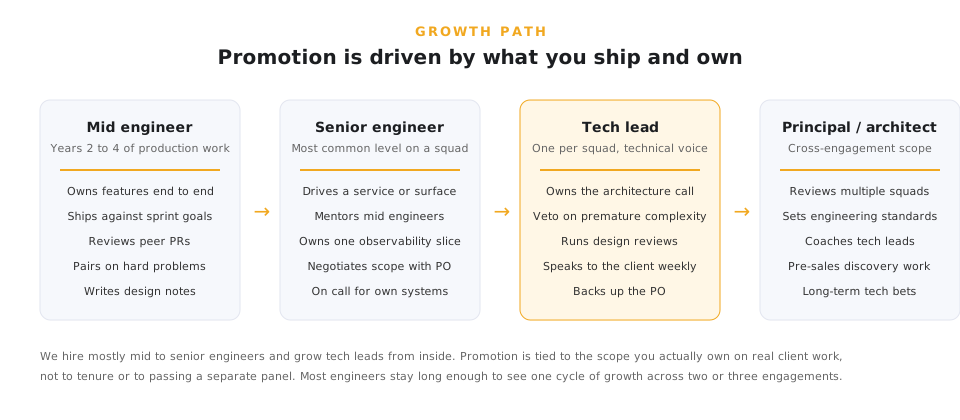
We hire mostly mid-senior engineers and grow tech leads from inside. Promotion is tied to the scope you actually own on real engagements, not to tenure or to an internal panel. The growth-path diagram above is what that looks like in practice.
Flexible schedule, with a window
Within the client overlap window, your day is yours. We do not require all-day Slack presence, we do not run mandatory after-hours calls, and we will not page you on systems your squad did not build.
What we do not promise
We are honest about what is not on the table by default: stock options, a fixed PTO calendar, healthcare benefits attached to a specific country's payroll, and free meals. Some of those depend on contract structure and country and we work them out individually; some simply are not part of how a US-based outsourcer hiring LATAM contractors operates. If those are critical to you, we should talk about it before either side spends an interview hour.
How to apply
One inbox, one process, no portal to register on. We read every CV that comes in.
What to send
- Your CV or résumé, ideally as a PDF
- A link to GitHub, a portfolio, or a couple of representative repos — even private snippets you can talk through
- A short note about why this role and what kind of work you want next
- Any certifications or credentials relevant to the posting
What happens next
- CV review within three to five business days
- If there is a match, a 45-minute technical interview about the role, your experience, and the project
- For some roles, a small take-home or a live coding exercise
- A second conversation with the tech lead or hiring manager if the squad is already known
- Offer, contract structure, and start date
Send your CV to:
If you would rather start by reading about the company first, take a look at who we are, our leadership team, our founder Javier Uanini, or the client case studies that show the kind of work the squads ship, including the Relay Works recruiter platform we dogfood for resume search.
If you want to understand the kinds of engagements you would actually sit on, the staff augmentation and dedicated development team pages describe what we sell to clients in those models. You can also browse our LinkedIn page or our GitHub organization to see the public side of the team.
Frequently Asked Questions
Most clients run on US Eastern Time. From Mexico City, Bogotá, and Lima the overlap with a 9-to-5 EST day is six to eight hours and matches a normal local day. From Buenos Aires, Montevideo, and Santiago the day starts a couple of hours later and ends a couple of hours later. A few roles state a different window, such as US Pacific hours or occasional Asia-Pacific overlap, and say so in the posting. Specifics get confirmed during the interview before anyone signs anything.
It depends on the role, and each posting states the bar explicitly. Most open roles today ask for B2 or B2+, client-facing delivery roles such as the Project Manager position ask for C1, and one cloud security role also asks for C1+ Spanish. The working language for PRs, design notes, and client calls is English.
Most engagements run as contractor agreements, which is the common arrangement when a US-based firm hires across LATAM. Some are long-running dedicated seats and some are fixed-length engagements, such as three or five months with a possible extension; each posting says which. The exact paperwork depends on your country, and we work it out with each candidate before the offer.
Compensation is set in USD and reviewed regularly. Payment cadence is monthly against a contractor invoice in most countries. We help with the paperwork on the first invoice cycle so the engagement starts cleanly. We do not publish public salary bands because seniority, country, and engagement type each move the number; we share a specific range during the first interview once we understand which seat the offer would land in.
We aim for one to two weeks from CV to offer. CV review takes three to five business days. Selected candidates run one or two technical interviews, sometimes with a small take-home or a live coding exercise depending on the role. We try not to drag it out, and we will tell you which round is the decision round.
Yes. As of 2025 and 2026, almost every client repo has at least one AI coding assistant in the loop, most often Cursor, Claude Code, or GitHub Copilot, plus AI-assisted code review for pull requests. We expect senior engineers to be comfortable reviewing AI-generated diffs, rejecting them when the trade-off is wrong, and writing the test that proves the model got it wrong. The skill we screen for has shifted from raw output to judgment under AI assistance.
Backend in Go, Rust, Java with Spring, Node.js, and Python. AI work in Python with LLMs, RAG, and agent frameworks such as LangGraph, often on Vertex AI. Cloud, security, and infrastructure work on GCP and AWS with Terraform, Kubernetes, and GitHub Actions. Mobile in native Swift and Kotlin, React Native, and Flutter, with Espresso, XCUITest, and Appium for test automation. The mix changes engagement to engagement, but those are the stacks the squads pick up most weeks.
Talk to a recruiter
Prefer to send a message rather than an email? Use the form below and we will route it to recruiting. To apply directly with a CV attached, email camila@siblingssoftware.com.