MVP Development Company for Founders With an Idea
MVP development at Siblings Software is for founders who have an idea, a target customer and a deadline, but not yet an engineering team. We turn the idea into a working web or mobile product that real users can sign up for, pay for and give feedback on, in fixed-scope sprints with a demo every two weeks. This page explains how we scope an MVP, what it costs, how long it takes, what we have shipped for other founders, and when a different route fits you better.
Most MVPs we build combine a web app, a mobile app or both, with payments, sign-in and messaging, and increasingly an AI feature at the core. If you already have a prototype built with a no-code tool or an AI coding assistant, we also take those to production: see vibe coding development and AI code security.
Siblings Software coordinates from Miami, with senior engineers across Latin America working in US time zones. Fixed-scope work runs under our project-based outsourcing model; after launch you can keep the same people as a dedicated development team.
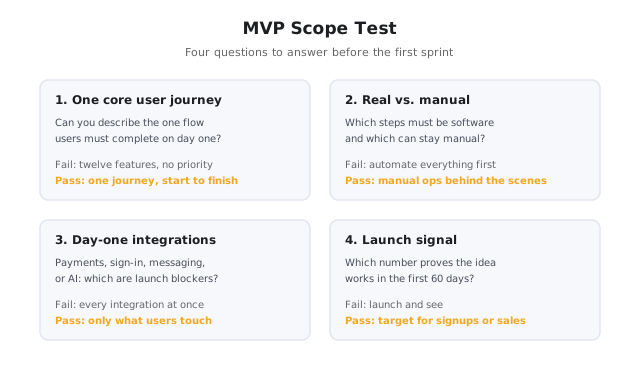
We run the MVP Scope Test in discovery. If a question has no answer yet, we answer it together before the first sprint, not after the budget is spent.
What MVP Development Actually Means
A minimum viable product is the smallest version of your product that real users can use end to end, so you can learn whether they want it before you build everything else. It is not a clickable prototype: an MVP has a real backend, real accounts, real data and, when the model needs it, real payments.
It is also not version 1.0 with every feature on the roadmap. The hard part of an MVP is deciding what to leave out. A marketplace MVP might launch with search, profiles, reviews and contact by WhatsApp, and handle payouts manually for the first months. An AI MVP might launch with one well-tested assistant flow instead of five half-tested ones.
And it is different from a no-code or AI-generated prototype. Those are great for validating demand, but they often hit limits on security, data ownership or scale once paying users arrive. When that happens we rebuild the product on a mainstream stack such as Next.js, React Native, Node.js and PostgreSQL, keeping what you learned and replacing what will not survive production.
Who Hires Us for an MVP
Founders and product owners who need a working product in weeks, not a year of hiring. If you can describe your first customer and the one thing they must be able to do, you are ready for discovery.
Non-technical founders
You know the market and the customer. You need a team that can turn the idea into software, explain trade-offs in plain language, and not lock you into choices you do not understand.
Founders with a prototype
You built a first version with a no-code tool or an AI coding assistant. Users like it, but it is slow, insecure or impossible to extend. You need it rebuilt properly.
Marketplace and platform ideas
Two-sided products where buyers and sellers, owners and tenants, or clients and professionals meet. They need profiles, search, trust signals and payments from day one.
AI-first products
The core value is an AI feature: an assistant, document extraction, search over your data or an agent that takes actions. It has to work reliably, not just in a demo.
Companies launching a new product
An established business, such as a real estate agency or a retailer, launching a digital product for its customers, with a budget but no in-house engineering team.
Founders raising a round
You need something real to show investors and early customers, with a codebase a future CTO will not want to throw away.
What We Build
Every MVP is different, but most fall into four shapes. These are the ones we have shipped or are shipping now.
Marketplaces and directories
Search, verified profiles, reviews, messaging and admin moderation. The Boca en Boca services marketplace launched with exactly this scope on Next.js.
E-commerce with a twist
Stores where the product is configured or personalized by the buyer. Vyxia combines an in-browser design editor, AI background removal and Mercado Pago checkout. See also e-commerce development.
Mobile apps with payments
iOS and Android apps built with React Native or Expo, with in-app purchases, payment collection, push notifications and an admin panel on the web. A rental-management app we are delivering now follows this shape.
AI features at the core
Assistants, search over your own data, document extraction and agents, with human review where mistakes are expensive and usage limits so costs stay predictable.
How MVP Delivery Works
Five phases. A typical MVP runs 8 to 16 weeks from the first call to launch, and you see working software by week 3 or 4.
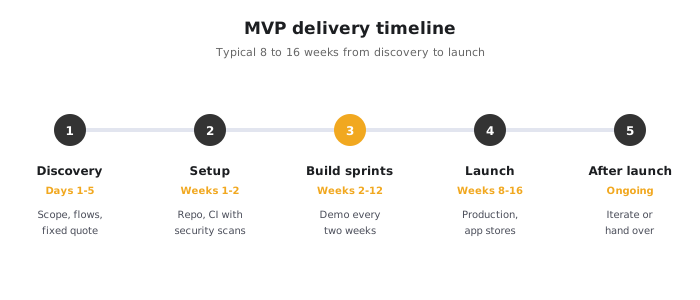
Discovery (3 to 5 days). We run the MVP Scope Test with you, map the core user journey, choose the stack and integrations, and agree on a fixed scope and price. You leave discovery with a written scope, even if you decide not to work with us.
Setup (weeks 1 to 2). Repository, environments and a CI pipeline that runs tests, type checks, secret scanning and dependency audits on every change. Clickable flows for the key screens so you can react before code is written.
Build sprints. Two-week sprints with a demo and a short retrospective each time. You test real software on a staging environment, not slides. Scope changes go through a written change request, so the budget never moves silently.
Launch. Production deploy, app store submissions when there is a mobile app, monitoring and error tracking. We plan app store review early, because Apple and Google rules on payments and accounts can change your design.
After launch. Keep iterating with the same engineers as a dedicated team, scale down to one or two developers, or hand the product over to your own hires with documentation and a walkthrough.
AI-Assisted Delivery, Human-Reviewed Code
We use AI coding agents to move faster, and we are strict about how. Agents work inside written rules for each repository, never approve their own work, and never see your credentials or customer data. Every change goes through a pull request that a senior engineer reviews before it merges.
The same pipeline that runs your tests also scans for leaked secrets, vulnerable dependencies and common security mistakes from the OWASP Top 10. That matters for an MVP: early users trust you with their data, and a security incident in month two can end a startup. For products with payments or sensitive data we add the controls described on our DevSecOps services page.
Who Is on Your Team
Most MVPs need two to six people, not a large agency team. A typical roster is a tech lead who owns scope and architecture and is your main contact, one or two full-stack engineers, a mobile engineer when there is an app, a part-time designer for flows and screens, and QA on the release path.
You talk to the people who write the code. For AI-heavy products we add an engineer with production LLM experience; if you only need extra hands on an existing team, hire AI developers or other specialists through staff augmentation instead.
Fixed scope to launch, then the same team to keep improving.
What an MVP Costs
Fixed-scope MVP
Project-based builds typically run USD 15k to 120k with 2 to 6 engineers over 1 to 6 months. A single-platform MVP with one core journey sits at the lower end; web plus mobile, payments, marketplaces and AI features push toward the upper end. You get a fixed price after discovery.
Dedicated team after launch
Keep building with the engineers who know the code: USD 12k to 60k per month for a team of 4 to 12 people, with two-week sprints and a shared velocity dashboard.
Staff augmentation
Add one or more developers to your own team at USD 4k to 9k per month each, with a 2-week satisfaction guarantee and 30 days' notice to scale down.
Specialized AI and security work can sit above these ranges. We confirm the number in writing after discovery.
Compared With Freelancers, No-Code and Hiring In-House
An MVP team like ours fits when
- You need web, mobile and backend working together, not one freelancer covering everything.
- Payments, user data or AI make security and reliability non-negotiable from day one.
- You want a fixed price and a launch date before you commit.
- You plan to raise money and need a codebase investors and a future CTO will respect.
Another route may fit better when
- A no-code tool can validate demand in a weekend: do that first, then call us when it hits its limits.
- You already have a technical co-founder who will write most of the code; staff augmentation may be enough.
- The scope is a landing page or a simple store: a template platform will be cheaper.
Freelancers can be fast and affordable for a single skill, but MVPs usually stall on the gaps between front end, back end, mobile and infrastructure. Hiring in-house takes months before the first line of code.
MVPs We Have Shipped or Are Shipping
Real products, not composites. We name clients only when they have approved it.
Boca en Boca
Local services marketplace with search, verified profiles, reviews, WhatsApp contact and admin moderation, built on Next.js.
Vyxia
Personalized-products store with an in-browser design editor, AI background removal, Mercado Pago checkout and a full admin.
Rental-management app
Owner app for leases, index-based rent updates, Mercado Pago collections and tenant credit checks. Expo and Next.js, scoped as a 12-week fixed-scope build. Argentina, in delivery in 2026.
Insurance-compliance SaaS
Rebuilding a no-code prototype into production code for a US compliance platform, with AI document extraction and human review. In progress in 2026, client name under NDA.
Risks and How We Handle Them
Scope creep eats the budget. Every change after discovery is a written change request with its cost and impact on the launch date. Nothing moves silently.
Building too much before learning anything. The MVP Scope Test forces one core journey and a launch signal. Everything else goes to a list for after launch.
App store rejection delays launch. We check payment and account rules in the App Store Review Guidelines during discovery and submit early builds for review.
A codebase nobody can take over. We use mainstream stacks, write documentation as we go, and keep every change in pull requests, so another team can pick it up.
AI features that work in demos but not in production. We test AI flows against real examples, add human review where mistakes are expensive, and set usage limits. See LLM evaluation engineering.
Security incidents after launch. Secret scanning, dependency audits and code review run on every change from week one, not as a pre-launch audit.
Questions founders ask before the first call
Frequently Asked Questions
Most fixed-scope MVPs we build fall between USD 15k and 120k. A single-platform product with one core user journey sits at the lower end. Web plus mobile, marketplaces with two types of users, payments and AI features push toward the upper end. We give you a fixed price in writing after a 3 to 5 day discovery.
You see working software on a staging environment by week 3 or 4, and a typical MVP launches in 8 to 16 weeks. The biggest factor is scope: one core journey launches faster than five half-finished ones.
No. Our tech lead plays that role during the build: explains trade-offs in plain language, makes architecture decisions with you, and documents them. When you hire your own CTO or engineers later, they inherit a documented codebase on a mainstream stack.
Yes. We review what you built, keep the parts that work, and rebuild the rest on a production stack with proper authentication, authorization, data ownership and security checks. Your prototype becomes the best specification we could ask for.
Yes. We build assistants, document extraction, search over your own data and agents that take actions, with testing against real examples, human review where errors are costly, and usage limits so your AI bill stays predictable.
You choose: keep iterating with the same engineers as a dedicated team, scale down to one or two developers, or hand the product to your own team with documentation and a walkthrough. Two-week sprints and demos continue either way.
Related Services