Hire Python developers who ship in your Django or FastAPI codebase
Most teams trying to hire Python developers in 2026 are not greenfielding a tutorial API. They are unblocking a Django monolith that grew Celery sprawl, extracting a FastAPI service from a hot path, or filling a gap when the one engineer who understood migrations left mid-quarter. You need someone who can read your pyproject.toml, your worker queues, and your deploy runbook, not another profile that lists Django and pandas without context.
Siblings Software places senior Python engineers from Latin America into U.S. and European product teams with four to six hours of real overlap. They join your pull requests, your standups, and your incident channel with predictable monthly pricing: typically USD 4,000–9,000 per month per engineer depending on seniority, data-handling load, and pager expectations. Median ramp from signed brief to a merged production fix sits around eight to ten business days once security paperwork runs in parallel.
This page is a hiring brief: what an embedded Python engineer does on Monday, how we vet differently from a marketplace listing, and how we contain the risks that make outsourced Python engagements spin.
“If your candidate cannot explain how they would roll back a migration that already shipped to half your Celery workers, they are not senior enough for your production queue.”
Reviewed by Javier Uanini, Founder and CEO, Siblings Software. Last reviewed 26 October 2026.
See our staff augmentation hub for model-wide guarantees and nearshore developer time-zone specifics.
What an embedded Python developer actually does with your team
Day-to-day work is rarely a fresh FastAPI scaffold from a blog post. In most engagements we join, the backlog mixes Django migrations that cannot lock large tables, Celery tasks that only fail at month-end volume, pandas notebooks that became production scripts without tests, and authorization middleware that predates your current identity provider.
The engineers we place own tickets end-to-end in your tools: GitHub, GitLab, Jira, PagerDuty, whatever you standardized on. They write migrations that can roll back, add structured logging where blind spots raised noise last quarter, and pair with your architects when a service extraction needs a written decision record. They treat your OpenAPI contracts and the Python language docs as references, not substitutes for reading your repo.
When you need a full pod with a tech lead, embedded QA, and shared on-call across API and worker tiers, step up to our dedicated Python development team. When you have managers and rituals but lack Python-shaped capacity, stay on staff augmentation. For warehouse pipelines and dbt models beyond application code, see data engineer staff augmentation. For Django-only depth, see hire Django developers.
Who hires Python developers through staff augmentation (and why now)
SaaS teams on a Django monolith
Multi-tenant row-level security, admin customization debt, and queryset performance that only shows up past ten million rows are senior Python problems. Buyers hire us when local recruiting cannot find someone comfortable owning migrations and Celery, not only shipping serializers.
API products extracting FastAPI services
Teams strangling a monolith need engineers who understand async boundaries, dependency injection, and how to keep worker tiers idempotent when traffic doubles. Staff augmentation is the lowest-friction way to park that expertise without rewriting org charts.
Data-heavy platforms with Python workers
Reporting pipelines, ETL scripts, and ML feature jobs often live in Python long after the demo notebook ships. You need engineers who treat queue depth, retry storms, and observability as production requirements, similar to how we staff MLOps engineers when model serving is in scope.
Teams recovering from attrition
When the engineer who understood your packaging and deploy scripts leaves mid-quarter, the bus factor is not abstract. We place Python engineers who can read Git history, finish the strangler slice, and document the seam before your next FTE starts.
The Python Runtime Fit Test (before we shortlist anyone)
We name the framework because buyers remember it on discovery calls. Three questions decide whether we send a monolith-minded principal, a FastAPI specialist, or route you toward a full pod.
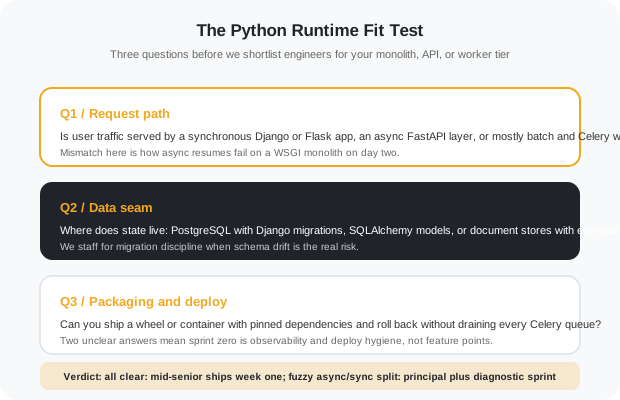
When all three answers are crisp, we have matched teams where the first pull request landed on day five. When two answers are fuzzy, we insist on a senior who has led at least one async extraction and we sell sprint zero as tracing and deploy hygiene, not story points.
Vetting signals we refuse to pretend do not matter
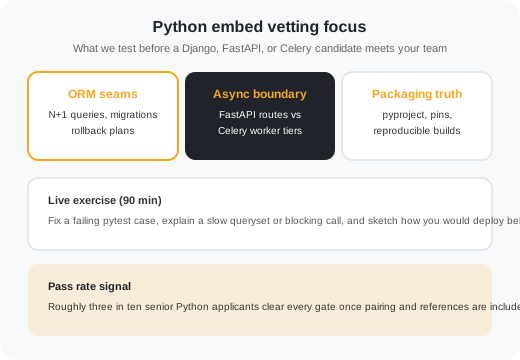
Roughly three in ten seniors who apply to our Python bench clear every gate once the live exercise, pairing session, and reference checks are included.
- ORM and SQL literacy: Can they explain
select_relatedversus a raw query plan without hand-waving? - Async honesty: FastAPI routes that block the event loop are a common failure mode. We test for it explicitly.
- Packaging discipline: Pinning, virtualenv or container parity, and reproducible CI installs using
pyproject.tomlor locked requirements. - Worker-tier temperament: If Celery backs revenue, we ask how they drain queues safely during deploys.
- Test shape: pytest fixtures that mirror production settings, not only unit tests on pure functions.
For language-agnostic API depth, compare with hire back-end developers and our Python development outsourcing service when you want delivery ownership end to end.
Ramp timeline: from brief to merged fix
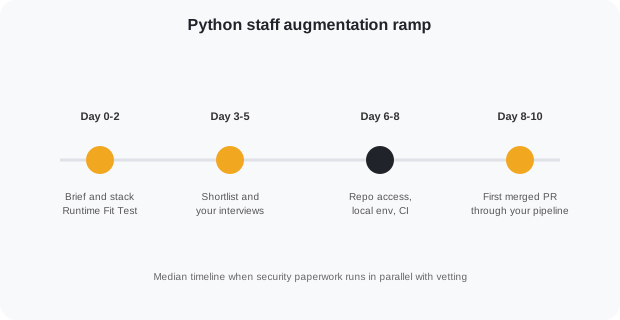
Regulated clients with device certificates and VPN splits can add a few days; we front-load paperwork with templates we have used on HIPAA- and PCI-adjacent programs so procurement does not become the bottleneck.
Engagement models, timelines, and pricing context
Single senior embed
Best when you have a tech lead who can context-share quickly. One engineer, your ceremonies, your Definition of Done.
Typical rate: USD 4,000–7,500/month for senior nearshore Python engineers.
Pair for extractions
Monolith-to-service cuts and dual-write windows get safer with two seniors on overlapping shifts, still staff augmentation, coordinated through our engagement lead.
Typical band: USD 8,000–14,000/month for a coordinated pair.
Dedicated Python pod
When you need QA plus DevOps plus a tech lead across API and worker tiers, compare with the dedicated Python team offering and with dedicated development teams when multiple services share one roadmap.
Typical pod band: USD 12,000–60,000/month depending on seats and SLO load.
What changed in the Python stack you actually have to care about (2025–2026)
Python 3.13 shipped with meaningful improvements to the default interactive shell and continued work on the free-threaded build. If candidates have not read the Python 3.13 release notes, they may struggle the first time you ask about subinterpreter constraints or stricter typing habits you enforce in CI.
Django 5.1 refined async views and form handling for teams still strangling synchronous code paths. We expect senior engineers to know when to keep WSGI and when a FastAPI sidecar is the safer extraction, guided by the Django 5.1 release notes, not by framework fashion alone.
Buyer diligence in 2026 increasingly asks how augmented engineers handle dependency supply-chain review and secrets in CI. We align with OWASP Top 10 remediation as a baseline when your Python services touch customer data.
Compared to marketplaces, in-house hiring, and generalist agencies
vs. Upwork-style lists
Speed of listing is not depth. We trade away huge resume dumps for one or two engineers who already survived an intentional ORM or async defect exercise.
vs. in-house FTE
Full-time remains right for culture carriers. Augmentation fits when headcount freezes or you need a six-month bridge while recruiting closes a local offer.
vs. generalist dev shops
Agencies that bounce between CMS and mobile rarely maintain muscle memory for migration rollbacks, Celery backpressure, and packaging drift. We bias toward Python specialists because your incident history usually has a worker or queryset story underneath.
Illustrative engagement: Harborstack Analytics (composite)
Harborstack Analytics (composite illustrative scenario) runs a B2B reporting product on a Django monolith with Celery-backed PDF generation. Month-end jobs spiked queue depth and support tickets when reports exceeded fifteen minutes. Siblings embedded two senior Python engineers through staff augmentation under the client's engineering lead.
The team split read-heavy report generation into idempotent Celery tasks, added queryset tuning on the hot export path, and introduced pytest coverage on the task module before touching serializers. Illustrative outcomes discussed in retros: median report runtime moved from about eighteen minutes to under four, and failed task retries dropped enough that on-call stopped treating month-end as a separate incident category.
For a published platform reference with observability expectations, see the NetApp Go platform engagement.
Risks, and how we keep them boring
- Packaging drift: We require locked dependencies in CI before engineers touch production settings.
- Intellectual property: You own the branches. NDAs precede repo access.
- Timezone drift: LATAM overlap with Eastern through Pacific is real time in Slack. EU-hours coverage is staffed explicitly when you ask for it in the brief.
- Notebook-to-production creep: We flag when pandas scripts lack tests and belong in a governed worker tier instead of cron on a laptop.
OUR STANDARDS
What "done" means when you hire Python developers through Siblings.
- Tests that match production shape: Settings modules, database fixtures, and Celery eager mode only when it truly mirrors your seam.
- Observability on workers: Structured logs and queue metrics before another retry policy tweak.
- Honest estimation: If a migration needs six sprints, we say six.
- Security first: Secrets stay in vaults, not checked into history.
Frequently asked questions
Buyer objections we answer on discovery calls when teams evaluate hiring Python developers through staff augmentation.
Hiring from Argentina instead? See the Argentina mirror of this page (separate site, same engagement model).
CONTACT US
Tell us about your Django monolith, FastAPI extraction, or Celery queue pain and we will shortlist accordingly.