AI Voice Agent Development Outsourcing Company in USA
We are an AI voice agent software outsourcing company headquartered in the United States (Miami, Florida). We design, integrate, and ship phone-ready conversational agents that listen in real time, call your systems with structured tools, and speak with a brand-appropriate voice instead of a brittle phone tree.
Voice is not chat with audio glued on. Callers tolerate almost no dead air, background noise breaks transcription, and barge-in requires careful turn-taking. Our engineers pair telephony experience with AI agents development patterns so the same safeguards you expect from text agents (tool validation, escalation, logging) survive the faster, messier world of PSTN and WebRTC audio.
Need retrieval during the call under tight latency? Our RAG development team helps you prefetch policy snippets and FAQs so the model cites grounded facts instead of improvising coverage language.
AI Voice Agent Development Services
Inbound, outbound, and hybrid programs where the agent actually completes work on your stack.
Most failed voice projects start with a generic assistant demo, then discover that carrier routing, echo cancellation, DTMF fallbacks, and CRM writebacks were never part of the prototype. We scope telephony, speech, model routing, and observability together so your first production traffic is boring on purpose.
Inbound Voice
Agents
Answer policy questions, reschedule deliveries, capture structured intakes, and authenticate callers with risk-aware flows. We wire function calling to Salesforce, ServiceNow, Zendesk, homegrown JSON APIs, or message buses so the agent updates tickets while speaking.
Outbound Voice
Campaigns
Reminders, resupply outreach, payment nudges, and post-sale follow-up at volumes humans cannot sustain. We implement reassigned numbers, quiet hours, consent tracking, and disposition codes so your ops team sees clean CRM outcomes, not mystery dials.
Voice Persona
and Conversation Design
Prosody, pacing, and confirmation patterns matter as much as model choice. We benchmark neural voices, craft barge-in friendly prompts, and run side-by-side listening tests with your customer success leads before traffic shifts.
How We Build Production Voice Agents
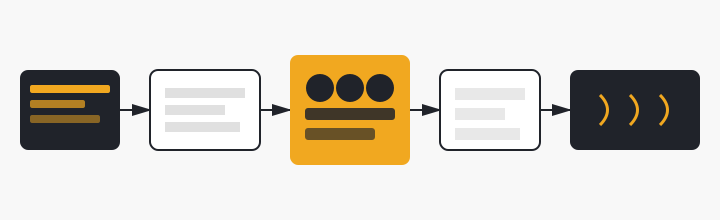
Streaming speech-to-text, constrained LLM turns, deterministic tool calls, and neural TTS stitched for sub-second perceived response.
We start from measurable outcomes: containment rate, average handle time, tool error rate, and transfer quality. The runtime stack usually combines a streaming recognizer, a policy-aware language model with JSON or XML-style tool responses, short-lived session memory, and a TTS renderer that can start speaking before the full reply is finalized.
When your product already exposes tools through the Model Context Protocol, our MCP development engineers align voice agents with the same contracts your desktop assistants use, which keeps security reviews aligned across channels.
For telephony primitives and carrier edge cases, we lean on vendor documentation from Twilio Voice and complement streaming ASR with Deepgram or other providers matched to your accent mix. For hosted speech APIs, we align with current OpenAI speech-to-text guidance when Whisper-class models fit your accuracy targets. Speech recognition research moves quickly; we also track open work such as the Whisper project when offline or batch transcription is part of the workflow.
Delivery Rhythm and Commercial Models
Voice programs ship faster when discovery is paid and narrow. Typical phases:
- Weeks 1-2: listen to real recordings (with consent), map intents, define automation ceiling, pick STT/TTS, draft compliance language.
- Weeks 3-5: build a single high-volume flow in staging, load-test latency, add tool sandboxes, and rehearse warm transfers.
- Weeks 6+: shadow traffic, compare QA scorecards to human baselines, widen percentage, and tune prompts with production transcripts.
Commercially, we support project-based builds, hybrid pods anchored from Miami, and dedicated AI teams when you expect continuous flow changes. Running costs combine carrier minutes, ASR, model tokens, and TTS; we model those using your historical average handle time so finance sees a monthly band, not a surprise bill.
Voice agents that answer phones, not slide decks.
Case Study: Southeast DME Resupply Hotline
How a durable-medical-equipment distributor cleared a multi-state resupply backlog without adding headcount.
Context
A distributor serving oxygen and sleep-therapy patients across Georgia, Florida, and the Carolinas averaged eleven thousand inbound calls monthly about resupply timing, insurance reauthorizations, and delivery changes. Twenty-two agents rotated shifts, yet peak Monday mornings still produced fifteen-minute holds. Leadership wanted automation, but every prior IVR attempt died when patients described edge cases ("I moved rooms at my daughter's house") that menus could not parse.
They also could not afford wrong answers on payer rules. The voice program had to read live eligibility flags from their billing adapter and refuse to guess when data was missing.
What we shipped
We deployed a staged voice agent that authenticates with DOB plus ZIP, pulls resupply windows from their warehouse API, explains payer holds in plain language, and books callback slots on a Calendly-backed route for escalations. Tool calls hit a FastAPI middle tier written in Python on AWS Fargate with per-patient rate limits and circuit breakers when the billing adapter slowed.
Transfers pass structured JSON to Five9 so agents see the attempted actions instead of replaying twenty questions. Synthetic voice came from a commercial TTS catalog after blind tests with their patient advocacy council; we documented the selection criteria for state regulators reviewing the pilot.
-38%
Average speed to answer during peak blocks
71%
Calls resolved without agent touch after eight weeks
4.5/5
Post-call SMS survey (n=1,840)
The program succeeded because operations trusted the metrics: per-intent containment, tool failure codes, and silent monitoring clips reviewed daily for the first month. For more portfolio context, browse our case studies hub.
Risks We Plan For Up Front
Hallucinated policy language: we constrain answers to retrieved records and train agents to hand off when confidence drops.
Latency spikes: streaming STT, speculative TTS starts, and short acknowledgement phrases while tools run keep callers oriented.
Biased or abrasive tone: we script empathy checkpoints for sensitive intents and log sentiment heuristics for QA.
Vendor lock-in: interfaces are abstracted so recognizers and voices can swap without rewriting conversation trees.
Academic and industry dialogue on spoken interfaces stays active through communities such as SIGdial, which informs how we evaluate turn-taking and evaluation methodology.
Why US-Led Voice AI Delivery Matters
Voice programs touch regulated data, brand tone, and frontline morale all at once. Our Miami leadership stays in US business hours for architecture reviews, security questionnaires, and executive checkpoints, while nearshore engineering squads scale implementation velocity. That mix is how we keep latency-sensitive collaboration sharp without giving up cost discipline.
We also integrate voice work with broader stacks: Node.js for websocket media servers, API development for partner callbacks, and AI development when you need custom classifiers beside the LLM.
For high-fidelity voice synthesis options and controls, product teams often evaluate ElevenLabs alongside cloud-native engines. We run bake-offs on your own audio samples instead of trusting marketing clips.
Common myths that derail voice AI programs
Reality Checks From the Field
Myth: "We can paste our chatbot prompt into a phone endpoint." Fact: Prosody, confirmation loops, and shorter utterances need a separate prompt pack and evaluation harness.
Myth: "If STT is wrong rarely, we are fine." Fact: Rare errors cluster on proper nouns and policy numbers; we add digit-by-digit readback patterns where needed.
Myth: "We will automate everything on day one." Fact: Gradual traffic ramps preserve trust with agents and give you clean A/B metrics.
Choose us for
AI Voice Agent Development Outsourcing
with US-led architecture and nearshore velocity
Frequently Asked Questions
An AI voice agent is a phone-native conversational system that listens in real time, interprets intent with a large language model, can call tools against your CRM or ticketing stack, and responds with natural speech. Traditional IVR forces rigid menus and keypad trees. A well-built voice agent handles open-ended questions, clarifies missing details, and completes tasks when policies allow, while still supporting deterministic fallbacks.
Most production builds land between twenty-five thousand and eighty thousand US dollars depending on call-flow depth, number of integrations, languages, and compliance controls. A paid discovery sprint is the fastest way to lock scope, pick STT and TTS vendors, and produce a latency and cost model tied to your real call volume.
Teams should architect for roughly four hundred to nine hundred milliseconds from end of caller speech to first audible reply, with streaming partial transcripts so the model starts reasoning early. Higher latency shows up immediately as awkward overlap or dead air, which increases hang-ups even when answers are correct.
We design disclosure scripts, retention windows, encryption in transit and at rest, role-based access to recordings, and redaction in stored transcripts where required. For healthcare and cardholder scenarios we align workflows with HIPAA and PCI expectations and document data flows for your security reviewers before writing telephony code.
Yes. We implement language detection on the first turns, separate prompt packs per language, and TTS voices matched to each experience so code-switching mid-call does not sound like two different companies. The same tool layer can stay language-agnostic as long as your backend fields support both locales.
For repeatable flows such as appointment changes, order status, or structured intake, live systems often resolve sixty to eighty-five percent of calls without transfer when discovery was honest about edge cases. Complex disputes, emergencies, and high-empathy conversations should remain with people, with the agent doing triage and warm handoff.
Related Services