Observability That Keeps Your AI Agents Honest in Production
Most people landing here are past the commercial research phase. They have agents live or about to go live, leadership is asking for incident posture and spend forecasts, and someone is comparing outsourcing partners on speed, who shows up in Eastern time, and who has actually untangled a bad week of tool-call failures. That is the search intent this page is written for.
At Siblings Software we implement AI agent observability the way you would for any revenue-critical system: with traces that show each step from user intent to model to tool, eval pipelines that catch regression after a deploy, and token and latency math your finance lead can read. Siblings is a US-led software outsourcing company with a Miami base and a team that has shipped work for SaaS, fintech, healthcare-adjacent products, and large retail operations since 2014. We are not a slide factory; you get working instrumentation, dashboards, and a runbook, then you decide if you want us on a dedicated team or augmented headcount afterward.
It complements AI agents, MCP, and AI DevOps: the layer that shows whether those investments hold when traffic doubles. When the dashboard is clear but the invoice keeps climbing, pair observability with LLM cost optimization development for routing, caching, and eval-gated downgrades. The 2025 Stack Overflow survey on AI still shows a gap between shipping and measuring—if that is your week, the rest of this page is a hiring brief.
What “AI agent observability development” means in practice
If you cannot name the failing tool call, you are not done.
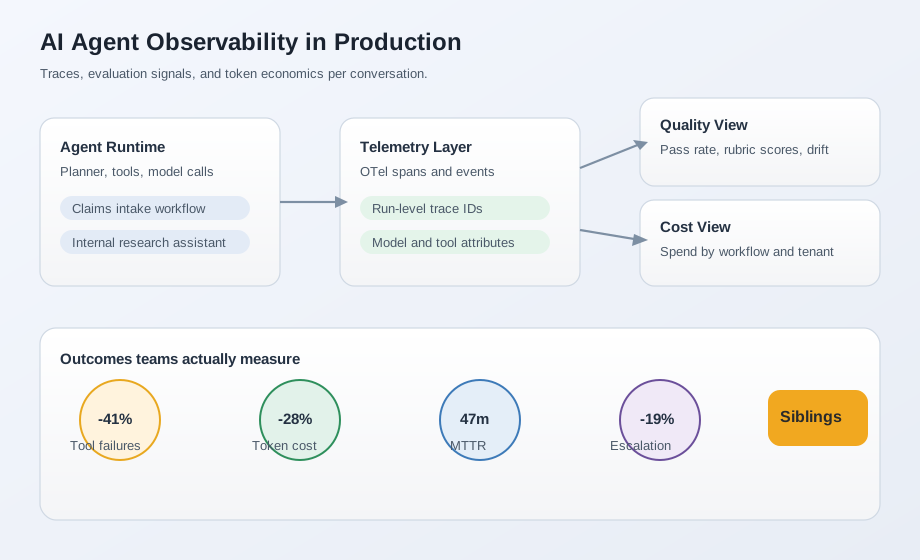
“Observability” is a tired word, so we spell it out: trace schema in the agent runtime aligned with OpenTelemetry (or your vendor’s shape); evaluation or scoring for the workflows that matter; dashboards and alerts on business tags, not just pod names; and written on-call ownership. Hyperscalers are converging on similar patterns—see the Google Cloud guide on instrumenting AI agents as a reference, not a mandate.
Distributed tracing for a full agent run
User message, plan, each model call, every tool or retrieval hop, guardrail result, and final output—under one trace id your support and engineering team can open together. That is how you stop arguing whether the model or the retrieval step was wrong. If you also use RAG, this is where you prove chunk quality, not just embedding dimension.
Evaluation pipelines and release gates
We wire scoring—human rubrics, model-as-judge where appropriate, and rule checks—so a prompt or routing change cannot ship without a before-and-after on your golden set. For deeper rubric design, golden datasets, and CI eval gates, see our LLM evaluation engineering practice. Ties to AI testing when you want the same rigor in CI.
Token spend and latency by workflow
Cost is not a finance surprise at month end; you see it per workflow and can decide whether a cheaper model route, caching, or shorter prompts are the fix. Harness engineering engagements often start here so guardrails and budgets stay aligned.
Alerting and incident playbooks
Alerts that map to a single on-call runbook, not a wall of “CPU high” noise. Agent SLOs are about successful outcomes, not just 200s from the API.
Data minimization and audit support
Redaction, retention tiers, and evidence exports. Complements AI code security and customer security reviews without inventing a parallel logging stack.
Enablement, not lock-in
We train product, support, and platform on the same definitions of “quality” and “incident,” then step back. If you want a long tail of improvements, the same AI development and platform engineering teams at Siblings can keep shipping with you.
Who this is for (and who should call someone else)
We are a fit if you are buying implementation and ops clarity, not a Gartner report.
Product org with more than one agent in flight. The pilot was cute; now six workflows share models and you need one place to see quality drift. You are not going to hire four specialists this quarter.
Revenue or risk owner before an enterprise security review. Prospects ask for evidence of monitoring and incident history. A PDF policy is not enough. You need traces and an audit path that stand up in a call with their infosec team—similar pressure to what we see on agile roadmaps for regulated B2B.
Head of platform watching LLM line items double. The spreadsheet says “increase in AI” but the teams cannot say which workflow or tenant drove it. AI-powered DevOps and this effort often run together when deployment and observability are both late.
Weak fit: “Set up OpenTelemetry” with no engineer time yields hollow traces. If we cannot talk to whoever deploys prompts, we will document only—not run your production risk.
How the hiring process and delivery actually run
Short version: a discovery call, a written scope, a paid technical session with your code or architecture, then a statement of work with milestones. Most clients pick either a fixed project or a three-month pod with an option to renew.
- Qualify the pain. We ask for your worst incident in the last sixty days, your current stack, and which outcome you will measure (for example, mean time to restore, cost per case, escalation rate). If the goal is vague, we fix that before anyone writes a span.
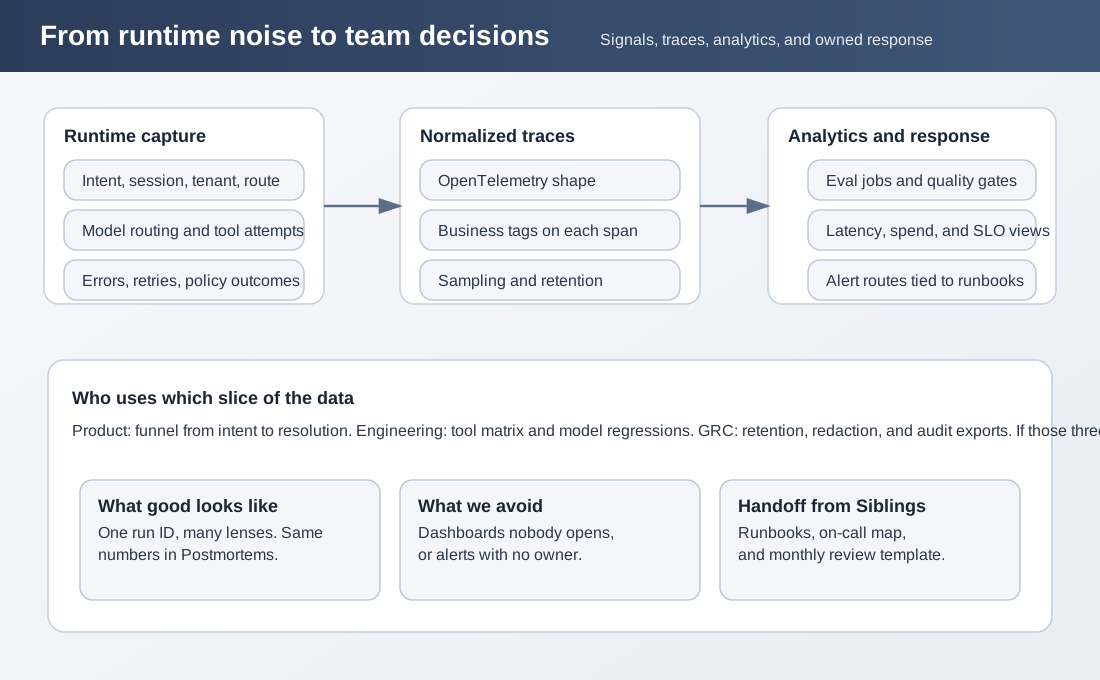
- Telemetry design. This is a workshop, not a ticket. Bad field names and missing correlation ids are the usual reason “observability” projects become shelf-ware. We model first, then build.
- Instrument the narrow path. One or two workflows in production, not the whole org chart. Prove signal quality, then scale.
- Evals and alert wiring. The same week we do not add fifty alerts. We add three the on-call list agrees on.
- Handoff or embed. You get runbooks, a thirty-minute monthly review template, and optional Siblings hours for the next quarter if you want continuity.
Typical calendar time: four to six weeks to harden one team, eight to twelve weeks when many teams, regions, or privacy constraints need alignment.
What buyers usually get wrong (so you do not have to)
They instrument every LLM call with the same trace and wonder why the bill explodes, or they ship “evals” with no versioned dataset and no owner when scores drop. A third common mistake: letting product pick model upgrades while platform owns the dashboard; nobody has end-to-end accountability. We are opinionated on those points because the failures are predictable. If your TypeScript services wrap the model at the edge, we still put span boundaries where the business decision happens, not only where the HTTP call returns.
Engagement models and price bands
Numbers are ranges from recent Siblings contracts for similar scope; your proposal will be specific. We publish bands because procurement teams are tired of “contact us for a quote” with zero anchor—yet every serious vendor in this space will refine after discovery.
Project: build and hand off
Four to twelve weeks, fixed scope. Approximately USD 45,000–140,000 for multi-workflow instrumentation, evals, and dashboards, depending on environment count, compliance rules, and whether you need 24/7 on-call in the SOW. Good when you have internal staff to run it afterward.
Dedicated observability pod
Starts around USD 16,000 per month for a small senior-led group (often three to four people) plus leadership touchpoints. Chosen when you are scaling agents faster than your platform team can absorb. Same shape as a hired AI team but scoped to observability and reliability outcomes.
Augmentation
We place named engineers in your Slack, Teams, or on-call rotation through staff augmentation. Hourly and monthly rates vary by seniority; ask for a matrix if procurement requires it. Best when your architecture is clear and you need velocity on instrumentation.
In-house, freelancers, big consultancies, or Siblings
In-house hires: the right long-term play if you can find senior LLM plus platform talent and wait six to nine months for them to gel. Freelancers: fine for a spike, risky for pager ownership and for keeping eval datasets consistent when people rotate. Global consultancies: can staff scale, and you will read more status decks per dollar. Siblings Software: a middle path—nearshore and US leadership, engineers who can join your retro the same day, and enough overlap with Miami and Eastern hours that the collaboration patterns feel familiar, not “ticket-only.”
A parallel offering is available for teams that procure through our Argentina entity with the same scope.
Case snapshot: e-commerce support agents and the escalation trap
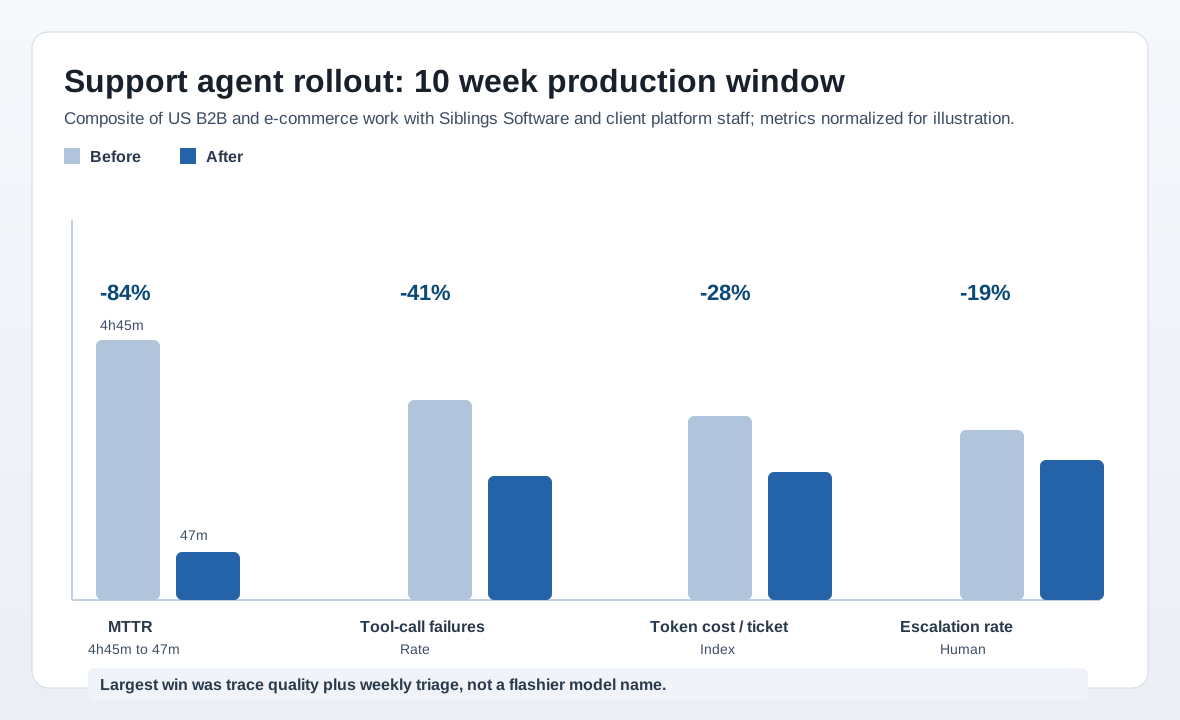
A US retailer with a mid-seven-figure monthly traffic pattern had support agents for order status, returns, and policy Q&A. Logs showed model errors sometimes, but the team could not see which tool or retrieval branch failed on a specific ticket, so mean time to restore was measured in hours, not minutes. Leadership suspected cost drift; finance saw only an aggregate LLM line.
We co-built the stack with their two platform engineers and four Siblings engineers on trace schema, policy-grounded evals, and per-interaction cost. The foundation model stayed the same in phase one; visibility and the weekly review did not.
Outcomes to sanity-check in your RFP
Time to mitigated incident dropped from roughly four hours and forty-five minutes to about forty-seven minutes for P1s tied to the agent. Tool-call failure rate fell about forty-one percent. Token cost per resolved ticket fell about twenty-eight percent after routing and prompt tightening. Human escalation went down about nineteen percent on the same quality bar, because support could trust the trace before escalating. Your numbers will move differently; the pattern we care about is that product, support, and engineering finally pointed at the same dashboard.
Miami coordination, US-friendly hours, engineers who can join a live incident
How Siblings works with product and security in US time zones
We coordinate from 1110 Brickell Ave, Miami, for steering, MSA, and security reviews. Delivery across the Americas overlaps Eastern and Central hours so your retro and deploy windows line up with ours. Telemetry is part of the data story in vendor questionnaires; we design retention and access accordingly. The same Siblings patterns apply when you add Node or Python workers to the agent stack.
Risks and how we design around them
Cardinality and bill shock on traces. We start with a minimal tag set, explicit sampling, and review with your APM owner so you are not the team that OOMs the collector during a product launch.
Logging things you should not keep. PII in raw prompts is a compliance incident waiting to happen. We map fields to redact or hash at the edge, aligned to your DPA and customer contracts.
“Observability in name only” dashboards. We tie every chart to a decision: who will change behavior based on it this month? If nobody, we do not build it yet.
Handoff gap. The last two weeks of a project are documentation, paired on-call dry runs, and a recorded walkthrough for your success and support leads. No ghosting after the milestone invoice.
Questions we hear in first calls
Almost never. We add the AI-specific dimensions and evaluation path; your existing backend handles storage and alerting where it already works.
For one or two workflows in one environment, often yes, if you can get us repo and production read access without a month of paperwork. Wider rollout is what stretches the calendar.
Yes, subject to legal review. We are used to data processing language for LLM-adjacent telemetry.
We are agnostic. If you are all-in on a cloud vendor, we use their instrumentation patterns. If you are multi-cloud, OpenTelemetry is the usual neutral spine.
We can advise when traces prove a cheaper route works for a class of tasks. Broader model strategy is often a joint effort with your AI agent and AI product workstreams.
Related services