Case study · Staff augmentation · Go
Eight senior Go developers for NetApp platform engineering
NetApp is a global leader in intelligent data infrastructure, helping organizations store, manage, and protect data across hybrid multicloud environments. Siblings Software supplied eight senior Go developers through staff augmentation to platform teams that build and operate the services behind that mission.
The engineers worked on REST and gRPC services, background workers, integration layers, and observability, inside squads led by the client’s own tech leads. This page does not publish dates, duration, internal team names, or performance figures for NetApp; where a field is not public, the snapshot says so instead of guessing.
At a glance
| Client | NetApp |
|---|---|
| Industry | Intelligent data infrastructure for hybrid multicloud environments |
| Engagement model | Staff augmentation |
| Team | Eight senior Go engineers |
| Working model | Embedded squads with client tech leads, overlapping US time zones |
| Stack named | Go, gRPC, Kubernetes, Prometheus and Grafana, CI/CD |
| Focus | REST and gRPC services, event-driven workers, integration layers, observability hooks |
| Start date and duration | Not published |
| Internal team or product names | Not published |
| Performance figures | Not published |
- Related services: Go development, hire Go developers, platform engineering
- More examples: all case studies
The challenge
Platform engineering needed to scale delivery of REST and gRPC services, background workers, and integration layers without pausing roadmap commitments. Hiring eight senior Go engineers locally on short timelines was unrealistic, so leadership wanted a partner who could match Go staff augmentation depth with enterprise-grade collaboration.
We structured the engagement around explicit SLOs, shared code review standards, and overlap with US time zones, so augmented engineers could pair with staff engineers, take part in design reviews, and own vertical slices of the backlog.
The hard constraint is “without pausing roadmap commitments.” New people first cost a platform team review time; senior engineers who work to written SLOs shorten that phase, which is why platform teams ask for senior profiles.
What the engineers’ work involved
The snapshot names four areas of work. The notes below explain how this kind of work is usually done in Go on a hybrid data-infrastructure platform. They describe the discipline, not NetApp’s internal systems.
REST and gRPC services
Platform teams typically expose REST where callers are external or varied, and use gRPC between internal services where typed contracts and streaming matter. The hard part is rarely the protocol. It is the contract: clear service boundaries, consistent error handling, and versioning, so one team’s change does not break another team’s caller.
Background and event-driven workers
Long-running jobs, retries, reconciliation, and reactions to events do not fit inside a request, so they run in workers. Goroutines make concurrent workers cheap to write and easy to get subtly wrong, which is why tests for concurrent code paths matter as much as the worker itself.
Integration layers
In hybrid environments, services depend on systems their team does not own. An integration layer puts those dependencies behind interfaces, so timeouts, partial failures, and graceful degradation are handled in one place instead of in every caller.
Observability for SLOs
An SLO is only useful if the service emits the signals to measure it. With Prometheus and Grafana in the stack, that means instrumenting latency and errors in code, building dashboards on-call engineers actually open, and writing runbooks that turn an alert into a next step. On high-volume read APIs, SLOs are usually written against tail latency, not the average.
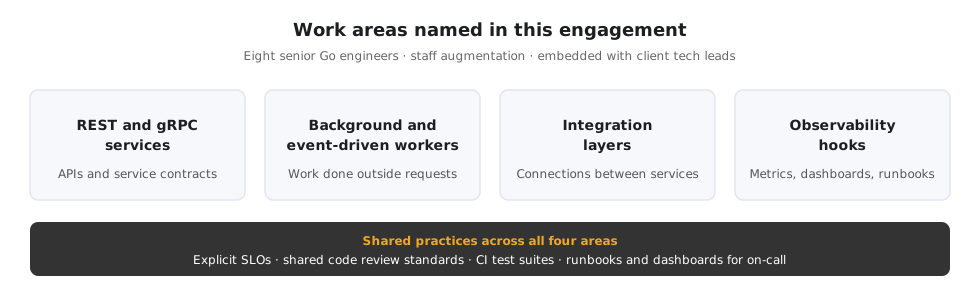
Implementation choices follow Effective Go and the official Go documentation.
What we delivered
- Hardened service boundaries and consistent error-handling patterns across new Go microservices.
- Load-tested critical paths and reduced tail latency on high-volume read APIs.
- Expanded automated test coverage for concurrent code paths and integration suites in CI.
- Documented runbooks and dashboards so on-call rotations could trace incidents faster.
The team operated as an extension of existing engineering, not a black box. Engineers joined sprint ceremonies, adopted internal style guides, and contributed to shared libraries. Where a dedicated pod with its own delivery lead is a better fit, we support that through our Go development services.
“The eight engineers plugged into our rhythm quickly—clear PRs, strong ownership of production issues, and they actually read our architecture docs before proposing changes.”
Director of Engineering, platform organization
Outcome and why it mattered
By front-loading senior Go capacity, the program accelerated delivery of customer-facing and internal platform capabilities while keeping operational risk in check. The work reinforced patterns that matter for any organization building resilient data and control planes: observability, graceful degradation, and API contracts. That is consistent with how NetApp positions hybrid cloud and intelligent data services globally.
How we staff senior Go engineers for a platform team
This is our standard staff augmentation process, described as a process. It is not a dated record of the NetApp engagement.
- Discovery, 3 to 5 days: the services the engineers will touch, review and on-call norms, SLOs, and required time-zone overlap.
- Team assembly, 5 to 10 days: we shortlist senior Go engineers and you decide who joins. For platform roles we weigh concurrency, service contracts, and production experience with metrics and alerts.
- First deliverables, weeks 3 to 4: first reviewed pull requests in your repositories.
- Two-week sprints with a demo and a retro each; augmented engineers join your ceremonies rather than running parallel ones.
- A 2-week satisfaction guarantee on placements, and 30-day notice to scale down.
Our published staff augmentation bracket is USD 4,000 to 9,000 per developer per month; seniority and required overlap move a role within it. We do not publish this client’s fee. Our typical augmentation is one to five specialists, so at eight, also compare a dedicated team.
What this means for a buyer
The useful question is which engagement shape fits the platform team you already have.
Augment your platform team (this case)
Fits when you already have tech leads, review standards, and on-call, and the gap is senior Go capacity on a known backlog.
Build a dedicated Go team
Fits when you want a pod with its own delivery lead to own a scope end to end. See dedicated development teams.
Start a platform engineering engagement
Fits when the charter is broader than Go services: an internal developer platform, golden paths, or a developer portal. See platform engineering services.
- Write the SLOs down before engineers start; they turn “senior” into a bar a reviewer can check.
- Budget staff-engineer review time for the first sprints, and ask for runbooks and dashboards as deliverables.
- Treat time-zone overlap as a requirement if you expect pairing; our nearshore developers work in client time zones.
Frequently asked questions
Staff augmentation: embedded squads led by the client’s tech leads. For a pod with its own delivery lead, see our Go development services.
Our standard process is discovery in 3 to 5 days, team assembly in 5 to 10 days, and first deliverables in weeks 3 to 4. Your security onboarding usually decides the real start date.
Our published staff augmentation bracket is USD 4,000 to 9,000 per developer per month, depending on seniority and required overlap. We do not publish the fee for this engagement.
Placements carry a 2-week satisfaction guarantee, so we replace an engineer who is not working out early. Monthly engagements scale down with 30-day notice.
Our engineers are based across Latin America and work in client time zones. Here, overlap with US time zones let augmented engineers pair with staff engineers and join design reviews. See hire nearshore developers for how that works.
We only publish what we can stand behind for a named client: scope, stack, and working model. Start dates, duration, internal names, and figures such as latency improvements are not public, and we do not estimate them.
Adding senior Go engineers to your platform team?
See hiring Go developers, Go development, platform engineering, or the case studies hub, or tell us about your platform below.