Hire API Developers for Your Software Team
Hire API developers through Siblings Software when you need senior engineers embedded in your squad without running a full recruiting loop. We help CTOs, engineering managers, and platform leads add contract-first capacity for partner APIs, internal services, webhook programs, and versioned public surfaces.
Screening focuses on OpenAPI discipline, auth design, idempotent handlers, observability, and the communication habits integrators expect. Typical buyers compare vetting depth, time to embed, and monthly cost against freelancers and in-house hiring. Shortlists usually arrive in 3-5 business days; most engineers embed in roughly two weeks. Roughly three in ten applicants pass five-stage vetting including a live contract exercise. On this page you can evaluate day-to-day scope, when augmentation fits, the API Contract Readiness Test, vetting, timelines, pricing, engagement models, comparisons, risks, an example engagement, and FAQs. If you need a full pod with tech lead, partner integration, and shared on-call, see our dedicated API development team page.
Reviewed by Javier Uanini, Founder and CEO, Siblings Software. Last reviewed 19 September 2026.
What API developers do in real client teams
Embedded API developers join planning, refine tickets with product and partner success, and ship in your repositories. They treat the published contract as the source of truth, add schema validation at the edge or handler, and write tests integrators can mirror.
Day to day that includes designing resource models and error shapes, implementing OAuth or mTLS flows your security team approved, tuning pagination and rate limits, wiring structured logs and traces on hot paths, and maintaining changelog entries partners actually read. They use your gateway, CI pipelines, and on-call rotation rather than a parallel vendor codebase.
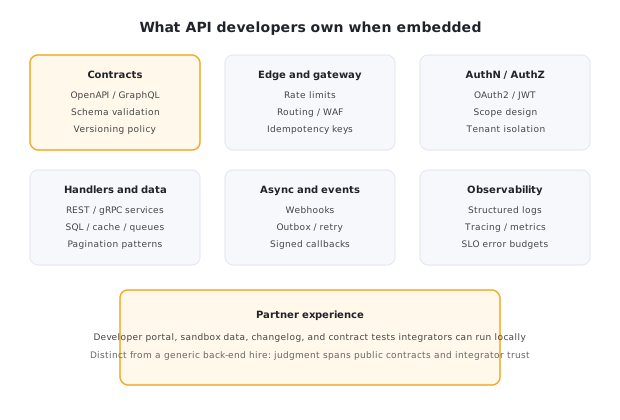
This role differs from a generic back-end developer hire because success is measured by contract stability, integrator time-to-first-successful-call, and predictable deprecation, not only feature throughput. Stack depth for Node.js, Python, Go, or Java lives on sibling pages when you need a language-specific bar.
When companies hire API developers
Most discovery calls fall into a handful of situations. Yours may combine two.
Good fit
- Partner onboarding slipped because nobody owns OpenAPI, sandbox keys, and contract tests.
- Public API v1 grew ad hoc; legal asked for versioning and audit-friendly auth before a renewal season.
- Internal microservices need a consistent error model and trace propagation before a mobile launch.
- Webhook delivery is flaky; support hears about missed events before engineering sees queue depth.
- You have an engineering lead and backlog but lack senior API capacity during a hiring freeze.
Usually not the right move
- Greenfield product with no API surface decided yet.
- One-week documentation tweak with no engineering owner.
- You need a full pod with API tech lead, partner engineer, DevX, and shared on-call.
Related: staff augmentation hub, nearshore developers, API development outsourcing.
The API Contract Readiness Test
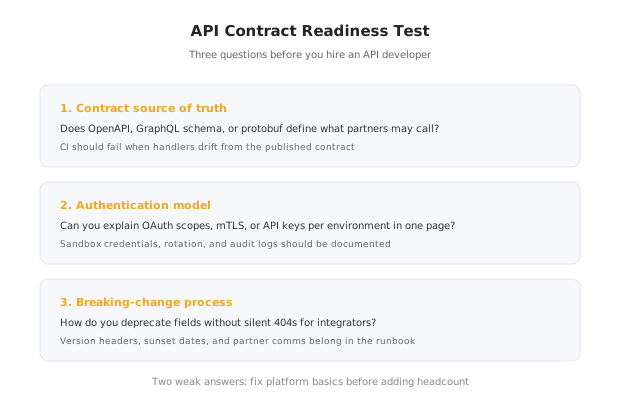
Before we recommend a hire shape, run these three questions internally. Weak answers mean platform work should come before headcount.
Q1. Contract source of truth
Does OpenAPI, GraphQL schema, or protobuf define what callers may invoke? CI should fail when handlers drift.
Q2. Authentication model
Can you explain scopes, keys, or mTLS per environment in one runbook page integrators and auditors can follow?
Q3. Breaking-change process
How do you deprecate fields without silent failures? Version headers, sunset dates, and partner comms belong in writing.
We reuse the same test in vetting. Candidates who only list frameworks rarely survive the live exercise where we ask them to extend a schema, add validation, and document a backward-compatible change.
How Siblings vets API developers
Resume keywords are cheap. We screen for signals that predict whether partners stay quiet in production.
- Contract discipline: OpenAPI or schema-first changes with consumer-driven contract tests or Prism-style mocks.
- Auth judgment: OAuth2 flows, scoped tokens, rotation, and least-privilege service accounts without storing secrets in repos.
- Data and performance: Pagination, N+1 avoidance, idempotency keys, and cache boundaries on read-heavy endpoints.
- Async reliability: Outbox patterns, signed webhooks, retry policies, and dead-letter queues partners can observe.
- Observability: Structured logs, trace propagation, and RED metrics on endpoints they touch in week one.
- Red flags: Hand-waving on versioning, no production on-call story, or skipping OWASP API Security basics.
Timelines and pricing context
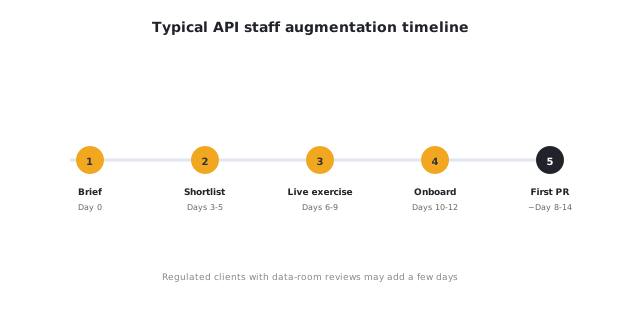
Discovery calls usually take 3-5 days. Shortlists arrive in 3-5 business days when you specify protocol, language, seniority, and overlap hours. Onboarding targets the second week; first meaningful pull request on a handler or contract change often lands around day eight on brownfield codebases with working CI.
Pricing follows our published staff augmentation brackets (USD 4,000 to 9,000 per specialist baseline). Senior API engineers with partner-program experience typically run USD 5,000 to 12,000 per month nearshore LATAM. Every tier includes a two-week satisfaction guarantee and 30-day notice to scale down after the initial period.
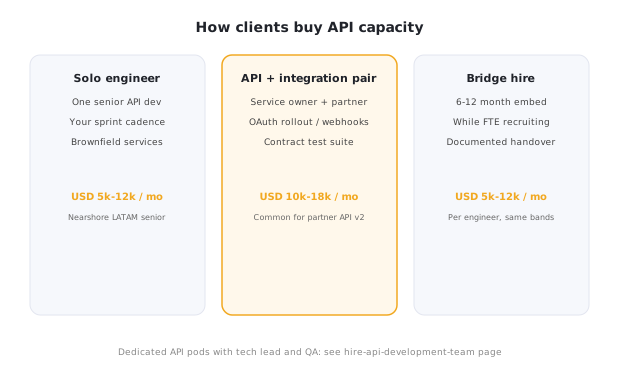
Embedded individual
USD 5K to 12K / month
One senior API engineer joins your ceremonies and owns stories end to end.
API plus integration pair
USD 10K to 18K / month
Service owner plus partner engineer for OAuth, webhooks, or a v2 cutover.
Bridge while recruiting
USD 5K to 12K / month
Six to twelve months with documented handover when internal FTE searches close.
Regional bands for a single engineer: Latin America mid-level USD 4-7K, senior USD 7-12K; United States senior USD 14-22K; Western Europe senior USD 11-16K. US and EU bands assume less daily US East overlap unless you staff explicitly for those hours.
Staff augmentation vs freelancers vs in-house hiring
Staff augmentation (Siblings). One or two vetted API engineers under your engineering lead, embedded in 1-2 weeks. Best when ceremonies and release ownership already exist.
Freelance marketplaces. Fast to start for isolated endpoints. Risky for partner programs, auth rollouts, and on-call habits without vetting depth.
In-house hire. Best long-term ownership of a public API program. Sourcing senior API specialists in US metros often takes several months per seat.
Project agency. Fits fixed-scope MVPs. Less institutional knowledge for year-two partner requests than embedded engineers in your repos.
Example engagement
Illustrative composite scenario. Not a published client case study.
Eastgate Catalog Exchange (composite) sells a B2B product catalog API to regional distributors. Partner onboarding stalled: sandbox keys were manual, error payloads varied by endpoint, and three integrators blocked a renewal until v2 shipped with written deprecation rules.
Two embedded API developers through staff augmentation for five months published OpenAPI 3.1 as a CI gate, added OAuth2 client-credentials with scoped sandboxes, rebuilt webhook signing and retry docs, and paired with internal QA on contract tests in the pipeline. Illustrative outcomes: self-serve sandbox onboarding replaced multi-week email threads; support tickets tagged API confusion dropped in the first quarter after changelog discipline.
Published references: Bari wholesale platform and BinSensors REST API backend.
Risks and how we reduce them
- Shadow codebase. Engineers commit to your org, gateways, and repos from day one.
- Silent breaking changes. Contract tests in CI and written deprecation windows before merge.
- Auth drift. Scoped credentials, rotation runbooks, and security review on new OAuth flows.
- Knowledge loss at roll-off. Handover docs, portal updates, and optional shadowing for internal hires.
Frequently Asked Questions
One to three vetted profiles in 3-5 business days when stack and seniority are clear. Most engineers embed in roughly two weeks, with a first reviewed pull request on a contract or handler change around day eight.
We match your production environment: Node.js or TypeScript, Python with FastAPI or Django REST, Java with Spring Boot, Go, and ASP.NET Core. We staff GraphQL, gRPC, and webhook programs when those are in your brief.
We trade listing speed for engineers who passed a contract-first live exercise and reference checks. Roughly three in ten applicants pass all gates.
Senior API engineers nearshore LATAM typically run USD 5,000-12,000 per month per engineer. Pairs for OAuth or webhook programs often land USD 10,000-18,000 per month. US and EU bands run higher.
All three when they match your architecture. We screen for the style in your brief. Public partner programs usually need OpenAPI-described REST plus signed webhooks; internal meshes often use gRPC.
Augmentation when you have a lead and backlog. Dedicated API pods when you want Siblings to supply tech lead, partner integration, DevX, and shared on-call. See the dedicated API development team page.
Raise it early. We replace the engineer at no additional placement fee on standard agreements and run overlap so your sprint does not stall.
OUR STANDARDS
A published OpenAPI file in CI beats a PDF export partners cannot test against.
We hold API engineers to the same bar as internal seniors: schema validation before handlers merge, tests partners can reproduce, and honest advice when a breaking change should wait for a major version.
See Bari for a published API-heavy delivery reference.
If you are interested in hiring API developers in Argentina, visit the Argentina version of this page.
CONTACT US
Tell us about your API surface, integrators, and timeline.