AI Customer Support Automation for U.S. Helpdesk Teams
AI customer support automation puts a helpdesk agent into Zendesk, Intercom, or Salesforce Service Cloud so tier-one replies cite published policy, ticket writes stay on an allowlist, and a human gets a handoff packet when confidence drops. It is for US support directors, CX leaders, and platform managers whose macros no longer match the product.
A chatbot pilot answered a refund from model memory, the escalation opened an empty queue, and nobody could show which article the reply used. Siblings Software, at 1110 Brickell Ave in Miami, staffs this with engineers in Latin America who overlap US business hours. Use this page to judge the Helpdesk Reply Release Review, the reply path, the squad, published pricing bands, a labeled example, and the risks before auto-send.
Phone work is AI voice agent development. Open-ended tools are AI agents development. ERP and CRM flows are AI workflow automation. Retrieval on its own is RAG development. Siblings Software is a software outsourcing company shipping since 2014, across 250+ engagements, with about 40 percent venture-backed clients. Compare regions on nearshore development or scan all services.
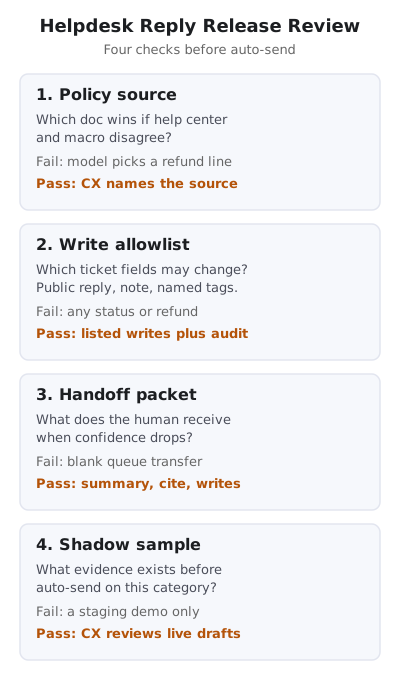
The review is the first artifact. If any box is unanswered, we do not widen auto-send.
Quick answer
What does an AI customer support automation project include?
One helpdesk, a written reply release review, cited drafts for a chosen category, an allowlist of ticket writes, a handoff packet, and a regression set your CX lead runs before auto-send expands.
What the Service Covers
Helpdesk replies with a citation, a write limit, and a person still on the hook.
Most US desks arrive with a help center, a macro library, and a vendor slide that disagree. The work is to name one source, draft replies that cite it, and limit ticket writes. The diagram is the operating path: intake, policy lookup, draft, write check, route, weekly sample. The agent looks up policy and either sends a listed write or hands the ticket over with the packet.
When the corpus is the hard problem, pair this with RAG development. When the regression set needs its own wave, pair it with LLM evaluation engineering. A change that fails the regression set stays off customer tickets. The ISO 27001 compliance SaaS case study shows the same gated-release habit on a different product. Prompt and write risks follow the OWASP LLM Top 10, especially sensitive data in logs and excessive agency on helpdesk writes.
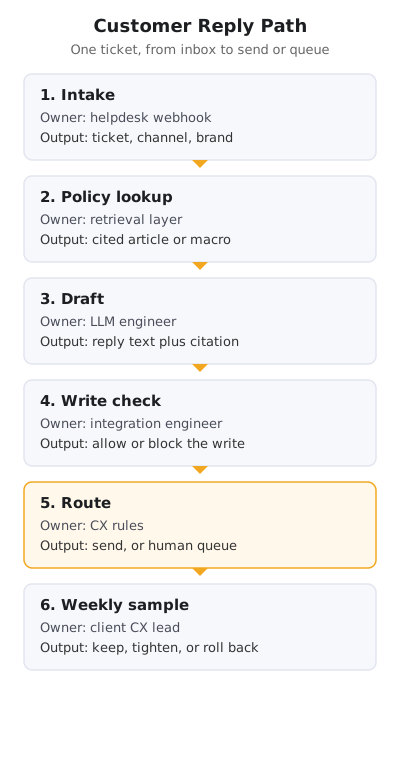
Each step names an owner and an output. CX keeps the weekly sample. Engineering keeps the write check.
Who It Is For
US buyers who already run a helpdesk and want a first auto-send lane they can defend in a security review. If nobody can name the refund-policy owner, that name is one of the four review boxes.
B2B SaaS support leads
Plan changes, failed payments, and seat questions repeat. Macros exist, and agents still rewrite them after each product change.
Subscription and commerce ops
Order status and return windows need the same answer in chat and email.
Multi-brand Zendesk orgs
Several products share one helpdesk, and each brand has its own refund rule.
The review also fits teams leaving a chatbot pilot, security reviewers who want an OAuth app and a data-flow note, and desks whose Notion and Confluence copies disagree.
Typical Project Scenarios
Six situations we scope in the first discovery week. Each stays inside one helpdesk and a short category list.
Plan and billing questions with a citation
Macros contradict the pricing page. We name the winning document, cite it in the draft, and limit auto-send to categories CX already treats as routine.
Handoff that keeps the thread
The packet carries the summary, the citation, the writes already attempted, and the destination queue.
Scoped writes on Zendesk or Intercom
OAuth apps use the Zendesk tickets API or the Intercom tickets API. Public reply, internal note, and a named tag are the usual allowlist. Refunds and account deletion wait for legal.
Index refresh when an article changes
A publish hook refreshes the index. The regression set blocks prompt promotion when the new wording fails the sample.
Shadow mode on one live category
CX reads drafts beside the human reply in US hours. Auto-send for that category starts after the sample matches the policy source. Other categories stay manual.
Separate samples by language
English and Spanish macros diverge. Retrieval and the regression set are split by locale. Escalation queues stay shared when the brand is the same.
How Delivery Works
The first three milestones match the onboarding ranges already published for Siblings Software.
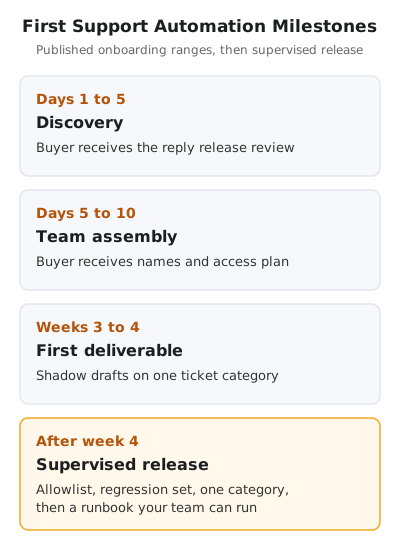
Days 1 to 5, discovery. Categories, macros, queues, and the Helpdesk Reply Release Review. A box with no owner is the deliverable. Auto-send waits.
Days 5 to 10, assembly. Named roles, a repository plan, and the helpdesk access request. Empty sandboxes and missing legal contacts are the usual delays.
Weeks 3 to 4, first deliverable. Shadow drafts with citations on one category, reviewed with your support lead in US hours.
After week 4. Allowlisted writes, a regression set, supervised send on that category, and a runbook. Timing then depends on sandbox data, legal sign-off, and brand count. Sprints are two weeks. Scale-down notice is 30 days. The replacement window is two weeks.
Team Composition
A first lane is four specialists plus your part-time CX owner. The lead owns the review and US-hour calls. The LLM engineer owns retrieval, citations, and prompts, and pulls in RAG development when the corpus needs its own pipeline. The integration engineer owns the OAuth app and the write allowlist. The eval engineer owns golden tickets and the CI check. Deeper harness work is LLM evaluation engineering. Your CX owner signs tone, refund language, and the weekly sample. After the first category, the group can continue as a dedicated development team. One senior seat on a board you already run is hire AI automation developers.
Project, dedicated squad, or staff augmentation, using the pricing bands already published for Siblings Software.
Pricing and Engagement Models
These are the company bands. AI specialists usually sit 15 to 25 percent above the staff-augmentation baseline. Helpdesk licenses, model API bills, and observability tools are excluded. The figure inside the band comes after discovery.
Project-based
USD 15,000 to USD 120,000. Two to six engineers. One to six months. Fits the first category: review, index, shadow drafts, allowlisted writes, regression set, and runbook.
Dedicated team
USD 12,000 to USD 60,000 per month. Four to twelve people. Six months and longer. Fits category expansion, index refresh, and eval maintenance. Scale-down notice is 30 days.
Staff augmentation
USD 4,000 to USD 9,000 per developer per month, AI specialists usually 15 to 25 percent above that baseline. One to five people, when you already own the program. Replacement window is two weeks.
In-House Hiring, Freelancers, and Agencies
The useful question is who maintains the regression set after the help center changes.
When an outsourced squad fits
- You want one category through shadow mode and a runbook, and nobody on staff owns both CX policy and the helpdesk app.
- Procurement wants a Miami contract and engineers on US-hour reviews.
- Security wants an OAuth app and a data-flow note before production ticket access.
- The category list will grow, and the same people should keep the regression set.
When another option fits
- In-house hiring fits a team that already reviews citations weekly and only needs a short spike.
- A freelancer fits one prompt or a small app when next month's regression set is not the goal.
- A large consultancy fits a multi-country program where the helpdesk agent is one workstream.
Contracts are with the Miami company. Engineers in Latin America join US-hour reviews. See case studies and about us for how delivery is documented.
Example Scenario: Pellham Memberships
Composite example for buyers. Pellham Memberships is not a client. No outcome metrics are claimed.
The situation
Pellham Memberships is a fictional US membership product with a Zendesk desk in Austin. Tier-one tickets cover plan changes, failed cards, and trial extensions. The help center and the macro pack disagree on the trial rule. A previous chatbot sent refund language legal had not approved. The director wants one category in shadow mode, a short write allowlist, a handoff packet, and a data-flow note before production access.
What the engagement would include
The example follows the published milestones: discovery in days 1 to 5, assembly in days 5 to 10, shadow drafts in weeks 3 to 4. The squad is the four roles above plus Pellham's CX owner. Deliverables are the signed review, a cited index for trial extensions, a Zendesk app limited to public reply, internal note, and one tag, regression cases that block a bad trial rule, and a rollback note in the client's repository. Refunds stay with humans.
Risks and How They Are Reduced
Policy documents disagree. The review names one source per category, and drafts cite it.
Ticket writes get too broad. The allowlist, a second approver for new writes, and an audit log on the OAuth app keep refunds and merges off the agent.
Handoff drops context. The packet carries summary, citation, attempted writes, and the destination queue.
The regression set goes stale. Cases refresh when macros change, and promotion stops when the new wording fails.
A model swap changes tone. The same regression set runs before the new model serves customers. Rollback is the previous prompt in git.
Customer text lands in logs. Scoped permissions, a data-flow note, and agreed retention come before production access. Later tracing is AI agent observability.
Questions US buyers ask before discovery
Frequently Asked Questions
A first project covers one helpdesk, a written Helpdesk Reply Release Review, a policy index for the categories you choose, draft replies that cite the source, an allowlist of ticket writes, a handoff packet for the human queue, and a regression set your CX lead can run before auto-send expands. The first release covers one category, then additional lanes after that sample holds up.
We start from categories where the policy text is stable, the write is reversible, and a human already sends the same reply many times a day. Billing disputes, account deletion, and legal threats stay on the human queue until CX and legal sign a separate rule. Shadow replies on the chosen category come before any auto-send switch.
Zendesk, Intercom, Freshdesk, and Salesforce Service Cloud are the usual first releases, using OAuth apps and the vendor REST APIs. Custom ticket stores are possible when you already expose a documented API. If policy lives only in Notion or Confluence, we index that source before the agent replies to customers.
Published onboarding on this site is discovery in 3 to 5 days, team assembly in 5 to 10 days, and first deliverables in weeks 3 to 4. For this service, that first deliverable is shadow drafts on one ticket category, reviewed with your support lead during US business hours. Supervised auto-send comes after the regression set and the write allowlist are in place.
Project work on siblingssoftware.com is published at USD 15,000 to USD 120,000, dedicated teams at USD 12,000 to USD 60,000 per month, and staff augmentation at USD 4,000 to USD 9,000 per developer per month. AI specialists usually sit 15 to 25 percent above the staff-augmentation baseline. Helpdesk licenses, model API bills, and observability tools are excluded. We confirm a number after the reply release review, because brand count and write scope move the estimate inside those bands.
You do. Prompt versions, retrieval config, eval cases, and the helpdesk app live in your repositories and your helpdesk org. We leave a runbook for adding a category, refreshing the index, and reverting a prompt. Ongoing tracing is a separate engagement if you want it later.
Siblings Software contracts from Miami. Engineers are in Latin America and overlap US business hours, which is when shadow review and webhook failures need a same-day decision with your CX lead. You can scale the squad down with 30 days notice, and the published replacement window is two weeks.
Related Services
Contact Us
Tell us the helpdesk, the ticket category, and whether auto-send is already on.