AI Code Security Outsourcing Company in USA


We are an AI code security software outsourcing company based in USA (Miami, Florida). We build AI-native security pipelines that catch vulnerabilities in AI-generated code before they reach production, protecting your enterprise from the hidden risks of automated code generation.

The software industry reached a critical inflection point in 2026. With 84 percent of developers now using AI coding tools daily and AI-generated code accounting for over 40 percent of all new code shipped globally, the security landscape has fundamentally changed. The code being written is syntactically correct 95 percent of the time, but only passes security checks 55 percent of the time. That gap represents millions of potential vulnerabilities flowing into production systems every day.

Traditional security tools were not designed for this reality. They were built to scan code written by humans, where vulnerabilities follow predictable patterns learned over decades of security research. AI-generated code introduces entirely new vulnerability signatures: placeholder credentials that look intentional, deprecated APIs pulled from training data, and insecure patterns that compile perfectly but create exploitable attack surfaces. Enterprises need a new approach to code security, one built specifically for the AI development era.

Our AI security practice builds on deep expertise across our AI development outsourcing services and our AI-powered testing practice, combining AI engineering depth with application security methodology.

AI code security architecture showing AI code generation flowing through security scanning layer with SAST analysis, dependency scan, secret detection, and license audit into an AI security agent for contextual analysis and auto-remediation before reaching CI/CD security gate and secure production deployment

Our Services Contact Us

AI Code Security Services

From pre-commit vulnerability scanning to automated compliance verification, we deliver the full spectrum of AI code security.

The organizations that contact us share a common realization: their developers adopted AI coding tools months ago, productivity soared, but nobody built the security infrastructure to match. Code reviews that used to catch issues now miss AI-specific vulnerability patterns. SAST tools flood dashboards with false positives because they were never calibrated for AI-generated code. Secrets appear in commits because AI models hallucinate placeholder credentials that look real. Compliance teams cannot verify whether AI-written code meets regulatory requirements.

We solve this systematically. Our AI code security practice does not bolt security checks onto existing workflows. We build an AI-native security layer designed from the ground up for the reality that most of your new code is now AI-generated. The system catches vulnerabilities at every stage, from the moment code is generated in the IDE through to production deployment, with intelligence that improves over time.

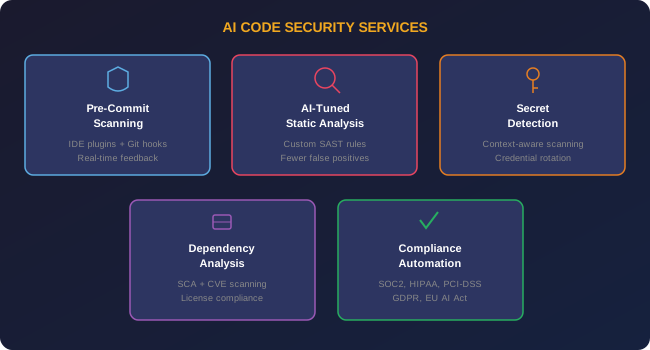
Six AI code security services including pre-commit scanning for shift-left security, AI-native SAST as the core engine reducing false positives by 70 percent, dependency security with SCA and SBOM generation, secret detection for AI-generated placeholder credentials, compliance automation for SOC2 HIPAA PCI-DSS GDPR and EU AI Act, and security training for developers

Our security practice integrates with the platforms built by our Python development and full-stack engineering teams, ensuring security is embedded at every layer of your application stack.

Pre-Commit
Security Scanning

IDE-level scanning that catches vulnerabilities the moment AI generates code. Our plugins for VS Code, Cursor, and JetBrains IDEs provide real-time security feedback, flagging SQL injection patterns, hardcoded secrets, and insecure API calls before code ever leaves the developer's machine. Git hooks add a second layer, blocking vulnerable commits from reaching your repository.

AI-Native
Static Analysis

Context-aware SAST built specifically for AI-generated code patterns. Unlike traditional scanners that generate noise, our AI-native analysis understands how models like Copilot and Cursor produce code and focuses on the vulnerability signatures they introduce. This reduces false positives by 70 percent while catching AI-specific flaws that conventional tools miss entirely.

Secret Detection
and Remediation

AI coding tools frequently generate code with placeholder credentials, API keys, and database passwords that look intentional but should never reach production. Our AI-aware secret scanning goes beyond pattern matching to understand context, distinguishing test fixtures from real credentials and preventing data exposure across your entire codebase.

The AI Code Security Problem in 2026

Why traditional security tools fail with AI-generated code.

Six major types of AI-generated code vulnerabilities showing SQL injection from string concatenation queries, cross-site scripting from improper output encoding, hardcoded secrets from placeholder passwords and API keys, weak cryptography from deprecated algorithms like MD5 and SHA1, data exposure from sensitive data in error responses, and unsafe dependencies from outdated packages in AI training data

The scale of the problem is staggering. Over 50 percent of new code at many enterprises is now AI-assisted or AI-generated. GitHub Copilot alone has 1.3 million paid subscribers. Tools like Cursor, Codeium, and Amazon CodeWhisperer are growing rapidly. Yet despite marketing claims of "secure code generation," independent analysis shows that AI models maintain only a 55 percent security pass rate, virtually unchanged from two years ago, while achieving 95 percent syntax correctness.

The security threat operates in two directions simultaneously. First, AI models generate vulnerable code because they were trained on millions of lines of public code, including code with known security flaws. The OWASP Foundation has documented how AI code generators reproduce the same vulnerability categories that human developers have struggled with for decades, but at dramatically higher volume and velocity.

Second, developers inadvertently expose proprietary code, API keys, customer PII, and database credentials by pasting sensitive context into AI tools. This bidirectional risk means organizations face both insecure output flowing in and sensitive data flowing out, with no unified framework to manage either direction.

Traditional SAST tools compound the problem rather than solving it. Designed for human-written code patterns, they generate torrents of false positives when scanning AI output, leading to alert fatigue and eventual tool abandonment. Security teams report that up to 40 percent of SAST findings on AI-generated code are false positives, compared to 15 percent for human-written code. Meanwhile, AI-specific vulnerabilities like hallucinated credentials and training data patterns slip through undetected. The Sonar engineering community has identified six distinct vulnerability categories that AI coding tools introduce, most of which traditional scanners were never designed to detect.

Ready to secure your AI-generated code?

We will audit your current codebase and deliver a comprehensive AI code security roadmap in 2 weeks.

Contact Us Learn more about us

How We Implement AI Code Security

Deploying an AI code security pipeline is not the same as enabling a single scanning tool. It requires understanding your development workflow, your AI tool adoption patterns, your compliance obligations, and the specific vulnerability landscape of your codebase. We follow a structured four-phase approach refined across enterprise security engagements.

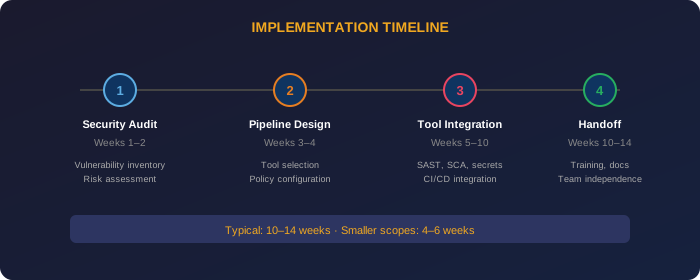
Four-phase AI code security implementation process showing security audit in weeks 1-2, policy design in weeks 3-4, tool integration in weeks 5-10, and AI agent deployment in weeks 10-14 with continuous monitoring and optimization, plus deliverables for each phase including vulnerability inventory, risk heat map, SAST DAST SCA integration, and ongoing model updates

The process begins with a Security Audit of your entire codebase, with specific focus on AI-generated code segments. We identify every vulnerability, map exposure patterns, measure your current security posture, and build a risk-prioritized remediation plan. The Policy Design phase establishes security guardrails: what AI tools are approved, what code patterns are blocked, what compliance frameworks apply, and how security gates integrate into your development workflow.

The Tool Integration phase deploys the full security stack: IDE-level scanners, pre-commit hooks, AI-native SAST, SCA for dependency analysis, secret detection, and compliance verification engines. Each tool is calibrated for your specific technology stack and AI tool usage patterns. The AI Agent Deployment phase activates intelligent security agents that provide contextual risk analysis, auto-remediation suggestions, and continuous learning from your codebase's specific patterns.

Contact Us Learn more about us

Security-First CI/CD for AI-Generated Code

Every AI-generated line scanned. Every pull request validated. Every deployment secured.

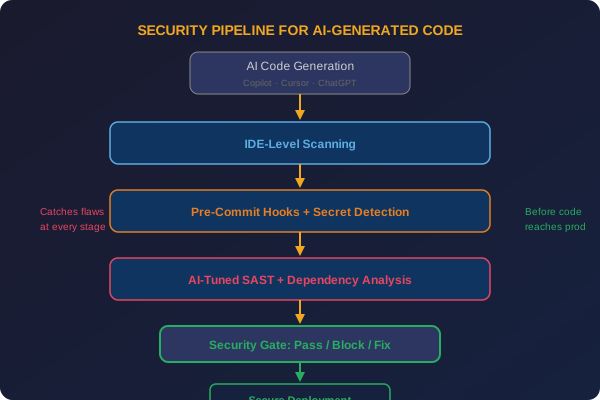
Security-first CI/CD pipeline for AI-generated code showing six stages from AI code generation through IDE security scan, pre-commit hooks, AI-native SAST and SCA, security gate, to secure deployment, with an AI security agent layer providing contextual risk analysis and auto-remediation, plus statistics showing 55 percent unprotected pass rate versus 97 percent with AI security pipeline

The most effective AI code security operates as a continuous pipeline, not a periodic checkpoint. Every interaction between a developer and an AI coding tool passes through multiple security layers before code can affect production systems. The pipeline starts in the IDE itself, where real-time scanning catches the most dangerous patterns, SQL injection, hardcoded credentials, insecure deserialization, before the developer even saves the file.

Pre-commit hooks add a second gate, running secret detection and basic SAST against staged changes. When code enters the repository, AI-native static analysis performs deep contextual scanning that understands not just the code itself but how it was generated and what vulnerability patterns the generating model tends to introduce. Software composition analysis validates every dependency for known CVEs and license compliance.

The security gate at the end of the pipeline makes the merge-or-block decision based on configurable policies. Critical vulnerabilities block the pull request with specific remediation guidance. Medium-severity findings trigger developer notification with auto-fix suggestions. The AI security agent layer sits across the entire pipeline, providing contextual risk analysis that considers the business criticality of the code being changed, the historical vulnerability rate of the AI tool that generated it, and the compliance requirements that apply.

We integrate with all major CI/CD platforms: GitHub Actions, GitLab CI, Jenkins, Azure DevOps, and CircleCI. Our AI DevOps expertise ensures the security pipeline adds intelligence without adding friction to your deployment workflow.

Security that scales with AI adoption, not against it.

Case Study: AI Code Security for a Series C HealthTech Platform

How we eliminated 96% of AI-generated vulnerabilities, achieved full HIPAA compliance, and saved $1.4 million annually for a clinical data platform processing 18 million patient records.

The Challenge

A Series C HealthTech company building a clinical data analytics platform had embraced AI coding tools aggressively. Their 45-person engineering team used Copilot and Cursor daily, and AI-generated code accounted for approximately 60 percent of their weekly commits. Productivity had increased by 35 percent. But a routine penetration test revealed 342 security vulnerabilities in their codebase, 23 of which were critical, including hardcoded database credentials, unencrypted PHI transmission, and SQL injection vectors in patient query endpoints.

The security team discovered 23 instances of hardcoded credentials across the codebase, many generated by AI tools as "temporary" placeholders that were never replaced. Three API endpoints exposed patient identifiers in error responses, a HIPAA violation that could trigger penalties up to $1.5 million per incident category. The company's manual security review process took four weeks per release, during which developers continued generating new vulnerable code faster than the security team could review it.

The breaking point came when their HIPAA compliance auditor flagged the platform for insufficient technical safeguards. The company faced a choice: either halt AI tool usage entirely, sacrificing the 35 percent productivity gain, or build a security infrastructure that could keep pace with AI-assisted development velocity. They chose the latter.

Our Solution

We deployed a comprehensive AI code security platform over a four-month engagement with an eight-person team: two AI/ML security engineers, two application security engineers, one DevSecOps engineer, one compliance specialist, one penetration tester, and one security architect leading the engagement. The solution operated across four layers:

  • IDE-Level Security: We deployed custom VS Code and Cursor extensions that scanned AI-generated code in real time. The extensions understood HIPAA-specific patterns and immediately flagged PHI exposure, unencrypted data handling, and credential hardcoding as developers accepted AI suggestions. This single layer caught 62 percent of all vulnerabilities before code left the developer's machine.
  • AI-Native SAST Pipeline: We built a custom SAST engine calibrated for the specific vulnerability patterns that Copilot and Cursor introduce in Python and TypeScript codebases. Unlike their previous SonarQube setup that generated 400+ false positives per scan, our engine reduced false positives to under 30 per scan while catching 34 percent more real vulnerabilities.
  • Automated Compliance Verification: Every pull request passed through HIPAA compliance agents that verified encryption requirements, access control patterns, audit logging, and PHI handling across the entire change set. Non-compliant code was automatically blocked with specific remediation instructions.
  • Continuous Secret Scanning: We implemented Git-integrated secret detection with historical scanning that found and rotated every exposed credential in the codebase, then deployed pre-commit hooks that prevented any future credential commits regardless of source.
HealthTech platform AI code security case study showing before and after comparison with four key results: 96 percent vulnerabilities blocked pre-commit, 78 percent faster security review cycles, 1.4 million dollar annual security cost savings, and zero security incidents post-deployment

96%

Vulnerabilities blocked pre-commit

78%

Faster security reviews

$1.4M

Annual cost savings

0

Security incidents post-launch

Within six months of deployment, the platform passed its HIPAA compliance audit with zero findings. The security review cycle dropped from four weeks to under one week. The engineering team continued using AI coding tools at full velocity, with the security pipeline handling validation transparently. Annual security-related costs, including incident response, manual reviews, and compliance penalties risk, dropped from $1.9 million to $500,000, a $1.4 million annual saving.

The platform was built using Python for the AI security agents, Node.js (TypeScript) for the CI/CD integration, and Semgrep with custom rules for the SAST engine. Agent orchestration used LangChain with Claude for contextual vulnerability analysis.

Want to see more of our work? Visit our case studies page for additional client success stories.

Discuss Your Project

Enterprise AI Code Security Use Cases

AI code security delivers the highest ROI in regulated industries and organizations where code vulnerabilities translate directly into financial, legal, or reputational damage.

Six enterprise AI code security use cases covering fintech with PCI-DSS and SOC2 compliance, healthcare with HIPAA requirements, SaaS platforms with SOC2 and GDPR, AI/ML products with EU AI Act compliance, e-commerce with PCI-DSS payment security, and government with FedRAMP and NIST frameworks

Each industry faces unique security challenges amplified by AI code generation. Fintech platforms need PCI-DSS compliant code for payment processing, but AI models frequently generate transaction handlers with insufficient encryption or improper key management. Healthcare applications require HIPAA-compliant data handling, but AI tools produce code that exposes protected health information in logs, error messages, and API responses without understanding the regulatory implications.

SaaS platforms operating in multi-tenant environments face data isolation risks when AI generates code that crosses tenant boundaries. E-commerce platforms need checkout and payment flows that resist injection attacks, but AI-generated forms and input handlers often lack proper sanitization. Government contractors require FedRAMP authorization, which demands documented security controls that AI-generated code rarely provides out of the box.

AI Code Security Technology Stack

We select the right security tools for your technology stack and compliance requirements. Our AI code security practice builds on five layers of proven technology that together deliver comprehensive, automated protection for AI-generated code.

AI code security technology stack with five layers covering AI models including GPT-4o Claude CodeLlama and custom fine-tuned models, security tools including Semgrep SonarQube Snyk Trivy Gitleaks and OWASP ZAP, CI/CD integration with GitHub Actions GitLab CI Jenkins Azure DevOps and CircleCI, agent orchestration with LangChain CrewAI custom agents MCP and webhook pipelines, and cloud infrastructure on AWS GCP Azure with Kubernetes Docker and Terraform

AI Security Models

GPT-4o and Claude power the contextual vulnerability analysis layer. CodeLlama and custom fine-tuned models handle high-volume pattern matching at lower latency and cost. Model selection depends on the complexity of your codebase and the depth of analysis required.

Security Scanners

Semgrep and SonarQube handle SAST with custom rule sets for AI-generated patterns. Snyk and Trivy manage SCA and container scanning. Gitleaks detects secrets. OWASP ZAP provides DAST for runtime vulnerability detection.

Agent Orchestration

Custom-built security agents coordinate multi-stage scanning workflows. LangChain and CrewAI handle agent orchestration. MCP integration gives agents governed access to your code repositories, issue trackers, and security dashboards.

The AI Code Security Market in 2026

From optional best practice to regulatory requirement.

AI code security market growth chart showing application security market and AI code security segment growth from 2023 through projected 2028 with accelerating adoption

The application security market reached an estimated $12 billion in 2026, with the AI code security segment growing at over 40 percent year-over-year, the fastest-growing category within AppSec. This growth reflects a structural reality: as AI generates more code, the attack surface expands proportionally, and traditional security tools cannot keep pace.

Regulatory pressure is accelerating adoption. The EU AI Act enforcement begins in August 2026, requiring documented security controls for code generated by or used in AI systems. The Colorado AI Act is already in effect. NIST has updated its Cybersecurity Framework with specific guidance for AI-generated code risks. Organizations that invest in AI code security infrastructure now are ahead of compliance requirements that will become mandatory across more jurisdictions.

The market reality is clear: 84 percent of developers use AI coding tools, but only 29 percent trust the output enough to ship it without review. AI code security bridges that trust gap, enabling enterprises to capture the full productivity benefits of AI development tools while maintaining the security posture their customers and regulators demand.

Why Choose Us for AI Code Security?

Security engineering depth, AI expertise, and compliance automation in one team.

AI + Security Expertise

Our engineers understand both how AI models generate code and how security vulnerabilities emerge from that process. This dual expertise means we build security systems that catch real threats, not just patterns that look suspicious to traditional scanners.

Compliance-First Approach

We build compliance verification directly into the security pipeline. SOC2, HIPAA, PCI-DSS, GDPR, EU AI Act: our automated compliance agents verify regulatory requirements at every code change, not just during annual audits.

Zero-Friction Integration

Security tools that slow developers down get disabled. We build security pipelines that add intelligence without adding friction: 2-minute scan times per PR, inline IDE feedback, auto-fix suggestions, and smart severity filtering that surfaces what matters.

AI code security team structure showing security architect as team lead with AI/ML security engineers, application security engineers, DevSecOps engineer, compliance specialist, penetration tester, and domain expert advisor totaling 8 specialists scalable based on project scope

OUR STANDARDS

Enterprise-grade AI code security built for teams that ship fast and cannot tolerate security debt.

Every AI code security system we deliver follows strict engineering standards aligned with OWASP, NIST, and industry-specific regulatory frameworks. All scanning engines include calibration suites that verify detection accuracy and false positive rates. Security policies are version-controlled and auditable. Dashboards provide real-time visibility into vulnerability trends, remediation velocity, and compliance status across your entire codebase.

Knowledge transfer is central to our delivery model. Every engagement includes documentation, threat modeling workshops, and developer security training. We measure success by whether your internal team can operate and extend the AI code security pipeline independently. That is the standard we hold ourselves to.

Our AI code security practice integrates with our broader full-stack development outsourcing engagements, where security pipelines become the protective layer within larger enterprise applications. For teams building AI products, our AI agents development and RAG development practices provide complementary AI expertise with security built in from the start.

Contact Us

AI Code Security Outsourcing

Why Outsource AI Code Security?

Benefits of AI Code Security Outsourcing

AI code security requires a rare combination of application security expertise, AI/ML knowledge, and DevSecOps engineering that most organizations do not have in-house.

Building an AI code security practice internally means hiring application security engineers who understand AI model behavior, DevSecOps specialists who can integrate security into CI/CD pipelines, compliance experts who can translate regulatory frameworks into automated checks, and AI engineers who can build intelligent security agents. That combination of skills is exceptionally rare and expensive to assemble:

Immediate Security + AI Expertise

We combine application security engineers, AI/ML specialists, and compliance experts into a ready-to-deploy team. You skip the 6 to 12 months it would take to find, hire, and integrate these capabilities internally.

Protection in Weeks, Not Quarters

While competitors are still evaluating security vendors, you can have production scanning operational within the first sprint. Every week without AI code security is a week of accumulating undetected vulnerabilities.

Full-Stack Security Capability

We bring AI security engineers, AppSec specialists, DevSecOps, compliance experts, and penetration testers as a coordinated team. AI code security touches every layer of the stack, and having all disciplines in one team eliminates coordination overhead.

Cost Efficiency

Hiring senior security engineers, AI specialists, and compliance experts in the US costs over $1.1 million annually for a minimal team. Our nearshore model delivers the same expertise at 40 to 60 percent lower cost, with engineers in your time zone.

Evolving Threat Landscape

AI models evolve quarterly and so do their vulnerability patterns. We track these changes continuously and update your security pipeline to address new threat vectors, so your protection stays current without consuming your team's bandwidth.

Knowledge Transfer

Every engagement includes structured handoff: documentation, threat modeling training, developer security workshops, and operational runbooks. We make your team self-sufficient in managing and extending the AI code security platform.

AI code security ROI metrics showing 96 percent vulnerabilities caught pre-commit, 78 percent faster security review cycles, 70 percent fewer false positives versus traditional SAST, 1.4 million dollar average annual security savings, 2 minute average scan time per pull request, and 100 percent compliance automation coverage

Flexible engagement models tailored to your AI code security needs.

How to Work With Us

Project-Based
Outsourcing

We own the AI code security transformation end-to-end. Ideal for companies that want production security infrastructure without managing the build process. We deliver deployment-ready security pipelines with documentation and training.

Learn More

Dedicated
Teams

A full AI code security engineering team dedicated to your organization: security architects, AI/ML engineers, AppSec specialists, and DevSecOps engineers. They work as an extension of your team with full context on your systems.

Hire a Security Team

Staff
Augmentation

Embed individual AI code security engineers into your existing team. Perfect if you have the security strategy defined but need hands-on expertise to build scanning pipelines, configure SAST engines, or implement compliance automation.

Hire Engineers

Industries We Serve

AI code security delivers the highest ROI in industries where code vulnerabilities create regulatory, financial, or reputational exposure.

The companies that benefit most from AI code security are those where a single vulnerability can trigger compliance penalties, data breaches, or customer trust erosion. Here are the industries where demand is strongest:

Financial Services and Fintech

PCI-DSS compliance for payment processing code. SOC2 verification for financial data handling. Automated scanning for encryption weaknesses, authentication bypasses, and transaction manipulation vulnerabilities in AI-generated financial logic.

Healthcare and Life Sciences

HIPAA compliance for patient data handling code. Automated verification of PHI encryption, access controls, and audit logging. FDA software validation support for medical device code generated by AI tools.

E-Commerce and Retail

Payment flow security for checkout code. XSS and injection prevention in AI-generated product pages and recommendation engines. PCI-DSS compliance for card processing integrations built with AI assistance.

SaaS and Technology

Multi-tenant data isolation verification for AI-generated code. SOC2 compliance for cloud applications. API security scanning for microservices architectures with AI-generated endpoints and data handlers.

Government and Defense

FedRAMP authorization support for AI-generated code. NIST framework compliance. ITAR and CUI handling verification for defense contractor codebases that use AI development tools.

Insurance and Banking

Regulatory compliance for AI-generated actuarial and claims processing code. Data privacy verification for customer information handling. Fraud detection system security validation.

Choose us as your

AI Code Security Outsourcing Company

in USA

USA AI Code Security Company

We are a US software development company specializing in AI code security outsourcing. We combine deep application security expertise with AI engineering knowledge to build automated security pipelines that protect enterprises from the unique vulnerabilities introduced by AI code generation tools.

Unlike generalist security firms that treat AI-generated code the same as human-written code, we build AI-native security systems designed specifically for the patterns and risks that AI models introduce. We understand how Copilot generates code differently from Cursor, how each model's training data influences vulnerability patterns, and how to calibrate security tools for each generation approach. This specificity means fewer false positives, faster remediation, and more effective protection.

Our AI code security practice draws on experience across our broader service offerings, including Python development, Node.js development, AI development, AI testing, and MCP development, giving us the full-stack capability to deliver comprehensive AI code security solutions.

Contact Us

AI Code Security

Frequently Asked Questions

AI code generation models are trained on millions of lines of public code, including code with known vulnerabilities. As a result, AI tools like Copilot, Cursor, and ChatGPT can produce code containing SQL injection flaws, hardcoded credentials, weak cryptographic algorithms, and insecure API patterns. Studies in 2026 show that AI models maintain only about 55 percent security pass rates while achieving over 95 percent syntax correctness, meaning the code looks right but often contains exploitable weaknesses that traditional code review misses.

AI-native SAST (Static Application Security Testing) is specifically designed to analyze code patterns produced by AI generation tools. Traditional SAST tools generate excessive false positives when scanning AI-generated code because they were built for human-written patterns. AI-native SAST understands the specific vulnerability signatures that AI models introduce, such as placeholder credentials, training data leakage patterns, and deprecated API usage. This reduces false positives by up to 70 percent while catching AI-specific vulnerabilities that traditional tools miss entirely.

A typical enterprise implementation takes 10 to 14 weeks from initial security audit to full production deployment. The first 2 weeks cover the security audit and vulnerability inventory. Weeks 3 and 4 focus on policy design and security guardrails. The tool integration phase runs from weeks 5 through 10, deploying SAST, SCA, secret detection, and compliance automation into your CI/CD pipeline. The final phase deploys AI security agents for continuous monitoring. Smaller teams with focused scope can have basic scanning operational within 4 to 6 weeks.

Our AI code security pipeline automates compliance verification for SOC2, HIPAA, PCI-DSS, GDPR, FedRAMP, NIST Cybersecurity Framework, and the EU AI Act. Each framework has specific code-level requirements that AI-generated code frequently violates. For example, HIPAA requires encryption of protected health information in transit and at rest, but AI models often generate code with placeholder encryption or hardcoded keys. Our compliance agents continuously verify that every code change meets the applicable regulatory requirements before it can be merged.

Yes. Our AI code security pipeline supports all major programming languages including Python, JavaScript, TypeScript, Java, Go, Rust, C#, Ruby, PHP, and Swift. The AI security agents understand language-specific vulnerability patterns. For example, Python applications are scanned for pickle deserialization attacks and SSRF vulnerabilities, while JavaScript code is checked for prototype pollution and XSS patterns. We also support infrastructure-as-code scanning for Terraform, CloudFormation, and Kubernetes manifests.

Related Services

CONTACT US