Hire back-end developers who inherit your APIs, schema, and on-call rotation
Most teams trying to hire back-end developers in 2026 are not starting greenfield microservices. They are unblocking a migration, fixing p95 latency on a hot endpoint, or filling a gap left when a senior engineer left mid-quarter. You need someone who can read your OpenAPI spec, your migration history, and your pager runbook, not another profile that lists "Node.js / Python / AWS" without context.
Siblings Software places senior engineers from Latin America into U.S. and European product teams with 4–6 hours of real overlap. They join your pull requests, your standups, and your on-call rotation (primary or secondary, your call) with predictable monthly pricing: typically USD 5,000–12,000 per month per engineer depending on seniority, compliance load, and pager expectations. Median ramp from signed brief to a merged production fix sits around eight to ten business days once security paperwork runs in parallel.
This page is a hiring brief: what the engineer does on Monday, how we vet differently from a marketplace listing, and how we contain the risks that make outsourced back-end engagements spin.
“If your candidate cannot walk through how they would roll back a bad migration under load, they are not senior enough for your on-call queue.”
Reviewed by Javier Uanini, Founder and CEO, Siblings Software. Last reviewed 1 June 2026.
See our staff augmentation hub for model-wide guarantees and nearshore developer time-zone specifics.
What a back-end developer actually does when embedded with your team
Day-to-day work is rarely a fresh REST controller scaffolded from a tutorial. In most engagements we join, the backlog mixes schema migrations that cannot lock production tables, queue consumers that only fail at peak traffic, authorization middleware that predates your current identity provider, and observability gaps that mean the last incident was debugged from grep instead of traces.
The engineers we place own tickets end-to-end in your tools: GitHub, GitLab, Jira, PagerDuty, whatever you standardized on. They write migrations that can roll back, add structured logging where blind spots raised noise last quarter, and pair with your architects when a service extraction needs a written decision record. They treat the twelve-factor app principles and your existing OpenAPI or protobuf contracts as the source of truth, not blog posts from 2019.
When you need a full pod, tech lead, QA automation, DevOps, shared on-call, step up to our dedicated back-end development team. When you have managers and rituals but lack API-shaped capacity, stay on staff augmentation. Stack-specific depth lives on sibling pages such as Node.js, Python, Go, and API specialists.
Who hires this role (and why now)
SaaS teams past the MVP wall
Multi-tenant row-level security, background workers hammering queues, and webhook retries that only fail for one enterprise customer, these are senior back-end problems. Buyers hire us when local recruiting cannot find someone comfortable owning production, not just shipping features behind a platform team.
Fintech and payments platforms
Idempotent POST handlers, ledger consistency, audit trails, and PCI-scoped logging still live in services written years ago. You need engineers who understand double-entry constraints and why your reconciliation window cannot slip another quarter.
Platform and data infrastructure groups
Internal platform teams buried under Terraform still need someone who can keep a Federated Identity gateway patched or a gRPC service within SLO. Staff augmentation is the lowest-friction way to park expertise without rewriting org charts, similar to how we support long-running programs like the NetApp Go platform engagement.
Teams recovering from attrition
When a senior engineer leaves mid-migration, the bus factor is not abstract, it is Tuesday's deploy. We place engineers who can read Git history, finish the strangler slice, and document the seam before your next hire starts.
The Service Boundary Test (before we shortlist anyone)
We name the framework because buyers remember it on discovery calls. Three questions decide whether we send a diagnostic-heavy principal, a mid-senior who can rip through features on a healthy pipeline, or route you toward a full pod.
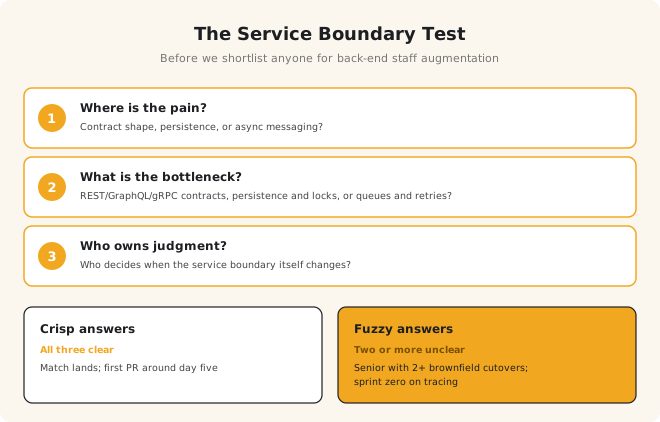
When all three answers are crisp, we have matched teams where the first pull request landed on day five. When two answers are fuzzy, we insist on a senior who has led at least two brownfield cutovers and we sell sprint zero as tracing, not story points. That honesty is cheaper than replacing someone in week four.
Vetting signals we refuse to pretend do not matter
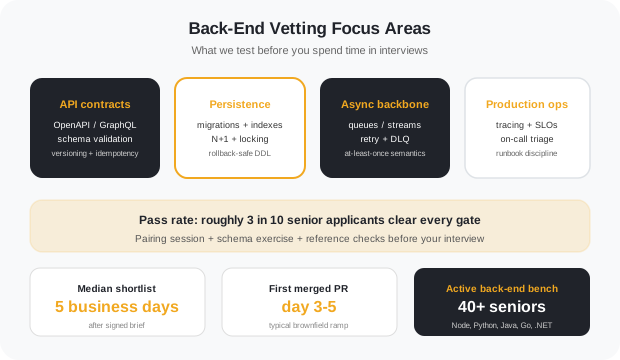
Roughly three in ten seniors who apply to our back-end bench clear every gate once the schema exercise, pairing session, and reference checks are included, not because we enjoy saying no, but because bad matches cost you a sprint and an incident review.
- Execution plan literacy: Can they describe index usage and lock behavior on your worst query without hand-waving?
- Contract discipline: OpenAPI or protobuf schemas checked in CI, breaking changes gated, idempotency keys on money-moving endpoints.
- Async failure modes: We look for engineers who can explain poison messages, retry storms, and dead-letter replay, not only happy-path queue publishing.
- On-call temperament: If you run a pager, we simulate a truncated incident timeline in vetting. Feature-only roles skip this gate.
- Shipping hygiene: If your repo lacks CI, we document that gap in writing on day four and refuse to let "temporary" deploy scripts live only on a laptop.
For a wider lens on how we staff engineering roles, see hire software developers and our back-end development outsourcing service when you want delivery ownership end to end.
Ramp timeline: from brief to merged fix
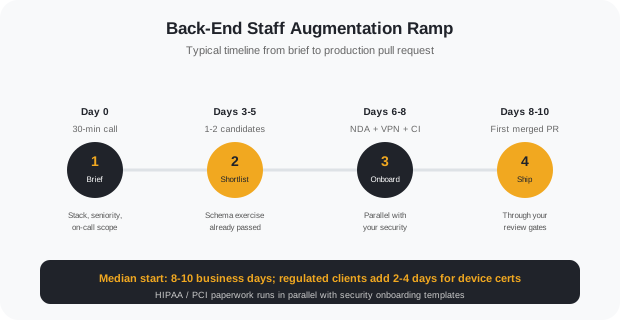
Regulated clients with device certificates and VPN splits can add a few days; we front-load paperwork with templates we have used on HIPAA- and PCI-adjacent programs so procurement does not become the bottleneck. According to the Stack Overflow Developer Survey, senior back-end talent remains scarce globally, which makes a structured vetting pipeline more valuable than a faster listing.
Engagement models: individual embed, pair for cutovers, and when to escalate
Single senior embed
Best when you have a tech lead who can context-share quickly. One engineer, your ceremonies, your Definition of Done. Scale up after two sprints if velocity supports it.
Typical rate: USD 5,000–9,000/month for senior nearshore engineers.
Pair for critical cutovers
Database dual-write windows, Kafka topic migrations, and certificate rotations get safer with two seniors on overlapping shifts, still staff augmentation, coordinated through our engagement lead.
Best for: Cutovers with a fixed calendar and zero rollback appetite.
Dedicated back-end pod
When you need QA plus DevOps plus a tech lead who owns on-call across multiple services, economics shift. Compare with the dedicated back-end team offering and with API development outsourcing when the public contract is the product.
Typical pod band: USD 18,000–42,000/month depending on seats and SLO load.
What changed in the back-end stack you actually have to care about (2025–2026)
Node.js 22 LTS (October 2024) is now the default recommendation for new services when your team already ships TypeScript on the front end. If candidates have never read the Node 22 release notes, they may struggle the first time you ask for native fetch hardening or stricter module resolution in a monorepo.
PostgreSQL 17 (September 2024) improved logical replication failover and vacuum behavior on large tables, exactly the seams brownfield SaaS teams hit when tenant count crosses six figures. We expect senior engineers to know when an index-only scan stopped being possible after a schema drift, not just how to add a column.
OpenTelemetry Logs GA in 2025 finally made log-trace correlation a default expectation in production reviews, not a "phase two" ticket. And the EU Cyber Resilience Act enforcement window in 2026 means European buyers increasingly ask for SBOM and vulnerability disclosure evidence in vendor diligence, something your augmented engineers should be able to discuss without forwarding the question to legal.
Compared to marketplaces, in-house hiring, and generalist agencies
vs. Upwork / Toptal-style lists
Speed of listing is not depth. We trade away "500 resumes in 48 hours" for two engineers who already survived an intentional schema regression exercise and a live pairing session on concurrency.
vs. in-house FTE
Full-time remains right for culture carriers. Augmentation fits when headcount freezes, hiring managers are underwater, or you need a six-month bridge while recruiting closes a local offer, common in competitive markets documented by the Stack Overflow survey.
vs. generalist dev shops
Agencies that bounce between mobile and CMS rarely maintain muscle memory for migration rollbacks, queue backpressure, and SLO error budgets. We bias toward back-end specialists because your incident history usually has a data or async story underneath.
Published reference: platform engineering at scale
When buyers ask whether we can staff senior back-end engineers for long-running platform work, not a three-month feature spike, we point to the NetApp Go platform engagement: eight senior Go developers embedded through staff augmentation to ship REST and gRPC services, workers, and observability for hybrid cloud data infrastructure. The engagement ran as augmentation under client engineering leadership, not as a black-box outsource, exactly the model this page describes at larger scale.
Smaller teams start with one or two engineers on the same terms. If the program grows past what individuals can own, we convert to a pod without restarting discovery from zero.
Risks, and how we keep them boring
- Knowledge silos: We require written runbooks for anything touched after hours; your wiki or repo docs, not our Notion.
- Intellectual property: You own the branches. NDAs precede repo access. Master agreements spell out code ownership explicitly.
- Timezone drift: LATAM overlap with Eastern through Pacific is real time in Slack, not async theater. EU-hours coverage is staffed explicitly when you ask for it in the brief.
- Scope creep through "small" asks: Our engagement lead flags when backlog thrash outpaces sprint commitments so product and engineering stay aligned.
- Security debt: We follow OWASP Top 10 remediation as a baseline and align cloud posture reviews with the AWS Well-Architected Framework when you run on AWS.
OUR STANDARDS
What "done" means when you hire back-end developers through Siblings.
- Production-shaped tests: Integration tests run against containers or disposable databases, not only mocks, unless your seam truly is pure logic.
- Observability, not printf debugging: Structured logs, traces on outbound calls, metrics on queue depth, the baseline for anything touching money or health data.
- Honest estimation: If a migration needs six sprints, we say six. Padding is expensive; surprise slips are worse.
- Security first: Secrets stay in vaults, not environment files checked into history. Dependency review gates run in CI.
Frequently asked questions
Real buyer objections we answer on discovery calls when teams evaluate hiring back-end developers through staff augmentation.
Hiring from Argentina instead? See the Argentina mirror of this page (separate site, same engagement model).
CONTACT US
Tell us about your API seam, schema pain, or on-call gap and we will shortlist accordingly.