Outsource eCommerce Development to a Team That Ships Revenue, Not Just Code
Most eCommerce agencies build stores. We build the systems behind them: inventory syncs, checkout optimisation, ERP bridges, subscription logic and the analytics layer that tells you what's actually working. Since 2016, Siblings Software has shipped commerce projects for retail, wholesale and DTC brands across 14 countries.
Our nearshore squads sit in your time zone (US Eastern overlap), join your Slack, push to your repo and demo every two weeks. You keep full code ownership. No lock-in, no surprises on the invoice.
Budgets start at USD 35K for an MVP storefront. Enterprise re-platforms typically land between USD 80K and 250K.
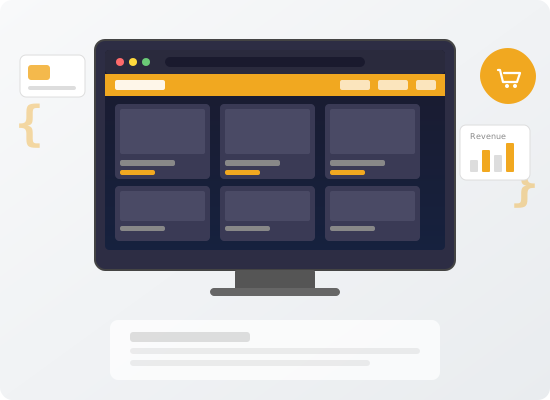
eCommerce Development Services We Deliver
We don't do everything — we do commerce well. Below is the scope we cover, from zero-to-launch greenfield builds to gnarly platform migrations where nobody wants to touch the legacy codebase. Looking for AI-powered personalization, recommendation engines or agentic shopping assistants? See our AI e-commerce development service.
Storefront Design & Build
Responsive storefronts with a real design system — not a purchased theme with surface tweaks. We deliver component libraries, conversion-tested layouts, ADA-compliant templates and brand guidelines your marketing team can extend without calling us.
Platform Migrations
Moving off Magento 1, a custom PHP monolith or an aging WooCommerce install is where most projects go wrong. We migrate products, customers, order history, SEO redirects and marketing data with rehearsed cutover plans and rollback windows. Typical downtime: under four hours.
Commerce Integrations
ERPs, PIMs, CRMs, payment gateways, marketplaces and last-mile logistics all need to talk to each other. We build secure APIs and event-driven pipelines that keep inventory, taxes and shipping rates accurate across every channel.
Shopify & Shopify Plus
Custom themes, app development, checkout extensibility and headless Hydrogen builds. We are members of the Shopify Partner Program and have delivered 20+ stores on the platform since 2019.
Adobe Commerce (Magento)
Module development, performance tuning, multi-store setups and B2B shared catalogues. We contribute to the Adobe Commerce developer community and handle the upgrade paths nobody looks forward to.
How an eCommerce Outsourcing Engagement Works
We've refined this process across 60+ commerce projects. It isn't theoretical — it's the actual sequence of events after you sign a statement of work.
1. Discovery & Scoping (1–2 weeks)
We run a paid discovery sprint. Your stakeholders, our tech lead and a UX strategist map out business rules, integration points, data migration scope and success metrics. Deliverable: a detailed project brief with architecture diagrams, a prioritised backlog and a cost estimate broken down by phase. If you decide not to proceed, you walk away with the brief — it's yours.
2. Team Assembly (3–5 days)
Based on the brief, we assemble a squad: typically a project manager, one to three full-stack developers, a UX designer and a QA analyst. You interview every team member before we start. No bait-and-switch.
3. Sprint Execution (8–24 weeks)
Two-week sprints, staging deploys after each. You see working software — not slide decks — every 14 days. We use your tools (Jira, Linear, Notion, whatever you run on) and attend your standups if you want us there.
4. QA, Security & Performance
Automated regression suites cover cart, checkout, payment and returns. We run Lighthouse audits against a performance budget, penetration testing with a third-party partner and accessibility checks against WCAG 2.1 AA. Nothing ships until the build passes all gates.
5. Launch & Cutover
We rehearse the cutover on a staging mirror. DNS changes, CDN warm-up, SSL provisioning, redirect verification, payment gateway go-live — all documented in a runbook your ops team can follow. We stay on-call for the first 72 hours after launch.
6. Post-Launch Growth
If you want continued support, we switch to a monthly retainer: CRO experiments, analytics dashboards, Klaviyo automations, SEO improvements and feature backlog work. Most clients keep a two-person squad running after launch. Some scale up, some scale down — the model flexes.
Engagement Models & Pricing
There is no single right model. The choice depends on your backlog depth, internal capacity and how much control you want over the day-to-day.
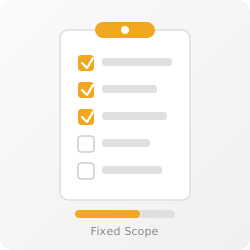
Project-Based
Fixed scope, fixed price. Best for launches, re-platforms or one-off migrations where requirements are well defined. We manage sprints, testing and release. You approve milestones.
Typical range: USD 35K–250K depending on scope.
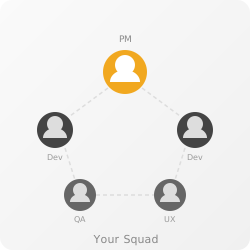
Dedicated Team
A multi-disciplinary pod — PM, developers, QA, designer — embedded in your organisation. Ideal for brands with a continuous backlog and omnichannel initiatives. You set the priorities; we execute.
Typical range: USD 15K–45K/month depending on team size.
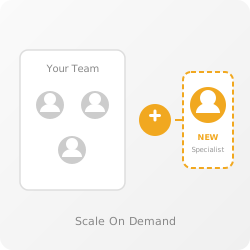
Staff Augmentation
Add one or two certified Shopify, Magento or React developers to your existing team. Good for short-term spikes, specialised skills (subscriptions, marketplace logic) or covering parental leaves.
Typical range: USD 4K–8K/month per developer.
Outsourcing vs. In-House vs. Freelancers
Clients ask us this constantly, so here's an honest comparison. None of these models is universally better — it depends on where you are as a business.
| Factor | In-House Team | Freelancers | Outsourcing Partner |
|---|---|---|---|
| Time to staff | 2–4 months per hire | 1–2 weeks | 3–5 days |
| Cost (US rates) | $120K–$180K/yr fully loaded | $60–$150/hr, variable quality | $35–$65/hr nearshore, vetted |
| Scalability | Slow — tied to hiring pipeline | One person at a time | Add/remove roles in days |
| Knowledge retention | High (if they stay) | Low — walks out with them | Medium — documentation + overlap |
| Best for | Core product, long-term IP | Small tasks, prototypes | Full builds, migrations, ongoing squads |
Our honest take: if you're a brand doing $5M+ in online revenue and don't have three or more engineers on staff, outsourcing the initial build and first year of iteration almost always makes more financial sense than hiring. You can bring it in-house later once the architecture is stable and the team knows what they need.
Case Study: Bari Wholesale Marketplace
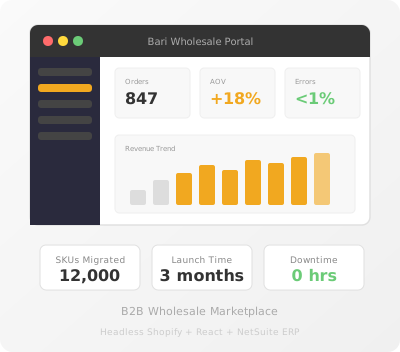
Bari is a Miami-based food distributor. Their wholesale buyers were placing orders by phone, email and spreadsheet. Average order errors ran at 8% and the ops team spent half their day on re-keying. They asked us to fix it.
What we built
- Headless Shopify + React storefront with customer-specific pricing tiers, credit terms and a quick re-order flow that pulls from previous purchases.
- ERP sync — real-time inventory and pricing pushed from their NetSuite instance to Shopify via a custom middleware layer.
- 12,000 SKU migration with tiered pricing rules, product images and customer accounts. Zero downtime during the cutover weekend.
Results after six months
- 18% increase in average order value from personalised bundles.
- Order errors dropped from 8% to under 1%.
- Three-month delivery from discovery to go-live.
Full details: read the Bari case study. For a custom personalized products store built on Next.js, see the Vyxia success case.
"Siblings Software rebuilt our wholesale ordering flow without disrupting operations. Their team jumped on late-night release windows, synced with our merchandisers every sprint, and left us with clean documentation we actually use."
Common Risks When Outsourcing eCommerce (and How We Handle Them)
We'd rather talk about the hard parts upfront than pretend outsourcing is risk-free. Here are the issues clients worry about most — and the specific things we do about each one.
Communication gaps
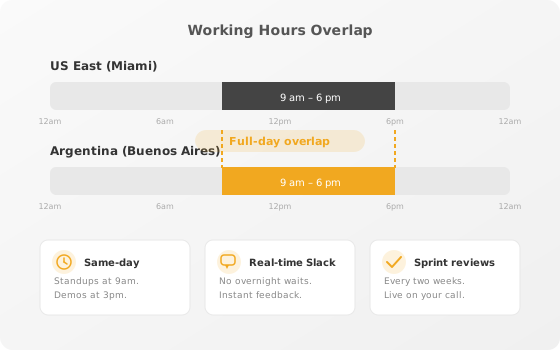
Our developers work from Argentina — same time zone as US Eastern. Daily standups happen at your preferred hour. Every project has a dedicated PM who speaks to you in business language, not Jira ticket numbers. We've had clients tell us they forgot the team wasn't in-house.
Unclear ownership
You own everything: source code, design files, infrastructure configs, documentation. We work inside your GitHub org and your cloud accounts. If you end the engagement tomorrow, there's nothing to migrate. This is non-negotiable for us.
Quality drops mid-project
We don't rotate developers off your project to fill another client's seat. Squad composition is locked for the duration unless you ask for a change. Code reviews, automated tests and staging demos keep quality visible — not just promised in a contract.
Vendor lock-in
We use standard, well-documented technologies. No proprietary frameworks, no custom CMS only we can maintain. If you hire in-house engineers six months from now, they'll understand the codebase because it follows industry conventions and has inline documentation where it matters.
Who Typically Hires Us
Not every company needs an outsourced eCommerce team. Here are the scenarios where it actually makes sense — the ones where we consistently deliver strong ROI.
Retail & DTC brands scaling past $2M–$5M online
You've outgrown your Shopify theme. Checkout customisation, subscription logic, loyalty programs and multi-market expansion need engineering depth your current team doesn't have. We build the infrastructure and hand it off when you're ready to hire internally.
B2B distributors and wholesalers
Your buyers still order by phone or PDF. A self-service portal with customer-specific pricing, credit terms, quick reorder and ERP integration can cut order processing costs by 40–60%. That's the exact project we built for Bari.
Mid-market companies migrating platforms
Magento 1 end-of-life, WooCommerce performance issues, or a legacy custom build that nobody wants to touch. Platform migrations are technically risky and we've done enough of them to know where the landmines are.
CTOs who need to move fast
You have the strategy but not the bench. Adding three certified developers in five days — instead of spending three months recruiting — means your Q3 roadmap actually ships in Q3. Our staff augmentation model is designed for exactly this.
What Most Buyers Get Wrong About eCommerce Outsourcing
After a decade of running these projects, patterns emerge. Here are the mistakes we see most often from buyers evaluating outsourcing partners — including some that almost derailed good projects.
Choosing on hourly rate alone
A $25/hour developer who takes three times as long costs more than a $50/hour developer who ships clean code on the first pass. We've inherited projects from budget agencies and the rebuild cost more than doing it right the first time. Ask for delivery speed and defect rates, not just rates.
Skipping discovery
Companies that jump straight to development almost always end up re-scoping mid-project. A two-week discovery sprint costs maybe 5–8% of the total budget and prevents 80% of scope creep. It's the single best investment in any commerce build.
Not involving operations early
Your fulfilment team, merchandisers and customer service reps will use the platform daily. If they aren't in the room during discovery, you end up building features nobody asked for and missing workflows everyone needs. We insist on including them.
Nearshore and Offshore eCommerce Development
Siblings Software operates from Argentina with a US entity in Miami. For North American clients, that means full overlap during Eastern and Central business hours. Standups at 9am, demos at 3pm — no awkward midnight calls.
For European clients, we adjust schedules to cover morning overlap (CET). It's not perfect synchronous time, but with structured async workflows, daily handoffs and recorded demos, it works well — we've run European engagements for three years running.
The practical difference: nearshore teams give you real-time collaboration and faster feedback loops. Offshore teams trade some synchronous time for cost efficiency. We help you decide which model fits your operating rhythm during discovery.
Frequently Asked Questions
An MVP storefront on Shopify or WooCommerce typically starts around USD 35,000. Full platform migrations with ERP integrations, multi-currency support and custom checkout flows range from USD 80,000 to 250,000. We publish a detailed breakdown after a paid discovery sprint so every cost driver is visible before development begins.
Simple storefronts ship in 8 to 12 weeks. Enterprise re-platforms with multiple integrations, data migration and custom logic take 16 to 24 weeks. We work in two-week sprints with staging deployments after each, so you can track real progress against the timeline.
We build on Shopify and Shopify Plus, Adobe Commerce (Magento), WooCommerce, BigCommerce and fully custom headless stacks using React or Next.js with a commerce API layer. Platform choice depends on your catalogue size, integration complexity and team skill set — we help you decide during discovery.
The main risks are communication gaps, unclear ownership and vendor lock-in. We mitigate these with overlapping time zones, a shared project manager, documented architecture decisions and full source code ownership from day one. Clients can walk away with everything at any point — that policy is in our standard contract.
Nearshore means your outsourced team is in a nearby time zone — for US companies, that's usually Latin America. Offshore typically refers to Eastern Europe or Asia with larger time gaps. We operate nearshore from Argentina with full overlap during US business hours, which makes daily standups and real-time Slack conversations practical.
Yes. All source code, design assets, documentation and infrastructure configurations belong to you from day one. We work inside your repositories, your cloud accounts and your project management tools. There is zero vendor lock-in.
Related Services
Web Development Outsourcing
Custom web applications, portals and marketing sites built by full-stack web teams.
React Development Outsourcing
Headless storefronts, SPAs and interactive UIs built with React and Next.js.
Hire an eCommerce Team
Dedicated eCommerce development squads ready to embed in your organisation.
AI E-Commerce Development
Recommendation engines, personalization platforms and conversational shopping assistants for human-facing AI commerce.
Agentic Commerce Development
Make your store transactable for AI shopping agents like ChatGPT, Gemini and Claude with protocol-level engineering — structured catalogs, MCP endpoints and signed checkout APIs.
API Development
RESTful and GraphQL commerce APIs that integrate cleanly with your storefront, payment and ERP backends.
GET A PROPOSAL
Tell us about your project — catalogue size, current platform, timeline and budget range. We'll respond within 48 hours with a preliminary approach and a suggested next step.
Last updated: August 2026