Platform Engineering Services for Product and SaaS Teams
Siblings Software provides platform engineering services when your product squads need an Internal Developer Platform, golden paths, and self-service environments instead of waiting on tickets for every new service. We work with CTOs, Heads of Platform, and VP Engineering who already have cloud and CI/CD in place, but still see provisioning delays, inconsistent deploy patterns, and platform work that never gets a product owner. This page covers what the service includes, who it fits, how delivery runs, typical team shapes, pricing context, comparisons with in-house and DevOps-only approaches, risks, and FAQs so you can decide whether to contact us.
We are a Miami-led software outsourcing company with engineering teams in Argentina. For pipeline and on-call ownership without an IDP product charter, see DevOps engineering outsourcing. When the immediate need is a bounded migration from colo or legacy cloud before an IDP rollout, see our cloud migration services. When golden paths need PR smoke suites and flake policies baked into CI, pair this work with QA automation services. For operator-facing admin panels and approval workflows, see internal tools development. To embed individuals under your platform lead, see platform engineer staff augmentation, Kubernetes developer staff augmentation, or DevOps engineer staff augmentation.
Reviewed by Javier Uanini, Founder and CEO, July 2026.
What Platform Engineering Services Cover
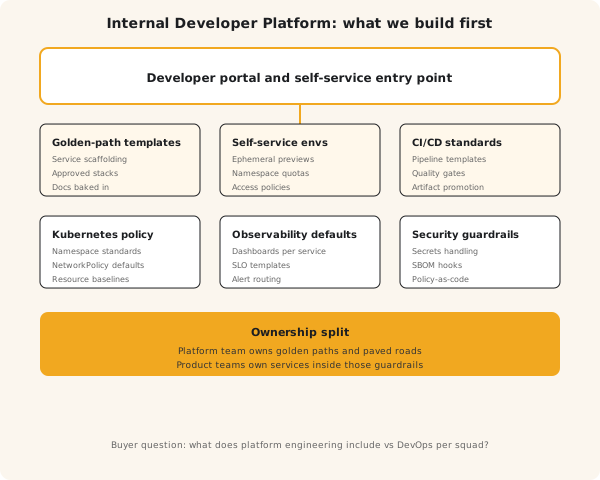
Platform engineering here means treating developer experience as a product. We help you define paved roads for common workloads, put self-service in front of environment and pipeline setup, and make sure someone owns the backlog after the first release.
Typical delivery includes:
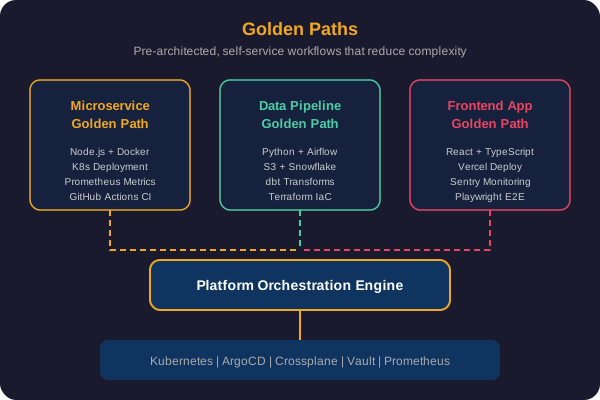
- Golden paths for a small set of service types (for example API, worker, and frontend) with templates, CI, and baseline observability
- Self-service provisioning for staging and preview environments with guardrails your security team accepts
- A developer portal or catalog when discovery across many repos is the real friction (often Backstage)
- CI/CD starter kits that product teams can adopt without opening an infrastructure ticket for every repo
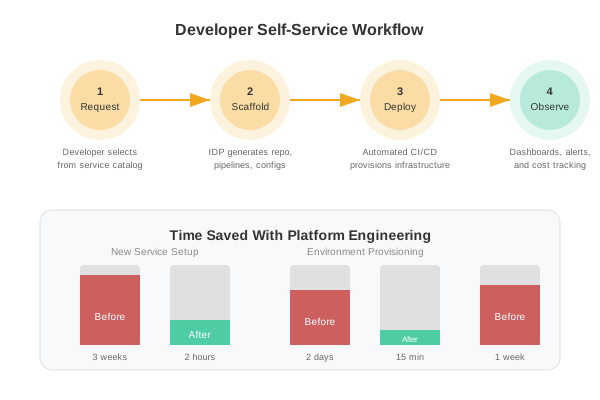
- Platform metrics that matter to buyers: time to first deploy for a new service, ticket volume for platform requests, and golden-path adoption
This is not a Wikipedia definition of Kubernetes, and it is not a generic DevOps ticket queue rebrand. The CNCF platforms whitepaper describes platforms as products that reduce cognitive load for delivery teams; we use that framing when scoping work with your leadership.
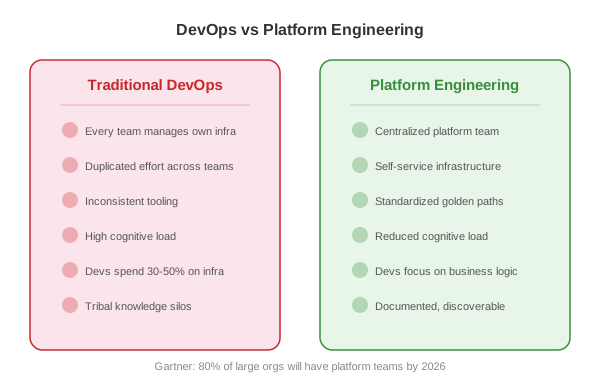
If your pain is deploy reliability and incidents for one product line, start with DevOps engineering. If many squads share the same friction, start with platform engineering.
Who This Service Is For
Teams with enough product squads that ad-hoc infrastructure help has become a bottleneck.
SaaS with five or more squads
Each squad invents its own deploy path. New services take weeks to land in a shared staging environment. Leadership wants one paved road without freezing feature work.
Regulated product companies
Security and compliance reviews repeat for every repo. You need golden paths that bake in logging, secrets, and change controls so audits stop rediscovering the same gaps.
Platform leads without bench depth
You have a Head of Platform or strong DevOps lead, but not enough senior engineers to ship an IDP while keeping production stable. A temporary outsourced squad fills the gap.
If you only need one senior engineer inside your rituals, staff augmentation is usually the better fit. If you need a self-contained pod with a delivery lead, compare our dedicated development team model on this same service line.
Platform Product Readiness Test
Before we propose a backlog, we run three questions with your CTO or Head of Platform. Honest answers prevent portal theater.
1. Staging without a ticket
Can a product team get a staging or preview environment without an infrastructure ticket? If not, self-service provisioning belongs near the top of the backlog.
2. Named product owner
Is there a named platform product owner with a backlog, or is platform work a shared side quest for whoever is on call? Without ownership, tools rot after the launch demo.
3. One golden path to production
Can a new microservice of a known type follow one documented path from repo template to production? If every service is a custom snowflake, start with one path, not a catalog of twenty.
How Delivery Works
- Discovery (about one week). Map current deploy paths, ticket volume for platform requests, cloud account layout, and who will own the platform after we leave. Run the Platform Product Readiness Test.
- Foundation (weeks two to four). Agree the first golden path, repo templates, CI baseline, and environment provisioning approach. Prefer one working path over a wide catalog.
- Pilot adoption (weeks five to eight). One product squad uses the path for a real service. We fix friction in docs, templates, and permissions based on that pilot.
- Portal and catalog (when justified). Add Backstage or a lighter portal only after at least one path has users. Catalogs without paved roads become unused directories.
- Handoff or retain. Document ownership, SLOs for the platform itself, and the next backlog. Optional retainer for path expansions and quarterly adoption reviews.
Work stays in your Git providers, cloud accounts, and identity systems. We do not ask you to migrate production into a Siblings-owned cloud.
Team Composition
Squad shape follows the Platform Product Readiness Test, not a fixed org chart from a conference talk.
Foundation squad
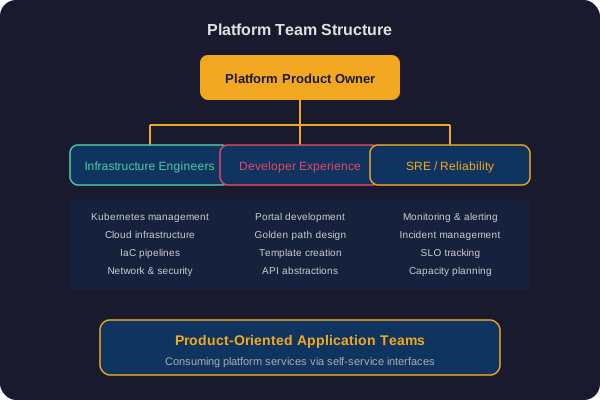
Three to four people: platform lead, senior infrastructure engineer, developer experience engineer, and often a part-time SRE for observability defaults. Fits a first golden path and self-service staging.
Portal-heavy squad
Adds a frontend or Backstage plugin specialist when the catalog and docs site are in scope. Keep this track after the first path works, not before.
Embedded specialists
One or two engineers under your platform EM when the product charter already exists. See staff augmentation pages for Kubernetes, Terraform, SRE, and FinOps when those gaps are narrower than a full IDP program.
Pricing and Engagement Models
Project-based IDP foundation
Fixed or capped scope for discovery, one golden path, and handoff docs. Usually sits in the company project band of USD 15,000 to 120,000. Best when the outcome is clear and you have an internal owner ready on day one.
Dedicated platform team
Monthly pod with a delivery lead. Platform squads commonly land around USD 22,000 to 45,000 per month inside the dedicated-team band of USD 12,000 to 60,000. Best for multi-quarter IDP programs with adoption coaching.
Staff augmentation
Individual specialists under your management. Useful after the platform product owner and backlog exist. For role-level pages, start with hire platform engineers, hire Go developers when data-plane services need Golang depth, hire DevOps engineers, or hire FinOps engineers when cost governance is the parallel track. When squads need delivery discipline inside two-week cadences before platform work lands, see hire agile developers.
What drives cost: number of cloud accounts, compliance gates, whether a portal is in scope, how many golden paths you want in the first release, and how much adoption coaching product squads need. We publish bands so finance can model; final quotes follow a short discovery call.
Comparison: Outsourced Platform Team, In-House, Generalist Agency
| Option | Fits when | Watch for |
|---|---|---|
| Siblings platform engineering | You need a delivery lead, paved roads, and adoption help while product teams keep shipping. | Still needs an internal platform product owner after handoff. |
| In-house platform hire | You can wait on recruiting and already have executive sponsorship for a lasting platform org. | Time-to-first-path is often measured in quarters, not weeks. |
| Generalist agency | You need a short consulting assessment or tooling proof of concept. | Risk of portal demos without golden paths or ownership transfer. |
| DevOps-only outsourcing | Incidents, pipelines, and IaC for existing systems are the bottleneck. | Does not create self-service product paths across many squads by itself. |
Example Engagement
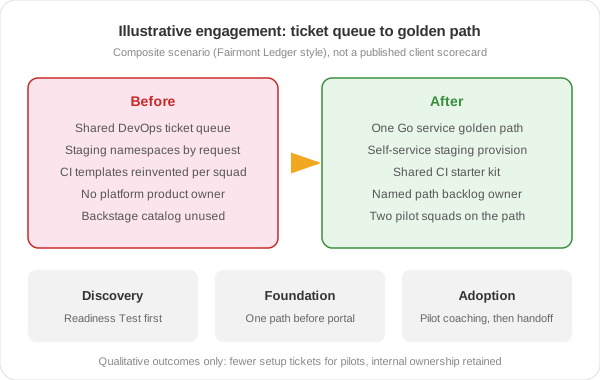
Fairmont Ledger (composite illustrative scenario, not a named public client). A US B2B payments API company with eight product squads on AWS EKS. New microservices waited on a shared DevOps queue for staging namespaces, secrets wiring, and CI templates. There was no named platform product owner; Backstage had been installed as a weekend experiment and had no catalog owners.
A four-person Siblings platform squad ran the Platform Product Readiness Test, shipped one golden path for Go services (template, CI, staging provision, baseline OpenTelemetry), and coached two pilot squads through their first services on that path. Portal cleanup waited until the path had real users. Outcome framing for this example: ticket volume for new-service setup dropped for the pilot squads, and an internal engineer took product ownership of the path backlog. No fabricated percentage claims.
For a real published engagement with platform-adjacent work, read the NetApp case study (Go engineers embedded in a platform-engineering organization). Browse more proof on the case studies hub.
Risks and How We Reduce Them
Portal without paved roads
Teams install a catalog and still open tickets for every environment. Mitigation: one golden path and a pilot squad before portal expansion.
No internal owner after launch
The outsourced squad leaves and templates drift. Mitigation: name a platform product owner during discovery; handoff includes backlog and review cadence.
Security rejects self-service
Provisioning is blocked in review. Mitigation: involve security early, encode guardrails in templates, and document what stays ticket-based on purpose.
Wrong engagement model
A full squad when you needed one senior, or the reverse. Mitigation: route to staff augmentation or DevOps engineering when the Platform Product Readiness Test says the IDP charter is not ready.
Frequently Asked Questions
We design and build Internal Developer Platforms: golden paths for common service types, self-service environment provisioning, CI/CD templates product teams can adopt without tickets, a developer portal when discovery matters, and the ownership model so the platform keeps improving after the first release. Work happens in your cloud accounts and repos. You keep IP, billing relationships, and production change authority.
DevOps engineering outsourcing focuses on pipelines, infrastructure as code, Kubernetes operations, observability, and on-call for the systems you already run. Platform engineering treats the developer experience as a product: paved roads, self-service, and adoption metrics across many squads. Many companies need both. If your bottleneck is incident response and deploy reliability for one product, start with DevOps engineering. If product teams wait on tickets for every new service, start here.
A focused IDP foundation project usually lands in the broader Siblings project band of USD 15,000 to 120,000 depending on scope and cloud complexity. A dedicated platform squad is typically USD 22,000 to 45,000 per month for three to six specialists with a delivery lead, inside the company dedicated-team band of USD 12,000 to 60,000 per month. Staff augmentation for individual platform engineers is available when you already have a platform product owner. Cloud bills, portal SaaS seats, and third-party licenses stay on your side.
Most programs put one golden path into the hands of a pilot squad in six to ten weeks: discovery and Platform Product Readiness Test in week one, backlog and architecture in weeks two and three, first path and docs in weeks four through seven, then adoption coaching. Multi-cloud, heavy compliance gates, or a full portal catalog take longer. We prefer one working path over a twelve-month portal launch with no users.
We use Backstage when you need a software catalog, techdocs, and plugin ecosystem that your team can extend. We also ship lighter portals or CLI-first platforms when a full Backstage install would outpace adoption. The decision follows how many services you have, who owns plugins after we leave, and whether discovery or provisioning is the first pain. Official Backstage documentation is a good primer if your team is evaluating that path.
Hire individuals through staff augmentation when you already have a platform lead, a clear backlog, and rituals for product feedback. Outsource the program when you need a delivery lead, parallel tracks for golden paths and portal, or a temporary squad while internal hiring catches up. Mixing both is common: a Siblings squad builds the first paths, then one or two embedded engineers stay for adoption.
We hand over runbooks, architecture notes, backlog priorities, and a named internal owner path. Optional retainers cover golden-path expansions, portal plugins, and quarterly adoption reviews. We do not treat a portal launch as the finish line. Success is measured by tickets avoided, time to first deploy for new services, and whether product teams choose the paved road without being forced.
Contact us
Tell us how many product squads you have, what cloud you run, and whether staging still requires a ticket. We will recommend platform engineering, DevOps engineering, or staff augmentation.