LLM Evaluation Engineering Services
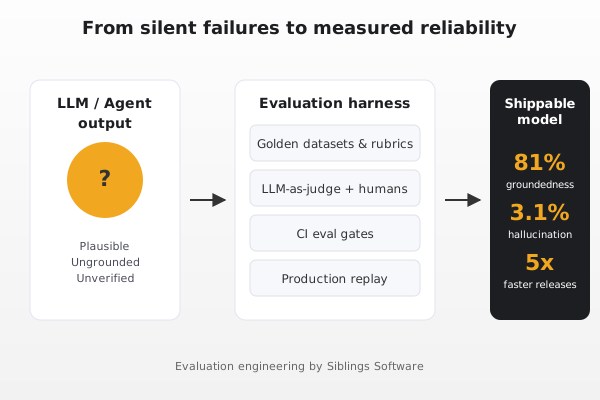
Your model demo wowed everyone. Three weeks into production traffic, the support inbox is full of subtly wrong answers, the legal team flagged two responses that quoted documents that do not exist, and nobody can tell you whether last Tuesday's prompt change made things better or worse. That is not a model problem. It is an evaluation problem, and it is what our eval engineering practice is built to fix. The same regression discipline applies to intelligent document processing pipelines when field extraction quality must gate release.
We design and build the harness around your AI products: golden datasets, judges, CI gates, red-team suites, and production replay. The same kind of plumbing your backend team takes for granted, applied to the probabilistic systems your engineers are now expected to ship every two weeks.
Siblings Software is a software outsourcing company based in Miami, Florida. Our engineers work in US time zones from Argentina, and we have been building outsourced software teams since 2014. Eval engineering became a dedicated practice inside our AI cluster in 2025, alongside harness engineering for coding agents, agent observability, and LLM guardrails development for runtime policy enforcement.
Why LLM Quality Cannot Be Tested Like Code
Software teams have spent two decades getting good at deterministic testing. Given the same inputs, a function returns the same output. Tests pass or fail. Coverage tells you how much of the code your tests touch. That mental model breaks the moment a generative model enters the request path.
An LLM can answer the same question two different ways, both technically correct, one of them subtly off-policy. A retrieval pipeline can return the right document with the wrong section highlighted. An agent can complete a workflow successfully and still leak a customer email along the way. None of those failures show up as a thrown exception. They look like working software.
According to Gartner's 2026 update on AI engineering markets, evaluation and observability now sit as a standalone category, and quality is the single biggest barrier teams cite to moving generative AI from prototype to production. The headline number worth remembering: roughly four in ten teams that ship an LLM feature regress on quality within ninety days, often without realizing it.
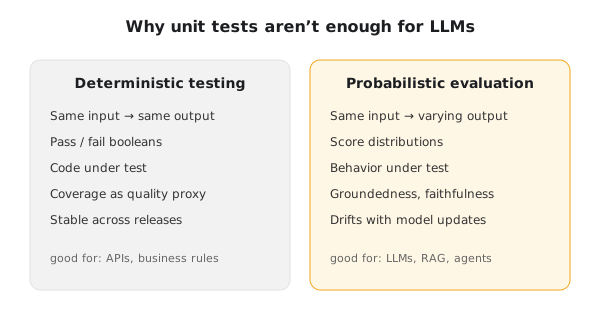
Eval engineering is the discipline that closes that gap. It is not a fancy test framework. It is a small operating model: a curated dataset, calibrated judges (some automated, some human), a CI pipeline that scores every change, and a feedback loop from production into the dataset so the harness improves as your traffic grows.
What We Build for You
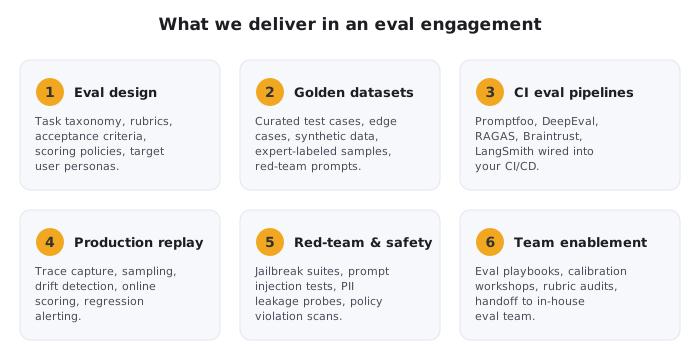
Six service areas, sequenced. Most clients start with eval design and a first golden dataset, then add CI gates and judges, then expand into red-team and production replay once the basics are stable.
Eval Design
We start with the failures, not the metrics. We sit with your support tickets, your incident logs, and the screenshots your sales engineers send you in disgust. From there we build a task taxonomy, write rubrics that map to real customer pain, and pick scoring policies that correlate with the business outcome you actually care about. Vague metrics like “quality score” are where most internal eval projects die.
Golden Datasets
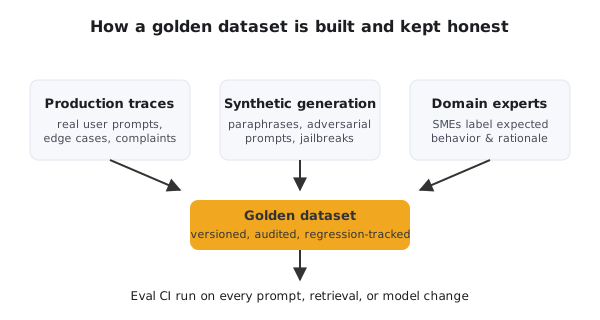
The dataset is the contract. We curate test cases from production traces, write synthetic adversarial prompts, label expected behavior with domain experts, and version everything so you can answer the question “what changed” six months later. The dataset evolves with your product, but it never silently mutates. RAG-specific datasets include source documents, expected citations, and traps for known retrieval failures.
CI Eval Pipelines
We wire your evals into the same CI/CD that runs your unit tests. Every prompt change, model upgrade, retrieval index rebuild, or agent tool addition triggers a scored run. Bad changes block the merge with a diff that explains which rubric regressed and on which examples. We work with Promptfoo, DeepEval, RAGAS, Braintrust, LangSmith, and the eval features in your cloud's AI platform.
Production Replay
The dataset you hand-curate is never the dataset your users actually use. We sample real production traces, hash-redact PII, score them against the same rubrics, and feed the interesting ones back into the golden set. The replay loop is what makes the harness adaptive. It is also the layer that catches drift after a silent provider model upgrade.
Red-Team and Safety
Adversarial suites built around your specific threat model: jailbreak attempts, prompt-injection vectors, PII leakage probes, regulated-content traps, and policy violations defined in your terms of service. We map each probe to an enforceable rubric so coverage gaps become visible. Pairs naturally with our AI code security practice when the same engineering team owns both surfaces.
Team Enablement
Once the harness is running, your team needs to own it. We run rubric calibration workshops, build playbooks for adding new tasks, and pair with your engineers on the first two or three model changes after handoff. The objective is your in-house team running the eval program independently within a quarter, with us available for occasional rubric audits and red-team refreshes.
The Four Layers of an Eval Stack
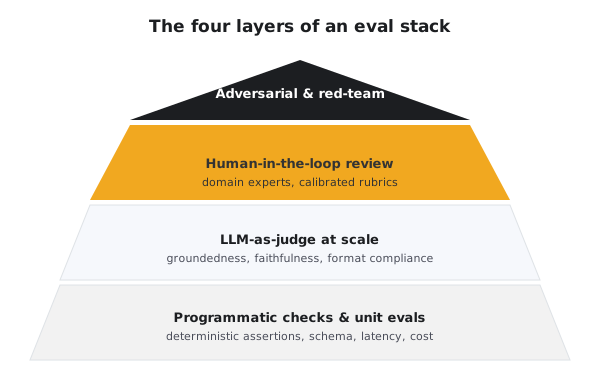
A working eval program runs four kinds of checks at different rhythms. Each layer catches a different failure mode. Skipping one is how teams end up with strong scores in CI and embarrassing incidents in production.
Programmatic checks
Schema validation, latency budgets, cost ceilings, exact-match for closed-vocabulary tasks, and regex assertions for the things that simply must be present. Cheap, deterministic, and run on every request.
LLM-as-judge at scale
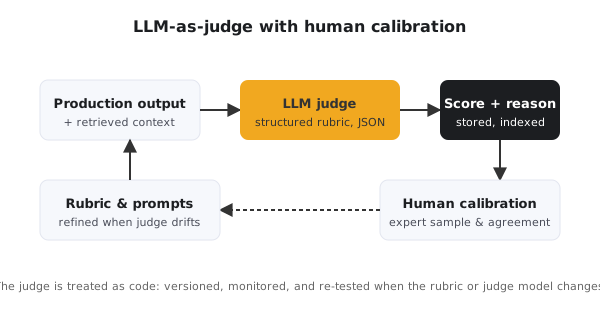
A second model scores outputs against a structured rubric and returns reasons. Not because it is perfect, but because it lets you score thousands of cases per change. We treat the judge as code: versioned prompts, agreement metrics with humans, and re-tests when the underlying judge model is upgraded.
Human-in-the-loop review
Domain experts spot-check the judge, calibrate the rubric, and label the hard examples that automated scorers cannot resolve. The volume is small. The value is keeping the rest of the stack honest.
Adversarial and red-team
For full adversarial programs with manual exploit exercises and GRC-ready evidence logs, see our dedicated LLM red teaming development page. Eval engineering still owns scored safety regression inside the quality harness; red teaming owns the attacker's mindset and exploit chains.
A continuously refreshed set of probes that try to break the system: jailbreaks, injections, off-topic baits, PII fishing, policy stress-tests. This is where most real-world incidents originate, and the layer most internal eval programs forget to maintain after launch.
LLM-as-Judge, Without the Judging Itself Going Off the Rails
Using a model to score another model's output is the technique that makes eval work tractable above a few hundred test cases. It is also the technique that fails silently when the judge itself drifts, mis-reads the rubric, or starts agreeing with itself. We have seen teams celebrate a 15-point quality jump that turned out to be the judge becoming more lenient after a provider update.
A few practical rules we apply on every engagement. The judge prompt is checked into the repo and reviewed like code. Every batch of judge scores ships with an agreement metric against a small human-labeled sample. When the judge model upgrades, we re-run the calibration set before trusting any new numbers. Ties between judges are broken by humans, never by majority vote of cousin models from the same family.
Building a Golden Dataset That Actually Reflects Your Users
Most teams start with a dataset of forty examples one engineer wrote on a Friday afternoon. It is a fine starting point. It is a terrible long-term truth. The cases are too clean, the phrasing is too uniform, and the edge cases that ruin Saturday mornings are not in there because nobody has been paged for them yet.
Our dataset work blends three sources. Real production traces, sampled and stripped of PII, give the actual distribution of user behavior. Synthetic generation, run with a different model family from the one under test, fills in adversarial gaps. Domain experts label expected behavior, including the rationale, so the next person who looks at the case understands why the answer is what it is. The result is a versioned, reviewable artifact your future engineers will thank you for.
A note on size. There is no magic number. We typically deliver a first dataset of 250 to 600 cases for a single product surface and grow it deliberately. Bigger is not better past a point. Coverage of failure modes is what matters, not raw count.
How an Engagement Runs
Eight to fourteen weeks for an enterprise build. Four to six weeks for a focused engagement covering one product surface. The shape is consistent across both.
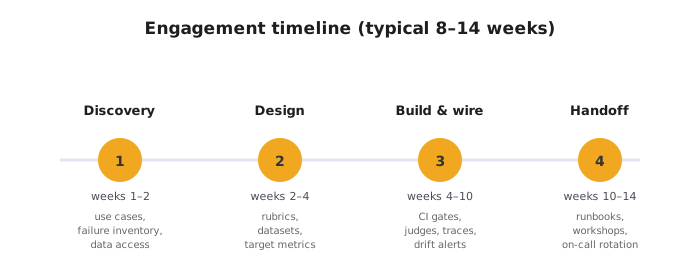
Phase 1: Discovery (weeks 1–2)
We map the product surfaces, the model providers, the existing test infrastructure, and the failure inventory. The deliverable is a prioritized list of evaluation targets and a baseline measurement: how the current system actually performs against the rubrics we are about to build. Teams are usually surprised. Sometimes pleasantly.
Phase 2: Design (weeks 2–4)
Rubrics get drafted, calibrated against a small expert sample, and frozen as versioned artifacts. The first golden dataset takes shape. We also pick the toolchain: most clients keep what they already pay for, but if you are running raw notebooks today we usually settle on Promptfoo plus RAGAS for retrieval-heavy systems and Braintrust or LangSmith for richer dashboarding.
Phase 3: Build and wire (weeks 4–10)
The pipelines go in. CI eval gates fire on prompt changes, model upgrades, and retrieval index rebuilds. Production replay is wired up, with sampling rates and PII redaction tuned to your data residency rules. Red-team suites are seeded with the threats your security team is willing to write down. Everything ships behind feature flags so we never block your team mid-flight.
Phase 4: Handoff (weeks 10–14)
Documentation, runbooks, calibration workshops, and pairing on the first two or three model changes after we are gone. We default to full ownership transfer. If you want us to stay on for ongoing rubric audits or red-team refreshes, we offer that as a small monthly engagement, not as a hostage situation.
Eval pipelines tend to bolt cleanly onto your existing AI DevOps pipelines. For teams shipping autonomous agents alongside the LLM features, our AI agents development practice covers the agent-runtime side of the same problem.
Mini Case Study: Meridian Labs Cuts Hallucinations 71%
The Situation
Meridian Labs is a US-based legal-research SaaS that ships a RAG assistant on top of a 2.4 million document corpus. Their team had been live for nine months when they came to us. Internal usage was strong, but two enterprise pilots had stalled because the assistant was citing case law that did not exist, occasionally inventing statute numbers that looked plausible to junior associates and embarrassing to senior partners.
They had unit tests on the application code, a small notebook with thirty examples a product manager had written, and a Slack channel where engineers posted screenshots of bad answers. No one could tell whether last sprint's prompt change had improved things or made them worse. Every model swap was a coin flip.
Their engineering director told us the line we hear a lot: “We do not have a model problem. We have a measurement problem, and the measurement problem is so bad we cannot tell whether it is a model problem.”
What We Built
An eleven-week engagement with a four-person squad: an eval lead, two eval engineers, and a part-time legal-domain reviewer we sourced through our network for the rubric calibration work.
The high-impact pieces:
- A 480-case golden dataset assembled from sampled production traces and synthetic adversarial prompts, with citations labeled by the legal reviewer. Hash-versioned, IP-clean.
- Three RAGAS-based judges for groundedness, citation correctness, and answer faithfulness, each calibrated against a 60-case human-labeled subset.
- A CI eval gate in their GitHub Actions that blocked merges when groundedness dropped below the agreed threshold or citation correctness regressed by more than two points.
- A production replay loop that sampled five percent of real traffic, scored it nightly, and surfaced new failure clusters in their existing Datadog stack.
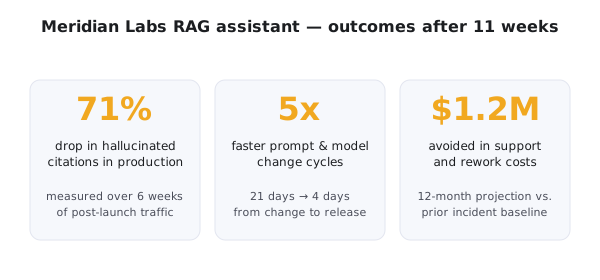
Six months post-handoff Meridian had landed both stalled enterprise pilots, the legal review board signed off on the assistant for paid tiers, and the engineering team was running rubric updates without us. The honest caveat: their first attempt to extend the dataset on their own missed a hallucination cluster around state-level statutes. We caught it in a quarterly audit. They have run the audits themselves since.
More on how we run engagements like this on our case studies page.
The Numbers Worth Tracking
Eval engineering without measurement is theatre. Four numbers carry most of the signal across the engagements we run. Each one needs a target, a trend line, and an alert.
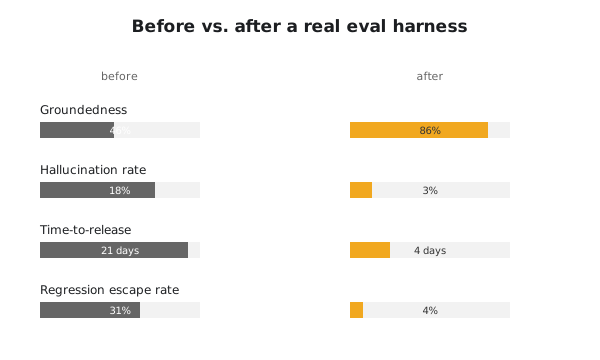
Groundedness — the share of answers whose claims are supported by the retrieved context or a recognized source. This is the metric that maps most directly to user trust on RAG products.
Hallucination rate — the inverse of groundedness, expressed at the response level. We track it separately because it is the number that ends up in board decks.
Time-to-release — the number of days between a prompt or model change being committed and being shipped to all users. A working eval harness compresses this dramatically because the human review step shrinks.
Regression escape rate — how often a quality regression slips past the harness and is caught in production. This is the metric that tells you whether the harness is actually load-bearing or just decorative.
Outsourced Eval Engineering vs. The Alternatives
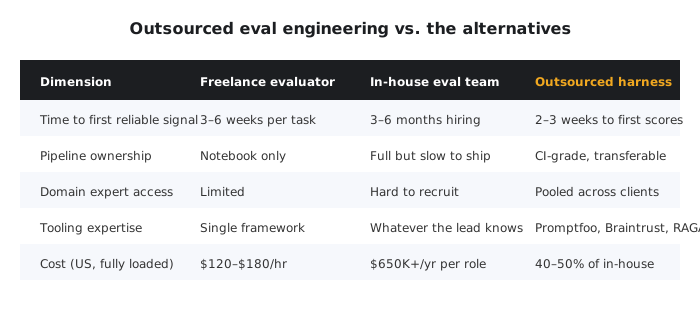
Eval engineering is not always the right thing to outsource. The honest answer depends on the maturity of your AI program, the budget for in-house hiring, and how much production pressure you are under right now.
Outsourcing makes sense when
- You have shipped an LLM feature, traffic is real, and you can already feel the quality drift you cannot measure.
- Your engineering team has not hired an eval specialist before, and you do not want to spend two quarters trying.
- You operate in a regulated industry and need defensible evidence that the model behaves the way your compliance team is being asked to sign off.
- You ship more than one AI surface and the duplication of judges, rubrics, and datasets across them is starting to hurt.
Stay in-house when
- You have a strong applied research team that just needs a reference architecture and the time to build it.
- Your AI surface is single-purpose, low-traffic, and the cost of a bad answer is reputational, not legal.
- You can afford the 6–9 months it usually takes to recruit, onboard, and ramp an eval engineer in the current US market.
A note on cost
Hiring a senior LLM evaluation engineer in the US currently lands between $160,000 and $240,000 base, before benefits, equity, and the recruiter fee. Add a domain expert and a part-time data engineer for the dataset work and you are at roughly $650,000 fully loaded for a year, assuming you can find the people. Our nearshore model delivers the same skill set at 40–50% of that, in your time zone, with a published replacement guarantee.
For project-based work, typical eval engineering builds run $80,000 to $240,000 depending on scope. Dedicated three-person squads start around $24,000 per month. Single-engineer AI staff augmentation placements range from $7,000 to $11,000 per month.
Risks We Plan For
Eval programs fail in five recognizable ways. We design around them up front rather than waiting to be surprised.
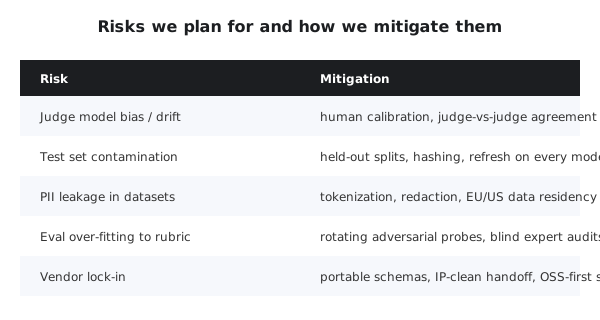
Judge bias and drift. Judges are LLMs, and they shift quietly when the underlying model is upgraded by the provider. We track inter-judge agreement and human-judge agreement on a fixed calibration set, and re-baseline whenever the judge model version changes.
Test set contamination. Public benchmarks leak into training data. We hash-version every dataset, keep held-out splits the model has never seen, and refresh the most-used cases on each significant model upgrade.
PII leakage in datasets. Production traces are toxic if mishandled. We tokenize and redact at sample time, store only what we need, and keep EU and US residency boundaries in the pipeline. The NIST AI Risk Management Framework is the policy spine we map to when a client asks for one.
Eval over-fitting. A team that runs the same fifty cases for nine months ends up with a model perfectly tuned to those fifty cases and nothing else. We rotate adversarial probes, add new failure clusters from production replay, and run blind expert audits to keep the harness honest.
Vendor lock-in. Every artifact we produce is portable. Datasets ship as JSON Lines you can parse without our tools, judge prompts live in your repo, CI definitions live in your pipelines. If you replace us with an in-house team next quarter, nothing breaks. We have walked clients through that exact transition before.
Where Eval Engineering Earns Its Keep
Some surfaces benefit from a harness more than others. The pattern: high traffic, regulated outputs, citation-heavy responses, or agents with side effects. Those are also the surfaces where teams come to us.
RAG assistants
Legal research, medical literature, internal knowledge bases. Citation correctness and groundedness are the headline rubrics. RAG-specific eval work overlaps heavily with retrieval debugging.
Customer-facing chat
Support copilots, sales assistants, eCommerce concierges. Tone, policy compliance, and refusal-handling matter as much as accuracy. We work with these alongside our AI eCommerce practice.
Code generation
Internal coding agents, code review bots, doc generators. Eval focuses on pass@1, regression risk, and security drift. Pairs naturally with agent harness engineering.
Autonomous agents
Workflows that take real-world actions: ticket triage, financial ops, scheduling. Trajectory evaluation, recovery from failed tool calls, and scope adherence drive the rubrics.
Regulated industries
Healthcare, banking, insurance. Defensibility matters: every score must be reproducible, every dataset auditable, every judge prompt versioned. The harness becomes a compliance artifact.
Internal LLM platforms
Companies running their own gateway in front of multiple providers. Eval gates protect the platform from silent vendor model changes that would otherwise propagate downstream.
Three engagement shapes, depending on how much of the eval program you want to own and how much you want us to run.
How to Work With Us
Project-Based
Outsourcing
We deliver a full eval harness for one or more product surfaces and hand over the whole thing. Includes rubric design, golden dataset, judges, CI gates, production replay, and runbooks. Typical duration 8–14 weeks. Best for teams that want a production-ready harness without spending six months building one in-house.
Dedicated
Eval Team
An ongoing three- to six-person squad embedded in your AI org. The team owns the eval program: new product surfaces, rubric refreshes, red-team rotations, and the production replay backlog. Works as an extension of your platform team, not a vendor at arm's length.
Staff
Augmentation
Embed individual eval engineers, judge specialists, or red-team operators into your existing AI team. Best when you have the strategy defined and need hands-on expertise to build pipelines, write rubrics, or chase down a specific failure cluster.
Why Teams Hire Siblings Software For This
We have been building outsourced engineering teams since 2014, with more than 250 engagements across healthcare, banking, eCommerce, logistics, and regulated SaaS. Our AI cluster grew out of that work over the past three years, and eval engineering became a named practice in 2025 because the same questions kept coming up: how do we know this model is better, and how do we keep it from regressing once it is.
A few specifics worth saying out loud. About 40% of our clients are venture-backed startups, the rest are mid-market and enterprise. We staff in two-week sprints with shared velocity dashboards, demos, and retros each cycle. Engineers are based across Latin America in US time zones. We publish a 2-week satisfaction guarantee and a 30-day notice to scale down. Our founder, Javier Uanini, still reads every weekly status report.
The opinions we have formed running these engagements are not negotiable parts of the offering, but they show up in every contract.
First, evaluation is a product surface, not a side project. It deserves the same code review, observability, and on-call rotation as the rest of the system. Teams that treat it as an internal tool always end up with stale data and quiet drift.
Second, the judge is never the answer by itself. Every program we ship has humans in the loop on a small calibration sample. The teams that try to run fully automated eval pipelines without a human anchor are the ones that come to us six months later with a quality crisis they cannot diagnose.
Third, your dataset is your moat. Tools come and go, model providers change pricing every quarter, the leaderboard you cared about last year is irrelevant now. The labeled, versioned, domain-specific dataset is the artifact that compounds. We treat it accordingly.
Frequently Asked Questions
Traditional QA tests deterministic code. The same input produces the same output, so unit tests assert exact values. LLMs and agents are probabilistic: the same prompt can yield different answers, with subtle quality drift across model upgrades. Eval engineering replaces boolean assertions with score distributions: groundedness, faithfulness, format compliance, latency budgets, and policy violations. It treats prompts, retrieval, and agents as the system under test, with versioned datasets, calibrated judges, and CI pipelines that block bad releases the same way unit tests block broken builds.
All three. Chat assistants use task-level rubrics and policy probes. RAG systems get retrieval-quality scoring, citation auditing, faithfulness checks against source documents, and end-to-end groundedness. Agents need trajectory evaluation: did the agent pick the right tool, complete the task, recover from a failed call, stay within scope. We match the harness to the modality rather than reusing one template.
Open-source default: Promptfoo for prompt-level CI, DeepEval for unit-style assertions, RAGAS for retrieval and faithfulness scoring, and LangChain or LlamaIndex tracing depending on the codebase. Commercial: Braintrust, LangSmith, Arize Phoenix, Humanloop, and the eval features inside Azure AI Foundry, Vertex AI, and AWS Bedrock. We work with whichever stack you already pay for and avoid forcing migrations unless a tool is genuinely blocking your team.
First scores in two to three weeks: a first-pass golden dataset, a working LLM-as-judge for the most painful failure mode, and a single CI gate that blocks regressions. Full enterprise deployment with multi-rubric scoring, red-team suites, production replay, and dashboards usually takes 8 to 14 weeks. Focused engagements covering one product surface and one model change cycle wrap in 4 to 6 weeks.
Project-based engagements typically run $80,000 to $240,000 depending on the number of product surfaces, dataset depth, and red-team coverage. Dedicated eval teams start around $24,000 per month for a three-person squad. Staff augmentation for a single eval engineer ranges from $7,000 to $11,000 per month. Hiring an in-house LLM evaluation engineer in the US currently costs $160,000 to $240,000 base salary plus benefits.
You do. All artifacts ship to your repositories under your IP. Datasets are versioned in a format you can read without our tooling. Judge prompts are checked in alongside their evaluation criteria and human-calibration samples. CI definitions live in your pipelines, not in a vendor portal. We design every engagement so that if you replace us with an in-house team, nothing breaks.
Related Services