Objective-C Development Outsourcing for Legacy Apple Platforms
Siblings Software outsources Objective-C work for iOS and macOS products that still earn revenue in UIKit, AppKit, and hybrid Swift codebases. We help VP Engineering, mobile leads, and founders who inherited a binary nobody wants to touch but cannot afford to freeze. You get a clear engagement model, vetting signals for scarce legacy talent, pricing bands, and a delivery path that respects store and notarization calendars. Miami-led since 2014 with engineers across Latin America in US-friendly time zones. On this page you can compare project, dedicated team, and staff augmentation models, run the Legacy Codebase Stewardship Test, and see when to route work to our Swift outsourcing or staff augmentation siblings instead.
Reviewed by Javier Uanini, Founder and CEO, Siblings Software. Last reviewed October 2026.
What Objective-C outsourcing covers
We take vendor ownership for legacy Apple platform delivery, not greenfield tutorials about the language.
UIKit and AppKit maintenance
Crash fixes, memory regressions, SDK upgrades, and Privacy Manifest updates without pausing feature teams.
Hybrid Swift boundaries
Bridging headers, module maps, and framework extraction so Swift features do not break Objective-C cores.
Release train discipline
App Store Connect pipelines, TestFlight gates, macOS notarization, and entitlements reviews.
Vendor-owned QA on legacy surfaces
Device matrices for older iPads and Intel Macs still in your install base, not only the latest Apple silicon lab.
For a self-contained squad charter, see dedicated Objective-C teams. For engineers inside your standups, see hire Objective-C developers.
Who this service is for
Revenue apps stuck on Objective-C
The product still ships but the original authors left. Every release feels like a coin flip.
macOS workstations with compliance clocks
Notarization, hardened runtime, and Gatekeeper changes force a delivery partner who owns desktop release cadence.
Swift migration programs that need a legacy lane
Greenfield SwiftUI moves forward while Objective-C cores stay stable. We keep the legacy lane explicit.
Agencies without legacy bench depth
Your client still runs an Objective-C binary and your Swift bench cannot safely touch it.
Legacy Codebase Stewardship Test
Before we quote a squad, we score three buyer realities. Honest answers keep you out of a staff augmentation contract when you actually need a vendor-owned release train.
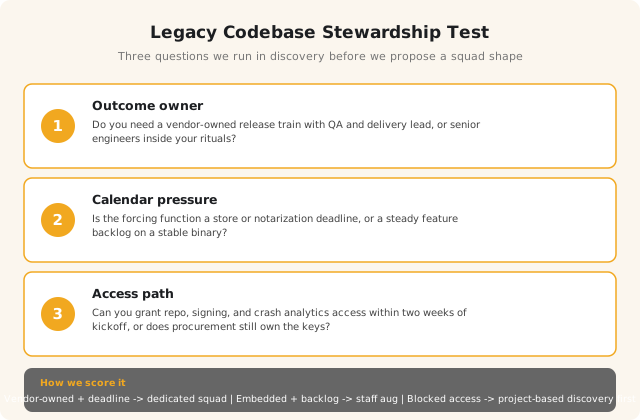
Apple platform policy moves faster than legacy code. We track Privacy Manifest requirements and bridging rules in imported Objective-C APIs so compliance work is scoped with engineering, not bolted on the night before submission.
How delivery works
- Discovery (3 to 5 days). Run the Stewardship Test, read crash trends, and map signing assets.
- Access sprint. Repos, CI, crash analytics, and App Store Connect roles before feature promises.
- Stabilization sprint. One safe production fix, dependency upgrades, and Instruments baselines.
- Roadmap lanes. Parallel tracks for compliance, hybrid Swift modules, and product features with explicit owners.
- Handoff or retain. Runbooks for bridging seams, release checklists, optional retainer for store seasons.

Vetting signals we look for on Objective-C engagements
General iOS portfolios are not enough. We screen for legacy production evidence.
- Commits touching
manual retain/releaseera code and modern ARC boundaries in the same module. - Shipped binaries through App Store review with entitlement or Privacy Manifest remediation stories.
- macOS notarization or Sparkle update channel experience when your SKU is desktop-first.
- Hybrid Swift work with owned bridging headers, not only SwiftUI greenfield samples.
- Instruments traces that show they can reproduce main-thread stalls in UIKit view controllers.
Staff augmentation candidates go through the Legacy Runtime Readiness Test on the hire page. Outsourced squads add delivery lead and QA coverage on top of those technical signals.
Team composition and pricing context
Stabilization pod
One senior Objective-C engineer, QA with legacy devices, part-time delivery lead. Fits store or notarization deadlines inside a USD 22,000 to 32,000 monthly band.
Modernization squad
Two senior engineers, QA, delivery lead, optional Swift engineer for module extraction. Often USD 32,000 to 55,000 per month.
Fixed-scope rescue
Bounded compliance or SDK upgrade after discovery. Typically USD 15,000 to 120,000 project-based inside our standard outsourcing brackets.
Compare models on project-based outsourcing, dedicated teams, and staff augmentation.
Comparison: freelancers, in-house, and Siblings outsourcing

Freelancers fit single crash loops. In-house hires make sense when you can wait six months for scarce legacy talent. Outsourcing wins when calendar pressure, hybrid Swift seams, and release ownership must land together.
Example engagement: Crestbar Trading Terminal
Composite illustrative scenario based on patterns from our Objective-C staff augmentation work. Full narrative lives on hire Objective-C developers.
A US market-data workstation (Objective-C and AppKit since 2013) plus a UIKit iPad companion faced a notarization deadline eight weeks out. One senior author had retired. We rebuilt signing pipelines, cleared Gatekeeper blockers, and retired UIWebView debt on the iPad companion while traders kept using the desktop build.
Outcomes published on the staff augmentation page: notarization shipped five weeks early, macOS crash-free sessions improved from 96.4% to 99.7% over a quarter, and iPad cold start on an older fleet device dropped from 6.2 seconds to 2.1 seconds after the web view migration.
Risks and how we reduce them
Silent bridging regressions
Module boundaries and header ownership are documented before Swift teams merge parallel work.
Store rejection loops
Privacy Manifest and entitlement diffs are reviewed against Apple guidance before submission.
Big-bang rewrite pressure
We publish a metered Swift lane so executives see progress without freezing revenue features.
Key custody disputes
Signing assets stay in your accounts. We work inside your CI and never ask to own production keys.
Frequently Asked Questions
When revenue still runs on UIKit or AppKit modules, third-party SDKs lack Swift ports, or a rewrite would freeze features for multiple quarters. We meter Swift adoption at module boundaries instead of betting the company on a big bang.
Signed build access, crash analytics, a recent App Store or notarization rejection if one exists, bridging header ownership notes, and one engineer who can explain the last production incident. Without that, week one becomes archaeology.
We look for production memory management history, Instruments fluency, hybrid Swift interop discipline, and comfort shipping through App Store Connect and macOS notarization. Swift-only portfolios without legacy commits are a poor fit for stewardship work.
A dedicated squad with QA and a delivery lead when the vendor must own the release train. Staff augmentation when your EM already runs ceremonies and you only need senior hands. Fixed-scope discovery first when signing keys or repos are still in procurement.
Yes. We document bridging seams, shared frameworks, and module boundaries so Swift feature teams do not break Objective-C cores. See our Swift development outsourcing page for greenfield SwiftUI work that should stay separate from legacy cores.
Stabilization projects often land in the USD 15,000 to 120,000 project band. Dedicated Objective-C squads typically run USD 22,000 to 55,000 per month inside the USD 12,000 to 60,000 dedicated-team range. Single senior engineers through staff augmentation sit in the USD 4,000 to 9,000 per month band.
Discovery takes three to five business days once access is granted. Team assembly is usually five to ten business days for staff augmentation and two to three weeks for a dedicated pod because Objective-C specialists are scarcer than Swift generalists.
Related: app development outsourcing, mobile app outsourcing, case studies, software outsourcing hub.
CONTACT US
Tell us about your legacy Apple codebase and release calendar.