DevOps Engineering for Product Teams That Need Reliable Delivery
Siblings Software is a DevOps engineering outsourcing partner for US companies that need production systems to ship safely—not another dashboard nobody opens. Since 2014 we have embedded platform and SRE specialists on CI/CD, Terraform baselines, Kubernetes operations, observability, and incident response while product teams keep building features.
This page is classic DevOps and site reliability: release engineering, infrastructure as code, and on-call discipline. If you are building an internal developer platform with paved roads and self-service portals, see platform engineering. For bounded migration programs moving workloads from colo or legacy cloud to AWS, Azure, or GCP, see our cloud migration services. When cloud COGS outpaces tag hygiene and commitment discipline, see FinOps services. When pipelines need Playwright merge gates and flake policies beside deploy automation, see QA automation services. If you want ML in pipelines and intelligent alerting, see AI-powered DevOps. For application depth alongside ops, we pair with back-end and full-stack squads when your roadmap spans services and delivery together.
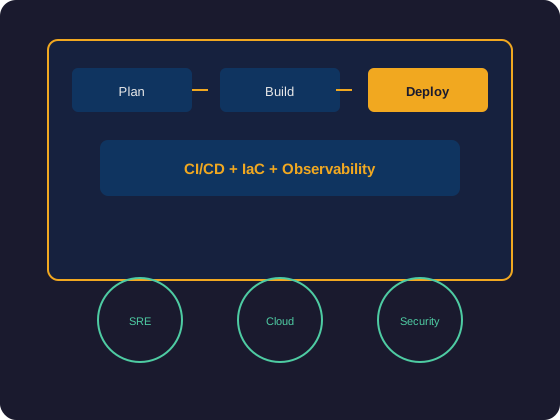
DevOps Engineering Services
Pipelines, cloud foundations, and operations your team can run after we step back.
Most “DevOps” engagements we see are really three different problems mashed together: getting merges to production without heroics, keeping clusters and accounts from drifting, and making incidents boring enough that engineers sleep. We tackle those directly—implementing patterns from the Google SRE book where they fit your culture, wiring GitHub Actions or GitLab CI the way your security team will approve, and treating Terraform modules as products your own engineers can extend.
CI/CD &
Release Engineering
Build pipelines with environment gates, artifact promotion, automated tests that fail for the right reasons, and deployment strategies—blue/green, canary, or rolling—that match your risk tolerance. We document rollback paths before we celebrate faster deploys.
Infrastructure
as Code & Cloud Ops
Terraform or OpenTofu baselines with policy checks, multi-account networking, secrets handled properly, and drift detection that security auditors recognize. We align to HashiCorp’s Terraform guidance unless your standards say otherwise.
Kubernetes, Observability
& Incident Response
Cluster hardening, autoscaling tied to real traffic signals, OpenTelemetry instrumentation, SLO-based alerting, and runbooks your on-call rotation will actually open at 2 a.m.—not a wiki graveyard.
How We Deliver DevOps Engineering
A practical sequence—discover, stabilize pipelines, then harden production operations.
We start with a short discovery: map services, identify where releases hurt, and read your last three incidents. Week one usually produces a prioritized backlog—fix the pipeline that still needs a named engineer, consolidate Terraform state, or instrument the API that pages everyone on Fridays. We do not rip out working tools to stamp our logo on a reference architecture.
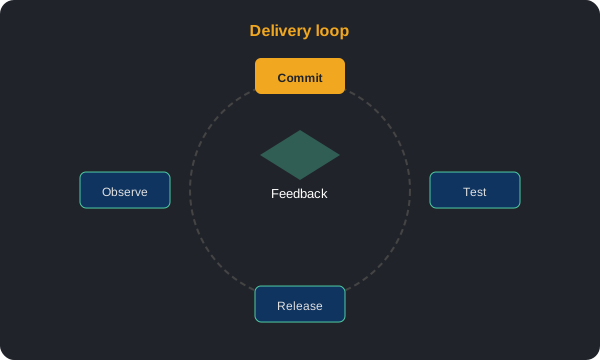
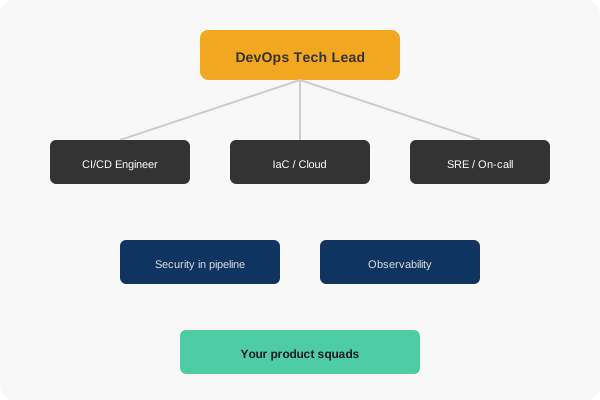
From there we work in increments your leadership can track: lead time for changes, change failure rate, mean time to restore, and pager load per engineer. When you need a dedicated pod instead of one senior embed, our outsource development team model adds a lead DevOps engineer, pipeline specialist, and observability engineer under one monthly statement of work. For a single seat inside your sprint cadence, DevOps staff augmentation is often the faster path. When the bottleneck is module libraries and remote state rather than pipelines alone, see Terraform engineer staff augmentation. When cloud spend governance lags infrastructure growth, see FinOps engineer staff augmentation.
Engagement models and monthly pricing (USD)
Figures below are typical ranges for US-facing delivery with Eastern/Central overlap. Final pricing depends on compliance scope, on-call expectations, and how much legacy automation we inherit.
Staff augmentation
USD 5,500–9,500 / month per senior DevOps or SRE engineer embedded in your ceremonies, repos, and on-call rotation.
Focused DevOps squad
USD 22,000–38,000 / month for a 3–5 person pod owning pipelines, IaC, and observability for a defined product line.
Multi-service program
USD 35,000–52,000 / month when you need multi-region Kubernetes, compliance evidence, and structured incident programs across many services.
Fixed-scope project-based outsourcing is available for audits, pipeline rebuilds, or migration windows; squads and augmentation are what most product companies choose when delivery is ongoing.
DevOps Technologies We Work With
We recommend tools your team can operate—not a shopping list from a conference booth. That usually means Terraform or OpenTofu for infrastructure, Kubernetes where orchestration already exists, and observability that exports through OpenTelemetry so you are not locked to one vendor forever.
Terraform / OpenTofu
Kubernetes / Docker
GitHub Actions / GitLab CI
AWS / GCP / Azure
Prometheus / Grafana / Datadog
Python / Go automation
Automation and glue code often ships with Python or Node.js services your application teams already own. We stay in the operational layer unless you ask us to co-own application repos.
If you need senior DevOps capacity without a six-month hiring cycle, we can start with one engineer and expand when the backlog proves value.
Reliable delivery is not a culture deck—it is pipelines, runbooks, and people who have been paged.
Case snapshot: DevOps and Python for a regulated collaboration platform
HighSide builds a zero-trust communications platform used by federal agencies and regulated enterprises. Their in-house engineers were shipping customer-facing capabilities on AWS and Kubernetes, but manual releases still took days, clusters drifted across US, EU, and GovCloud regions, and compliance reviews consumed bandwidth that should have gone to product work. They did not need a generic “DevOps transformation”—they needed senior people who could work inside existing security protocols from sprint one.
We embedded a DevOps engineer and a Python specialist into HighSide’s product squads within two weeks. The DevOps lead rebuilt CI/CD with GitHub Actions, standardized Terraform modules, and introduced GitOps patterns for Kubernetes so promotions were repeatable and auditable. The Python engineer supported the secure desktop sync client and cross-platform packaging while the platform team kept roadmap commitments. Releases that once required five days of manual handoffs dropped sharply; HighSide cites roughly 38% faster releases after automated delivery pipelines landed. The engagement has run 24+ months—not a hit-and-run audit.
That pattern—embed, document, transfer—is what we repeat for fintech, healthcare, and SaaS clients who cannot pause shipping for a six-month tooling migration. Read the full story, metrics, and stack detail on the HighSide case study.
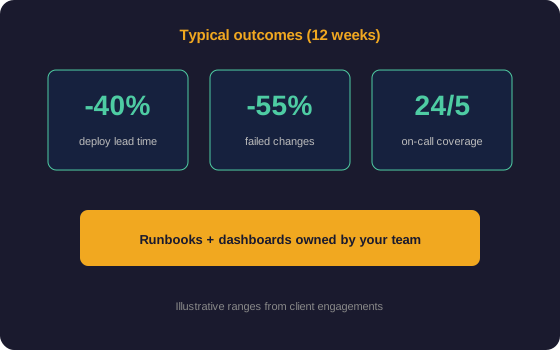
Your constraints will differ—data residency, mainframe handoffs, and vendor-mandated hosting all change the plan. Tell us where releases or incidents hurt today and we will propose a sensible first increment.
Why Choose Us for DevOps Engineering?
Operators who have carried pagers—not slide-deck consultants.
Since 2014, Miami-anchored
Siblings Software has delivered outsourcing engagements for more than a decade. Our Miami office gives US clients a familiar time zone for steering, security reviews, and executive readouts while engineering depth spans the Americas through nearshore development.
Evidence security teams expect
Change records tied to pipelines, least-privilege IAM, secrets out of git, and runbooks next to services. We have supported FedRAMP-style workflows, SOC 2 narratives, and healthcare environments where audit trails are not optional.
Knowledge transfer by default
We pair with your engineers, leave ADRs and modules in your repos, and train on-call rotations on what we built. The goal is a team that can operate without us—not permanent dependency.
Freelancers, in-house hires, agencies—or a focused DevOps partner?
How outsourcing compares to other ways of staffing DevOps
Freelancers can be fast to hire and inexpensive on paper, but continuity is fragile: context walks away when the contract ends, on-call coverage is inconsistent, and regulated clients struggle when one person holds all the Terraform knowledge. In-house hires make sense at scale—a Staff SRE in the US often costs USD 160K–220K fully loaded plus months to recruit—but hurt when you need three specialties tomorrow (pipelines, Kubernetes, observability) and only have one requisition approved.
Large agencies sometimes staff DevOps with generalists rotated across accounts. We stay narrower: senior engineers who join your stand-ups, commit to your repos, and are measured on delivery metrics you already track. If you want a product-shaped internal platform team, that is platform engineering; if you want ML-assisted operations on top of solid baselines, that is AI DevOps.
Risks we see—and how we mitigate them
- Shadow IT pipelines: We consolidate into reviewed workflows with owners named in your org chart, not side repos only contractors know.
- Alert storms: We replace noisy thresholds with SLO-based paging and runbooks tested in tabletop exercises.
- Compliance gaps: Evidence is generated from the same automation that ships code—access reviews, deployment logs, and change tickets linked by design.
- Vendor lock-in: OpenTelemetry and portable IaC modules keep you able to move observability or cloud tooling when economics shift.
Ship more often. Page less often. Sleep occasionally.
What Strong DevOps Engineering Changes for Your Business
Metrics executives and engineering leads both recognize.
When delivery and operations are intentional—not a pile of scripts someone wrote during an outage—you get predictable releases, fewer customer-visible failures, and engineers who spend more time on product work. Common outcomes we target with clients:
Shorter lead time
Automated builds, sane test gates, and environment promotion cut days off merge-to-production timelines—especially when releases were previously calendar events.
Lower incident load
Correlated alerting, runbooks, and blameless postmortems reduce repeat pages and help on-call engineers trust what wakes them up.
Controlled cloud spend
Rightsizing, scheduling non-production environments, and IaC guardrails curb waste without trading away availability during real traffic peaks.
Use cases we handle regularly: greenfield CI/CD for a Series B SaaS, Kubernetes hardening after a security review, observability rebuild after an acquisition doubles the service count, and on-call coaching when a first SRE hire needs a senior partner for ninety days.
Choose us as your
DevOps engineering partner
for US-focused delivery
Industries
Regulated and high-availability environments are where disciplined DevOps pays off.
Since 2014 we have supported teams in sectors where downtime and audit findings have real cost:
FinTech & Banking
Change-controlled pipelines, segregation of duties, and observability that satisfies SOC 2 and partner bank reviews.
Healthcare
HIPAA-aware deployment patterns, encrypted secrets, and disaster recovery tested against realistic failure scenarios.
SaaS & B2B platforms
Multi-tenant scaling, feature-flagged releases, and incident programs that scale with customer growth.
Government & defense contractors
FIPS-aware workflows, regional isolation, and evidence packages aligned to zero-trust expectations.
Media & high-traffic web
Autoscaling for campaign spikes, CDN and origin health checks, and cost controls when traffic is bursty.
Logistics & operations tech
Integrations with legacy systems, reliable batch pipelines, and monitoring for field-facing mobile backends.
Prefer a Latin America delivery lane with the same service shape? Our Argentina mirror at siblingssoftware.com.ar publishes sibling content for customers who want that model; this US site keeps procurement and compliance framing where your stakeholders expect it.
DevOps Engineering Outsourcing
Frequently Asked Questions
It means embedding senior platform and SRE specialists who own CI/CD, infrastructure as code, Kubernetes operations, observability, and incident response—inside your repos, ceremonies, and change controls. You get execution and documentation, not a PDF and a farewell.
Classic DevOps keeps production shipping and running: pipelines, IaC, cluster ops, on-call, and release engineering. Platform engineering builds internal developer platforms and golden paths. AI DevOps adds ML-assisted automation on top. We deliver all three when needed; this page is for reliable delivery first.
Senior staff augmentation is commonly USD 5,500–9,500 per engineer per month. A focused 3–5 person squad lands around USD 22,000–38,000 per month. Broader multi-service programs with compliance and on-call depth often range USD 35,000–52,000 per month. We confirm scope in discovery before you commit.
Pipeline and observability baselines often show measurable gains in four to ten weeks. Multi-region hardening, compliance-ready change records, and mature incident programs typically take three to six months depending on service count and inherited automation debt.
Terraform or OpenTofu, GitHub Actions or GitLab CI, Kubernetes, AWS/GCP/Azure, and OpenTelemetry-friendly observability (Prometheus, Grafana, Datadog, or similar). Practices align with the Google SRE book and your existing standards.
We have delivered software since 2014 with Miami-based coordination for US clients. Our engineers have operated regulated workloads—see our HighSide engagement for DevOps, Python, and compliance-heavy CI/CD—and we document changes security and finance teams can audit.
Related Services
CONTACT US
Last updated: June 2026