Event Streaming Development for US Product Teams
Event streaming development from Siblings Software is for US product and platform teams that need a production topic path: a named owner, an idempotent consumer, a dead-letter route, and a lag page on-call can act on. The buyer is usually a VP of engineering or a platform lead whose services already emit webhooks or cron jobs and now duplicate a payout, a notice, or a ledger write when a consumer restarts. Siblings Software contracts from Miami, with engineers across Latin America working US business hours, and has delivered product engineering since 2018. This page is how you evaluate the work: what it covers, who it fits, delivery phases, team shape, published prices, tradeoffs against hiring in-house, and the risks that show up after the first topic is live.
The diagram is the Stream Side-Effect Review we use in discovery: topic owner, delivery semantic, idempotent handler, poison path, lag budget, and who may reset offsets during US hours. One embedded engineer, when you already own the design, is hire data engineers. Warehouse models stay on that page.
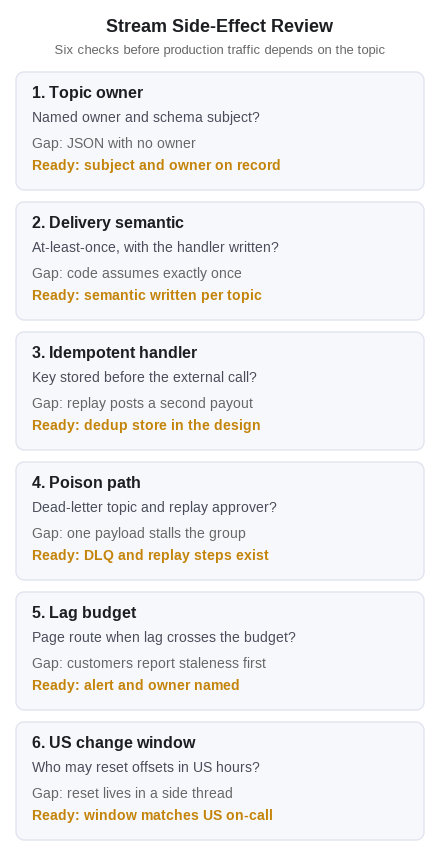
What the Service Covers
A producer writes the business row and an outbox record in one database transaction. The schema subject, Avro or Protobuf, has a compatibility rule in CI. The event lands on a Kafka topic or on Amazon MSK, partitioned so one key stays in order. The consumer commits its offset after the side effect is idempotent. A poison payload goes to a dead-letter topic. Lag past the budget pages a named person. Spans go out through OpenTelemetry.
Synchronous partner calls stay with API development. Service templates, paved roads, and a developer portal stay with platform engineering. Pipelines, cluster operations, and incident mechanics that are not specific to a topic stay with DevOps engineering. Streaming work is the bus itself: contracts, consumers, replay, and lag.
Many US teams already have a cluster and still cannot name who may add a required field. We start from that inventory, in your cloud account, under the review you already use. The parent offer is software outsourcing from our Miami headquarters.
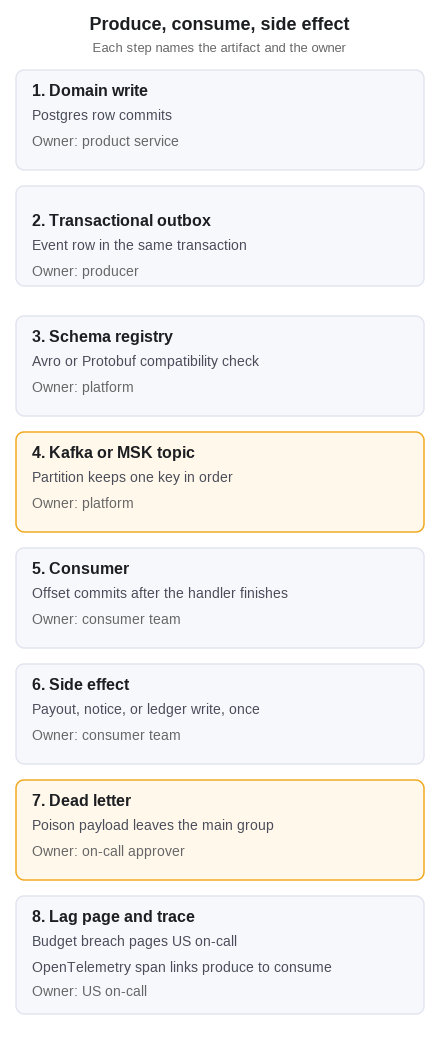
The path above is what a buyer can hold a vendor to. Each step has an artifact and an owner. If a step has no owner, it is still discovery, not a production topic.
Who It Is For
US companies where a real-time side effect has outgrown a webhook or a nightly job, and the platform lead can name the topic but cannot name the person who approves a schema change or an offset reset.
B2B SaaS billing
Usage meters and entitlement changes need to reach billing in the same business hour, with a lag budget finance can cite.
Payments and servicing
Payout status and borrower notices must survive a consumer restart. A second ACH notification becomes a support incident.
Platform groups
You want one producer template and one consumer template: ACLs, a registry check, and a lag page that the next squad inherits.
Typical Project Scenarios
Four situations from US discovery calls. Each can be a first slice inside the project band, or the start of a dedicated team when more domains share the bus.
Put an owner on an MSK cluster that already exists
Product teams create topics from the console. We inventory subjects, write ACLs, attach a schema registry, and leave one critical topic with a lag page before other squads self-serve.
Replace payout webhook retries
Retries send a second borrower email. We model one payout-status event, store an idempotency key before the notification call, and name who may replay the dead-letter topic.
Add schema checks to pull requests
A producer adds a required field and a downstream squad finds out in production. We put a compatibility check in CI, name the version owner, and require a shadow consumer before the field is required.
Give offset resets a US change window
We write the reset procedure, name a primary and a secondary on the US rotation, and rehearse one reset on a copied consumer group before anyone touches production offsets. If the larger job is the paved road, that stays on platform engineering.
How Delivery Works
Discovery takes 3 to 5 days. Team assembly takes 5 to 10 days. First deliverables are aimed at week 3 or 4. A full project sits inside 1 to 6 months. Sprints are two weeks, with a demo your platform lead attends. Work stays in your repositories and your cloud account.
Discovery. List topics, producers, and consumers, and fill the Stream Side-Effect Review. Open checks stay open until an owner signs them.
Access and broker. Networking, ACLs, and encryption use the first change window security can approve. Schema work continues on a staging tenant if peering slips.
Contracts. Avro or Protobuf subjects get owners and a CI compatibility check. A required field needs the downstream owner on the pull request.
Handlers. Outbox or CDC relay, consumer, dedup store, and dead-letter topic ship together, with a US on-call approver named for replay.
Shadow. Replay a copied partition while lag and handler errors stay inside the budget you signed. Paths that move money or inventory include this step.
Handoff. Your engineers add the next topic while we review. Runbooks cover offset reset, schema bump, and a new consumer group. Then we step down to advisory hours or stay as a dedicated development team.
Team Composition
A first path is usually four roles: a streaming lead, a backend engineer on the outbox and the handler, a platform engineer on ACLs and the registry, and observability time while the lag page is wired. Your platform owner approves schema bumps during US hours. The same people can be a project, a dedicated team of 4 to 12, or one embedded engineer. A pair is USD 8,000 to 18,000 a month. Monolith producers are often paired with back-end development.
Siblings Software does not publish a Kafka case study. Adjacent public work is the Sur Technology Holdings payment gateway for US independent sales offices, and the NetApp platform team (eight senior Go engineers on REST, gRPC, workers, and observability). Those engagements are not event streaming projects, and this page does not borrow their figures. The case studies index is the full list.
A project for one topic path. A dedicated team when the bus keeps growing. Staff augmentation when you already have the lead.
Pricing and Engagement Models
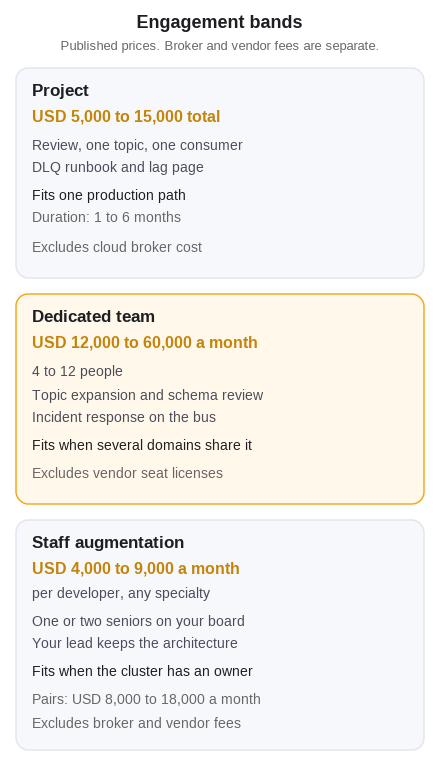
These are the only Siblings Software prices. Broker fees, schema-registry vendor seats, and your observability tools are yours. We confirm the band after the 3 to 5 day discovery.
Project-based
A bounded first slice: the review, one critical topic, schema subject, one consumer, dead-letter runbook, and lag page. USD 5,000 to 15,000 total. Larger programs are later phases inside the same band, or they move to a dedicated team. See project-based outsourcing.
Dedicated team
A standing squad for topic expansion, schema review, and streaming incidents. USD 12,000 to 60,000 a month for 4 to 12 people. Headcount times USD 4,000 to 9,000 stays inside that band.
Staff augmentation
One or two senior engineers on your sprint when the cluster already has an owner. USD 4,000 to 9,000 a month per developer, streaming included. No specialty premium.
Compared With In-House Hiring, Freelancers, and Agencies
Outsource the path when
- You need one governed topic in this quarter, and a US hiring loop for a streaming specialist is longer than the launch.
- Your product engineers know HTTP well and have not operated consumer groups, partition skew, or a safe offset reset.
- Security or enterprise diligence wants named owners for schema changes and replays, written down before the next audit sample.
- Several squads will share the bus, and you want one template before the second cluster appears.
Hire or stay in-house when
- A platform team already carries Kafka or MSK on-call, and the open work is a single consumer.
- Volume is low, ordering does not matter, and a log covers the need.
- A managed event bus already covers the integrations you have.
A freelancer can publish the first producer. Shadow traffic, schema review, and a safe replay usually outlast that engagement. A dedicated squad or an embedded senior stays through the shadow window. Engineers work US hours from Latin America, coordinated from Miami. Overlap with Eastern and Central time is on the nearshore development page. The catalog is all services.
Illustrative Scenario: Lakeshore Settlements
Composite illustrative scenario only. Not a published client case study. No performance metrics are claimed.
The situation
Lakeshore Settlements is a fictional US servicing company for regional lenders. Payout status reaches the borrower portal and a notification service through HTTP callbacks. Retries send a second email. The ledger is Postgres. Two squads write unsigned JSON to the same Amazon MSK topic. The US Central platform lead can list the services and cannot name who approves a required field or a Tuesday offset reset.
What we would deliver
Phase one is a project inside USD 5,000 to 15,000: the review, one payout-status subject, one idempotent notification consumer, a dead-letter topic, a replay runbook with a US Central approver, and a lag page. Miami runs the weekly demo. Engineers pair with the platform lead during US business hours. Later domains would continue as a dedicated team inside USD 12,000 to 60,000 a month. The point is one notice per payout status, and a named person for replay.
Risks and Mitigation
A replay repeats a side effect. The consumer restarts and sends a second payout notice or posts a second ledger line. Mitigation: an idempotency key stored before the external call, and one replay exercised in shadow before production depends on the handler.
A schema change lands on a squad that did not review it. Mitigation: a subject owner, a compatibility rule in CI, and a shadow consumer before a field becomes required.
Lag crosses the launch budget. Mitigation: a page with a named owner, a look at partition skew, and the budget written in the review before the feature flag flips.
One bad payload stalls the group. Mitigation: a dead-letter topic, an alert, and a replay approver on the US rotation. The main group keeps moving.
Network approval slips. MSK peering or a security review can sit in week two. Mitigation: file the network request in discovery, and keep schema and consumer work on a staging tenant until production ACLs exist.
The design leaves with the vendor. Mitigation: paired weeks where your engineers add the next topic under review, runbooks in your repository, and a written owner for offset reset before we drop to advisory hours. Repository access stays on your identity provider, with the same review you use for employees.
Frequently Asked Questions
Topic inventory with owners, cluster setup on Amazon MSK, Confluent Cloud, or self-managed Kafka, schema subjects with compatibility rules, an outbox or CDC producer, an idempotent consumer, a dead-letter topic with a replay runbook, and a lag page with a named on-call route. HTTP APIs are scoped as API development. Warehouse models are scoped with a data engineer.
A first slice is a project at USD 5,000 to 15,000. A dedicated team of 4 to 12 people is USD 12,000 to 60,000 a month. One embedded engineer is USD 4,000 to 9,000 a month. Discovery takes 3 to 5 days. Broker fees and vendor seats are separate.
Use the cluster your security review can already approve. Amazon MSK fits when the producers already share that VPC. Confluent Cloud fits when you want the registry and the brokers operated for you. Self-managed Kafka fits when your team already runs upgrades. The same six checks apply on all three.
Each side effect stores an idempotency key before the external call commits. Restarts and replays check that store. Poison messages go to a dead-letter topic, and a named approver decides on replay. We run one replay in shadow traffic before production depends on the consumer.
Yes. Staff augmentation at USD 4,000 to 9,000 a month fits when your platform lead already owns the architecture. A project or a dedicated team fits when you also want the review, the first path, and the runbooks. Warehouse pipelines are hired through the data engineer page.
Siblings Software contracts from Miami. Engineers across Latin America work US business hours, so standups, pull request review, and incident calls sit in Eastern or Central time with your platform lead. Offset resets and schema promotions that affect production are scheduled inside the change window your US on-call already uses. The Argentina team page describes how US clients work with that office.