Outsource Back-End Development to Senior Engineers
Siblings Software assembles back-end squads that build and operate the APIs, data pipelines, and cloud infrastructure behind your product. We have been doing this since 2014, across industries from logistics and fintech to healthcare and e-commerce. Our engineers work in your time zone, inside your codebase, following your ceremonies.
Most clients come to us in one of three situations: they need to scale a back-end team fast without a six-month hiring cycle, they have a legacy system that keeps breaking during peak traffic, or they are building a new product and lack the in-house expertise to architect it properly. We handle all three. When the legacy system is a monolith that must lose one module at a time, see application modernization services. When you need independently deployable services with event contracts and Kubernetes, see microservices development services.
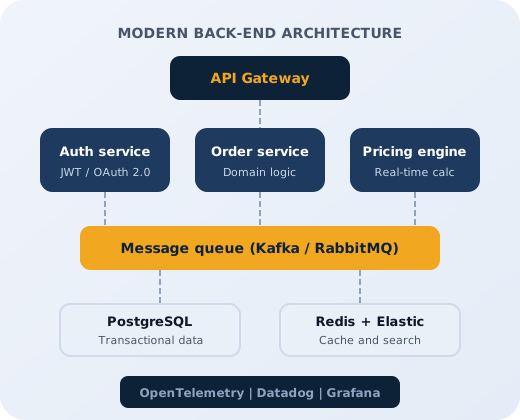
Who typically outsources back-end development
Not every company needs an outsourcing partner for their back-end. But there are specific situations where it makes a lot of sense, and others where it clearly does not. Here is who we usually work with:
Series A-C startups scaling their platform
You raised funding and need to ship fast, but your engineering team is small. Hiring locally takes 3-4 months per senior back-end engineer. An outsourced squad gives you production-ready capacity in two weeks while you continue building your internal team.
Mid-market companies with legacy debt
Your monolith was fine when you had 500 users. Now you have 50,000, and every release is a gamble. You need engineers who have done strangler-fig migrations before and can keep production running while they replace it piece by piece.
Enterprise teams with a skills gap
Your Java back-end needs a Kafka integration, a new GraphQL layer, or a move to Kubernetes. Your current engineers are capable, but they do not have that specific experience. Staff augmentation fills the gap without permanent headcount.
CTOs who need a second opinion on architecture
Sometimes the first step is not code. It is a week-long reliability workshop with someone who has seen dozens of back-end architectures go wrong. We help you figure out what to build before you commit resources to building it.
Back-end services we deliver
Every engagement below can run as a dedicated team, individual staff augmentation, or a scoped project.
API design and microservices
REST, GraphQL, and event-driven services with schema governance, contract tests, and versioning strategies. We have built loyalty APIs serving 20M+ users and pricing engines that recalculate in under 150ms. For latency-critical paths, our Go development and Rust development teams deliver C-level performance with memory safety.
Data platforms and integrations
Streaming pipelines, ETL workflows, and OLTP/OLAP databases tuned for growth. We connect ERPs, CRMs, and third-party feeds with lineage tracking and automated quality checks. Our teams also build the data layer behind RAG systems, including vector database integration, embedding pipelines, and retrieval optimization.
Legacy modernization
Replacing brittle monoliths does not require a big-bang rewrite. We use the strangler-fig pattern: new cloud-native services run behind feature flags while the old system stays operational. Automated contract tests and blue-green deployments make cutovers boring, which is exactly what you want them to be.
Cloud infrastructure and DevOps
Infrastructure-as-code with Terraform, container orchestration on Kubernetes, and CI/CD pipelines that make deploys reversible. We pair this work with our platform engineering team when clients want an Internal Developer Platform with self-service golden paths. For operator-facing admin panels and approval workflows wired to those APIs, see internal tools development.
Observability and reliability engineering
Dashboards, alerts, SLO tracking, and synthetic monitors delivered alongside every feature. We set up OpenTelemetry instrumentation, define error budgets with stakeholders, and run incident simulations so your team is ready when things break at 2 AM.
API-first product development
Building a product where the API is the product? We design developer-facing APIs with clean docs, SDKs, rate limiting, and usage analytics. This is different from internal APIs: the DX has to be good enough that external developers actually adopt it.
How a back-end engagement works
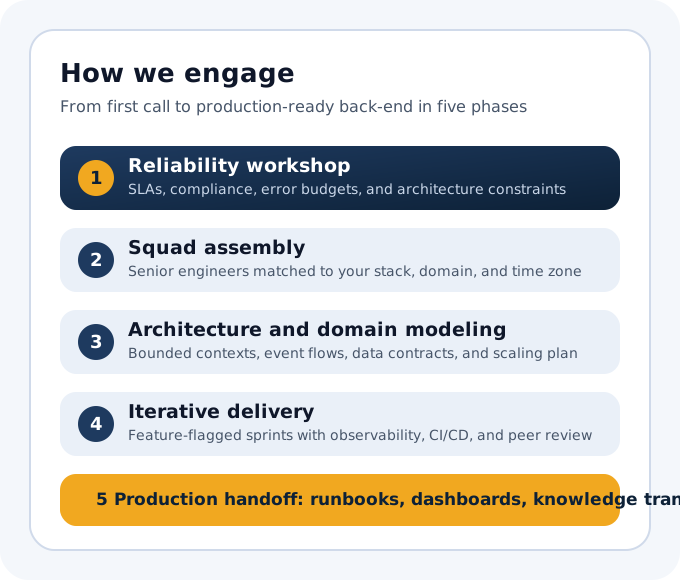
Every engagement follows the same five phases. The length of each phase depends on complexity, but the sequence matters because skipping the reliability workshop always costs more later.
- Reliability workshop (5-7 days). We sit down with your engineering and product leads to document SLAs, SLIs, security constraints, compliance requirements, and the architecture landscape. This is not a formality. It is where we catch 80% of the assumptions that would otherwise derail the project.
- Squad assembly (1-2 weeks). We match senior engineers to your stack, domain, and time zone from our bench. You interview them. If someone is not the right fit, we replace them before the first sprint.
- Architecture and domain modeling. Domain-driven design sessions define bounded contexts, event flows, data contracts, and scaling thresholds. We produce architecture decision records, not slide decks.
- Iterative delivery. Two-week sprints ship observable increments with feature flags, pair programming, and peer reviews. Observability is not bolted on at the end; it ships with every feature.
- Handoff and transition. Runbooks, response playbooks, onboarding guides, and live knowledge transfer sessions. We do not disappear. We stay available for quarterly audits, incident support, or seasonal scaling.
Engagement models and typical pricing
We are not going to pretend that pricing is one-size-fits-all. Rates depend on seniority, stack, and engagement length. But here is the honest range so you can budget before a conversation.
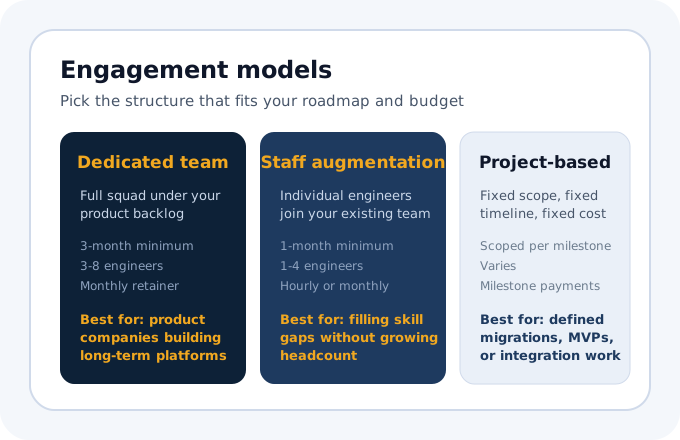
Dedicated team
A squad of 3-8 engineers works under your product backlog on a monthly retainer. Typical rate: $6,500-$9,500/month per engineer depending on seniority. Minimum commitment: 3 months. This is the model most clients choose for ongoing product development. Learn more about dedicated back-end teams.
Staff augmentation
Individual engineers embed in your existing team, join your standups, push to your repos. Billed hourly ($45-$65/hr) or monthly. Minimum: 1 month. Ideal when you need one or two specialists rather than a full squad. See back-end staff augmentation.
Project-based
Fixed scope, fixed timeline, milestone payments. We scope it after the reliability workshop and give you a number before we start coding. Best for defined migrations, MVP builds, or integration projects. How project-based engagements work.
Outsourcing vs. freelancers vs. hiring in-house
This is a comparison we get asked about in almost every sales call. There is no universally correct answer, but after working with hundreds of clients, the patterns are clear.
Freelancers
Good for short, well-defined tasks. The problem with freelancers on back-end work is continuity. Back-end systems are long-lived and interdependent. When a freelancer leaves after three months, the next person inherits undocumented decisions. The hourly rate looks low, but the total cost of ownership rarely is.
Hiring in-house
The right long-term play if you can afford the timeline. A senior back-end engineer in the U.S. runs $160K-$220K/year fully loaded, and the hiring cycle is 3-6 months. For teams that need capacity now, that gap is where outsourcing fits. Many of our clients use us to bridge while they recruit internally.
Outsourcing partner
You get a managed team with institutional knowledge, documented processes, and continuity guarantees. If an engineer leaves, we replace them and handle the transition. The trade-off is cost: it is not the cheapest per-hour option. But for back-end systems where mistakes compound, the reliability premium usually pays for itself.
The honest advice: if you are building a short-lived prototype, use a freelancer. If you are building something that needs to run for years and handle real traffic, either hire in-house or outsource to a partner with retention policies and knowledge management. The middle ground, an offshore body shop, is the option that costs the most in the long run.
Case study: supply chain back-end modernization in 12 weeks
A mid-size U.S. logistics provider came to us with a SOAP-based integration layer built in 2011. The system processed 40,000 orders daily but experienced nightly outages during peak shipping seasons. Their internal team of four Java developers was fully consumed by firefighting and could not allocate time to rewrite the brittle parts.
What we did
We embedded a squad of five engineers (two senior, two mid-level, one SRE) for 12 weeks. The work followed our standard engagement process:
- Week 1: reliability workshop with the client's ops team and warehouse managers to map every integration point, SLA, and failure mode.
- Weeks 2-4: migrated the three most failure-prone SOAP endpoints to event-driven microservices using Spring Boot and Kafka. Feature flags controlled traffic routing so we could roll back instantly.
- Weeks 5-10: built a streaming pipeline that fed order events into a consolidated data warehouse for finance and operations dashboards. Replaced manual CSV reconciliations with automated data quality checks.
- Weeks 11-12: incident simulations with the client's ops team, producing shared runbooks and escalation playbooks. Transferred ownership via pair programming sessions.

Eighteen months later, this system still powers their customer portal, mobile app, and analytics platform. The client's internal team maintains it independently and has extended the architecture to support two new shipping carriers without our involvement. That is what a good handoff looks like.
Explore more client case studies across different industries.
Real-world scenarios where we get brought in
Abstract service descriptions only go so far. Here are five actual situations (anonymized) where clients engaged our back-end teams:
Fintech payment processor. Needed to migrate from a monolithic Ruby on Rails back-end to Node.js microservices handling 12,000 transactions per minute. We ran both systems in parallel for 6 weeks before cutting over.
Healthcare SaaS platform. Required HIPAA-compliant API development for patient data exchange between EMR systems. We implemented field-level encryption, audit logging, and consent management.
E-commerce marketplace. Their Python-based recommendation engine was returning results in 4 seconds. We rebuilt the query layer with Redis caching and Elasticsearch, bringing response time to 280ms.
Logistics company expanding internationally. Needed multi-tenant back-end architecture to onboard partners in three new countries with different tax rules, currencies, and data residency requirements.
Series B startup launching an API product. Had a working internal API but needed to make it developer-facing with docs, SDKs, rate limiting, and usage analytics before opening to paying customers.
Technology stack
We pick the right tools for each project. Here is what our teams use most frequently.
Languages and frameworks
Java with Spring Boot, Node.js with NestJS and Express, .NET 8, Python with FastAPI and Django, Go for concurrent systems, Rust for performance-critical paths, and Kotlin for modern JVM workloads.
Databases and data infrastructure
PostgreSQL, MySQL, MongoDB, Redis, Elasticsearch, Kafka, and cloud data warehouses (Snowflake, BigQuery). We select based on query patterns and scaling requirements, not trend.
Cloud and observability
AWS, Azure, and GCP. Kubernetes platforms certified by the Cloud Native Computing Foundation. Infrastructure managed with Terraform. Observability through OpenTelemetry, Datadog, and Grafana. SOC 2-ready access controls and secrets management.
Building something that spans the full stack? Our front-end development team syncs sprint ceremonies with back-end squads so API contracts and UX evolve together. For organizations that need both, full-stack outsourcing keeps everything under one roof.
Risks of outsourcing back-end work and how we handle them
We would rather be transparent about the risks than pretend they do not exist. Back-end outsourcing can go wrong. Here is what we see go wrong most often, and what we do about it.
Knowledge loss when engineers rotate
This is the number one risk. We mitigate it with architecture decision records, pair programming rotations, and a minimum 3-week overlap during any engineer transition. Every significant decision is documented in the repo, not in someone's head.
Security and IP concerns
Engineers sign NDAs before accessing your codebase. We work within your VPN or zero-trust setup. Code lives in your repositories. We do not retain copies. For regulated industries, we provide SOC 2 and HIPAA documentation as part of the engagement.
Communication gaps across time zones
Our engineers work from Latin America, which means 1-3 hours offset from U.S. Eastern. That is not the same as a 12-hour gap. We overlap 6+ hours with most U.S. teams, attend all standups and retros live, and respond to production incidents within 15 minutes during business hours.
Quality declining over time
This usually happens when there is no feedback loop. We avoid it with mandatory code reviews (no self-merges), automated test coverage thresholds, and monthly architecture reviews with your tech lead. If quality slips, you will see it in the metrics before it hits production.
What clients usually get wrong about outsourcing back-end work
After a decade of doing this, we have seen the same mistakes enough times to warn you in advance.
- Treating outsourced engineers as disposable. If you do not invest in onboarding them properly, they will produce generic code. The best results come from treating the external team as an extension of your own.
- Skipping the architecture phase. Starting to code on day one feels productive. Three months later, you are refactoring everything because nobody agreed on bounded contexts or data ownership.
- Optimizing for hourly rate instead of total cost. A $30/hr developer who takes twice as long and produces code that needs rework is more expensive than a $55/hr developer who gets it right. This is especially true on back-end systems where bad architecture decisions compound.
- Not planning the handoff from day one. If the documentation and knowledge transfer only happen in the last two weeks, it is already too late. We bake handoff artifacts into every sprint.
Frequently asked questions
If you are interested in hiring developers for this capability in Argentina, visit the Argentina version of this page.