A software outsourcing company built around how you actually want to engage
Siblings Software is a Miami-based software outsourcing company that has been assembling and running engineering programs since 2014. Across 250+ engagements we have refined three ways to work with us — project-based, a dedicated team, or staff augmentation — and the most useful thing this hub can do is help you pick which one fits your roadmap before the first sales call.
Engineers sit across Latin America in client time zones. You interview every developer, join every standup you want to, and own the code in your own repositories from the first commit. HQ at 1110 Brickell Ave, founded by Javier Uanini. Technology-specific pages — web, app, API, AI, the rest in the all-services index — cover per-stack detail. This page covers the engagement-shape decision.
What software outsourcing means at Siblings Software
The Gartner IT outsourcing glossary defines the category broadly. In practice the variable that matters is how much control you keep and whether the people doing the work feel like part of your team or a black box.
At Siblings Software, outsourcing means a team of engineers — tech lead, two to ten developers, QA automation, sometimes a designer or DevOps specialist — working on your roadmap, in your tooling, on your schedule. Not a body shop shipping endpoints; not an offshore vendor filtering requirements through a PM who rewrites them. The team is yours; we handle recruiting, retention, payroll, replacement. Outsourcing is not staff augmentation (one of the three models below) and not a fixed-bid agency optimising for the contract instead of the program.
Who hires a software outsourcing company
About 40% of the book is venture-backed startups; the rest is mid-market and enterprise. Across 250+ engagements since 2014, four buyer shapes account for almost everything we see.
Funded founders racing an investor calendar
Seed or Series A is closed; investors have a milestone in their head; the founding team does not include enough engineers and US recruiting cycles do not fit. Three to five engineers in two weeks instead of three months — usually a small dedicated development team.
Mid-market product orgs hitting a hiring ceiling
The roadmap has more in it than the team can ship. Hiring senior US engineers takes 60–90 days per seat at $180k–$220k fully loaded. Outsourcing adds capacity in weeks and scales back when the crunch passes — without approving five new headcount lines this quarter.
Enterprises modernising a legacy stack
The monolith still pays the bills, every feature takes twice as long, and the people who understand the legacy do not want another year inside it. An outsourced team owns the modernisation track — strangler-fig extractions, API stand-ups, infrastructure upgrades — while senior staff stays on the revenue roadmap.
Engineering leaders who need specific seats
Two senior React Native engineers for six months. A Rust specialist for a performance-critical module. A DevOps/SRE lead to harden CI/CD before SOC 2. Classic staff augmentation — plug a known gap, not commission a whole pod.
Three engagement models, one honest conversation
Every engagement starts with a 30-minute call that ends in a recommendation. Sometimes that recommendation is “hire two senior engineers in your home market and call us when the roadmap doubles.” The three models below cover the rest.
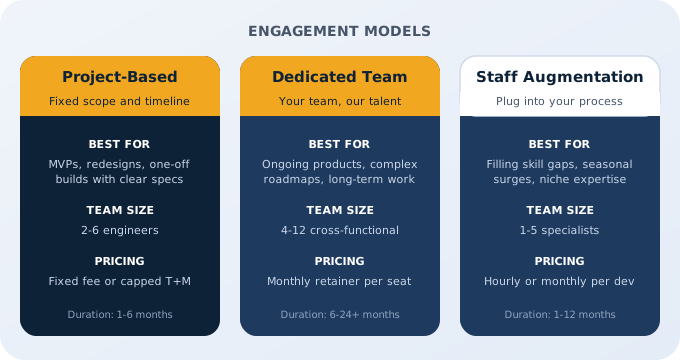
Project-based outsourcing
Fixed scope, agreed timeline, defined deliverables. We own architecture, build, QA, and deployment; you review progress in biweekly demos. Fits MVPs, redesigns, integrations, standalone tools. We will refuse fixed-bid when requirements are still being discovered.
Budget: $15k–$120k · Team: 2–6 engineers · Duration: 1–6 months
Choose this when: scope is clear and you want a predictable handoff date.
Dedicated development teams
Your team, our recruiting and operational layer. A cross-functional pod — tech lead, engineers by stack, QA automation, supporting seats — on your roadmap for as long as you need them. You set priorities and run rituals; we run the people side. Most long-term Siblings relationships live here.
Budget: $12k–$60k/month · Team: 4–12 people · Duration: 6–24+ months
Choose this when: the roadmap is open-ended and needs cross-functional capacity.
Staff augmentation
Individual engineers embedded in your existing team. They join your standups, code reviews, and on-call rotation; we handle payroll, benefits, equipment, and replacement. Right model when your org has the shape and just needs two or three seats — not a whole pod.
Budget: $4k–$9k/mo per dev · Team: 1–5 specialists · Duration: 1–12 months
Choose this when: the gap is a known seat, not a missing program.
Every seat carries a 2-week satisfaction guarantee and 30-day scale-down notice. No multi-year minimums.
How an engagement runs end-to-end
Pattern from 250+ engagements: rushing discovery to start coding a week earlier almost always costs more later. Calendar times below are from a signed MSA.
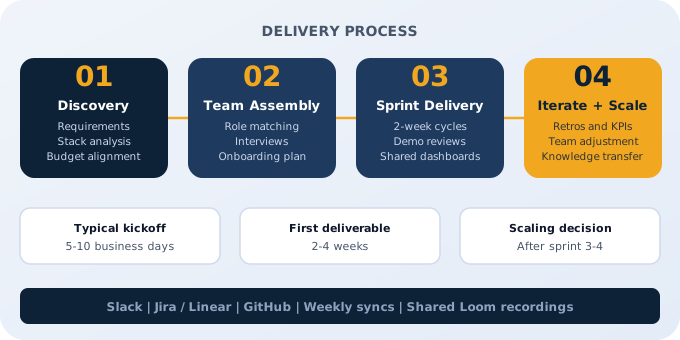
1. Discovery — 3–5 days
Map requirements, review the existing codebase, name the right stack, agree on the engagement model. You leave with a written proposal: roles, timeline, pricing, replacement policy, and the explicit list of things we are not doing.
2. Team assembly — 5–10 days
Two or three shortlisted candidates per role from the internal bench. You run the technical interview. Contracts, equipment, repo access, and SSO provisioning land before sprint zero.
3. Sprint delivery — week 3 onwards
First deliverables ship by week 3 or 4. Two-week cadence with a sprint goal, a demo, a retro, and a shared velocity dashboard. Most clients join two or three standups a week and own sprint planning.
4. Iterate and scale
After sprint three or four we revisit whether the team shape still fits. Add a DevOps engineer, swap a backend developer for a data engineer, reduce headcount post-launch — short addendum, not a new MSA.
Tooling stays yours: Slack or Teams, Jira or Linear, GitHub or GitLab, ADRs in the repo, weekly Loom-recorded design reviews.
Outsourcing as a relationship vs. the alternatives
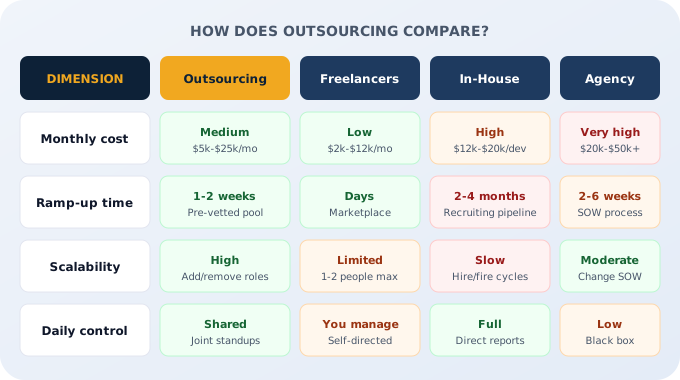
There is no universally correct answer to “in-house, freelance, agency, or outsource?” Each model wins in some situations and fails in others. Relationship style does more of the work than geography.
Where outsourcing as a relationship wins
A team of three or more, US-business-hour overlap, long-term maintainability, no time for a 60–90 day domestic recruiting cycle. Outsourcing buys managed delivery without consultancy markup, replacement guarantees freelancers do not offer, and a relationship that compounds over years. The Atlassian distributed-team playbook covers the mechanics; relationship style is what we add on top.
Where we will tell you to do something else
When work depends on deep domain knowledge that only lives inside your organisation — proprietary trading models, regulated medical devices, underwriting logic that moves a P&L — outsourcing the core is risky. Surrounding infrastructure, QA, or platform work still works. We would not recommend fixed-bid when requirements still change between meetings — use a small dedicated team. The Stack Overflow Developer Survey shows distributed engineering is mainstream; the new appetite is for vendors who behave like co-workers.
Where outsourcing programs fail — and how we prevent it
Outsourcing does not always work. Four failure modes account for almost every engagement we have seen go sideways — including some of our own early ones.
Misaligned expectations
Client expected a polished product; vendor shipped a prototype. The fix is a paid discovery sprint with a written scope document and an explicit list of things we will not do without a separate conversation.
Communication breakdown
Eight-hour gaps, a single point of contact filtering everything. Engineers across Latin America keep the gap to zero to two hours, work in English, and talk to your team directly — not through a PM who rewrites requirements.
Developer turnover
A tech lead leaves after three months and nobody wrote anything down. We refuse to staff a program without ADRs in the repo, a runbook for the top three alerts, and a pair on every critical surface — bus factor is never one.
Hidden costs and scope creep
Initial estimate $40k, final invoice $85k. We work in fixed-price contracts or monthly retainers with transparent time tracking on a shared dashboard. Scope changes are flagged before work starts on the new ask, not at the end of the sprint.
Programs we have actually shipped
Three engagements mapped onto the three models. Numbers below are the ones our clients let us publish; everything is verifiable on the linked case-study page or in the case studies hub.
Dedicated team · product build
Bari — B2B wholesale platform
A 6-person dedicated team (.NET Core API, React frontend, GraphQL) shipped a wholesale-ordering portal end-to-end for an Argentinian B2B distributor.
- 12 distributors and 230 retailers live
- 80,000 wholesale orders, 2,400M AR$ processed
- Released in 6 months
Project & small team · smart cities
BinSensors — smart-cities IoT
A 3-person team built the REST API backend and Azure cloud-native services behind a waste-collection platform routing municipal trucks against real-time fill-level data.
- 50,000 fuel gallons saved last year
- 25,000 driving hours saved
- Multi-municipality Azure deployment
Staff augmentation · platform
NetApp — platform engineering
Eight senior Go developers augmenting NetApp’s platform-engineering org — REST and gRPC services, workers, and the observability layer behind hybrid data-infra SLOs.
- 8 senior Go engineers placed
- REST + gRPC service surface ownership
- Long-running enterprise engagement
NetApp platform-engineering team →
Need a full IDP program rather than embedded seats? See platform engineering services.
Different industries, different stacks, different engagement shapes. Browse the rest in the case studies archive.
What we build — the short tour
Six service families cover ~90% of engagements. Each link opens the dedicated page with stack-specific decision frames, team shapes, and case studies.
Shopify Plus, Adobe Commerce, BigCommerce, headless commerce on Next.js. Peak-season runbooks included — plus agentic commerce work for AI shopping agents.
For narrower stacks — Python, Go, Rust, .NET, Rails, React, Next.js, TypeScript, Swift, Kotlin, Flutter — see the all-services index.
Industries where we have shipped
Industry experience matters less for greenfield work and a great deal in regulated or operational corners where domain mistakes cost real money. The bench has shipped enough in the verticals below to skip the explainer phase.
Where we are deliberately careful: regulated medical devices, critical-infrastructure SCADA, anything tied to a real-time trading P&L. We can run surrounding work, but the core domain logic belongs on a team you can sit next to in person.
What clients usually get wrong when outsourcing
After ten years and hundreds of programs the same handful of mistakes recur. None are technical — they all happen before code is written.
Picking on hourly rate alone
A $25/hour developer who needs four times the supervision and ships code that gets rewritten is more expensive than a $55/hour developer who lands production-ready work. We have inherited too many projects with 30–40% of the budget burned fixing preventable bugs. Compare total cost of delivery, not the hourly label.
Skipping discovery
Founders sometimes push to start coding on day one. Discovery is where requirement gaps surface as questions instead of mid-sprint scope changes that cost 5–10x to absorb. We would not recommend skipping it on anything more complex than a single-screen prototype.
Treating the vendor as a ticket queue
The best outsourcing relationships work when the external team operates like insiders — shared Slack, joint sprint planning, the same roadmap, honest feedback both ways. Treat the pod as a ticket queue and you get ticket-queue results on every dimension that matters.
Frequently asked questions
Hub-level questions. Per-stack questions live on each child page.
Who you are talking to
Siblings Software has been running outsourcing programs since 2014, HQ at 1110 Brickell Ave in Miami with engineers across Latin America. Founded by Javier Uanini; 250+ engagements across healthcare, eCommerce, payments, smart cities, and the verticals above. Longer story on the about us page.
Looking for engineers in your hemisphere specifically? Our nearshore software development practice places senior engineers in same-day-overlap time zones at 40–60% of fully-loaded domestic cost. For buyer-relative offshore programs, see offshore software development.
Start a Conversation
Tell us what you are building and we will tell you honestly whether outsourcing is the right move.