Hire data engineers for embedded staff augmentation
· Typical time to first merged pipeline: 12–15 business days
Hire data engineers through Siblings Software when product teams wait on reliable tables while ingestion still lives in one-off scripts. This page explains what embedded data engineers do in client squads, when staff augmentation beats a warehouse migration project, how we vet candidates on pipeline and quality problems, monthly pricing bands, risks, and when a small data platform pod makes more sense than a solo hire.
Buyers searching for hire data engineers usually need three answers on one screen: who can own warehouse pipelines and dbt models in your repositories, what it costs per month in plain numbers, and how you avoid the contractor who ships a demo mart and disappears before freshness SLAs exist. We staff data engineers from Latin America as full-time employees who overlap US Eastern business hours and join your ceremonies from planning through pipeline review.
Enterprise data hiring in 2026 is bottlenecked on pipeline reliability, not SQL literacy. Buyers evaluating nearshore partners now ask what ingestion SLAs and data quality gates look like before they discuss rate cards, because the productivity gap between teams with tested marts and orchestration versus teams still exporting CSVs is wide enough to affect quarterly planning. For model serving and drift monitoring, see embedded MLOps engineers; for application backends, explore Python developer staff augmentation; for timezone context, read nearshore developer hiring.
If retrieval workflows depend on clean warehouse tables, compare RAG development outsourcing and how ingestion feeds embedding pipelines. When you need Siblings to own a full warehouse build rather than individuals in your standups, review Python development outsourcing or platform engineering services from the same leadership group.
"The expensive data hire is not the one who writes fast SQL. It is the one who merges a mart your finance team trusts on day one and nobody documents how to backfill it."
Reviewed by Javier Uanini, Founder and CEO, Siblings Software. Last reviewed 25 June 2026.
Prefer numbers before a call? Jump to monthly pricing bands for solo engineers, pairs, and data platform pods.
What data engineers do in your squad week to week
Warehouse ownership between the landing zone and the dashboard.
A strong data engineer on staff augmentation joins planning with your data or platform lead, owns ingestion and transformation pipelines in your repositories, and documents contracts before analysts publish new metrics. Day to day that means incremental loads, dbt tests that fail before executives see wrong numbers, orchestration fixes when a partition goes empty, and spend reviews when warehouse queries scan raw history.
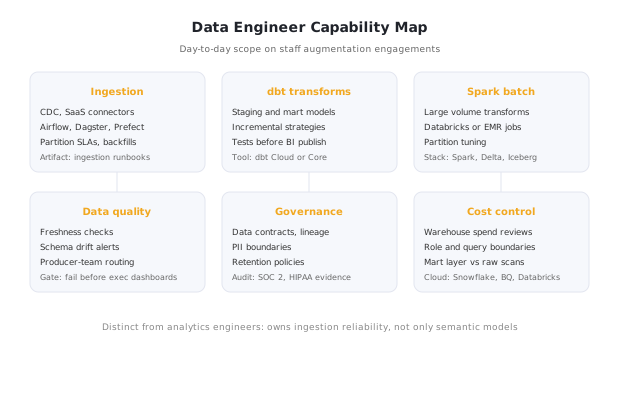
This role differs from a generic Python developer because judgment spans ingestion SLAs, schema evolution, and warehouse cost at once. It differs from an analytics engineer because success is measured by pipeline freshness and test failure rates, not only semantic layer polish. It differs from a MLOps engineer because the deliverable is trusted tables and orchestration, not model serving endpoints alone.
When companies hire data engineers
Five situations cover most discovery calls. Yours may combine two.
Product metrics blocked on messy source tables
Analysts can write SQL, but nobody owns ingestion SLAs, slowly changing dimensions, or the nightly job that failed quietly last Tuesday. Staff augmentation bridges while you close an in-house platform hire.
CTO inheriting spreadsheet-driven data debt
Post-acquisition or post-departure, you need a calm audit: which pipelines are load-bearing, where PII boundaries are unclear, which metrics disagree between finance and product.
AI features shipping faster than warehouse refresh cadence
RAG prototypes need chunked documents and metadata on a known schedule, but research moved faster than ingestion. You need someone who hardens embedding pipelines without blocking every experiment.
Regulated reporting windows approaching
Financial, health, or insurance audit seasons. You need lineage, access logs, tested backfills, and documented retention, not a slide deck about data maturity.
Data lead without pipeline bandwidth
A head of data owns strategy and BI partnerships but cannot also refactor twelve Airflow DAGs while running hiring loops. Staff augmentation adds execution capacity without reorganizing the department chart.
The Data Pipeline Reliability Test
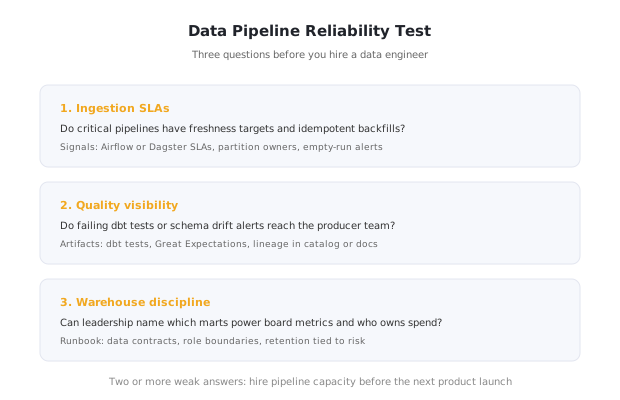
Before we recommend a hire shape, we run three questions we call the Data Pipeline Reliability Test. If two or more answers are weak, you need data engineering capacity before the next product launch depends on new metrics.
- Ingestion SLAs: Do critical pipelines have freshness targets and idempotent backfills? Airflow, Dagster, or Prefect schedules should page the right owner when a partition is empty.
- Quality visibility: Do failing dbt tests or schema drift alerts reach the producer team before leadership sees wrong numbers? Freshness checks tied to producer ownership beat vanity dashboards.
- Warehouse discipline: Can you name which marts power board metrics and who owns spend? Role boundaries and retention policies should match real risk, not default cloud admin access.
We use the same test in vetting. Candidates who only describe tutorial warehouse examples rarely survive the live exercise where we ask them to fix a failing test on a slowly changing dimension under time pressure.
How Siblings vets data engineering candidates
Resume keywords are cheap. We screen for signals that predict whether your warehouse ships trusted tables in quarter one, not quarter three.
- Pipeline authorship: Can they show dbt models or orchestration code others actually depend on, with tests and backfill runbooks? Tutorial repos alone do not count.
- Incremental load design: Experience with slowly changing dimensions, late-arriving facts, and clear replay rules when upstream sends duplicates.
- Quality wiring: Alerts that route to producer teams, not a generic data channel nobody owns.
- Warehouse fluency: Hands-on work on Snowflake, BigQuery, or Databricks matched to your brief, not a stack they used three years ago.
- Communication: Data contract notes, pipeline READMEs, and incident write-ups that finance and product can read.
- Red flags: Only dashboard screenshots, no orchestration story, inability to explain backfill strategy, or treating every problem as "just add another materialized view."
Roughly three in ten applicants pass all gates. Profiles with regulated-industry warehouse experience (payments, healthcare, insurance) take a few extra days to source because the qualified pool is thinner.
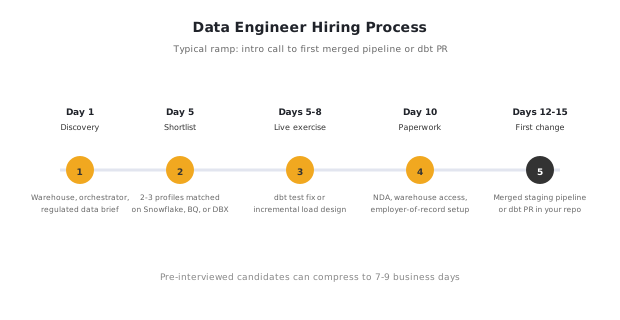
Typical ramp from discovery call to first merged staging pipeline or dbt pull request.
Engagement models and pricing context
Data engineering staff augmentation pricing depends on seniority, warehouse stack depth, source count, and whether the engineer also owns semantic layer work. These bands reflect nearshore LATAM delivery on full-time monthly engagements:
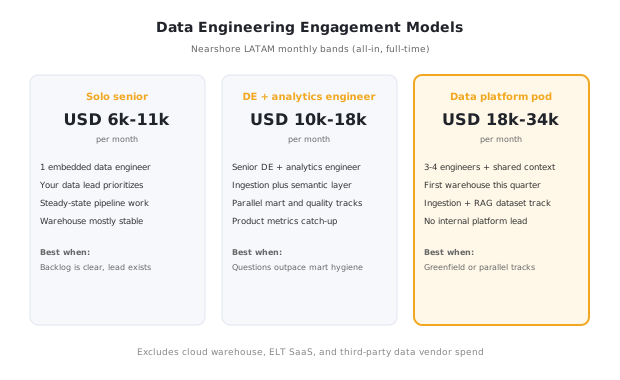
Single senior data engineer
Best when you have a data lead who can prioritize the backlog and the warehouse mostly works. One engineer, your ceremonies, your repositories.
Typical band: USD 6,000–11,000/month.
Data engineer plus analytics engineer
Ingestion and semantic layers both lag behind product questions. Common when mart hygiene and quality gates need parallel attention.
Typical band: USD 10,000–18,000/month.
Data platform pod
When you need a first warehouse stood up this quarter, parallel ingestion and RAG dataset tracks, or lack internal platform leadership. Compare with platform engineering outsourcing when you want Siblings to own delivery end to end.
Typical band: USD 18,000–34,000/month.
Figures align with our published staff augmentation data platform brackets. Your cloud warehouse, ELT SaaS, and third-party data vendor spend stay on your billing.
Compared to freelancers, in-house hiring, and data consultancies
vs. freelance marketplaces
Marketplaces optimize for profile volume. We trade listing speed for engineers who already passed a live pipeline exercise and can join your Slack with a fifteen-day notice window after the minimum term.
vs. in-house FTE
Full-time data platform hires make sense when warehouse ownership is a multi-year commitment. Augmentation fits headcount freezes, bridge roles while recruiting closes, or specialty spikes before audit season. Senior data roles often sit open for months in US markets.
vs. data consultancies
Project firms deliver a warehouse deck and leave. Embedded data engineers work in your repositories, your orchestrator, and your approval workflow. If you want Siblings to own outcomes, that is a different conversation on our Python outsourcing pages.
Example engagement: subscription analytics platform
Illustrative scenario based on a composite US healthcare subscription analytics engagement. Numbers are representative, not a published client case study.
Meridian Health Analytics (composite) operates a B2B subscription reporting product for regional clinic groups. Their data team ran Snowflake with ad hoc SQL scripts: no dbt project, inconsistent freshness checks, and finance metrics that disagreed with product dashboards during monthly close.
Siblings placed one senior data engineer and one analytics engineer through staff augmentation in fourteen business days. Over ten sprints they stood up a dbt project with staging and mart layers, wired Airflow DAGs for EHR and billing extracts, added freshness tests that routed failures to source-system owners, and documented PII boundaries for HIPAA review. Illustrative outcomes: finance and product agreed on active subscriber counts within one definition, nightly pipeline failures surfaced in Slack before executives opened dashboards, warehouse spend per core mart dropped after role boundaries tightened, and the internal AI team could point retrieval experiments at tables with a documented refresh cadence.
For a published reference with observability-heavy platform engineering, see the NetApp platform engineering case study (eight senior Go engineers on hybrid data-infrastructure SLOs).
What changed for data platform teams in 2025–2026
Lakehouse and open table formats pushed more teams to evaluate Delta, Iceberg, and Hudi alongside classic warehouses. Data engineers now document compatibility paths when procurement asks about vendor lock-in.
RAG and embedding pipelines added warehouse tables that product and AI teams share. Ingestion cadence, metadata schemas, and PII exclusion rules became part of every data engineering brief, not only ML platform work.
Cost governance returned to executive attention as warehouse bills grew with AI experimentation. Role boundaries, mart layers, and query routing reviews are baseline expectations, not optional FinOps projects.
dbt as contract layer expanded beyond analytics teams into finance and operations metrics. We follow dbt testing conventions in vetting regardless of which orchestrator sits upstream.
Risks and how we reduce them
- Pipeline reliability risk: Week one includes pairing on a read-only staging run so orchestration access and backfill rules are verified before production changes.
- Quality risk: dbt or equivalent tests merge before dashboards publish new metrics tied to executive reporting.
- Access risk: Least-privilege warehouse roles, NDAs before production data access, and no shared service accounts without your security sign-off.
- Communication risk: LATAM overlap with Eastern through Pacific is real time in Slack. EU-hours coverage is staffed explicitly when you ask in the brief.
- Continuity risk: Pipeline runbooks, data contract ADRs, and backfill commands live in your wiki or repo, not a vendor portal.
- Cost risk: We flag runaway scan patterns in review early. Warehouses should not ship with every analyst querying raw event history because nobody owned the mart layer.
OUR STANDARDS
What "done" means when you hire data engineers through Siblings.
- Pipelines have SLAs: Freshness targets, idempotent backfills, and named owners when a partition is empty.
- Transformations are testable: Quality checks fail before leadership sees wrong numbers.
- Contracts are documented: Producer and consumer teams agree on schemas, retention, and escalation paths.
- Honest scope advice: If a warehouse rip-and-replace will cost more than incremental hardening, we say so before the sprint starts.
Frequently asked questions
Buyer objections we answer on discovery calls when teams evaluate data engineering staff augmentation.
Hiring from Argentina? See the Argentina mirror of this page (separate site, same engagement model).
CONTACT US
Tell us about your warehouse stack, source count, and data quality risks. We will shortlist accordingly.