Hire an API development team that owns the contract, the gateway, and the developer experience
If you are searching for an API development team to hire, you are usually past the point where one more freelancer fixes the problem. The OpenAPI spec is out of date with the code. The gateway rate limits fire inconsistently across regions. Webhooks drop silently when the partner pool grows. A roadmap-critical v2 keeps slipping because nobody owns the deprecation calendar. The unit you actually need is a pod that owns the contract, the versioning policy, the gateway, and the developer portal — in that order — before it owns the next endpoint.
Siblings Software has been staffing API pods for US, Canadian, and European product organizations since 2014. Every team we send out the door arrives with an API tech lead who can read your spec on day one, two senior backend engineers who have shipped public APIs before, a partner integration engineer who has lived through three OAuth2 rollouts, a developer-experience and docs engineer who treats the portal as a product, and a QA automation engineer running contract tests inside the sprint. If your existing squad just needs a few more hands, our API developer staff augmentation model places vetted seniors in under two weeks.
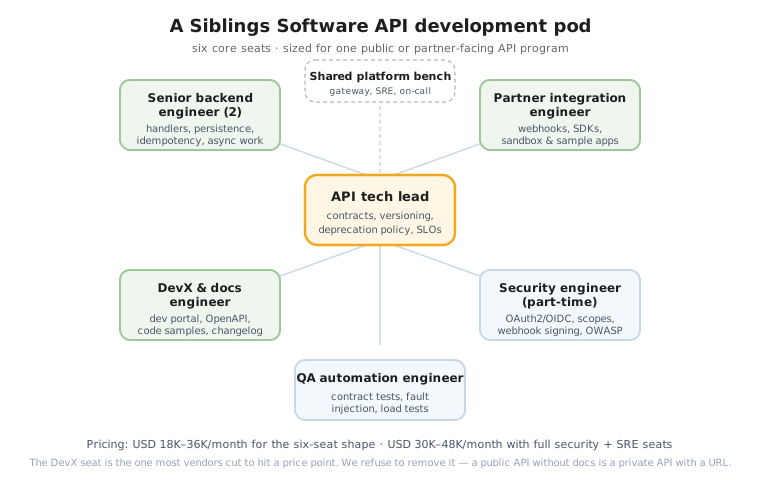
What an API development team actually owns
An API development team is not the same engagement as a stack-specific squad (a Node team, a Python team, a Go team) and it is not the broader back-end development team. The first is "we are hiring engineers who write this language". The second is "we are hiring engineers who own everything the customer never sees". An API pod is narrower and more opinionated: "we are hiring engineers who own the contract between systems, the discipline that keeps partners from breaking, and the developer experience that makes integration time predictable".
In practice, that ownership covers seven artefacts. The service contract — OpenAPI 3.1, gRPC proto, GraphQL SDL, or AsyncAPI 3 — with versioning rules and a deprecation policy that lives outside Slack. The gateway configuration — rate limits per partner, quotas, request shaping, canary fan-out, and the WAF rules nobody else feels like writing. The authentication and authorization layer — OAuth2 client credentials with scopes, OIDC for human-driven flows, mTLS for partner-perimeter calls, and a tenant-isolation story that survives an audit. The webhook program — signed payloads, retry policy, dead-letter queue, replay tooling, and AsyncAPI specs that partners can subscribe to from their side. The developer portal — auto-generated SDKs, runnable code samples, sandbox credentials, the changelog, and the deprecation calendar. The contract-testing harness that gates every pull request. And the operational SLOs the partner contracts say you owe.
Most outsourcing engagements buy you the first one and call it an API team. The bill arrives, the endpoints ship, the spec drifts, and nine months later three partners are paying for a v1 that breaks every release because nobody owns the deprecation calendar and nobody wrote a contract test. We treat the seven artefacts above as load-bearing. If you do not see them produced inside the first three sprints, the team is shipping endpoints, not an API program.
For the standards we treat as load-bearing on every engagement: the OpenAPI Initiative describes the spec format every partner integration tool already speaks; RFC 9110 is the HTTP contract every REST endpoint is judged against; the OWASP API Security Top 10 is the security baseline every endpoint passes before it ships.
Who is on a Siblings Software API pod
Composition is opinionated. The numbers below come from running API engagements across payments, healthcare integrations, hospitality, logistics, and B2B SaaS. Smaller pods leave the developer-experience and security seats unstaffed, which is where partner-onboarding time quietly doubles. Larger pods break the code-review SLA on the spec itself, which is where versioning drift starts.
Focused API pod (5–6 people)
An API tech lead, two senior backend engineers, a part-time DevX engineer, a part-time security engineer, and a shared QA automation engineer. Best when one product surface or one partner program is the bottleneck and the rest of your platform is already healthy.
Public-API and partner-program pod (7–8 people)
A tech lead, two senior backend and one mid-level engineer, a full-time partner integration engineer, a full-time DevX engineer, a part-time security engineer, and a QA automation engineer. The default shape when the API has paying partners, an SLO that lives in contracts, and a portal a sales team demos.
Multi-API platform engagement (9–12 people)
Two product pods plus a shared platform team running Kanban on the gateway, the dev portal, and shared libraries. Used when the company runs three or more partner-facing APIs, mixes REST with gRPC or GraphQL, and needs a single versioning policy across surfaces.
The roles below are the ones vendors cut first to hit a price point and the ones we refuse to remove. A pod without them is not an API pod; it is a pile of engineers writing endpoints in someone else's framework.
DevX and docs engineer
Owns the developer portal, the auto-generated SDKs, the runnable code samples for the top three partner languages, the changelog, and the deprecation calendar. Treats the portal as a product, not a wiki page. Without this seat, partner onboarding time is whatever your support team has the patience for.
Partner integration engineer
Lives in the integration layer where your customers' code touches yours. Writes the signed-webhook reference implementation, the OAuth2 onboarding flow, the SDK fixtures, and the sandbox data. Pairs with sales engineering during partner onboarding so a botched integration is caught in week one, not in production.
Security engineer (part-time, full-time when scope demands)
OAuth2 + OIDC scopes, mTLS at the perimeter, webhook signature verification, JWT validation, secrets rotation, and the OWASP API Top 10 checklist for every PR that opens a public surface. Without this seat, security ends up as somebody's quarterly initiative; with it, security is a Definition-of-Done line.
API tech lead
Owns the spec, the versioning policy, the deprecation calendar, the SLOs we sign with partners, and the hard veto on shipping endpoints that contradict the spec. Writes the one-page contract decision records. The lead is the person you call when a partner says "your API broke us" at 11pm on a Friday.
If your backlog leans on a specific stack, we blend specialists from our Node.js development team, Go development team, or Python development team bench into the pod, so framework decisions are made by people who have lived with the consequences. The shared platform bench — gateway specialists, SREs, and a fractional security architect — sits behind every dedicated development team we field.
Picking the protocol — an opinionated map
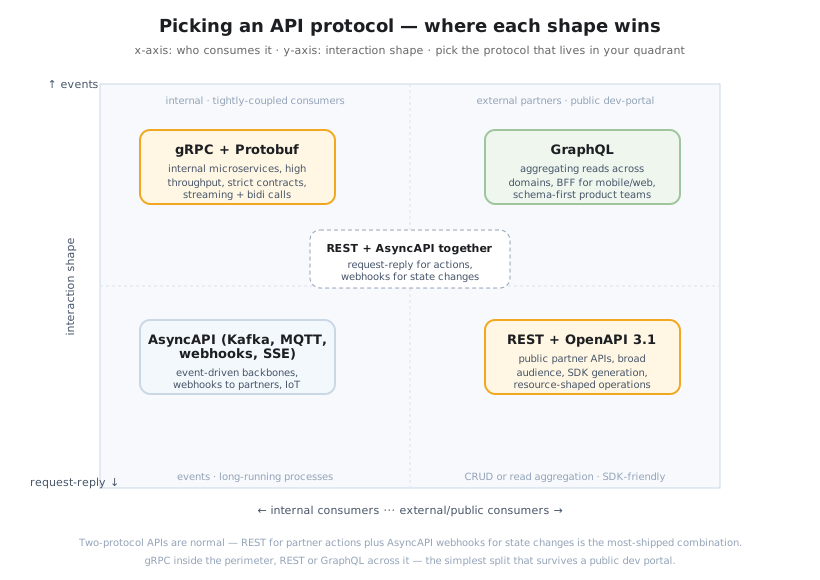
"REST or GraphQL or gRPC?" is not a neutral question. Each protocol ships with trade-offs that punish you for using it outside its quadrant. The diagram below is the opinionated default we bring to a discovery call. We will argue you out of it whenever the workload demands, but it is the starting frame.
REST + OpenAPI 3.1 — the safe default for public APIs
Wins for partner-facing programs, public dev portals, SDK generation, and any audience you do not control. Every integration tool already speaks OpenAPI; every partner has at least one engineer who can read it. Loses on aggregation-heavy reads (the N+1 across resources is real) and on streaming. We default to REST whenever the API will sit behind a public dev portal and we want SDKs auto-generated for at least three partner languages.
GraphQL — the aggregating-reads winner
Wins when the consumer is your own mobile or web client and you are aggregating across domains. Schema-first GraphQL shines for backend-for-frontend layers where a single round trip replaces five REST calls. Loses on public partner programs because every partner now has to reason about query budgets and persisted operations. We field GraphQL when the same team owns the API and at least one of the clients consuming it; we avoid it when the audience is "anyone with an API key".
gRPC — concurrency, streams, and strict contracts
Wins for internal microservice-to-microservice calls, high-throughput service meshes, bidirectional streaming, and any place you control both ends of the wire. Protobuf-defined RPCs give you strict typing and small wire payloads. Loses in browsers without a translation layer (gRPC-Web is decent but not free) and at public dev portals where partners do not want to maintain proto toolchains. Our default split is gRPC inside the perimeter, REST or GraphQL across it.
AsyncAPI / event-driven — for state changes that travel
Wins when the partner needs to react to your state, not just query it. AsyncAPI 3 specs describe Kafka topics, MQTT channels, signed webhooks, and Server-Sent Events with the same fluency OpenAPI brings to REST. The most common shape we ship is REST plus AsyncAPI: REST for the partner action, AsyncAPI-described webhooks for the outcome. Loses if you treat webhooks as an after-thought, ship them un-versioned, and discover the dead-letter queue six months in.
When to pick two protocols
Most APIs that survive five years run two protocols, not one. gRPC inside the perimeter and REST across it. REST for partner actions and AsyncAPI for the events those actions produce. GraphQL for the product client and REST for the partner SDK. The discipline is to pick the second protocol because measured pain forces it — not because a conference talk made it look cool. We refuse to add a third protocol without a written record of why; three protocols is where most API programs lose their shape.
Who hires an API development team
The buyer profiles below cover roughly nine in ten conversations on this page. If you recognize yourself in one, the next call is usually about the spec, the gateway, and the deprecation calendar — not CVs.
CTO opening a public API for partners
The product is past Series A, the platform team built v1 in a hurry, and now sales is signing partner contracts that name an SLO, a deprecation runway, and a developer portal. The buyer needs a pod that can take v1 from "internal API with an external URL" to "public API with versioning, scopes, signed webhooks, and a portal a partner can integrate against without a Slack channel".
Founder building an API-first SaaS
There is no frontend yet, or the frontend is somebody else's app. The product is the API. The buyer wants a senior pod that has shipped public APIs before and will refuse to skip versioning, idempotency, deprecation policy, or rate-limit semantics because "we can fix that later". The shape we ship for these companies looks a lot like Stripe or Twilio — opinionated, contract-first, with a portal that is a feature rather than a marketing afterthought.
Integration team building third-party connectors
The job is the other side of an API: shipping the connector that ingests a vendor's webhooks, the OAuth2 onboarding flow that brings new tenants in, the SDK adapter that lets your platform talk to fifteen disparate partner shapes. The buyer wants engineers who have spent enough time on the integration side to know what bad APIs feel like, and who will not ship a bad one in return.
Platform team replatforming a monolith into APIs
An eight-year-old monolith with a tangled internal API. The job is to extract clean, well-bounded service contracts from inside the box, put them behind a gateway, and let internal product teams move from a shared database to a shared API. The risk is over-engineering and the pace is calendar-driven; the right pod arrives with strangler-fig discipline and a refusal to ship more services than the workload justifies.
How we onboard an API pod in two to three weeks
The numbers below match every dedicated-team engagement we run. API specifics drop into the same shape; sprint zero is where the spec, the contract test, and the dev-portal skeleton are first touched.
Discovery (3–5 days)
Two-hour working session with your API owner and product lead, a read-only walk through the current spec and the top ten endpoints, an audit of the gateway and the auth layer, a written team configuration proposal, and a target SLO per partner tier.
Team assembly (5–10 days)
Pre-vetted candidates introduced for paired technical sessions. You interview every engineer. The tech lead and DevX candidates run a live spec review on an anonymized sample, not a coding kata, so you see them think about contracts before signing.
Sprint zero (week 2–3)
CI access, gateway access, OpenAPI / proto spec versioned in source, contract tests gating PRs, observability wired with structured logs and per-endpoint RED metrics, and a first runbook line drafted for the top three partner-facing alerts.
Sprint one (week 3–4)
First quick wins typically land here: an idempotency key on the booking POST, a 429 response that finally returns Retry-After, a webhook signature scheme partners can verify, an SDK regenerated from the spec instead of hand-edited. The pod is now operating on the cadence and the SLOs you saw on paper during discovery.
A 2-week satisfaction guarantee covers any seat in the pod. After the first 30 days, scaling down requires 30-day notice; scaling up takes one to two weeks per seat. None of this is unusual — it is the same engagement spine we use across every API development outsourcing engagement we run.
Real hiring scenarios we handle every quarter
The five scenarios below cover most of the API engagements we sign. The shape of the pod, the first sprint goal, and the headline number we agree to ship against differ by scenario, not by language.
Launch a v1 public API on a calendar
Sales has signed three pilot partners and the contract names a launch date. The pod ships v1 OpenAPI-first, with OAuth2 client credentials, signed webhooks, an SDK in two languages, and a dev portal good enough to demo. We refuse to skip versioning, deprecation policy, or rate-limit semantics for the launch — the things you trade for speed in week one are exactly what blows up in month nine.
Ship a partner API gateway on top of legacy services
The internal services are fine; the partner-facing surface is a tangle of un-versioned endpoints, ad-hoc auth, and inconsistent error shapes. The pod stands a gateway in front of the existing services, normalizes the contract, adds rate limits and quotas per partner tier, and maps the inconsistencies behind a clean v1 facade. The legacy services keep shipping internal feature work; the partner contract starts looking like a product.
Harden a leaking API before the next audit
Webhook signatures missing or weak, rate limits inconsistent, partner credentials never rotated, no dead-letter queue, no SLOs you can defend in a board review. The pod treats the first two sprints as instrumentation and security: signed webhooks, OAuth2 with scoped tokens, rate-limit headers that tell the partner what they have left, OWASP API Top 10 checklist green per endpoint, and dashboards a CTO can show an auditor.
Migrate REST to GraphQL with a deprecation runway
The product clients (mobile and web) are paying for the N+1 across REST resources; the partner API is fine. The pod ships GraphQL as a backend-for-frontend on top of the existing REST surface, lets the product clients move first, keeps REST stable for partners, and publishes a 12 to 18 month deprecation calendar for any REST endpoint the BFF retires. No flag day, no surprise sunset.
Build a Stripe-quality dev portal
The API is fine; the integration experience is not. Partner onboarding takes six weeks because the docs disagree with the spec, the sandbox is a staging environment with shared state, and the SDKs are hand-edited. The pod ships an OpenAPI-driven portal with auto-generated SDKs, runnable code samples for the top three partner languages, isolated sandbox tenants, a published changelog, and the deprecation calendar. The metric we agree to ship against is partner integration time, measured from contract signing to first successful production call.
Engagement models and what an API pod costs
Pricing for a dedicated API development team is monthly and predictable. The brackets below sit inside the broader dedicated development team range; we lean to the higher end of the dedicated bracket because the DevX and security seats are non-negotiable on a real API program.
Focused API pod
USD 18K–28K / month
Five to six people. API tech lead, two senior backend engineers, part-time DevX, part-time security, shared QA. Best for one product surface or a focused refactor of one partner program. Initial 3-month commitment, then month-to-month.
Public-API and partner-program pod
USD 30K–42K / month
Seven to eight people. Tech lead, two senior plus one mid backend engineer, full-time partner integration engineer, full-time DevX, part-time security, QA automation. 24/5 on-call rotation included. The default shape when paying partners are integrating against the API.
Multi-API platform engagement
USD 42K–48K+ / month
Two product pods plus a shared platform team on Kanban for the gateway, dev portal, and shared SDK tooling. Nine to twelve people. Includes a fractional security architect, 24/7 on-call coverage, and a quarterly contract review across surfaces.
A 2-week satisfaction guarantee runs across every seat. Scaling down takes 30 days' notice; scaling up takes one to two weeks per role. If you would rather start project-based and convert to a dedicated cadence later, the focused API pod is the bracket that converts most cleanly into a fixed-window engagement — typically a 12-to-16-week v1 launch — before becoming a long-running pod.
Mini case study — rebuilding a hospitality channel-manager API
Marbleline Bookings is a US-based hospitality channel-manager SaaS. Their public partner API connects hotel property-management systems to about forty online travel agency partners on the OTA side. The original v1 was the first thing the founding team shipped: REST-shaped but with no formal OpenAPI contract, three different auth flows for historical reasons, breaking changes propagating to OTA partners on roughly half the company's monthly releases, rate limits firing inconsistently across regions, and webhooks dropping silently during the Friday-evening peak when bookings spike. Two of the largest OTA partners had escalated to the CRO; one had paused renewal conversations.
The engagement charter was narrow on purpose. Stand v2 up behind the existing gateway with a strict OpenAPI 3.1 contract and OAuth2 client credentials. Replace the home-grown webhook layer with AsyncAPI-described, signed events and a dead-letter queue partners could replay from. Publish a 14-month deprecation calendar for v1 the day v2 went current. Ship a developer portal with auto-generated SDKs in TypeScript and Python plus a sandbox tenant per partner. Hold v1 stable while v2 ramped — no flag days.
We placed a six-person pod alongside the existing internal team: an API tech lead, two senior Node.js backend engineers, one partner integration engineer, one DevX and docs engineer, and one QA automation engineer, with a fractional security architect for the OAuth2 + webhook signing review. Sprint zero shipped contract tests gating every PR, a versioned spec in source, RED metrics per endpoint and per partner, and the runbook for the top three partner-facing alerts. Sprints one through four ran v2 in shadow against real partner traffic. Sprints five through seven cut the first three OTA partners over to v2 with a rollback flag. Sprints eight through eleven shipped the dev portal and the SDK pipeline.
Headline numbers across the first eleven sprints: silent webhook drops during the Friday peak 4.1% → 0.06%; breaking-change incidents per quarter 7 → 0; partner integration time, measured from contract signing to first successful production call, 6 weeks → 9 days after the portal landed; p95 booking POST latency 1.4s → 280ms once idempotency keys moved the retry storm off the relational core; partner OTA count 38 → 71 over the nine months after v2 launch. Engagement cost ~USD 36K/month for the six-person pod across the eleven sprints, with the security architect on a fractional retainer. The internal team stayed and shipped product features on the existing PMS surface throughout; nobody was replaced.
What we would do differently next time: spend an extra discovery week on the AsyncAPI spec for webhooks before any partner saw v2. We shipped REST first and AsyncAPI a sprint later because partner pressure on the booking POST was loudest, and the seam cost us two unnecessary webhook redesigns when partners asked for fields the AsyncAPI spec had not formalized yet. For a published case study with disclosed metrics on a real B2B platform, see Bari's wholesale portal.
API pod vs. in-house, freelancers, and integration agencies
A dedicated API pod is one of four ways to add API capacity. The trade-offs below are why the same buyer keeps landing on this page after trying the other three.
vs. in-house hiring
Best in the long run, slowest to start. A senior API engineer with public-API fluency and gateway experience takes four to nine months to hire and ramp; a senior DevX engineer who has shipped a Stripe-quality portal is rarer still. The pod route gives you a working cadence, a published spec, and an on-call rotation in three weeks. Convert later if the program is large enough to absorb permanent headcount.
vs. freelance marketplaces
Two senior freelancers can ship endpoints. They cannot share contract ownership. There is no shared spec, no contract test that gates a merge, no deprecation calendar, no shared on-call. You are managing four contracts and a Slack channel pretending to be an API tech lead. The first breaking-change incident is the moment that becomes obvious.
vs. integration agencies
Integration agencies are great at writing the connector that ingests somebody else's API. They are usually weak at building the API somebody else integrates against. The skill set is adjacent but not identical — designing a public surface that thirty partners will live with for five years is a different muscle from wiring up one partner connector at a time. We have replaced enough of these engagements to know the shape; the diagnostic question is whether the agency staffs a DevX seat by default.
vs. body-shop offshore
Body shops sell hours and tickets-marked-done. Predictability is whatever your internal lead can extract from asynchronous status updates. An API pod sells a contract, an SLO you can defend in a partner conversation, and a deprecation calendar a CRO can quote in a renewal call. The price gap is real (body shops are cheaper per seat) but the unit you are buying is not the same.
The request lifecycle an API pod owns end to end
If an API engagement is going to fail, it is usually because one of the boxes below was assumed to be somebody else's problem. The diagram is the shorthand we draw on a whiteboard during discovery to confirm scope.
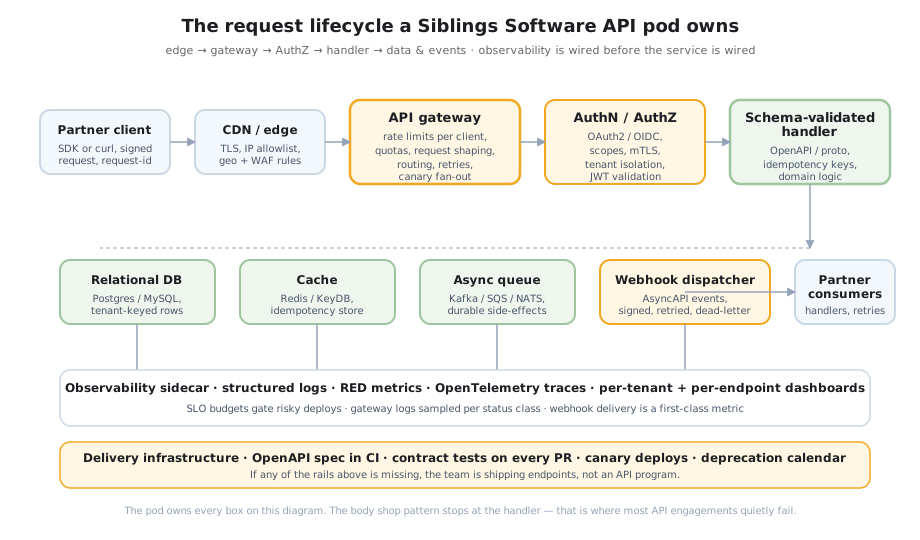
Three principles drive how the pod operates inside the diagram. First, the spec is the contract; if the implementation contradicts it, the implementation is wrong, not the spec. Second, the dev portal is a first-class surface; we treat the changelog and the deprecation calendar as load-bearing infrastructure, not marketing collateral. Third, the on-call rotation belongs to the people who wrote the code; that is non-negotiable on long-running engagements and the single biggest reason most outsourced APIs drift into operational debt.
Risks specific to API engagements (and what we do about them)
Generic outsourcing risks — IP ownership, NDAs, time-zone overlap — we treat the same way on every engagement: written into the master agreement, US-style work-for-hire IP, source-controlled deliverables, four-hour daily overlap with US time zones. The risks worth naming on this page are the ones unique to API work.
Versioning drift
The most expensive failure mode. The spec says one thing, the code does another, the SDK is hand-edited, and partners trust whichever artefact they read first. Mitigation: the OpenAPI or proto spec is the source of truth; SDKs are auto-generated from it; contract tests gate every PR; the changelog is published from the same diff.
Breaking changes without runway
The version bump that ships on Tuesday and burns three partners on Wednesday. Mitigation: every version runs in parallel for the published deprecation window (12-18 months for paying partners), per-version metrics surface the long-tail consumers by name, and sunset is gated on a measured traffic threshold — not a calendar entry.
Missing contract tests
Endpoints that drift from the spec because nothing is enforcing the contract at merge time. Mitigation: contract tests run on every PR; PRs that change request or response shape without a corresponding spec update fail to merge. The tech lead has a hard veto on shipping endpoints whose behaviour disagrees with the spec.
Weak developer experience
The portal that disagrees with the spec, the SDKs that lag the API by three releases, the changelog that is a Slack pin. Mitigation: the DevX seat is full-time on the public-API pod; the portal is generated from the same OpenAPI source as the SDKs; the changelog ships with every release as a reviewed artefact, not an afterthought.
Webhook security holes
Unsigned payloads, replay-able events, no idempotency on the consumer side, no dead-letter queue. Mitigation: every webhook is signed (HMAC-SHA256 by default), includes a request-id and a monotonically increasing event-id, retries with exponential backoff for 24 hours, then dead-letters to a queue your support team can replay from with a tool we ship in week three.
Rate-limit abuse and noisy neighbours
One partner's misbehaving retry loop starves the other thirty. Mitigation: rate limits are tiered per partner contract, quotas measured at the gateway, response headers tell the partner what they have left, 429 includes Retry-After, and noisy-neighbour endpoints get their own workload tier so a single tenant cannot starve the others.
Frequently asked questions about hiring an API development team
Is REST, GraphQL, or gRPC the right protocol for our public API?
REST with OpenAPI 3.1 is still the safest default for a public, partner-facing API: every SDK generator, every developer portal, every QA tool already speaks it. GraphQL wins when the consumer is your own mobile or web client and you are aggregating reads across domains; we avoid it for fully external partner programs. gRPC wins inside the perimeter. The most common shape we ship is REST plus AsyncAPI: REST for partner actions, AsyncAPI-described webhooks for state changes.
How do you stop our partners from being broken every release?
Three discipline rails. The OpenAPI or proto spec lives in source control and a contract test gates every PR; any breaking change blocks merge unless an explicit version bump rides with it. We run two versions live in parallel for the entire deprecation window, behind the gateway. The deprecation calendar is published to your dev portal the day a version becomes current, not the day before sunset.
Who actually owns the developer portal, the SDKs, and the changelog?
The pod does. The DevX engineer owns the portal, the auto-generated SDKs from the spec, the runnable code samples for the top three partner languages, and the human-written changelog. We refuse engagements that try to scope DevX as a marketing problem or a quarterly side project. A public API without a usable portal is a private API with a URL.
How do you secure webhooks, partner credentials, and rate limits without making the API painful?
Webhooks are signed (HMAC-SHA256), include a request-id and monotonically increasing event-id, retry with exponential backoff, then dead-letter for replay. Credentials follow OAuth2 client credentials with scoped tokens; long-lived API keys are reserved for legacy integrations and are rotated on a schedule. Rate limits are tiered per partner contract, with quotas measured at the gateway and headers that tell the partner what they have left.
Can the squad take on-call rotations for the partner SLOs we sign?
Yes. We staff a 24/5 on-call rotation by default with two engineers per shift, paired with a shared SRE seat. 24/7 is possible with a second pod or a shared rotation across time zones with your in-house team. We refuse to take a partner SLO we did not write the runbook for. The SLO that lives in a slide deck and not in the pager configuration is a fiction.
How do you migrate a noisy v1 to a clean v2 without losing partners?
We never write v2 in a side branch and surprise people with a flag day. v2 stands up behind the gateway with its own version prefix; shadow traffic runs for two to four weeks; the deprecation calendar publishes with a 12-to-18-month runway; per-partner v1 usage is instrumented so the long tail is callable by name; an SDK-level codemod or migration guide ships with the breaking changes; v1 only sunsets when v1 traffic crosses a previously-agreed threshold for a previously-agreed window.
Can we move from staff augmentation to a full API pod later?
Yes. We routinely start with two or three augmented seniors on your existing squad through our staff-augmentation model and convert to a dedicated pod once we know your domain. The conversion adds the API tech lead, the DevX engineer, the part-time security engineer, and the QA seat without churning the engineers you already trust.
How do you handle multi-region API deployments and gateway federation?
Gateways federate to a primary configuration store, not to each other; we never run drifted gateway configs in production. Per-region rate limits are coordinated through a token-bucket cache rather than independent counters, so a partner cannot multiply their quota by talking to two regions in parallel. Webhook delivery is region-pinned per partner with documented failover. The pattern is boring on purpose — clever multi-region API designs are the ones that page everyone at 03:00.
OUR STANDARDS
Spec over slideware. Contract tests over good intentions. Published deprecation calendars over surprise sunsets.
An API story is not done until the spec is updated, the contract test is green, the SDK is regenerated, the changelog entry is written, the dashboard shows the new endpoint by name, and the runbook covers the alert path it can produce. We treat the developer portal as load-bearing infrastructure, not a quarterly project, and we report on the partner-facing SLOs we agreed to defend, not the velocity we estimated against.
Our Definition of Done is a written checklist with hard gates in CI: code review approved by the API tech lead, automated tests passing, OpenAPI or proto contract updated, contract test green against the previous version, SDK pipeline regenerated, changelog entry written, deploy to staging successful, runbook entry for any new alert path. Until those gates close, the story is not done, regardless of what the board says.
If you’re interested in hiring developers for this capability in Argentina, visit the Argentina version of this page.
CONTACT US
Get in touch and build your idea today.