Case study · Security and compliance SaaS
ISO 27001 Compliance SaaS Case Study: AWS Production
This page is a software development case study for a European ISO 27001 compliance SaaS that Siblings Software finished and moved to production on the client's own AWS account. The product helps customers run ISO/IEC 27001 programs: control libraries, evidence requests, gap assessments, risk and audit registers, access reviews, vendor registers, and generated ISMS documents.
If you are a CTO, founder, or security product leader comparing vendors for a similar compliance platform, migration, or hardening project, you will find the engagement model, stack, security controls, release gates, timeline, and split of work between Siblings and the client's infrastructure team. The client stays anonymous under NDA. Siblings delivered the Next.js application, CI/CD pipeline, and runbooks. The client's team owned Terraform and the AWS account.
The MVP ran on Supabase Auth and Vercel. Production targets were ECS Fargate, RDS PostgreSQL, Cognito, S3, and SES, with mandatory multi-factor sign-in, database-level tenant isolation, and a release path where every change is scanned, rehearsed, and gated before it reaches production.
Reviewed by Javier Uanini, Founder and CEO, November 2026.
At a glance
| Client | European information-security company (name under NDA) |
| Product | Multi-tenant ISMS SaaS for ISO/IEC 27001 programs |
| Engagement | Fixed-scope completion and production hardening (project-based outsourcing) |
| Timeline | September to October 2026 |
| Stack | Next.js 16, Prisma, PostgreSQL 18 on RDS, ECS Fargate, Cognito, S3, SES, GitHub Actions |
| Split of work | Siblings: application, CI/CD, release runbooks. Client: AWS account and Terraform |
| Status | Live on AWS since October 2026 |
- Delivery partner: Siblings Software
- Related services: DevSecOps services, Cloud migration services, Next.js development
- More examples: All case studies
Who Should Read This Case Study
Teams usually land here with one of three questions. First, you sell compliance or GRC software and your MVP works, but enterprise buyers ask for MFA, tenant isolation, and an auditable deploy path your current host cannot provide. Second, you already chose AWS and need an application partner who can ship into your account without taking over Terraform. Third, you are evaluating whether DevSecOps outsourcing or a full product completion package is the right next step after an AI-assisted build.
This story is not a certification guide. Siblings builds and hardens software; your auditors and consultants still own ISO/IEC 27001 certification scope. What we demonstrate is how a multi-tenant compliance SaaS can meet the security bar its own customers expect when the product is engineered for production on AWS.
The Challenge
The existing product worked as an MVP, but three gaps blocked enterprise sales. Authentication lived in a third-party service that did not match the contract's AWS target. Tenant isolation depended on application filters, so one missed WHERE clause could expose another customer's compliance evidence. There was no repeatable, auditable way to ship a change to production.
The contract fixed the target: GitHub Actions to Amazon ECR, two ECS Fargate tasks behind a load balancer, RDS PostgreSQL, Cognito, and S3, inside the client's AWS account. The client's infrastructure team owns that account and writes the Terraform. Siblings had to deliver an application that fits that platform exactly, without ever handling secret values.
Engagement Model and Pricing Context
The client bought a fixed-scope completion and production hardening package, not open-ended staff augmentation. That fits when the product vision is clear, the gap is execution on security and cloud fit, and leadership wants a defined handoff to the client's operations team. On Siblings published brackets, project-based outsourcing typically runs USD 5,000 to 15,000 for two to six engineers over one to six months, depending on module count, migration risk, and compliance depth. This engagement sat in that band; we do not publish the client's fee.
Day to day, Siblings engineers worked in the client's GitHub repositories and coordinated with their platform team on environment names, health checks, and migration order. Siblings never applied Terraform and never read production secret values. A written deployment contract bridged application releases and infrastructure readiness.
If your bottleneck is only CI gates and image signing, start with DevSecOps services. If the first job is leaving Supabase or Vercel, see cloud migration services. If the app still needs feature completion after launch, a dedicated development team is often the next step.
What Siblings Built
We finished and hardened the product modules the client's customers use every day: the control library and mappings, evidence requests with file uploads, questionnaires and sheets, gap assessments, risk, audit, access-review and vendor registers, generated ISMS documents with an editor, reminders by email, metrics, and two-way Outlook calendar scheduling through Microsoft Graph.
Then we made the platform production-grade. Sign-in moved to Amazon Cognito with mandatory authenticator-app MFA, checked by the application on every session, so a password alone never reaches customer data. Tenant isolation moved into PostgreSQL with forced row-level security, no bypass role at runtime, and an append-only audit log. Every request gets a fresh Content Security Policy nonce, every write is checked against cross-site request forgery, uploads are validated by content and size, and sensitive routes are rate-limited.
How Releases Work
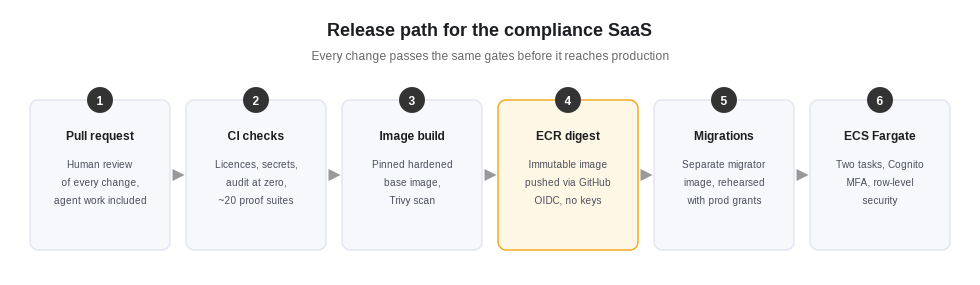
Continuous integration checks dependency licences, scans for leaked secrets, keeps npm audit at zero findings, runs lint and type checks, and executes about twenty automated proof suites against a real PostgreSQL 18.3 database: tenant isolation, authentication and the MFA gate, application security, storage, calendar sync, deployment contracts and every product module.
Container images are built on pinned hardened base images and scanned with Trivy, which blocks the release on any fixable critical vulnerability. GitHub Actions authenticates to AWS through OpenID Connect, so there are no long-lived AWS keys in the repository. Images are pushed to ECR by immutable digest. Database migrations ship in a separate migrator image, are rehearsed against PostgreSQL 18.3 with the production role's exact permissions, and the ECS service update only proceeds once that exact digest has been migrated. Rollback is a redeploy of the previous digest.
Results and Current Status
The production readiness package closed on 13 October 2026. A live password-plus-authenticator sign-in on the production Cognito pool reached the application on 10 October, and during the rollout requests alternated between two ECS tasks while the encrypted session held across both, with no forced re-login. Email left the SES sandbox on 6 October. All automated proof suites pass in CI, and npm audit stays at zero.
A few items are deliberately the client's: connecting Microsoft Graph for live mailbox sync, scheduling the reminder and calendar jobs in their infrastructure, and loading their own data. A penetration test was outside this package. Each of those is documented in a runbook the client's team can follow without us.
Buyer Takeaways for Your ISO 27001 SaaS
If you are shortlisting vendors for similar work, these are the decision points that mattered in this engagement.
- Where tenant boundaries live. Application filters are not enough when your buyers audit databases. Forced row-level security in PostgreSQL plus CI tests on two tenants caught regressions before review.
- Who owns the AWS account. Many security vendors keep Terraform in-house. A partner that documents application contracts without touching secrets reduced trust friction.
- Whether releases are evidence. Gated deploys with Trivy, OIDC to AWS, and rehearsed migrations gave security reviewers a story that matched the product's own ISO/IEC 27001 narrative.
- How AI-assisted code is governed. Agents wrote much of the code, but the same CI gates applied to every pull request. See AI code security for how we review agent output.
When Siblings Fits vs Other Options
In-house hiring
Makes sense when you already have a platform team and need long-term product headcount. Slower when you must ship before the next enterprise pilot.
Freelancers
Can unblock one feature. Risky when MFA, RLS, and supply-chain gates must hold for every release across modules.
Fixed-scope outsourcing (this case)
Fits a defined AWS target, a live MVP, and a need for completion plus auditable delivery in weeks, not a multi-year staff aug program.
How We Used AI Coding Agents Safely
Much of the code was written with AI coding agents working inside written rules for the repository. Those rules ban credentials, keys, tokens and customer data from prompts, require sanitized fixtures, and require a human review of every generated migration and every piece of security code. The CI gates above apply to agent-written changes exactly as they apply to human ones.
This is the delivery model we use across projects. See DevSecOps services for the pipeline controls and AI code security for how we review AI-generated code.
Frequently Asked Questions
Yes. In this project the client's team owned the AWS account and the Terraform, and Siblings delivered the application, the CI/CD pipeline and a written contract between the two: environment and secret names, task size, health endpoints, migration steps and rollback. We never read secret values.
When you want us to, yes, as part of our platform engineering and cloud migration services. When your team already owns Terraform, as here, we document exactly what the application needs and leave the infrastructure with you.
Here, sign-in uses Amazon Cognito with a mandatory authenticator app, and the application itself checks enrolment on every session, so a token without a confirmed second factor never reaches customer data. Passkeys were deliberately not accepted as a replacement for the authenticator.
In PostgreSQL itself, with forced row-level security, so even a bug in application code cannot return another tenant's rows. The application connects with a role that has no way to bypass those policies, and automated tests prove the isolation with two tenants on every change.
This ran as fixed-scope completion under project-based outsourcing, which fits when the product already exists but must ship on a defined AWS stack before enterprise sales. For pipeline design alone, see DevSecOps services. After launch, staff augmentation or a dedicated team can own the roadmap.
Active delivery ran September through October 2026, with the production readiness package closing on 13 October 2026. Calendar length depends on how complete your MVP is and whether your team already runs the target AWS account.
Yes. This client's name stays private under a mutual NDA, which is why this case study describes the work without naming them. We can arrange a reference call with permission.
Building or hardening an ISO 27001 compliance SaaS?
We complete, harden, and ship products that have to pass enterprise security reviews. Start with DevSecOps services, cloud migration, or project-based outsourcing, or tell us about your product below.