Cloud Migration Services for US Product and Platform Teams
Siblings Software provides cloud migration services when your platform team must move production workloads from colocation, on-premises data centers, or legacy cloud accounts into AWS, Azure, or GCP without losing control at cutover. We work with VP Engineering, infrastructure leads, and cloud program owners at US B2B SaaS, fintech, and healthcare companies who need landing zones, wave plans, cutover runbooks, and IAM models your team can operate after handoff. This page explains what the service covers, typical project scenarios, delivery phases, squad composition, pricing context, comparisons with in-house and consultant approaches, risks, and FAQs so you can evaluate us before a discovery call.
We run discovery and executive alignment from Miami and deliver engineering with Latin America depth and daily overlap on US East Coast business hours. Programs align with AWS Migration Hub, Azure Migrate, and Google Cloud Migration Center. Need one senior engineer inside your sprint board? See DevOps engineer staff augmentation. For ongoing CI/CD after cutover, see DevOps engineering. For internal developer platforms after the estate is stable, see platform engineering.
Reviewed by Javier Uanini, Founder and CEO, September 2026.
What the Service Covers
Cloud migration services outsourcing is the engineering work of moving applications, databases, queues, and supporting infrastructure into a governed cloud landing zone without losing data integrity or operational control. A typical program inventories every workload and dependency, designs account structure and network segmentation, builds landing zones with IAM guardrails, plans migration waves by risk and coupling, executes lift-and-shift or re-platform moves with replication testing, rehearses cutover with rollback triggers, and hands off runbooks your platform team can extend.
That is different from ongoing DevOps engineering, which optimizes CI/CD pipelines and production operations after you are already in the cloud. It is also different from platform engineering, which builds internal developer portals and golden paths. Migration work optimizes for assessment accuracy, cutover safety, and landing zone governance during the transition window. We pair with Terraform engineer staff augmentation when your team needs additional IaC capacity during landing zone build.
Security and compliance follow cloud provider well-architected guidance: least-privilege IAM, encryption at rest and in transit, network segmentation, and audit logging before production traffic routes through new accounts. Application teams often combine migration work with our back-end development practice when services need refactoring during re-platform. When analytics workloads move in parallel, we coordinate with data engineer staff augmentation so warehouse ingestion does not fork a separate migration track.
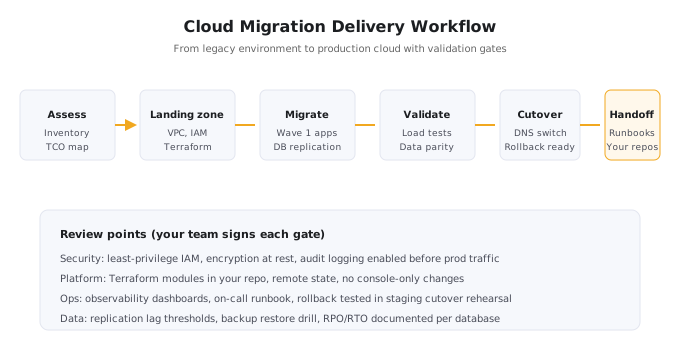
Production migration programs treat documented cutover runbooks and legal sign-off on data residency as non-negotiable: every wave records who approves rollback before production traffic switches.
Who It Is For
Infrastructure and platform teams where colocation leases expire, cloud spend is unpredictable, or compliance demands a governed landing zone but engineering is focused on the product roadmap. If nobody owns the workload inventory and cutover keeps slipping, you are the audience.
B2B SaaS platform teams
Multi-tenant apps on aging colo VMs need containerized landing zones on EKS or AKS with wave migration plans that do not block feature releases during cutover month.
Fintech and regulated finance
Payment and ledger systems need region selection, encryption key ownership, and audit trails documented before any production database replicates to a new cloud account.
Enterprise IT modernization
Datacenter exit programs with hundreds of workloads need wave prioritization, dependency mapping, and cutover runbooks procurement can audit without opening tickets.
Infrastructure and cloud platform leads
Landing zone design, account vending, and IAM guardrails need Terraform modules and documentation your team inherits, not a consultant deck that nobody implements.
Teams exiting legacy cloud accounts
Shadow IT sprawl across personal cloud accounts needs consolidation into a governed organization with billing visibility and role-based access before the next audit.
Data-heavy migration programs
Large databases and analytics stores need replication lag testing, cutover windows aligned with batch jobs, and coordination with data engineering when warehouses move in the same wave.
Typical Project Scenarios
Six situations we see on discovery calls with US platform teams. Each maps to a bounded migration wave we can scope in the first week.
Exit colocation before lease renewal
B2B SaaS runs on rented rack space with manual VM provisioning and no infrastructure-as-code. We deliver AWS or Azure landing zone, Terraform modules, wave plan by dependency, and cutover runbooks before the lease ends.
Consolidate shadow cloud accounts
Engineering teams spun up workloads across personal cloud accounts with no central IAM. We design organization structure, migrate workloads into governed accounts, and document billing and access policies.
Re-platform monoliths to containers on EKS or AKS
Lift-and-shift preserves technical debt. We containerize selected services, build Kubernetes landing zones, migrate stateful dependencies with replication testing, and hand off to your DevOps engineering team for ongoing operations.
Migrate databases with minimal downtime windows
PostgreSQL, MySQL, or SQL Server replicas lag during peak traffic. We implement continuous replication, define cutover lag thresholds, rehearse rollback, and align maintenance windows with business stakeholders.
Build landing zone before wave one
Security and compliance block migration until account structure, network segmentation, and IAM guardrails exist. We deliver landing zone Terraform, SCP policies, and onboarding documentation before any workload moves.
Coordinate application and data platform moves
Product databases and analytics warehouses must migrate without breaking nightly ETL. We sequence waves with data engineer staff augmentation so ingestion paths stay consistent through cutover.
How Delivery Works
Six phases, usually ten to sixteen weeks for a first wave with landing zone, three to eight workloads, cutover runbooks, and handoff documentation. Cutover rehearsals with documented rollback triggers are non-negotiable on migrations that touch production databases.
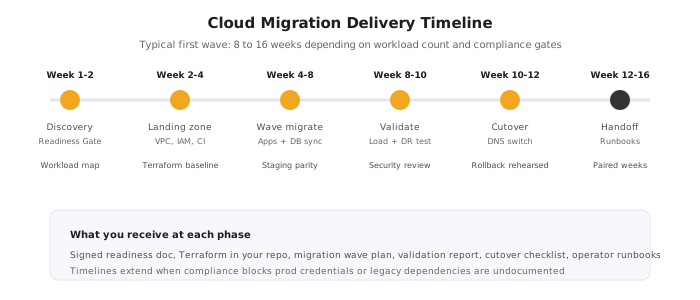
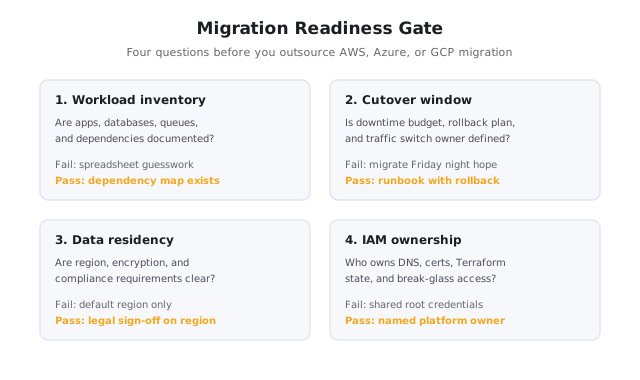
Discovery inventories workloads, runs the Migration Readiness Gate from the hero diagram, and documents dependencies, data residency requirements, cutover windows, and IAM ownership. If any gate is undefined, we capture it before designing landing zones.
Landing zone build delivers account structure, network segmentation, IAM guardrails, and Terraform modules aligned with AWS, Azure, or GCP well-architected patterns. Compliance and security reviews start in week one.
Pilot wave migrates one to two low-risk workloads to validate replication, networking, and monitoring before larger waves. Lessons feed back into the wave plan and runbook templates.
Wave migration executes lift-and-shift or re-platform moves in dependency order with replication monitoring and rollback checkpoints. Platform engineering reviews security groups and logging before each cutover window.
Cutover rehearsal exercises DNS switches, traffic routing, and database promotion in staging with production-like data volumes. Infrastructure and product owners sign off before the production window.
Handoff includes runbooks for onboarding new waves, rehearsing rollback, extending the landing zone, and escalating incidents. Paired weeks let your team operate under our review before we step down to advisory hours or transition to project-based outsourcing for the next wave.
Team Composition
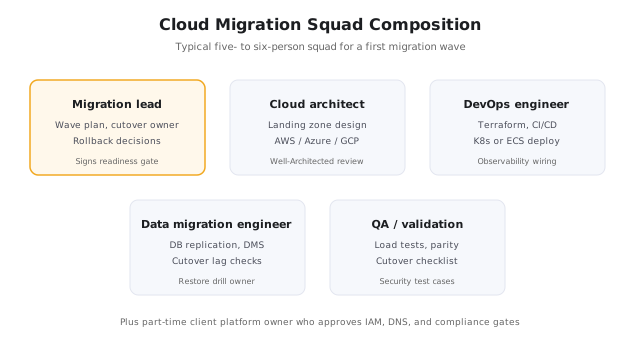
A four- to six-person squad is the usual shape for a first migration wave. The migration lead who owns cutover runbooks and wave sequencing and the cloud architect who owns landing zone Terraform are the two roles vendors cut to win on price. Those are also the roles that determine whether rollback works when replication lag spikes during a maintenance window.
Typical roster: migration lead, cloud architect, DevOps engineer, data migration engineer during database waves, QA engineer for replication and cutover test suites, and a part-time infrastructure owner from your side who signs the workload inventory. For ongoing wave delivery after wave one, the same squad can run as a dedicated development team on a monthly retainer. For a single senior DevOps engineer inside your org, staff augmentation is the better fit.
Project, dedicated team, or staff augmentation depending on how much of the migration program you want us to own.
Pricing and Engagement Models
Project-based
Fixed scope for a bounded migration program: workload assessment, landing zone, one to three waves, cutover runbooks, and handoff documentation. Typical duration ten to sixteen weeks. Published bands run USD 35,000 to USD 120,000 after discovery, depending on workload count, data volume, and compliance scope.
Dedicated team
Ongoing squad owning wave migration, landing zone extensions, cutover support, and migration incident response. USD 22,000 to USD 45,000 per month for four to six people depending on seniority mix and workload surface area.
Staff augmentation
Embed one or two senior DevOps or cloud engineers when you already own architecture and need hands on Terraform, replication, or cutover execution. USD 5,500 to USD 9,500 per month per senior engineer on published brackets.
Compared With In-House Hiring, Freelancers, and Large Consultancies
Outsource when
- You need a governed landing zone and first migration wave in a quarter, not after a six-month hiring cycle for scarce cloud architects.
- Your product team knows the application but not landing zone design, wave sequencing, or cutover rollback procedures.
- Infrastructure leaders want a third party to document the Migration Readiness Gate before SOC 2 or enterprise diligence.
- You are exiting colocation or consolidating accounts and want shared Terraform modules and cutover patterns from the start.
Keep it in-house when
- You already run a mature cloud center of excellence and only need a short spike on one database replication path.
- Your entire estate is three stateless services with no compliance or data residency constraints.
- A hyperscaler migration factory program covers every workload with acceptable limits on custom cutover runbooks.
Freelancers can clone VMs quickly but rarely stay for cutover rehearsals or landing zone governance when compliance blocks region selection during launch month. Miami-led coordination with Latin America engineering gives US platform teams senior migration profiles and Eastern or Central overlap for cutover windows. Browse case studies for examples of how we work with product teams.
Illustrative Scenario: Clearfield Payments
Composite illustrative scenario only. Not a published client case study. No performance metrics are claimed.
The situation
Clearfield Payments is a fictional US B2B payment processing company serving mid-market merchants with an API-first platform. The stack runs on eight VMware hosts in a Chicago colocation facility with manual provisioning, nightly PostgreSQL backups via scripts, and PCI DSS scope that includes cardholder data environment segmentation on fixed subnets. The VP Engineering inherited a colocation lease renewal in eleven months and a board mandate to move to AWS.
Application services bind to static IPs and local storage volumes. Dependencies between the authorization API, settlement workers, and the reporting database were never mapped in a single document. The infrastructure lead wants a PCI-aware landing zone, wave migration by service boundary, and cutover runbooks the on-call team can execute without vendor support tickets.
What we would deliver
A twelve-week project with a five-person squad: migration lead, cloud architect, DevOps engineer, data migration engineer, and part-time infrastructure owner from the client side. Discovery and cutover planning run with the US platform lead from Miami; engineering delivery overlaps Eastern business hours.
- Migration Readiness Gate documenting workload inventory, cutover window, data residency in us-east-1, and IAM ownership signed by infrastructure and security.
- AWS landing zone with organization accounts, VPC segmentation, ECS and RDS patterns, and Terraform modules for networking and IAM guardrails.
- Three migration waves: stateless API services first, settlement workers second, PostgreSQL with continuous replication and lag thresholds third.
- Cutover rehearsal report with DNS TTL plan, rollback triggers, and replication lag checkpoints before production switch.
- Handoff runbooks for onboarding wave four, extending the landing zone, and transitioning ongoing operations to DevOps engineering or internal SRE.
In a scenario like this, the win is operational confidence: the platform team owns a governed AWS estate, cutover is rehearsed, and colocation exit happens on schedule without an undocumented rollback gamble.
Risks and Mitigation
Undocumented dependencies break cutover. A hidden cron job or hard-coded IP blocks traffic switch. Mitigation: dependency mapping in discovery, pilot wave validation, and integration tests that block wave promotion when dependencies are unresolved.
Replication lag exceeds cutover window. Database promotion fails during the maintenance window. Mitigation: continuous replication monitoring, lag thresholds in runbooks, and rehearsal with production-like data volumes before signing off.
IAM sprawl in the new landing zone. Over-permissive roles create audit findings. Mitigation: least-privilege templates, SCP guardrails, and security review before any workload lands in production accounts.
Compliance blocks region selection late. Legal review delays migration after landing zone build starts. Mitigation: data residency sign-off in week one of discovery, documented encryption and backup locations, and no production replication until legal approves.
DNS and TTL surprises extend downtime. Traffic routes to old infrastructure after cutover. Mitigation: TTL reduction plan weeks before cutover, documented DNS switch owner, and rollback procedure tested in rehearsal.
Handoff failure. Mitigation: paired weeks where your team executes cutover under review, recorded runbooks for wave onboarding and rollback, and explicit ownership transfer before we step down to advisory hours.
Questions buyers ask before the first discovery call
Frequently Asked Questions
A weekend lift-and-shift can copy VMs into a cloud account, but production migration needs a signed workload inventory, landing zone design, wave sequencing, cutover runbooks with rollback triggers, compliance sign-off on regions and encryption, and an IAM ownership model that survives the first incident. Outsourced cloud migration services deliver assessment, Terraform landing zones, wave execution, cutover rehearsals, and operator runbooks your platform team can extend. The gap shows up when DNS flips during peak traffic and nobody documented who approves rollback.
We migrate workloads on AWS, Azure, and Google Cloud using lift-and-shift, re-platform, and selective re-architecture where containers or managed services reduce operational load. Landing zones follow AWS Control Tower or equivalent account vending, Azure landing zone patterns, and GCP organization policies. We use AWS Migration Hub, Azure Migrate, and Google Cloud Migration Center for discovery and tracking. When analytics stores move in the same program, we coordinate with data engineer staff augmentation so warehouse ingestion does not fork a separate migration track.
Cutover runbooks define downtime budget, traffic switch owner, DNS TTL changes, database replication lag thresholds, and rollback triggers before any production window opens. We rehearse cutover in staging with production-like data volumes. PCI, HIPAA, or SOC 2 requirements get legal and security sign-off on region, encryption keys, and backup locations before landing zone build. IAM ownership is documented per environment: who provisions roles, who approves cross-account access, and who rotates break-glass credentials.
A first wave migration with landing zone, three to eight workloads, cutover runbooks, and handoff documentation typically ships in ten to sixteen weeks. That includes discovery with the Migration Readiness Gate, landing zone build, pilot wave, cutover rehearsal, and paired handoff weeks. Timelines stretch when workload inventory is incomplete, compliance reviews delay region selection, or legacy databases need extended replication testing.
Project-based migration programs for a bounded first wave typically land between USD 35,000 and USD 120,000 depending on workload count, data volume, compliance scope, and whether landing zone build is included. Dedicated migration squads run USD 22,000 to USD 45,000 per month for ongoing wave delivery and cutover support. Senior staff augmentation for DevOps or cloud engineers ranges from USD 5,500 to USD 9,500 per month per engineer on published brackets via hire DevOps engineers. We confirm pricing after discovery once we know your workload inventory and cutover constraints.
You do. Terraform modules, landing zone configuration, migration scripts, cutover runbooks, IAM policies, and monitoring dashboards ship to your repositories under your IP. We document how to onboard a new wave, rehearse rollback, and extend the landing zone without paging us. Ongoing SRE and CI/CD operations are a separate engagement through DevOps engineering if you want managed ops after cutover.
Discovery, procurement, and executive alignment run from our Miami office with Eastern and Central US overlap. Engineering delivery is based in Latin America with daily overlap on US East Coast business hours. Cloud migration projects need same-day iteration with platform leads when a cutover rehearsal fails or replication lag blocks a maintenance window, so account coordination in Miami and engineering depth in your time zone matter together.
Related Services