Hire MLOps engineers for embedded staff augmentation
· Typical time to first staging deployment: 12–15 business days
Hire MLOps engineers through Siblings Software when your data scientists have strong offline metrics and nothing reliable in production. This page explains what embedded ML platform engineers do in client teams, when staff augmentation beats a consulting project, how we vet candidates on pipelines and serving paths, monthly pricing bands, risks, and when a small platform pod makes more sense than a solo hire.
Buyers searching for hire MLOps engineers usually need three answers on one screen: who closes the gap between the notebook and the endpoint, what it costs per month in plain numbers, and how you avoid the contractor who wires a demo API and disappears before drift monitoring exists. We staff MLOps engineers from Latin America with full-time engineers who overlap US Eastern business hours and join your ceremonies from sprint planning through on-call handoffs.
Enterprise AI hiring in 2026 is bottlenecked on production skills, not model research. Randstad Digital reported that more than 11 percent of machine learning engineer roles in major markets remain vacant while enterprises move from pilots to scaled deployment. MLOps engineers are the role that owns registry promotion, serving SLOs, and retraining cadence. For model research capacity, see AI developer staff augmentation; for cluster and CI foundations, explore embedded DevOps engineers; for timezone context, read nearshore developer hiring.
If you need Siblings to own an entire AI platform build rather than individuals in your standups, compare AI software development services or a dedicated AI development team from the same leadership group.
"The expensive ML hire is not the one who chases leaderboard points. It is the one who ships a model you cannot roll back on a Friday night."
Reviewed by Javier Uanini, Founder and CEO, Siblings Software. Last reviewed 23 June 2026.
Prefer numbers before a call? Jump to monthly pricing bands for solo engineers, pairs, and platform pods.
What MLOps engineers do in your squad
Production ML operations, not another research notebook.
A strong MLOps engineer on staff augmentation joins planning with your ML lead and platform team, owns the path from trained artifact to monitored endpoint, and documents what happens when accuracy drops. Day to day that means:
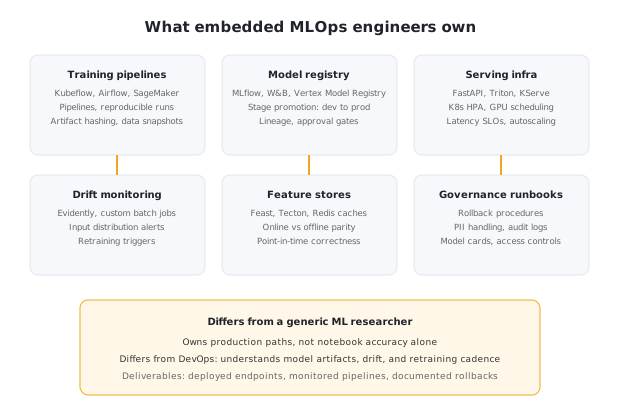
This role differs from a generic Python developer because judgment spans data contracts, model artifacts, and infrastructure SLOs at once. It differs from a data engineer because success is measured by model deployment frequency and drift recovery, not only warehouse pipeline freshness. It differs from a data scientist because the success metric is deployment frequency and incident recovery time, not offline AUC alone. It differs from a DevOps engineer because they understand model versioning, feature parity between training and serving, and when retraining should be automated versus human-approved.
When companies hire MLOps engineers
Five situations cover most discovery calls. Yours may combine two.
Pilots stuck in notebooks
Data science teams hit strong offline metrics six months ago. Production still calls a hard-coded heuristic because nobody owns registry promotion, container builds, or endpoint health checks.
First model going live under audit
Fintech, insurance, and healthcare buyers need lineage, access logs, and rollback evidence before legal signs off. Manual deploy scripts do not survive a SOC 2 or model-risk review.
Drift showed up in support tickets first
Input distributions shifted after a partner API change or seasonality event. Nobody had batch scoring comparisons or alerts wired. Customer complaints arrived before engineering dashboards.
GPU bills climbed without serving SLOs
Endpoints autoscale aggressively because requests and limits were never tuned. An MLOps engineer right-sizes inference, adds caching, and defines latency budgets per model.
ML lead without platform bandwidth
A head of machine learning owns roadmap and model quality but cannot also rebuild Kubeflow pipelines while running hiring loops. Staff augmentation adds execution capacity without reorganizing the department chart.
The MLOps Production Readiness Test
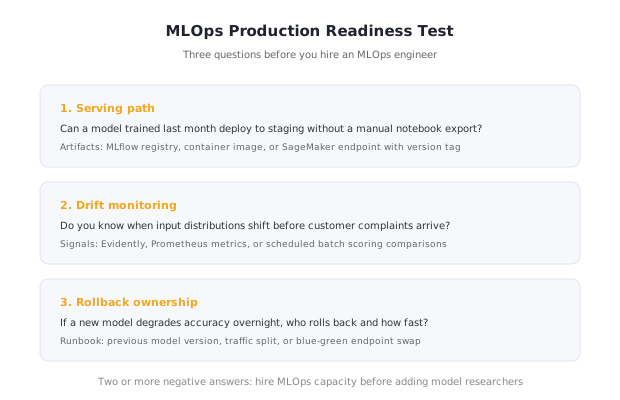
Before we recommend a hire shape, we run three questions we call the MLOps Production Readiness Test. If two or more answers are negative, you need platform engineering capacity before you add another model researcher.
- Serving path: Can a model trained last month deploy to staging without a manual notebook export? Artifacts should live in a registry such as MLflow with a tagged container or managed endpoint.
- Drift monitoring: Do you know when input distributions shift before customer complaints arrive? Batch scoring comparisons, Evidently reports, or Prometheus metrics on feature means are minimum viable signals.
- Rollback ownership: If a new model degrades accuracy overnight, who rolls back and how fast? A runbook should name the previous version, traffic split, or blue-green swap without a war room.
We use the same test in vetting. Candidates who only describe training pipelines rarely survive the live exercise where we ask them to promote a model stage and wire a health-checked serving endpoint.
How Siblings vets MLOps candidates
Resume keywords are cheap. We screen for signals that predict whether your first production model ships in quarter one, not quarter three.
- Pipeline judgment: Can they explain when to skip Kubeflow for a scheduled batch job on Airflow? Engineers who over-build platforms on day one rarely ship.
- Serving fluency: FastAPI, Triton, TorchServe, or managed endpoints on SageMaker and Vertex with autoscaling, health probes, and graceful shutdown.
- Registry discipline: Stage gates, approval workflows, and artifact immutability in MLflow, W&B, or cloud-native registries.
- Observability: Drift dashboards, inference latency histograms, and alert routing that pages the right owner. For agent-specific tracing, teams often pair this role with AI agent observability workstreams.
- Communication: Clear runbooks, model cards, and incident notes that legal and product can read without a PhD.
- Red flags: Only Kaggle medals, no production serving story, inability to describe a rollback, or treating feature stores as optional forever.
Roughly three in ten applicants pass all gates. Profiles with regulated-industry experience (insurance scoring, credit risk, clinical decision support) take a few extra days to source because the qualified pool is thinner.
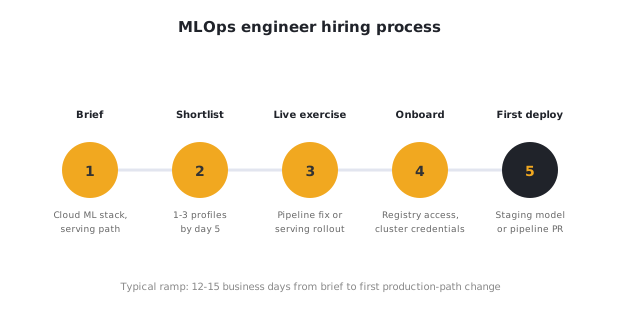
Typical ramp from discovery call to first pipeline or staging deployment change.
Engagement models and pricing context
MLOps staff augmentation pricing depends on seniority, cloud stack depth, on-call expectations for inference incidents, and whether the engineer also owns data platform work. These bands reflect nearshore LATAM delivery on full-time monthly engagements, typically 15 to 25 percent above our general software engineer baseline because production ML skills are scarce:
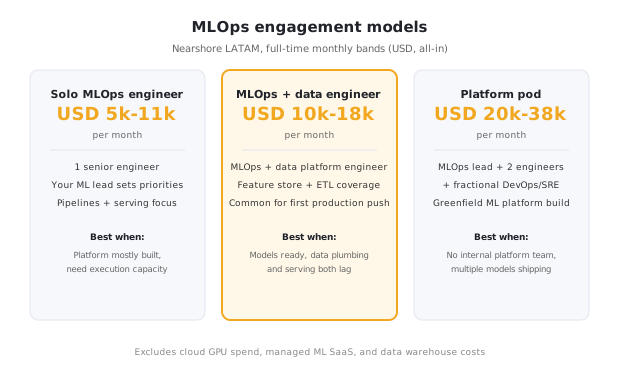
Single senior MLOps engineer
Best when you have an ML lead who can prioritize the backlog and the registry exists. One engineer, your ceremonies, your data access policies.
Typical band: USD 5,000–11,000/month.
MLOps plus data engineer pair
Feature pipelines, warehouse exports, and serving both lag behind model research. Common for the first production push.
Typical band: USD 10,000–18,000/month.
Platform pod with fractional DevOps
When you need registry, pipelines, serving, and observability stood up together while researchers keep experimenting. Compare with a dedicated AI team when you want Siblings to own delivery end to end.
Typical band: USD 20,000–38,000/month.
Figures align with our published staff augmentation brackets (USD 4,000–9,000 per specialist baseline) with the AI and MLOps premium noted in our pricing guidance. Your GPU instances, managed ML control planes, and data warehouse spend stay on your cloud accounts.
Compared to freelancers, in-house hiring, and ML consultancies
vs. freelance marketplaces
Marketplaces optimize for profile volume. We trade listing speed for engineers who already passed a live pipeline exercise and can join your Slack with a fifteen-day notice window after the minimum term.
vs. in-house FTE
Full-time MLOps hires make sense when platform ownership is a multi-year commitment. Augmentation fits headcount freezes, bridge roles while recruiting closes, or specialty spikes before audit season. Industry surveys in 2026 cite multi-month time-to-fill for senior ML platform roles.
vs. ML consultancies
Project firms deliver a platform deck and leave. Embedded MLOps engineers work in your repositories, your Kubernetes namespaces, and your on-call rotation. If you want Siblings to own outcomes, that is a different conversation on our AI outsourcing pages.
Example engagement: commercial underwriting SaaS
Illustrative scenario based on a composite US insurtech underwriting platform engagement. Numbers are representative, not a published client case study.
Copperfield Underwriting (composite) sells commercial property risk scoring to regional carriers. Their data science team had a gradient-boosted fraud model at 0.91 offline AUC in Jupyter, but production still ran a rules engine from 2019 because nobody owned SageMaker endpoint promotion, batch drift jobs, or rollback runbooks.
Siblings placed one senior MLOps engineer and one mid-level data platform engineer through staff augmentation in thirteen business days. Over eight sprints they registered models in MLflow, wired a FastAPI inference service behind the existing API gateway, added weekly Evidently drift reports on the top twelve features, and documented a blue-green rollback that swapped endpoint aliases in under four minutes. Illustrative outcomes: manual underwriting review queue down 34 percent on scored submissions, mean inference latency 420ms to 95ms after batching and instance right-sizing, first model-risk audit passed without a remediation letter, time from trained artifact to staging deploy dropped from "never" to under two days.
For a published reference with observability-heavy platform engineering, see the NetApp platform engineering case study (eight senior Go engineers on hybrid data-infrastructure SLOs).
What changed for MLOps teams in 2025–2026
LLM serving pushed many teams to add GPU scheduling, token-rate limits, and prompt-version registries alongside classical tabular models. MLOps engineers now often own both batch scoring pipelines and real-time inference gateways.
Feature store adoption accelerated as teams discovered training-serving skew the hard way. Feast, Tecton, and cloud-native feature views appear in more production checklists than two years ago.
Regulatory attention on model risk means lineage and rollback evidence matter in insurance and banking even for mid-market vendors. We follow NIST AI RMF language in runbooks when scope includes model governance, without claiming certifications Siblings does not hold.
Agentic workflows added non-deterministic outputs to products that previously shipped deterministic scores. Teams pairing MLOps hires with evaluation engineering should read our LLM evaluation engineering page for the quality-gate side of that problem.
Risks and how we reduce them
- Integration risk: Week one includes pairing with your ML lead on a real model promotion so ownership is visible, not a separate Jira board nobody reads.
- Data access risk: Least-privilege accounts, NDAs before warehouse access, and no production PII in ad-hoc notebooks without your security sign-off.
- Model quality risk: We require shadow-mode or canary deploys on first production changes, not big-bang cutovers.
- Communication risk: LATAM overlap with Eastern through Pacific is real time in Slack. EU-hours coverage is staffed explicitly when you ask in the brief.
- Continuity risk: Runbooks for registry promotion, rollback commands, and retraining triggers live in your wiki or repo, not a vendor portal.
- Cost risk: We flag GPU autoscaling misconfigurations early. Inference bills should not double because nobody set max replicas.
OUR STANDARDS
What "done" means when you hire MLOps engineers through Siblings.
- Models are versioned: Every production endpoint maps to a registry artifact with an owner and a rollback path.
- Drift is monitored: Input shifts trigger alerts before support tickets do.
- Serving has SLOs: Latency and error budgets are named, not implied.
- Honest production advice: If the model is not ready for audit or cutover, we say so before the deploy button, not after legal escalates.
Frequently asked questions
Buyer objections we answer on discovery calls when teams evaluate MLOps staff augmentation.
Hiring from Argentina? See the Argentina mirror of this page (separate site, same engagement model).
CONTACT US
Tell us about your ML stack, serving path, and production timeline. We will shortlist accordingly.