Hire AI automation developers for embedded staff augmentation
· Typical time to first production workflow: 12–15 business days
Hire AI automation developers through Siblings Software when operations teams drown in manual handoffs while brittle Zapier chains nobody owns. This page explains what embedded workflow engineers do in client teams, when staff augmentation beats an automation consultancy project, how we vet candidates on production-shaped flow problems, monthly pricing bands, risks, and when a small automation pod makes more sense than a solo hire.
Buyers searching for hire AI automation developers usually need three answers on one screen: who can wire document intake, CRM sync, and LLM extraction steps in your n8n or Make workspace, what it costs per month in plain numbers, and how you avoid the contractor who demos a flow that breaks when a PDF field is empty. We staff workflow engineers from Latin America as full-time employees who overlap US Eastern business hours and join your ceremonies from planning through production cutovers.
This lane is not ML model hiring, not agentic coding staff augmentation for repository throughput, and not customer-facing AI agents outsourcing. We focus on operational automation: intake pipelines, ERP and CRM connectors, structured LLM steps with human review, and monitoring ops teams can trust. For timezone context read nearshore developer hiring; for security review of generated code in adjacent repos see AI code security.
When retrieval features depend on clean operational data rather than model training, compare RAG development outsourcing. If you need Siblings to own delivery end to end rather than individuals in your standups, review AI workflow automation development or nearshore development outsourcing from the same leadership group.
"The expensive automation hire is not the one who connects APIs fast. It is the one who ships a flow your ops team can rerun at month-end without calling the original consultant."
Reviewed by Javier Uanini, Founder and CEO, Siblings Software. Last reviewed 2 July 2026.
Prefer numbers before a call? Jump to monthly pricing bands for solo engineers, pairs, and automation pods.
What AI automation developers do in your team week to week
Business workflow automation, not ML research or IDE agent orchestration.
A strong AI automation engineer on staff augmentation joins planning with your operations or platform lead, owns flows in your automation workspace, and documents approval paths before anything touches customer records. Day to day that means webhook chains with idempotency, LLM extraction with schema validation, CRM writes with duplicate detection, review queues for low-confidence rows, and alerts when runs fail silently.
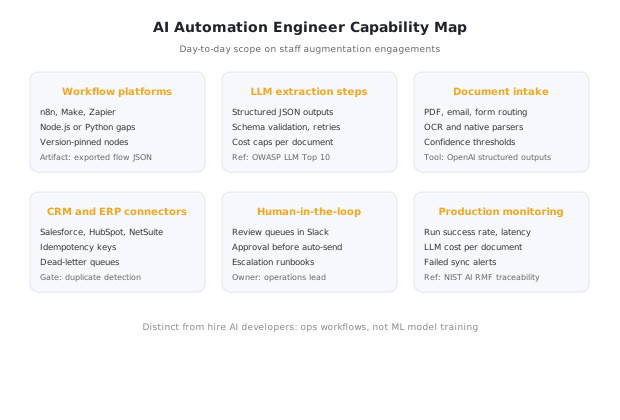
This role differs from hire AI developers because success is measured by workflow throughput and sync reliability, not offline model metrics. It differs from agentic coding developers because deliverables are operational flows and connector hygiene, not pull request velocity inside application repos. It differs from a generic integrator because judgment spans LLM guardrails aligned with the OWASP LLM Top 10, PII boundaries, and runbooks ops can execute without the original builder.
When companies hire AI automation developers
Five situations cover most discovery calls. Yours may combine two.
Ops leads drowning in manual handoffs
Spreadsheets, email threads, and orphaned Zapier zaps. Staff augmentation bridges to documented workflows with monitoring, not another demo that fails when volume doubles.
CTO inheriting brittle consultant automations
Flows that fail on edge-case payloads, LLM steps with no schema validation, no written rollback path. You need a calm audit before anyone suggests a greenfield rebuild.
Revenue teams waiting on document processing
Quotes, POs, and contracts stuck in inboxes while CRM records lag. You need intake, extraction, human review, and sync without a six-month platform project.
Regulated environments with automation evidence gaps
SOC 2, HIPAA, or financial audit windows. You need change logs from approval to production run and tested failure paths, not a maturity slide deck.
Operations lead without automation bandwidth
A head of ops owns vendor relationships and SLAs but cannot also refactor twelve Make scenarios while running hiring loops. Staff augmentation adds execution capacity without reorganizing the department chart.
The Workflow Automation Readiness Test
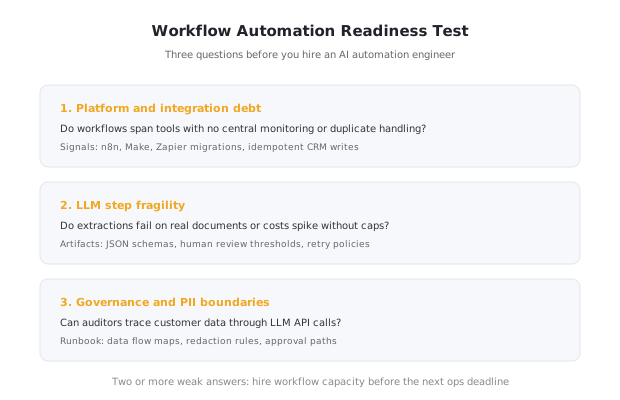
Before we recommend a hire shape, we run three questions we call the Workflow Automation Readiness Test. If two or more answers are weak, you need automation engineering capacity before the next ops deadline depends on new flows.
- Platform and integration debt: Do workflows span multiple tools with no central monitoring or duplicate handling? We overweight candidates who have migrated chains between n8n, Make, or Zapier and can show idempotent CRM writes.
- LLM step fragility: Do extractions fail on real documents or costs spike without caps? We prioritize engineers who enforce JSON schemas, human review thresholds, and retry policies drawn from production logs.
- Governance and PII boundaries: Can auditors trace customer data through LLM API calls? We bias toward builders who document data flows and explain tradeoffs to compliance teams without blocking every iteration, aligned with NIST AI RMF traceability ideas where governance teams ask.
We use the same test in vetting. Candidates who only describe tutorial automations rarely survive the live exercise where we ask them to fix a CRM sync that loops on duplicate records under time pressure.
How Siblings vets AI automation candidates
Resume keywords are cheap. We screen for signals that predict whether your workflows ship with monitoring in quarter one, not quarter three.
- Flow authorship: Can they show n8n or Make workflows others depend on, with exports, rollback notes, and incident write-ups where shareable?
- Integration hardening: Experience with idempotency keys, dead-letter queues, and alerts when vendor APIs change behavior.
- LLM step design: Structured outputs, cost caps, and human review thresholds instead of open-ended chat in production pipelines.
- Communication: Runbooks and connector notes that finance and sales ops can read without a technical translator.
- Red flags: Only demo prompts, no orchestration story, inability to explain duplicate handling, or treating every problem as "add another Zap."
Roughly three in ten applicants pass all gates. Profiles with regulated-industry workflow experience take a few extra days to source because the qualified pool is thinner.
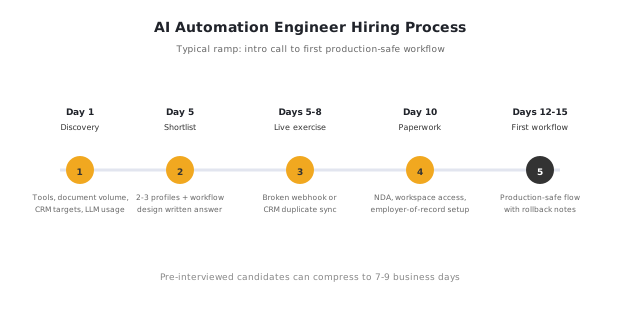
Typical ramp from discovery call to first production-safe automation flow.
Engagement models and pricing context
AI automation staff augmentation pricing depends on seniority, platform depth, document volume, and whether the engineer also owns CRM connector migrations. These bands reflect nearshore LATAM delivery on full-time monthly engagements:
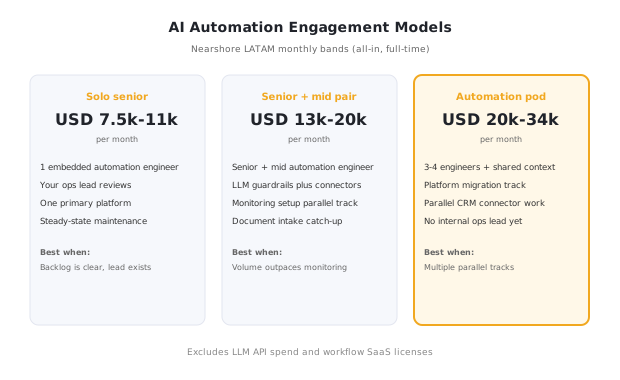
Single senior AI automation engineer
Best when you have an operations lead who can review every change and one primary automation platform. One engineer, your ceremonies, your workspaces.
Typical band: USD 7,500–11,000/month.
Senior plus mid pair
The senior sets LLM guardrails and flow architecture; the mid-level absorbs connector tickets and monitoring setup once context lands, usually by week four.
Typical band: USD 13,000–20,000/month.
Automation pod
When you need platform migration, parallel document intake, and CRM connector work under your lead without pausing SLA-sensitive flows. Compare with nearshore outsourcing when you want Siblings to own delivery end to end.
Typical band: USD 20,000–34,000/month.
Figures align with our published staff augmentation automation brackets. LLM API spend and workflow SaaS licenses stay on your billing.
Compared to freelancers, in-house hiring, and automation consultancies
vs. freelance marketplaces
Marketplaces optimize for narrow spikes under eighty hours. We trade listing speed for engineers who passed a live workflow exercise and can join your Slack with a fifteen-day notice window after the minimum term.
vs. in-house FTE
Full-time automation hires make sense when workflow ownership is a multi-year commitment. Augmentation fits headcount freezes, bridge roles while recruiting closes, or specialty spikes before audit season.
vs. automation consultancies
Project firms deliver a flow deck and leave. Embedded engineers work in your workspaces, your approval workflow, and your incident channel. If you want Siblings to own outcomes, that is a different conversation on our outsourcing pages.
Example engagement: field service dispatch automation
Illustrative scenario based on a composite US field service dispatch engagement. Numbers are representative, not a published client case study.
Clearpath Dispatch (composite) operates a regional HVAC and plumbing dispatch network. Quote requests arrived by email and web form; coordinators retyped details into ServiceTitan while Salesforce opportunity stages lagged by a day. Twelve coordinators touched every rush job manually.
Siblings placed one senior AI automation engineer through staff augmentation in thirteen business days. Over eight sprints they migrated critical intake to n8n with LLM field extraction on quote PDFs, human review for low-confidence rows, idempotent writes to ServiceTitan and Salesforce, and Slack alerts on failed runs. Illustrative outcomes: median quote-to-schedule time dropped from same-day manual entry to under two hours for standard jobs; failed syncs surfaced in Slack before coordinators opened dashboards; compliance reviewers received a documented data flow map for customer PII touching LLM APIs.
For a published reference with platform engineering depth, see the NetApp platform engineering case study.
What changed for ops automation teams in 2025–2026
Structured LLM outputs replaced open-ended chat steps in most production briefs. Automation engineers now default to JSON schemas, eval sets on real documents, and cost caps per run.
n8n self-hosting grew as teams wanted workflow definitions in their own repos with audit trails, not only SaaS dashboards. Migration from Zapier or Make appears in most mid-market discovery calls.
Human-in-the-loop as default became baseline for regulated buyers. Automatic sends without review queues are rare in scopes we accept; ops leads sign off on thresholds explicitly.
Connector fragility returned as vendors tightened API rate limits. Idempotency, backoff policies, and vendor change alerts are part of every vetting exercise, not optional nice-to-haves.
Risks and how we reduce them
- Production fragility risk: Week one includes pairing on a read-only staging run so workspace access and rollback rules are verified before customer-facing changes.
- Shadow automation risk: We refuse engagements where production flows bypass your documented approval path.
- PII and API key risk: Least-privilege connectors, NDAs before production data access, keys in your vaults not ours.
- Communication risk: LATAM overlap with Eastern through Pacific is real time in Slack. EU-hours coverage is staffed explicitly when you ask in the brief.
- Continuity risk: Exported flow definitions, runbooks, and handover notes live in your wiki or repo, not a vendor portal.
- Vanity demo risk: Monthly scorecard on successful runs per day, mean time to recover failed syncs, review queue depth, and LLM cost per document processed.
OUR STANDARDS
What "done" means when you hire AI automation developers through Siblings.
- Workflows are versioned: Exports checked in or documented, blast radius stated, rollback path named before production cutover.
- LLM steps have schemas and caps: Structured outputs, retry limits, cost ceilings, and human review thresholds your governance team approves.
- Connectors are idempotent: Duplicate detection, dead-letter queues, and alerts when syncs fail instead of failing silently.
- Honest scope advice: If a platform rip-and-replace will cost more than incremental hardening, we say so before the sprint starts.
Frequently asked questions
Buyer objections we answer on discovery calls when teams evaluate AI automation staff augmentation.
Hiring from Argentina? See the Argentina mirror of this page (separate site, same engagement model).
CONTACT US
Tell us about your workflow tools, document volume, and CRM targets. We will shortlist accordingly.