AI Workflow Automation Development Services
Operations teams are being asked to automate invoice matching, vendor onboarding, ticket triage, and claims intake with LLM steps that actually write back to ERP and CRM systems. Most internal prototypes stop at a chat demo or a brittle Zapier chain. This page explains how Siblings Software outsources production AI workflow automation: orchestration, integrations, human review gates, eval coverage for LLM steps, and handoff your ops team can run.
This is for VPs of operations, platform engineering leads, and CTOs evaluating a complete delivery partner, not a single embedded hire. If you need individuals inside your sprint board, see our AI automation developer staff augmentation page. If the core problem is unstructured PDF and scan extraction rather than multi-system orchestration, see intelligent document processing development. If you need customer-facing autonomous agents, see AI agents development.
Siblings Software is a software outsourcing company based in Miami with engineering teams in Argentina. We have shipped outsourced software since 2014 across healthcare, finance, logistics, and B2B SaaS.
What AI Workflow Automation Covers
AI workflow automation is the engineering work of moving a multi-step business process across systems with one or more LLM steps in the middle. Typical pattern: ingest from email or a portal, classify the document or ticket, extract structured fields with a model, score confidence, route low-confidence rows to a human reviewer, then write to NetSuite, Salesforce, or ServiceNow with idempotent APIs and an audit log.
That is different from buying another SaaS seat. You own the orchestration, the prompts, the exception queues, and the rollback story. It is also different from a standalone AI agent that decides its own tool path. Workflows have named owners, SLAs, and compensating transactions when a step fails mid-flight.
We build on orchestrators your team can operate: Temporal for durable execution, n8n or custom services where integration speed matters, and LangGraph when reasoning density is high but the tool surface stays small.
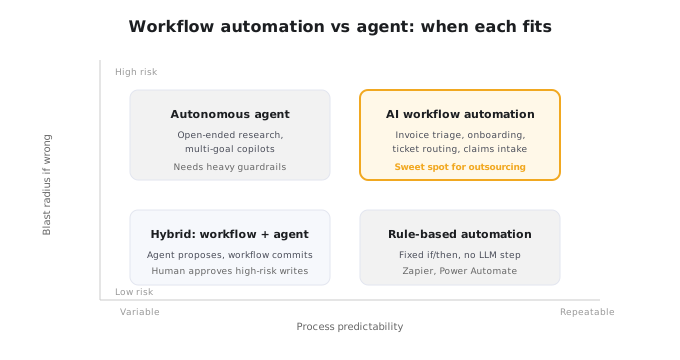
Most back-office automation belongs in the workflow quadrant: repeatable steps, bounded writes, human approval on exceptions.
Who This Service Is For
Teams with real transaction volume, messy exceptions, and systems that predate the latest AI launch keynote.
Finance and AP ops
Invoice intake from email and vendor portals, three-way match exceptions, PO variance routing, and payment approval queues tied to your ERP.
Support and IT operations
Ticket classification, priority scoring, suggested resolutions, and auto-routing across Zendesk, Jira, or ServiceNow with escalation when confidence drops.
HR and vendor onboarding
Document collection, ID verification handoffs, policy acknowledgments, and provisioning triggers across HRIS and ITSM with PII boundaries enforced.
Insurance and claims
First notice of loss intake, adjuster assignment rules, medical or repair estimate extraction, and fraud flags sent to a review desk before claim updates.
Logistics and field ops
Work order creation from unstructured requests, technician dispatch, parts lookup, and status sync across fleet and facilities platforms.
B2B SaaS platform teams
Embedding workflow automation inside your product for customers: configurable pipelines, tenant-scoped credentials, and usage metering on LLM steps.
Typical Project Scenarios
Five situations that show up on almost every discovery call. Each maps to a bounded MVP we can scope in the first week.
Replace a fragile no-code chain
Your ops team built invoice routing in a visual automation tool. It worked until vendor PDF layouts changed and writes started duplicating rows in NetSuite. We rebuild the same flow with versioned orchestration, structured extraction, and compensating deletes on failure.
Add LLM steps to an existing RPA job
UiPath or similar bots handle login and navigation. The variable part is reading unstructured attachments. We insert an LLM extraction service with confidence thresholds and keep the RPA bot for systems without APIs, or replace the bot once connectors are stable.
Unify three intake channels
Email, web form, and EDI feed the same process but with different teams touching each channel. One workflow, one exception queue, one write path to your ERP.
Stand up a human review console
Models extract well enough to cut manual work in half, but not enough to auto-post payments. We ship a reviewer UI with keyboard shortcuts, audit reasons, and SLA timers so exceptions do not sit in a shared inbox.
Prepare for compliance review
Regulated buyers ask who approved each automated write. We map flows to the OWASP LLM Top 10, document PII paths, and pair with our LLM evaluation engineering practice when you need scored regression gates on extraction quality.
Scale from one workflow to a platform
First workflow proves ROI. Second and third share observability, credential vaulting, and a template library. We architect for that on day one so you are not rebuilding auth for each new process.
How Delivery Works
Six phases, usually six to twelve weeks for a first production workflow. Shadow mode before full cutover is non-negotiable on writes that touch money or customer records.
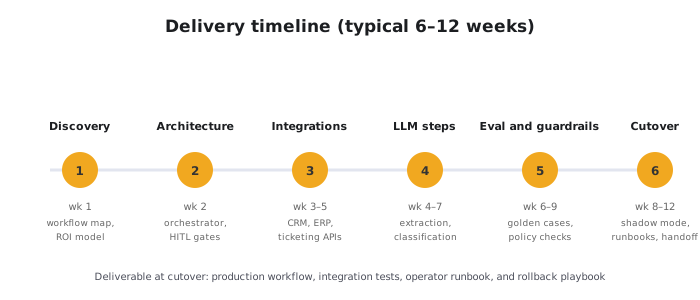
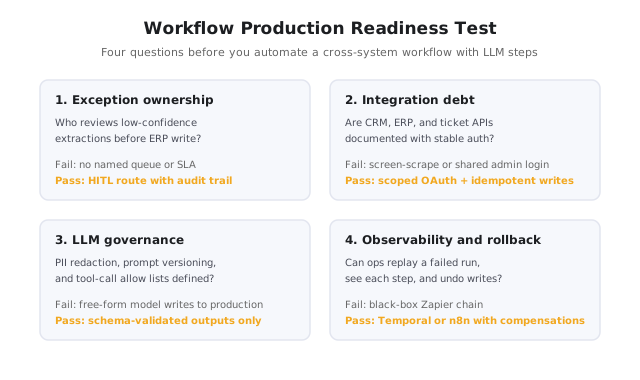
Discovery maps the as-is process, measures exception rates, and runs the Workflow Production Readiness Test shown in the hero diagram. If integration debt or exception ownership fails, we fix that before model work.
Architecture picks the orchestrator, defines idempotency keys, designs the human queue, and drafts the observability schema: run ID, step latency, model version, confidence score, reviewer ID.
Integrations land first with contract tests against sandbox APIs. We do not wire LLM steps to production credentials until connectors pass replay tests.
LLM steps use structured outputs, not free-form prose, for anything that feeds a write API. Prompts are versioned. Golden cases cover layout variants your ops team already complains about.
Eval and guardrails add regression suites on extraction fields, PII redaction checks, and tool permission boundaries. Pairs with LLM guardrails development when the same squad owns policy enforcement, and with AI code security when internal agents touch application repositories.
Cutover runs shadow mode beside manual processing, compares outcomes for two to four weeks, then flips traffic with a rollback switch documented in the runbook.
Team Composition
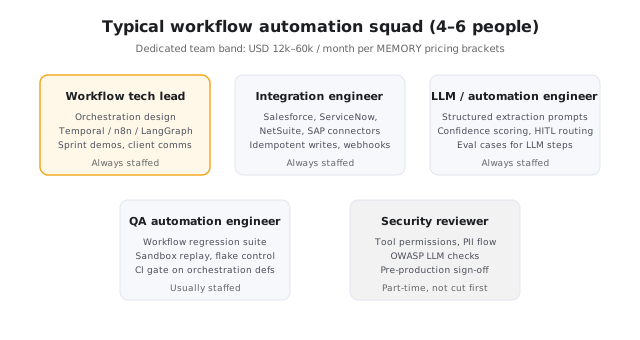
A four- to six-person squad is the usual shape for a first workflow. The integration seat and the security reviewer are the two roles vendors cut to win on price. Those are also the roles that determine whether production writes stay safe when PDF layouts change.
For ongoing expansion after launch, the same squad can run as a dedicated AI development team on a monthly retainer. For a single connector or prompt specialist inside your org, staff augmentation is the better fit.
Project, dedicated team, or staff augmentation depending on how much of the workflow platform you want us to own.
Pricing and Engagement Models
Project-based
Fixed scope for one workflow MVP: orchestration, integrations, HITL queue, eval cases, runbooks. Typical duration six to twelve weeks. Budget bands align with our published project-based outsourcing range of USD 15k to 120k; AI workflow builds with multiple integrations often land in the USD 25k to 120k band after discovery.
Dedicated team
Ongoing squad owning a workflow portfolio: new processes, connector maintenance, model upgrades, on-call for failed runs. USD 12k to 60k per month for four to six people depending on seniority mix and security review load.
Staff augmentation
Embed one or two automation engineers into your platform team when you already own architecture and need hands on Temporal, n8n, or LangGraph. USD 4k to 9k per month per engineer on standard brackets; AI automation specialists often run toward the top of that band.
Compared With In-House Hiring, Freelancers, and Agencies
Outsource when
- You need the first production workflow in a quarter, not after a six-month hiring cycle for scarce integration-plus-LLM talent.
- Your internal team knows the business process but not Temporal, idempotent ERP writes, or eval gates on extraction.
- Compliance wants a third party to document PII flows and rollback before auto-posting invoices.
- You are planning three or more workflows and want shared platform components from the start.
Keep it in-house when
- You already run a mature integration platform team and only need a short prompt-tuning sprint.
- The process is fully deterministic with no LLM step and no cross-system writes.
- A vendor SaaS product covers eighty percent of your volume with acceptable exception handling.
Freelancers can prototype quickly. They rarely stay for on-call, connector drift when Salesforce changes an API, or the second workflow that shares auth with the first. Agencies that sell strategy decks without shipping runbooks are the other common dead end.
Illustrative Scenario: Ironcrest Facilities Work Order Automation
The following is a composite illustrative scenario, not a published client case study.
The situation
Ironcrest Facilities manages commercial HVAC and electrical maintenance for mid-rise buildings across the US Southeast. Property managers email work requests, tenants use a web form, and the dispatch desk retypes everything into ServiceNow before technicians see jobs in the field app. Peak summer volume meant a forty-eight-hour backlog and duplicate work orders when the same leak was reported twice with different wording.
Their CIO had approved a pilot using a generic chat assistant. Technicians liked asking questions, but nothing wrote back to ServiceNow with correct site codes. Finance blocked auto-posting until exception ownership was documented.
What we would deliver
A nine-week project with a five-person squad: workflow lead, integration engineer, LLM engineer, QA automation, and part-time security reviewer.
- Unified intake workflow on Temporal ingesting email, web form, and API payloads.
- Classification and site-code extraction with structured JSON output and confidence thresholds.
- Human review queue for low-confidence or high-priority emergency tickets with four-hour SLA.
- Idempotent ServiceNow create and update with deduplication on building plus issue fingerprint.
- Shadow mode for three weeks comparing automated vs manual dispatch decisions before full cutover.
Expected outcomes in a scenario like this: manual retyping time down sharply for routine requests, duplicate work orders reduced when dedup rules hold, and a runbook the dispatch lead can execute without calling engineering for every connector error.
Risks and How We Reduce Them
Silent write corruption. Models return plausible JSON with wrong totals. Mitigation: schema validation, dual-field checksums on money fields, shadow mode, and automatic hold when confidence drops below threshold.
Integration drift. SaaS APIs change without warning. Mitigation: contract tests in CI, sandbox replay weekly, pinned API versions where vendors allow it.
Exception queue starvation. Humans ignore the review inbox. Mitigation: SLA timers, escalation to named backup, weekly sampling audit on auto-approved rows.
PII leakage into model logs. Mitigation: redact at ingest, separate logging streams, retention policies aligned with your DPA. We follow OWASP LLM guidance on input handling and tool permissions.
Vendor lock-in on orchestration. Mitigation: exportable workflow definitions, infrastructure-as-code, and documentation that does not require our SaaS login to operate.
Handoff failure. Mitigation: paired on-call weeks, recorded runbooks, and explicit ownership transfer checklist before we step down to advisory hours.
Questions buyers ask before the first discovery call
Frequently Asked Questions
Workflow automation follows a defined sequence with deterministic checkpoints: ingest a document, classify it, extract fields, route exceptions to a human queue, write to ERP. An autonomous agent chooses its own path across tools with less structure. Workflows fit invoice processing, onboarding, ticket triage, and claims intake where you need audit trails and rollback. Agents fit open-ended research or copilots where the goal shifts per session. Most production programs use workflows for back-office automation and agents for customer-facing surfaces.
Common connectors include Salesforce, ServiceNow, NetSuite, SAP, Microsoft Dynamics, Workday, Zendesk, Jira, and custom REST or GraphQL APIs. We prefer OAuth-scoped service accounts and idempotent write patterns over screen scraping. If your integration layer is immature, we scope a connector sprint before LLM steps go live.
We pick based on your stack and reliability needs. Temporal for long-running workflows with compensation logic. n8n or custom Node services for faster MVPs with strong integration catalogs. LangGraph when the workflow is mostly LLM reasoning with a small set of tools. We avoid black-box SaaS chains for production writes unless your compliance team explicitly accepts vendor lock-in.
A single-workflow MVP with two to three LLM steps and two to three system integrations typically ships in six to ten weeks including shadow mode and operator runbooks. Multi-workflow platforms with shared observability and a human review console run ten to fourteen weeks. Timelines stretch when API access, security review, or sandbox data are slow to arrive.
Project-based builds follow the same brackets as other outsourcing pages on siblingssoftware.com: bounded MVPs often land in USD 25k to 120k depending on integration count, compliance review, and number of LLM steps. Dedicated squads run USD 12k to 60k per month for ongoing workflow expansion. We confirm pricing after discovery once we know your systems, exception volume, and whether you need managed operations after launch.
You do. Workflow definitions, integration adapters, prompts, eval cases, and infrastructure-as-code ship to your repositories. We document rollback steps and train your ops team on the human review queue. Managed operations are optional, not a requirement to keep the system running.
Yes. Delivery teams are based in Córdoba, Argentina, with overlap on US East Coast business hours. Workflow projects need tight iteration with operations and integration owners, so same-day feedback on connector specs and exception routing matters as much as it does for product engineering.
Related Services
Contact Us
Schedule a call to scope your first workflow.