Hire LLM engineers for embedded staff augmentation
· Typical time to first production-safe LLM change: 12 to 15 business days
Hire LLM engineers through Siblings Software when your US product team needs senior talent inside your repositories without a six-month search for scarce RAG and eval skills. Siblings Software is a Miami-led outsourcing company; engineers deliver from Argentina with four to eight hours of overlap with US Eastern business hours. This page explains the role, vetting on live retrieval and eval regressions, engagement models, monthly bands, risks, and when RAG development outsourcing or a dedicated AI development team fits better than individual seats.
Buyers evaluating hire LLM engineers usually need three answers on one screen: who owns eval gates before prompt changes ship, what embedded capacity costs per month in plain USD, and how you avoid the contractor who tunes demos while production retrieval rots. This lane is not classical ML staff augmentation, not ops workflow automation, and not IDE agent orchestration. For the parent service see staff augmentation; for timezone context see nearshore developer hiring. When you want Siblings to own eval program design end to end, compare LLM evaluation engineering and LLM guardrails development from the same leadership team.
Reviewed by Javier Uanini, Founder and CEO, Siblings Software. Last reviewed 16 October 2026.
Prefer numbers before a call? Jump to monthly pricing bands for embedded seniors, pairs, and small pods.
What LLM engineers do in your product team
RAG, evals, guardrails, and production APIs inside your codebase.
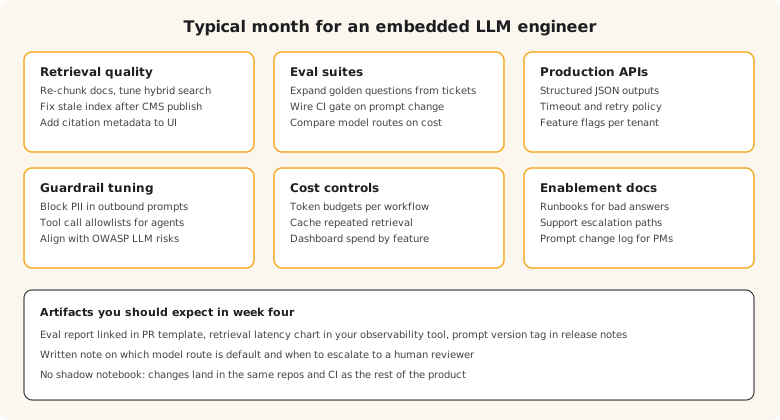
An embedded LLM engineer is not a prompt freelancer. In a typical month they might refresh chunking after a policy CMS publish, extend golden-set evals that block regressions in CI, add schema-validated JSON to a copilot endpoint, tune guardrails after a support escalation, and document default model routes per tenant. The diagram below shows parallel tracks; your mix depends on launch pressure and how mature your eval harness is today.
Retrieval and RAG pipelines
Hybrid search, rerankers, citation metadata, and index refresh jobs after ticket or document updates. Work stays in your vector store and application repos, aligned with your RAG architecture rather than side notebooks.
Eval harnesses and merge gates
Golden questions sourced from support tickets, regression suites on prompt changes, and CI gates that fail when user-visible quality drops. For serving and registry gaps see MLOps engineer staff augmentation.
Structured LLM APIs
Schema-validated outputs, timeout and retry policies, feature flags per tenant, and integration with OpenAI, Azure OpenAI, Anthropic, or Bedrock using your keys and data boundaries.
Guardrails and observability
PII filters, tool allowlists for agents, trace spans for LLM calls, and cost attribution dashboards your finance team can audit. Policy-heavy launches may also use LLM guardrails development as a project lane.
When US companies hire LLM engineers through us
Four situations cover most discovery calls; yours may combine two.
Copilots shipped without eval discipline
Demos looked fine, support escalations climbed, and no golden-set eval blocks prompt regressions in CI. Staff aug adds engineers who live in retrieval and eval repos while you close a full-time hire.
Inherited RAG from a vendor sprint
Chunking ignores tables, embeddings never refresh, and nobody wrote rollback steps when a model route changes. You need a calm audit and production fixes without freezing the roadmap.
Security or legal wants guardrail evidence
Traceability on prompts, tool calls, and human review paths before a public launch. Embedded engineers pair with your leads to wire guardrails aligned with OWASP LLM Top 10 risks without freezing velocity.
LLM API bills outran usage
Token spend grew because routing and caching were never owned. Engineers embed to add attribution dashboards, semantic cache where it helps, and eval-gated model downgrades without silent quality collapse.
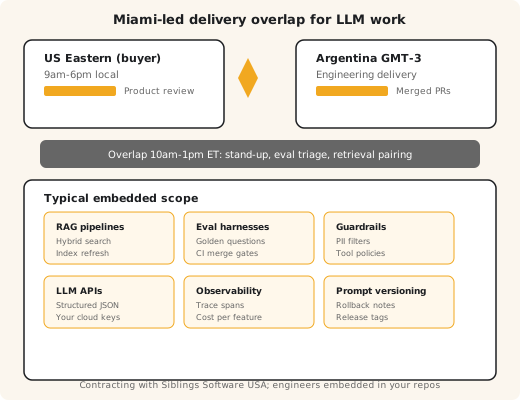
The overlap diagram below shows how Miami-led contracting and Argentina engineering time align for daily collaboration on those problems.
How Siblings vets LLM engineers
Resume screens miss failures that show up in week three.
Before anyone joins your stand-up, candidates submit a written scoping answer on a small RAG or eval design question, then complete a ninety-minute live session on production-shaped work: stale retrieval after a publish, evals that pass while answers fail, or structured outputs that break on one locale. We check English communication with product leads, whether they reach for eval evidence before prompt tweaks on money paths, and whether they can read your vector index configuration. Red flags: treating prompts as the only artifact, needing a greenfield demo to show value in week one, or inability to explain rollback for a model route change. Roughly one in five bench profiles reaches a client shortlist.
We align practice with the OWASP LLM Top 10 and provider guidance such as the OpenAI production best practices guide, not notebook-only workflows.
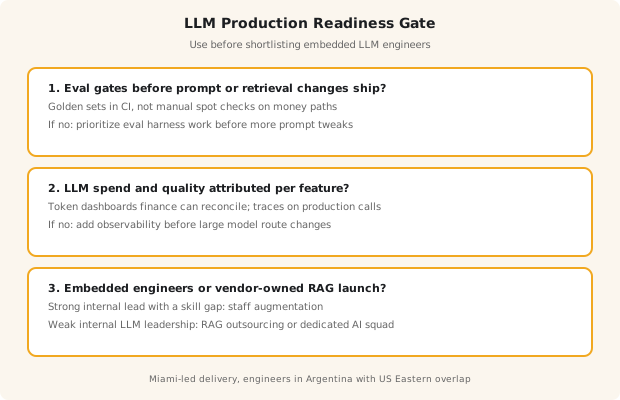
The LLM Production Readiness Gate
Three questions we reuse on discovery calls before we shortlist.
- 1. Do eval gates run before prompt or retrieval changes ship? Manual spot checks on money paths usually mean you need harness work before more staff aug seats.
- 2. Can you attribute LLM spend and quality per feature? If not, finance will see surprises before engineering does. We sequence tracing and attribution before large route changes.
- 3. Do you need embedded engineers in your rituals or a vendor-owned launch? Weak internal LLM leadership points toward RAG development outsourcing or a dedicated AI development team. Strong internal leadership with a skill gap points toward staff augmentation on this page.
Engagement models and monthly ranges
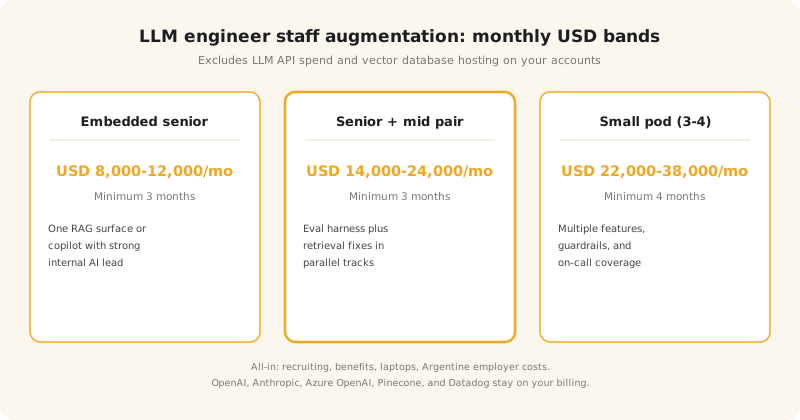
Published bands help you budget a quarter without a pricing mystery tour.
Embedded senior
One senior in your ceremonies and code review rotation. Strong when your engineering culture is healthy and you need throughput without re-teaching basics.
Monthly: USD 8,000 to 12,000. Minimum: three months.
Senior + mid pair
The senior sets quality guardrails; the mid-level absorbs tickets once context lands, usually by week four. Common when you want sustained velocity across retrieval and eval tracks.
Monthly: USD 14,000 to 24,000. Minimum: three months.
Small pod (three to four engineers)
Covers vacations internally and can split retrieval rebuild from guardrail and eval expansion under your product lead. For a vendor-owned roadmap, a dedicated AI development team is usually the better commercial shape.
Monthly: USD 22,000 to 38,000. Minimum: four months.
Figures include recruiting, benefits, laptops, and employer costs. LLM API spend, vector databases, and observability SaaS stay on your accounts.
How hiring an LLM engineer through us works
Short steps that end with you meeting the person who will commit.
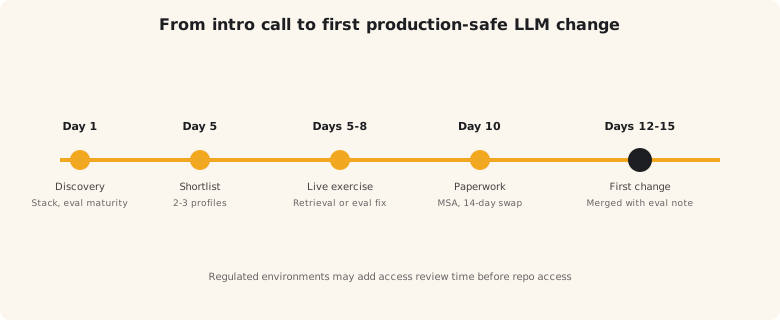
- Discovery (day 1). Stack, team topology, eval maturity, budget envelope. We say no when we are the wrong partner.
- Shortlist (by day 5). Two or three profiles plus a written answer to a scoped RAG or eval design question.
- Live exercise (days 5 to 8). Ninety minutes with your tech lead on retrieval regression, eval failure, or structured output breakage.
- Paperwork (days 8 to 10). Master services agreement, monthly statement of work, fourteen-day swap clause in plain language.
- First merged change (days 12 to 15). Onboarding pairs on a small production-safe change so you see integration speed, not slide decks.
LLM engineers with us versus freelancer, in-house, or large offshore bench
Each option wins sometimes.
Freelance marketplaces
Win on narrow spikes under roughly eighty hours. Lose on continuity, eval ownership, and repository hygiene when the incentive is ticket throughput.
In-house hiring in the US
Wins on five-year ownership. Loses on funnel length and regret cost when the hire misses at month six while incidents continue.
Large offshore agencies
Win when you need many mid-level seats with a PM layer. Lose when RAG and eval depth are treated as change-order territory or when the interview engineer is not the engineer in the repo.
Where we sit
Miami-led contracting, senior bench in Argentina, US Eastern overlap, fifteen-day notice after the minimum, and the person you interview is the person who commits.
Illustrative composite: policy copilot hardening
Anonymised composite scenario. Not a named case study with verified metrics.
Context. A US insurtech team shipped an internal policy copilot on a thin retrieval index and spreadsheet QA. Underwriters stopped trusting answers after endorsement PDFs updated without re-indexing.
What we did. Embedded senior plus mid LLM engineers refreshed chunking for tables, wired golden-set evals into CI, and added citation metadata in the UI so reviewers could open source paragraphs.
Outcome. No fabricated percentage claims here. The team gained eval gates before prompt changes and a written runbook for index refresh. For published platform API delivery see the NetApp case study.
At a glance
Model: LLM staff augmentation
Scale: senior plus mid pair
Focus: RAG, evals, citations
Risks of embedding LLM engineers and how we reduce them
Interview star, week-three stall
Mitigation: live exercise on real LLM code, fourteen-day swap window, explicit day-fourteen check-in with your lead.
Shadow contractor behavior
Mitigation: engineers join your reviews both directions, not only outbound pull requests in a side lane.
Knowledge leaves with the engagement
Mitigation: ADRs for non-obvious calls, runbooks for jobs we touch, handover notes at month three even if you extend.
Prompt tweaks without eval evidence
Mitigation: monthly scorecard on quality regressions caught in CI, token spend per feature, and open incidents tied to LLM routes.
Frequently Asked Questions
Senior LLM engineers employed full-time by Siblings and embedded in your team. They join your stand-ups, open pull requests in your repositories, extend RAG pipelines and eval harnesses, and work in your Slack or Microsoft Teams. We cover recruiting, payroll, hardware, benefits, and employer obligations. You keep model policy, data custody, and intellectual property. Typical scope spans retrieval tuning, golden-set evals, structured LLM APIs, guardrails, prompt versioning, and observability for spend and quality regressions.
A single senior LLM engineer is usually USD 8,000 to 12,000 per month all-in. A senior plus mid pair lands around USD 14,000 to 24,000 per month. A three-to-four person pod with shared product context is typically USD 22,000 to 38,000 per month. Figures assume a full-time month, include recruiting and local taxes, and exclude LLM API spend, vector databases, and observability SaaS so you keep billing and data custody.
Most engagements reach a first production-safe LLM change in roughly 12 to 15 business days: discovery on day one, a two-or-three-person shortlist by day five, a ninety-minute live exercise on retrieval or eval regression before day eight, paperwork by day ten, then onboarding with your product or platform lead. Regulated environments can take longer when access reviews are required.
The last gate is a live session on production-shaped LLM work: stale retrieval after a CMS publish, evals that pass while user answers fail, or structured outputs that break on one locale. We watch for eval discipline, honest pushback when a prompt tweak is the wrong fix, and scars from real launches. Roughly one in five bench profiles reaches a client shortlist. If the match is wrong in the first fourteen days, we replace the engineer at no placement fee with overlap for handover.
A solo senior fits one copilot surface, mature evals, and a lead who reviews every prompt change. A pod wins when retrieval rebuild, guardrail hardening, and eval expansion for a new locale run in parallel. For vendor-owned squads compare dedicated AI development teams.
LLM engineer staff augmentation focuses on product LLM features in your codebase. Hire AI developers covers classical ML and training pipelines. Hire AI automation developers covers n8n-style ops workflows. We say no on the discovery call when another lane is the better fit.
We replace the engineer at no placement fee during the first fourteen days and cover reasonable handover overlap. After that, either side may exit with fifteen days notice once the minimum term is met. We track fit with a simple day-fourteen question to your tech lead so quiet failure modes do not drift for a quarter.
Our standards for LLM work
- Eval before prompt. Golden sets and CI gates before ad-hoc prompt edits on production paths.
- Retrieval you can explain. Citations, chunk boundaries, and index refresh jobs documented for support teams.
- LLM calls you can trace. Spans, token attribution, and dashboards finance can reconcile.
- Guardrails with owners. PII rules, tool policies, and human review paths assigned, not implied.
- Model routes versioned. Prompt and routing changes tagged in release notes with eval evidence linked.
Hiring from Argentina? See the Argentina mirror of this page (separate site, same engagement model).
CONTACT US
Describe your copilot surface, eval maturity, and retrieval stack. We will shortlist accordingly.