LLM Cost Optimization Development Services
Token prices keep falling while AI bills keep climbing. That usually means the leak is in orchestration: retries, oversized RAG context, agent loops, and every request routed to the most expensive model. This page explains how Siblings Software outsources LLM cost optimization as engineering work: attribution, routing, caching, compression, eval gates, and handoff your platform team can operate.
This is for CTOs, ML platform leads, and product directors evaluating a complete delivery partner, not a dashboard subscription alone. If you need embedded engineers inside your sprint board, see MLOps engineer staff augmentation. If the immediate problem is tracing and incident response, see AI agent observability development. If quality regression is the blocker before any model downgrade, see LLM evaluation engineering.
Siblings Software is a software outsourcing company based in Miami with engineering teams in Argentina. We have shipped production AI systems since 2014 across B2B SaaS, finance, healthcare, and support platforms.
What LLM Cost Optimization Covers
LLM cost optimization is the engineering discipline of reducing inference spend without shipping worse answers. The work spans how requests are attributed, which model handles each step, what gets cached, how much context enters the prompt, and whether agent loops have hard stop conditions.
That is different from buying another observability seat. Dashboards show the problem. Optimization changes routing tables, cache policies, batch jobs, and eval gates in your codebase. It is also different from cloud FinOps: AWS and Snowflake rightsizing does not fix a support copilot that sends every ticket to a frontier model with a 40-page system prompt.
We implement against the stack you already run: gateway middleware, OpenTelemetry spans, Redis or vector stores for semantic cache, and provider batch APIs where latency allows.
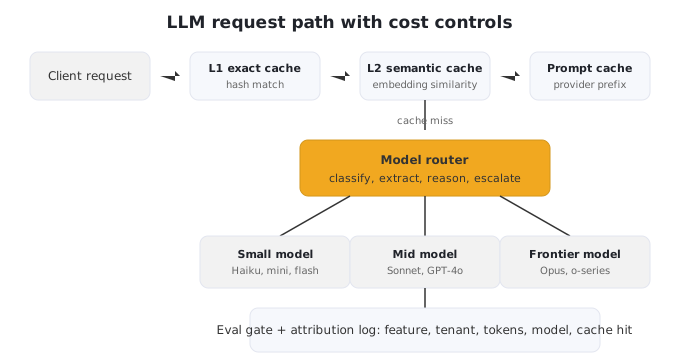
Most savings come from layered controls on the request path, not from negotiating a lower per-token list price.
Who This Service Is For
Teams with real production traffic, more than one LLM workflow, and a finance lead asking why the AI line item doubled after a feature launch.
B2B SaaS with AI features
Embedded copilots, summarization, and classification inside your product where per-tenant margins matter and one noisy customer can distort unit economics.
Agent and workflow platforms
Multi-step agents where tool calls, retries, and retrieval loops multiply token use faster than product teams forecast.
RAG-heavy search products
Knowledge bases where chunk count, rerankers, and oversized context windows dominate spend more than the final answer model.
Finance and ops automation
High-volume extraction and classification where batch endpoints and smaller models can replace synchronous frontier calls.
Internal platform teams
Central AI platform groups supporting multiple product squads that need shared routing, cache namespaces, and showback by feature.
Regulated buyers
Teams that need cost cuts with audit trails: which model version answered, what context was retrieved, and why a cheaper route was allowed.
Typical Project Scenarios
Five situations that show up on discovery calls when the AI bill is the agenda item, not the roadmap slide.
Post-launch bill shock
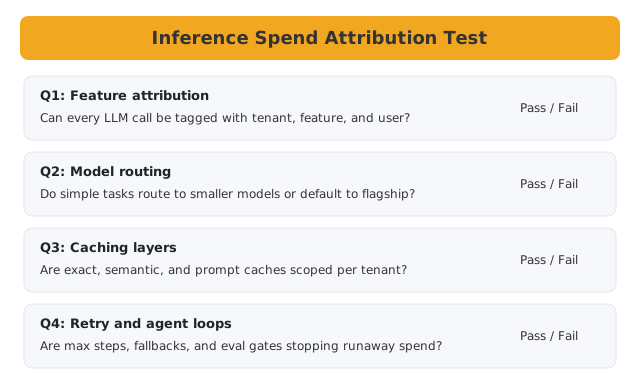
A copilot shipped on schedule. Finance sees a 3x API jump in sixty days. Usage attribution is missing, so product and platform teams argue about which feature caused it. We start with thirty-day spend baselines and the Inference Spend Attribution Test before touching models.
RAG retrieval bloat
Every question retrieves twelve chunks because the team feared hallucinations. Latency and input tokens climb together. We tighten retrieval policy, add reranker thresholds, and pair changes with eval cases from your RAG development pipeline.
Agent loop runaway
An internal agent retries tool calls until it succeeds or times out. Users love the demo. Finance hates the invoice. We add max-step budgets, cheaper planner models, and circuit breakers with logged reasons.
One-model-fits-all routing
Classification, drafting, and summarization all hit the same flagship endpoint because it was easiest in the prototype. We introduce task-based routing with quality gates so downgrade is deliberate, not hopeful.
Missing cache strategy
Support macros, policy snippets, and system prompts repeat on every request. We add exact-match cache, semantic cache with tenant namespaces, and provider prompt caching where your contracts support it.
Batch-eligible workloads on sync APIs
Nightly digests, backlog summarization, and offline eval replays still use real-time endpoints. We move eligible jobs to batch or queue workers without changing the user-facing SLA on interactive flows.
How Delivery Works
Eight to ten weeks for a first optimization pass on one product surface. Every cost change ships behind an eval gate so product does not trade a lower bill for silent quality regression.
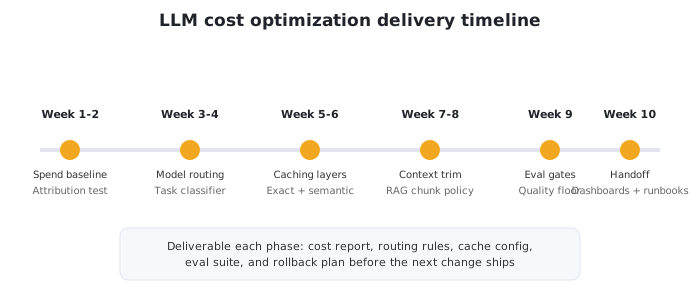
Baseline and attribution export provider invoices, align them with application logs, and tag requests by tenant, feature, and workflow. If Q1 of the Inference Spend Attribution Test fails, we fix telemetry before optimization work.
Routing design maps task types to model tiers. Classifiers and extractors move down. Reasoning and customer-facing drafts stay up. Routing rules live in version-controlled config, not scattered prompt files.
Caching implementation adds exact, semantic, and prompt cache layers with TTL policies per data sensitivity. Tenant isolation is explicit so one customer's cache never serves another.
Context compression trims system prompts, deduplicates examples, and caps retrieved chunks. For agent flows, we reduce tool output fan-out and log what was dropped.
Eval gates pair with our LLM evaluation engineering practice when you need scored regression on faithfulness, extraction accuracy, or safety checks before a cheaper model ships.
Handoff delivers dashboards, runbooks, and rollback steps. Your team owns thresholds after launch. We can stay on retainer for model-release tuning when providers change pricing or context limits.
Team Composition
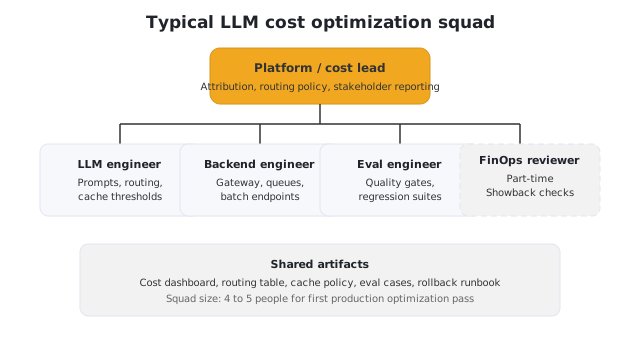
A four- to five-person squad is the usual shape. The eval engineer and FinOps reviewer are the roles vendors skip to win on price. They are also the roles that keep a routing change from becoming a support ticket spike two weeks later.
For ongoing tuning across multiple product lines, the same squad can run as a dedicated AI development team. For one specialist inside your platform group, MLOps staff augmentation is often the better entry point.
Project audit, dedicated squad, or staff augmentation depending on how much of the cost platform you want us to own.
Pricing and Engagement Models
Project-based
Fixed scope for one optimization pass: baseline, routing, caching, compression, eval gates, dashboards. Typical duration eight to ten weeks. Budget bands align with published project-based outsourcing of USD 15k to 120k; multi-workflow platforms with tenant isolation often land in the USD 25k to 120k band after discovery.
Dedicated team
Ongoing squad tuning routing as models change, onboarding new product features to shared cache namespaces, and reviewing monthly showback with finance. USD 12k to 60k per month for four to five people depending on workflow count and eval load.
Staff augmentation
Embed one or two platform or MLOps engineers when you own architecture and need hands on gateways, eval pipelines, or cache infrastructure. USD 4k to 9k per month per engineer on standard brackets; AI platform specialists often run toward the top of that band.
Compared With In-House Hiring, Freelancers, and Agencies
Outsource when
- You need a measurable bill reduction this quarter, not a six-month hiring cycle for scarce routing-plus-eval talent.
- Your team built the features but lacks time to instrument attribution and regression suites across every workflow.
- Finance wants showback by feature before approving the next AI roadmap item.
- You run multiple models and providers and need one routing policy, not three separate prompt folders.
Keep it in-house when
- Monthly LLM spend is still low and a single senior engineer can fix obvious prompt waste in a sprint.
- You already operate a mature AI platform with centralized routing and eval gates.
- The workload is a one-off prototype with no production traffic.
Managed FinOps-for-AI vendors can audit invoices. They rarely own the code changes in your gateway, RAG pipeline, or agent runtime. Freelancers can patch one endpoint. They rarely document rollback across ten workflows.
Illustrative Scenario: Maplewood Support Agent Copilot
The following is a composite illustrative scenario, not a published client case study.
The situation
Maplewood Support sells analytics software to mid-market B2B support teams. They shipped an agent-assist copilot that drafts replies from ticket history and a Confluence knowledge base. Adoption was strong. The OpenAI invoice tripled in ninety days.
Engineering could see total tokens in the provider dashboard but not which customer tier or UI surface drove spend. Every draft used the same flagship model with full ticket thread and eight retrieved articles, even for short password-reset questions.
What we would deliver
A ten-week project with a five-person squad: platform lead, LLM engineer, backend engineer, eval engineer, and part-time FinOps reviewer.
- Request attribution with tenant, feature, and workflow tags on every inference call.
- Task router sending classification and short-reply drafts to a smaller model; escalation path to frontier for complex threads.
- Semantic cache for repeated policy and macro questions with per-tenant namespaces.
- RAG chunk cap and reranker threshold tuned against fifty golden tickets from their eval set.
- Monthly showback dashboard finance can reconcile to the provider invoice.
Expected outcomes in a scenario like this: lower average cost per assisted ticket when routing and caching hold, faster replies on cache hits, and eval gates that block model downgrades when faithfulness scores drop.
Risks and How We Reduce Them
Quality regression after downgrade. Mitigation: eval gates on golden cases, shadow traffic comparison, and explicit rollback per routing rule.
Stale semantic cache answers. Mitigation: TTL by data class, cache bust hooks on knowledge-base publish, and periodic live-vs-cache sampling.
Cross-tenant cache leakage. Mitigation: namespace keys by tenant, no shared embeddings for customer-specific policy text, security review on cache storage.
False savings from batching. Mitigation: separate SLAs for interactive and offline jobs; finance reports show both cost and latency impact.
Attribution blind spots. Mitigation: OpenTelemetry conventions agreed in week one; no optimization ships until top workflows are measurable.
Vendor pricing changes. Mitigation: routing tables externalized from code, quarterly review cadence documented in the handoff runbook.
Questions buyers ask before the first discovery call
Frequently Asked Questions
Observability tells you what you spent and where latency spiked. Cost optimization is the engineering work that reduces spend without breaking quality: model routing, caching, context compression, batch endpoints, and stopping retry loops. Most teams need observability first, then optimization. We can deliver both, but this page is about changing the bill, not only charting it.
If you are under roughly USD 5k per month on LLM APIs, self-serve dashboards and a few prompt edits usually suffice. Between USD 10k and 50k per month, routing and caching changes often pay back a project in one to two quarters. Above USD 50k per month, attribution gaps, agent loops, and RAG overhead tend to dominate the bill and justify a dedicated squad.
Only if you swap models without eval gates. We route by task type, not by optimism. Classification, extraction, and routing decisions move to smaller models. Multi-step reasoning and high-stakes drafting stay on frontier models. Every routing change ships with a regression suite tied to your golden cases so quality drops block release.
We fit your stack. Common patterns include a gateway layer in your API service, Redis or a vector store for semantic cache, provider-native prompt caching where supported, and OpenTelemetry spans for attribution. We do not mandate a single vendor. If you already run Langfuse or Helicone, we extend those signals rather than rip them out on day one.
Eight to ten weeks for one product surface with three to five high-volume workflows. Week one and two establish a spend baseline and run the Inference Spend Attribution Test. Routing and caching land in weeks three through six. Eval gates and handoff finish the engagement. Multi-tenant platforms with separate RAG corpora per customer run longer.
Project-based optimization audits and implementation typically land in the USD 25k to 120k band on siblingssoftware.com project brackets, depending on workflow count, tenant isolation, and how many model providers you use. Dedicated squads for ongoing tuning run USD 12k to 60k per month. We confirm scope after reviewing thirty days of usage data.
You do. Routing tables, cache policies, eval cases, dashboards, and infrastructure-as-code ship to your repositories. We document rollback for every cost change. Managed tuning is optional if you want us to keep adjusting thresholds as models and prices change.
Related Services
Contact Us
Schedule a call to review your spend baseline.