Native iOS apps built end to end, from first brief to App Store release
Siblings Software builds native iPhone and iPad apps for companies that want a finished App Store product, not contractors to manage. We run discovery, turn your designs into SwiftUI, ship TestFlight betas, get the build through App Review and keep it healthy after launch. You own the Apple Developer account, the repository and the roadmap.
Miami headquarters, 250+ engagements since 2014, engineers across Latin America in US time zones.

Outsourcing the app vs hiring Swift capacity
Nearby pages, different buying decisions.
On this page we own delivery: scope, architecture, QA, App Store submission and the release calendar. The pages below fit when you keep that ownership and buy engineering capacity instead.
Swift language work
Choose Swift development outsourcing when the job is Swift code rather than an app release: a macOS utility, an SDK, server-side Swift or a legacy module cleanup.
Senior iOS engineers for your team
Choose hire iOS developers when you have an iOS lead and a release process and need one to five senior engineers on your board.
Feature throughput on an existing app
Choose iOS app developer staff augmentation when the app is live, your product manager runs sprints, and the gap is SwiftUI or UIKit throughput.
A long-running Swift squad
Choose a dedicated Swift development team when the roadmap runs past six months and you want the same people on your product quarter after quarter.
Need Android too? See our app development outsourcing hub or Android app development. For one shared codebase, read React Native development.
Who outsources an iOS app build
Four common situations.
Founders without a mobile lead
The web product has traction and the iPhone version keeps slipping. You need architecture calls made and code your first iOS hire can inherit. If the product is still unproven, MVP development scopes a smaller first release.
Product teams with an orphaned iOS backlog
The iOS app is stuck on an old deployment target, a half-finished SwiftUI migration or the original StoreKit API.
Regulated companies
Healthcare, finance and insurance buyers who need security questionnaires answered and App Privacy answers that match what the app collects.
Brands whose core business is not software
Retail and hospitality companies that need a flagship app, a fixed scope and a clean handover to a small internal owner.
What an iOS build includes
The parts often left for later.
Swift 6 and SwiftUI architecture
New apps start in the Swift 6 language mode with strict concurrency checking, SwiftUI with the Observation framework, and UIKit only where a screen needs it. Features live in Swift packages.
Design handoff to components
Figma files become a SwiftUI component library with color, type and spacing tokens. Screens are checked against the Human Interface Guidelines, and iPad layouts are flagged before anyone builds them.
StoreKit 2 and subscriptions
Paywalls, introductory offers and subscription groups on StoreKit 2, with entitlements confirmed on your server through the App Store Server API and Server Notifications. Flows are tested with StoreKit configuration files before sandbox.
Privacy manifests and labels
The app and each bundled SDK ship a PrivacyInfo.xcprivacy file declaring required-reason APIs such as UserDefaults. App Privacy answers in App Store Connect come from the real data flows, not memory.
Accessibility as acceptance criteria
VoiceOver labels, Dynamic Type at accessibility sizes, contrast and Reduce Motion are checked on every story, so the accessibility features you declare on the App Store are true.
TestFlight and release pipeline
Signed builds from Xcode Cloud or fastlane on every merge, internal TestFlight groups for your team, and external beta groups once Beta App Review approves the build.
You own the Apple Developer account, the code and the release calendar. We do the work that gets the app there.
How an iOS build runs
Standard timings, adjusted to your scope.
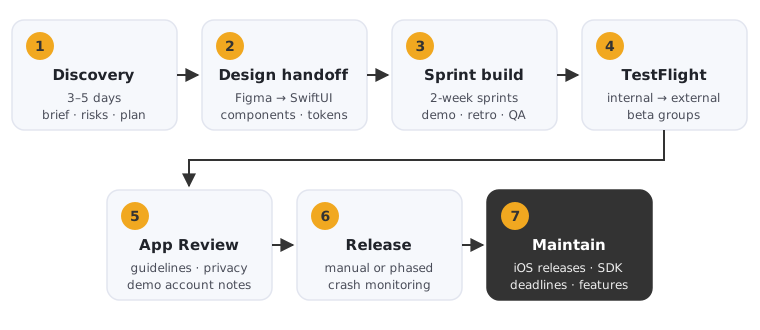
- Discovery, 3 to 5 days. User journeys, minimum iOS version, integrations, payments and personal data. You sign off a brief, a release plan and a risk list.
- Team assembly, 5 to 10 days. An iOS tech lead, one to three Swift engineers, QA and, when the API is ours too, a backend engineer. App Store Connect roles are set up in the same window.
- Design handoff and architecture. Component library, navigation, data layer (SwiftData or Core Data) and API contracts are agreed before feature work.
- Sprints. Two weeks each, with demo and retro. First deliverables land in weeks 3 to 4, usually as a TestFlight build on your own phones.
- Beta and App Review. External beta, review notes with a working demo account, privacy answers and screenshots prepared in parallel.
- Release. A manual release on your date. Later updates can use phased release, which spreads automatic updates over seven days and can be paused if crashes spike.
- Maintenance. The yearly iOS release, Apple's minimum Xcode and SDK requirement for uploads, dependencies and the backlog real users create.
App Store review: rejections we design around
Most rejections are predictable.
We read the App Store Review Guidelines during discovery and check these points before the first submission.
- App completeness (2.1). Reviewers need a working demo account and written steps for anything tied to hardware or location. Crashes and placeholder content end the review.
- In-app purchase (3.1.1). Digital content and subscriptions go through Apple's in-app purchase unless a storefront-specific rule applies. Those rules have shifted in the US and EU, so we check the current text before designing a paywall.
- Minimum functionality (4.2). An app that is mostly a wrapped website tends to be rejected.
- Login services (4.8). Third-party sign-in such as Google needs an equivalent privacy-focused option; Sign in with Apple qualifies.
- Data collection (5.1.1). Apps with account creation must offer account deletion inside the app, and permission prompts need a clear purpose string.
- Privacy manifests. Missing declarations for required-reason APIs or listed SDKs get flagged at upload. Apple's privacy manifest documentation lists what to declare.
When a rejection still happens, we answer in App Store Connect, fix, resubmit and log the cause so it does not return next release.
Native Swift or React Native for your app
We build both, so we oversell neither.
Native Swift is the better default when the app leans on Apple frameworks such as HealthKit, widgets and Live Activities, Apple Watch or Bluetooth accessories; when iOS users bring most of the revenue; or when you want new OS features the season Apple ships them.
A shared React Native codebase makes more sense when iOS and Android need parity on one budget and the interface is mostly content, lists and forms. Our rental-management app case study is an example: a fixed-scope, 12-week contract for iOS and Android apps in Expo and React Native, plus a Next.js API and admin panel. It is cross-platform, not native Swift, but its lesson applies to both: start store account procedures on day one, because approvals can take weeks. If you go native, Android usually follows as a separate Kotlin app against the same API.
Illustrative scenario: a subscription app from brief to release
A composite example, not a client story.
Picture a wellness company with a web product, approved Figma screens and no iOS engineers. Discovery sets iOS 17 as the minimum so SwiftData and Observation are available, picks StoreKit 2 with server-side entitlement checks, and limits HealthKit reads to two data types. A tech lead, two Swift engineers and a QA engineer deliver the first TestFlight build in week four. External beta opens once account deletion, the privacy manifest and VoiceOver labels pass QA; review notes include a demo account with a sandbox subscription.
Engagement models and pricing
Published ranges you can budget against.
Project-based build
$5k to $15k, 2 to 6 engineers, 1 to 6 months. The usual model for a defined first version.
Dedicated iOS team
$12k to $60k per month, 4 to 12 people, 6 to 24+ months, for a long roadmap.
Staff augmentation
$4k to $9k per developer per month, 1 to 5 specialists, when you keep delivery ownership.
Screen count, backend work, payments, offline sync and compliance set where a build lands. Every engagement includes a 2-week satisfaction guarantee and a 30-day notice to scale down.
Risks we plan for on outsourced iOS work
Specific to Apple platforms.
- Account custody. You hold the Account Holder role; certificates, profiles and API keys live in your accounts, and our roles are revocable.
- Scope drift. Every change request carries a cost and date impact before anyone builds it.
- Handover. Decision records, a README that builds on a clean Mac, and pull requests open to your engineers from sprint one.
- Platform deadlines. We track Apple's yearly upload requirements, so a new iOS version never blocks an urgent fix.
Frequently Asked Questions
Yes. We read the cited guideline, reproduce the issue on the reviewed build, and decide whether it needs a code change, a metadata fix or a reply in App Store Connect. The usual causes are missing demo access, in-app purchase rules, no in-app account deletion and privacy manifest gaps.
You do. All IP belongs to the client from day one. Your company enrolls in the Apple Developer Program as an organization, which requires a D-U-N-S number, and keeps the Account Holder role. We join your App Store Connect team with roles you can remove, and the repository lives in your GitHub or GitLab organization. We never publish your app under our account.
Native Swift wins when the app depends on Apple frameworks such as HealthKit, widgets or Apple Watch, or when iOS carries most of your revenue. React Native fits when both platforms need the same features on one budget. We build both and recommend one after discovery.
The first weeks after release surface crashes beta testers never hit, so every project plans a stabilization window. After that, most clients keep a smaller team for features, the yearly iOS release and Apple's annual Xcode and SDK upload requirement. If you hire your own iOS engineers, we hand over with documentation and paired sessions.
Discovery takes 3 to 5 days, team assembly 5 to 10 days, and first deliverables arrive in weeks 3 to 4. Project-based builds typically run 1 to 6 months with 2 to 6 engineers, in the $5k to $15k range; a dedicated team runs $12k to $60k per month. App Review and Apple account approvals sit outside the build schedule.
Yes. A short audit covers build reproducibility, crash reports, signing setup and dependency health. You get a written plan before anyone mentions a rewrite; most takeovers keep the existing code and fix the riskiest parts first.
Related services
Contact us
Tell us about the app and where it stands today.