Hire Cross-Platform Developers for Mobile App Delivery
You need engineers who ship React Native or Flutter code in production , not people who finished a tutorial last month. Siblings Software staffs cross-platform mobile developers from Latin America who overlap your US business hours, already work inside agile squads, and have shipped apps that real users depend on.
We handle sourcing, vetting, and onboarding. You get senior developers joining your stand-ups within two to three weeks, writing code against your backlog from day one.
- React Native, Flutter, and .NET MAUI engineers with 4+ years of cross-platform production work.
- Nearshore teams in Argentina and Colombia , same time zones as New York, Chicago, and San Francisco.
- Flexible engagement: one developer or a full pod with QA, design, and DevOps.
"Cross-platform fails when teams hire for the framework logo instead of the native module runway they need in month four."
Reviewed by Javier Uanini, Founder and CEO. Last reviewed 16 June 2026.
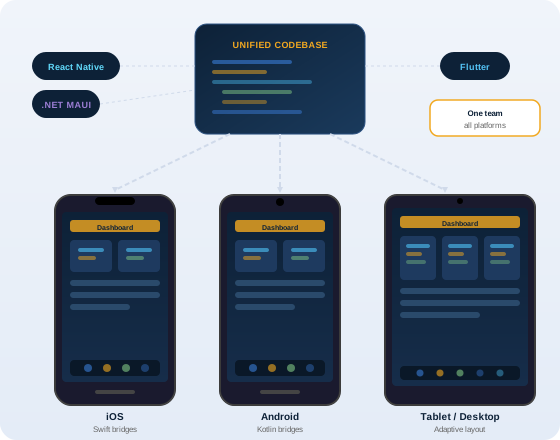
The Cross-Platform Fit Test
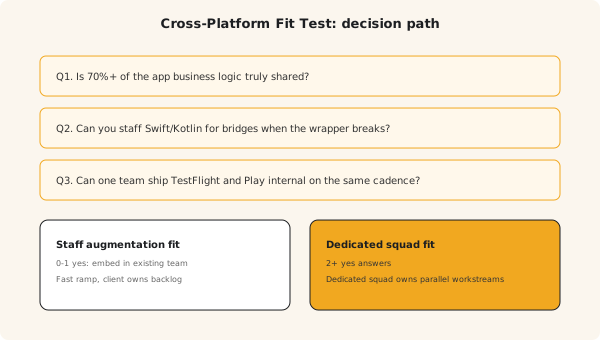
Shared logic ratio
Below 70% shared surface, cross-platform savings evaporate into bridge work.
Native module runway
BLE, PassKit, and Terminal need TurboModules, not plugin roulette.
Dual-store release train
One team ships TestFlight and Play internal on the same weekly cadence.
Store submission and device matrix on cross-platform teams
Privacy Manifest and data safety apply to RN and Flutter binaries. We version policy artefacts in repo and gate on real mid-range Android hardware plus two iOS generations back.
Who Hires Cross-Platform Developers (and Why)
Three scenarios we see every month , chances are, yours is one of them.
Startups scaling to both platforms
You raised a Series A or B, you have a working product on one platform, and you need to reach both iOS and Android users without doubling your engineering headcount. One codebase, one team, one release pipeline. Cross-platform frameworks let you move fast without maintaining two apps that drift apart over time.
Companies consolidating native apps
You're running a native Android app and need to launch on iOS within a quarter. Hiring and onboarding native iOS developers from scratch takes months. A cross-platform rewrite with React Native or Flutter lets you consolidate without starting from zero , and your Android team stays productive during the transition.
Enterprises building internal tools
Field service, logistics, warehouse management , these teams need Bluetooth, offline storage, camera integration, and push notifications across devices. They have a backend team but no mobile expertise. Cross-platform augmentation gives them mobile capability without building a permanent department.
If any of those sound familiar, we've probably worked with a company in your position before. The specifics vary , fintech, healthtech, retail, IoT , but the pattern is the same: you need experienced mobile engineers, and you need them soon.
React Native, Flutter, and .NET MAUI , What We Actually Staff
We don't staff generic "mobile developers" who dabble in everything. Our engineers specialize.
React Native
TypeScript-first developers who know the difference between Expo managed and bare workflows. They build native module bridges when the JavaScript layer isn't enough , Bluetooth, biometrics, in-app purchases. Our React Native engineers have worked with Expo Application Services for OTA updates, CodePush migrations, and Hermes optimization. Most have backend experience with Node.js, which means they troubleshoot API integration issues without waiting for your backend team.
Flutter
Dart developers who build with Riverpod or Bloc for state management, follow clean architecture patterns, and create adaptive layouts across phones, tablets, and desktop. Our Flutter engineers handle platform channels for native functionality, write integration tests with Patrol, and manage CI/CD pipelines with Codemagic or Bitrise. Several have published packages on pub.dev.
.NET MAUI
For teams invested in the Microsoft ecosystem, we staff C# developers experienced with MAUI for cross-platform desktop and mobile. These engagements are less common than React Native or Flutter, but we keep a bench of senior MAUI engineers available. Useful when your Windows desktop app needs a mobile companion.
Native depth when needed
Cross-platform doesn't mean "no native." Every non-trivial app eventually needs a native module, a platform-specific permission flow, or a workaround for an OS-level bug. We keep Swift and Kotlin specialists on hand so you don't hit a wall when React Native or Flutter falls short.
Stacks and tools we use daily
React Native, Expo, Flutter, .NET MAUI, Firebase, Supabase, GraphQL, REST, Fastlane, Bitrise, Codemagic, AWS Amplify, Azure DevOps, and bespoke Node.js or API backends. We also integrate with your existing tooling , Jira, Linear, GitHub Actions, Firebase App Distribution, TestFlight , rather than imposing our own.
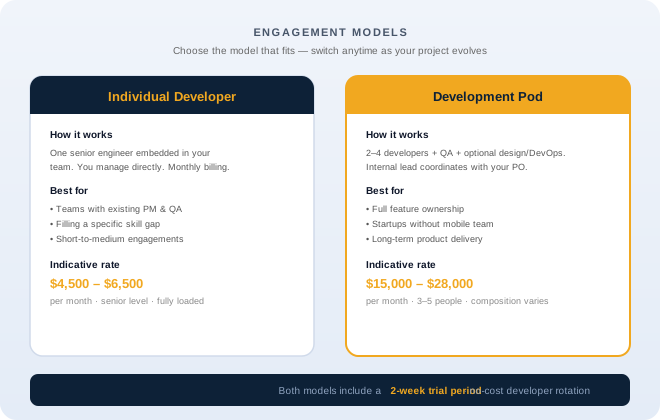
Engagement Models and Indicative Rates
Pick the model that fits your current need. You can switch as the project evolves.
Individual developer
One senior cross-platform engineer embedded in your team. You manage them directly, they follow your processes, they bill monthly. This works best when you already have a product manager, designer, and QA process in place , you just need more mobile hands.
Indicative rate: $4,500-$6,500/month for a senior React Native or Flutter developer. Fully loaded , no hidden management or overhead fees.
Development pod
A self-contained unit: two to four developers, one QA engineer, and optional design or DevOps support. The pod has an internal lead who coordinates with your product owner. You set priorities; we handle execution cadence, code reviews, and release mechanics.
Indicative rate: $15,000-$28,000/month for a three- to five-person pod. Composition and seniority mix affect the final number.
Both models include a two-week trial period. If the fit isn't right, we rotate the developer at no extra cost.
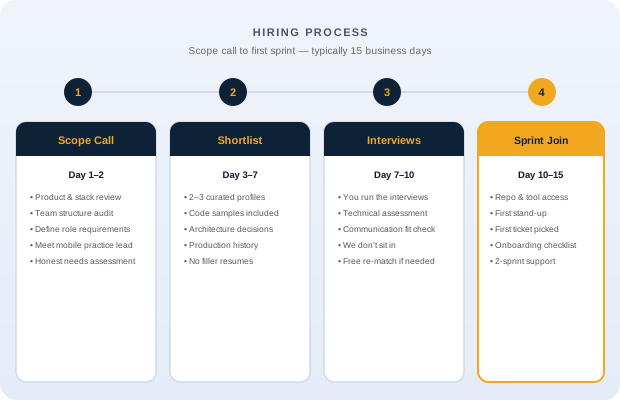
From First Call to First Sprint in Four Steps
01. Scope call
We learn about your product, tech stack, team structure, and what's blocking you. You meet our mobile practice lead and get an honest assessment of what kind of developer you actually need , which sometimes differs from what the job description says.
Day 1-2
02. Candidate shortlist
We send you two or three curated profiles with code samples, architecture decisions they've made, and a summary of their production experience. No filler resumes, no padding years of experience that don't match.
Day 3-7
03. Your interviews
You interview the candidates directly. We don't sit in. If none of them feel right, we go back to the bench , but that rarely happens because we pre-screen for your stack and communication style before sending profiles.
Day 7-10
04. Sprint integration
The developer joins your Slack, attends their first stand-up, gets repo access, and picks up a ticket. We provide an onboarding checklist and stay involved for the first two sprints to make sure communication patterns work.
Day 10-15
Looking for a full product build rather than augmentation? Explore our app development outsourcing model instead.
Staff Augmentation vs. Freelancers, In-House Hires, and Agencies
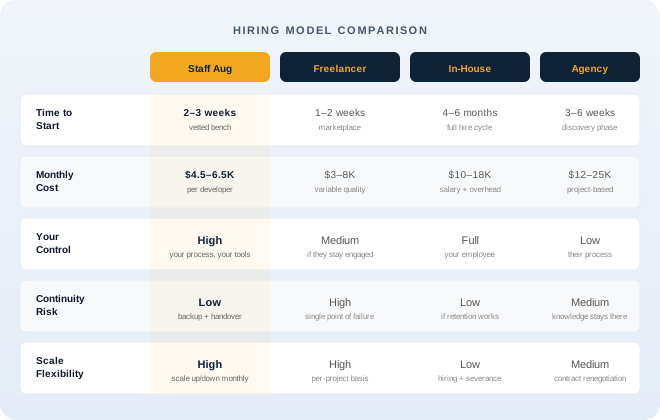
This is the comparison most buyers run in their head before reaching out. Here's our honest take.
Freelancers
Cheap and fast to engage, but they disappear. No backup, no QA safety net, no accountability beyond the next invoice. For a two-week prototype, freelancers can work. For anything that needs continuity over months, they're a gamble , and you'll spend time managing them that you'd rather spend on product decisions.
In-house hires
Maximum control, but the timeline is a killer. Between sourcing, interviewing, negotiating, and the first 90 days of onboarding, you're looking at four to six months before someone is fully productive. If you hire wrong, you start over with severance costs. Great for long-term roles you're certain about; painful for everything else.
Agencies
They build your product for you. Sounds convenient until you realize the engineering decisions stay with them, velocity depends on their internal priorities, and knowledge lives in their org , not yours. Agencies work for well-defined, time-boxed projects. For ongoing product development, they create dependency.
Staff augmentation (our model)
Sits in the middle: speed and flexibility without giving up control. The developers work on your terms, in your tools, under your engineering standards. When the engagement ends, you keep the code, the docs, and the knowledge. That's the fundamental difference.
Mini case study: Hearthline Meal Club
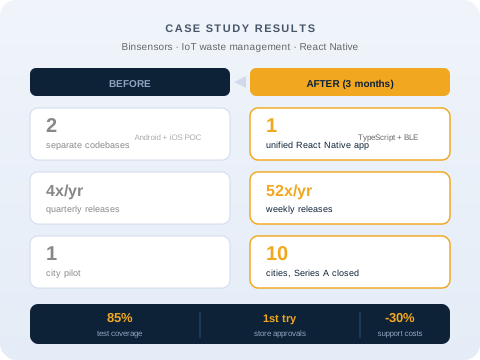
Hearthline Meal Club is a US meal-kit app on React Native 0.72 with Hermes off and broken BLE oven pairing on iOS 18.
Two senior RN engineers and a fractional architect for ten weeks rebuilt the oven TurboModule, enabled Hermes with Fabric on a canary branch, and locked dual-store reviewer notes in CI.
- Cold start on Samsung A14: 4.2s to 1.8s
- Crash-free: 98.4% to 99.5%
- Peak-season release cleared both stores on first submission
Risks of Cross-Platform Staff Augmentation
We'd be dishonest if we pretended augmentation always goes perfectly. Here's what can go wrong and what we do about it.
Communication gaps
Remote developers in different countries can misread priorities or context. We mitigate this by staffing exclusively from Latin America , same time zones, cultural proximity to US teams, and strong English skills. Every developer we place has passed a live communication assessment, not just a grammar test.
Knowledge silos
An augmented developer leaves, and the knowledge goes with them. We require shared documentation, pair programming sessions, and recorded architecture decision records throughout every engagement. If you end the contract, we produce a handover package that your next hire (internal or augmented) can use to get up to speed.
Quality mismatch
The developer interviews well but underperforms on real work. Our two-week trial exists for exactly this reason. We also assign a delivery manager who checks in with both sides during the first month to catch misalignment before it becomes a problem.
Framework lock-in
You pick Flutter, then realize six months later you need native performance for a specific feature. We architect for this from the start , isolating platform channels, keeping business logic separate from UI, and documenting where native fallbacks may be needed. If you decide to go fully native eventually, the transition is incremental rather than a rewrite.
What Most Clients Get Wrong About Cross-Platform Hiring
After staffing cross-platform teams for seven years, we've noticed a few patterns.
Hiring for the framework, not the problem
A "React Native developer" who has only built CRUD apps won't help you with a real-time IoT dashboard. The framework matters less than domain experience and the ability to debug production issues under pressure. When you talk to us, we push back on framework-first job descriptions and ask about the actual problems your team is solving.
Underestimating native knowledge
Cross-platform doesn't mean "no native." Every non-trivial app eventually hits a native wall , custom permissions, OS-level bugs, performance-critical modules. Developers who can't read Swift or Kotlin will hit a ceiling. We vet for this specifically, even when the job looks 100% React Native or Flutter on paper.
Skipping the trial
You wouldn't hire a full-time employee without a probation period. The same logic applies to augmented developers. Two weeks is enough to see whether someone matches your velocity and communication expectations. We insist on this even when clients say they trust our vetting , because the cost of a bad fit compounds fast.
Quality Guardrails We Apply to Every Engagement
Release-ready code
Pair programming on critical flows, enforced linting, and CI pipelines that gate merges with automated tests, visual diffs, and security scans. We treat augmented developers like core team , same standards, no exceptions.
Device coverage
Our device lab validates features on flagship and low-end devices, including network throttling and battery drain profiling. We don't ship features that work on a Pixel 8 but crash on a Samsung A14.
Documentation and handover
Runbooks, API references, and recorded demos make transitions smooth , whether for internal hires, investors, or new product managers joining later. Continuity never depends on a single person.
Frequently Asked Questions
React Native for TypeScript teams. Flutter for brand-heavy UI. Native modules alongside either for BLE, wallet, or AR.
Ten to fifteen business days once repo, Fastlane or EAS, and store roles provision in parallel.
Individuals USD 4.5k to 7.5k per month nearshore. Pods with QA USD 15k to 28k.
Yes. Reviewer notes and policy artefacts ship with every release branch.
Pixel and flagship iPhone reference, lowest 5% Android from Play Console, three-year-old iOS still in MAU.
When two Cross-Platform Fit Test signals fail after a focused optimization sprint.
You do. We join with least privilege.
Frameworks and Communities We Work With
We stay active in the ecosystems that keep your product current and maintainable.
- Active contributors to the React Native ecosystem and Expo community packages.
- Regular participants in Flutter community meetups across Latin America, with engineers who have published packages on pub.dev.
- Published technical guides on Dev.to sharing production lessons from real cross-platform launches.
Related Services
Need to round out your mobile initiative? These complement cross-platform augmentation.
Mobile app squads
Combine cross-platform developers with backend engineers, product designers, and QA for end-to-end mobile product delivery.
Dedicated development teams
Long-term partnership that blends staff augmentation with managed delivery for complex, multi-year programs.
Web development
If your cross-platform app needs a companion web portal, dashboard, or admin panel, our front-end and full-stack teams can build it in parallel.
OUR STANDARDS
Contractors that ship like your core team.
Our Definition-of-Done includes performance budgets, accessibility checks, device coverage, and release checklists. Augmented developers follow the same standards you expect from your permanent engineers , because anything less creates friction.
Readable code, thorough code reviews, and automated tests are non-negotiable. We leave documentation and handover notes so continuity never depends on a single person, whether they're ours or yours.
Interested in hiring cross-platform developers based in Argentina specifically? Visit the Argentina version of this page.
Contact Us
Tell us about your project and we'll match you with the right cross-platform developers.