Hire Android Developers for Mobile App Delivery
If you are searching for "hire Android developers," odds are you already have an app in the Play Store or one close to launch. What you need is not a generic mobile contractor. You need a Kotlin engineer who can step into your sprint, understand your architecture, and start shipping features that move your product metrics.
Siblings Software has embedded Android developers into product teams since 2019. We work mostly with SaaS companies, logistics operators, healthcare platforms, and marketplace startups across the US and Canada. The pattern is usually the same: the internal team built something solid, velocity stalled because there are not enough hands, and hiring in-house takes too long.
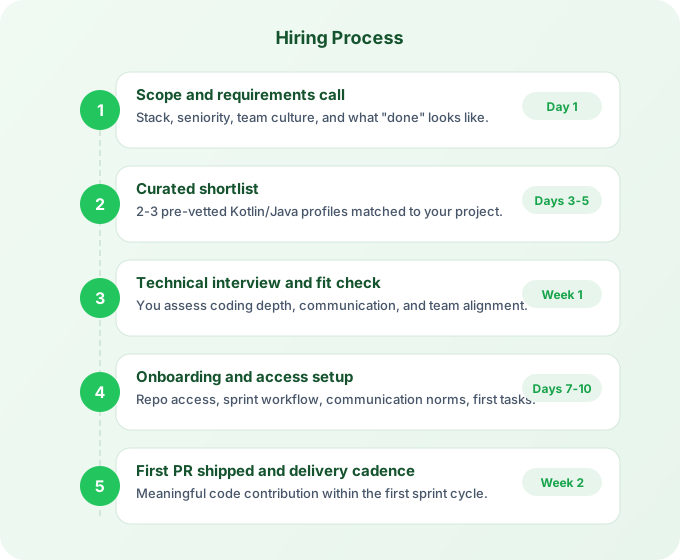
- Vetted Kotlin and Java profiles typically land in 3 to 5 business days, with onboarding in 7 to 10 days.
- Our most common placement: a senior Android developer with Compose, Coroutines, and Jetpack experience who joins an existing squad full-time.
- Monthly engagements are the norm. They are easier to budget than hourly contracts and discourage the time-tracking friction that slows real delivery.
"The expensive Android hire is not the one who ships slow features. It is the one who treats Play Console policy as someone else's job."
Reviewed by Javier Uanini, Founder and CEO. Last reviewed 26 October 2026.
The strongest Android hires care about the product, not just the platform. They think in terms of retention, crash rates, and release cadence.
Typical turnaround for a curated shortlist after scope and seniority are defined.
Daily overlap for North American teams working with our Latin American engineers.
Miami-led staff augmentation across mobile, web, and platform roles for US and Canadian product teams.
When does it make sense to hire Android developers through staff augmentation?
Not every team needs this model. Here is an honest breakdown so you can skip the sales pitch and decide whether this fits your situation.
Good fit for staff augmentation
- Your Android app already exists, but feature delivery is falling behind because the team is stretched thin across too many priorities.
- You need to modernize: migrate Views to Compose, update target SDK levels, or fix an architecture that grew tangled without a dedicated mobile lead.
- Hiring a full-time senior Android developer in-house is taking 3+ months and you cannot wait that long for your next release cycle.
- Your product roadmap requires coordination between Android, iOS, backend, and analytics, and you want the Android engineer inside your sprint rituals, not working in isolation.
- Crash-free rates are below Play Console benchmarks and you need someone who can triage, stabilize, and instrument the app without stalling new feature work.
Probably not the right move
- You need a quick bug fix or a one-off task on an internal tool. A freelancer will be cheaper and simpler for that scope.
- Nobody on your team owns product priorities or can review pull requests. Staff augmentation fills capacity gaps, it does not replace leadership.
- The real blocker is not Android skill, it is missing designs, unclear requirements, or a backend API that changes every week.
- You want a full team with delivery ownership, QA, PM, and DevOps included. In that case, consider a dedicated Android development team or the broader dedicated development team hub.
- You expect Kotlin alone to rescue an app with fundamental UX problems. Technology does not fix confused product direction.
If you also need iOS coverage, many clients pair this role with Swift developers or choose Flutter developers when cross-platform makes more sense for their roadmap.
Typical Android developer rates and engagement models
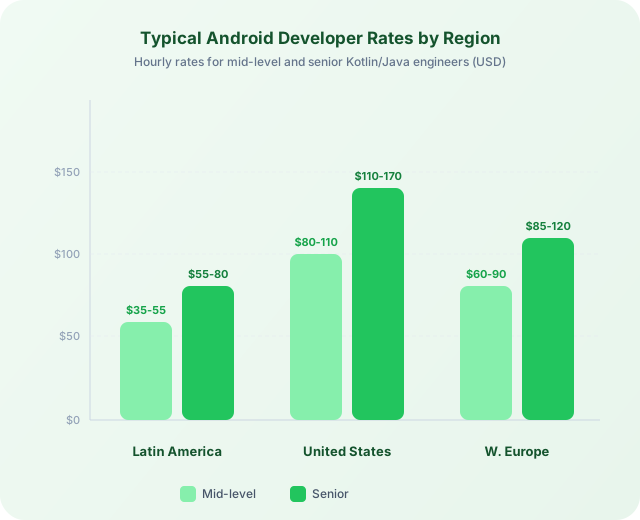
These are real ranges for developers who work in English, join product teams, and contribute in modern Kotlin stacks, not bargain-tier profiles with outdated Java-only experience.
| Region | Mid-level | Senior | What you usually get |
|---|---|---|---|
| Latin America | $35-$55/hr | $55-$80/hr | Strong value for teams needing real-time overlap with North America and engineers who think about product, not just tickets. |
| United States | $80-$110/hr | $110-$170/hr | Best for roles demanding deep local domain context, on-site presence, or very specialized leadership. |
| Western Europe | $60-$90/hr | $85-$120/hr | Solid for mature product engineering, but timezone overlap with US teams is usually limited. |
A practical rule we tell clients: if the work touches your main app module, Play Store compliance, or shared business logic, shop for judgment and Kotlin depth first. Cheap Android gets expensive when it introduces regressions in code 500,000 users depend on.
How clients typically engage
Dedicated full-time engineer. The most common model. The person joins your sprint cadence, owns Android backlog items, and collaborates daily with your product and design teams.
Fractional senior support. Works for architecture reviews, Compose migrations, or crash stabilization when your in-house team still owns daily delivery.
Pod extension. One Android developer plus QA or a shared backend engineer when a single hire will not unblock the roadmap fast enough.
At Siblings Software, most Android engagements run on monthly billing rather than pure hourly. This makes budgets predictable and eliminates the micro-management overhead that comes with tracking hours on a timesheet.
The Play Release Readiness Test (before we shortlist anyone)
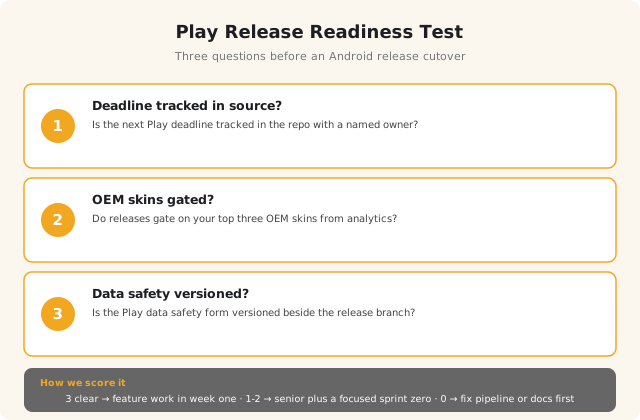
This is the named checklist we run in discovery so you know whether an embedded Kotlin hire can ship in week one or needs a sprint-zero pipeline fix first.
Three questions, scored together with your engineering lead:
- Deadline tracked in source? Is the next Play target-SDK or policy deadline tracked in the repo with a named owner, not only on a calendar invite?
- OEM skins gated? Do releases gate on the top three OEM variants from your analytics (Samsung One UI, Xiaomi MIUI, Motorola near-stock), not just Pixel smoke tests?
- Data safety versioned? Is the Play data safety form versioned beside the release branch so policy drift is caught in pull request review?
How we score it: three clear answers mean feature work in week one. One or two gaps mean a senior engineer plus a focused sprint zero on pipeline and docs. Zero clear answers mean fix release plumbing before adding headcount.
In 2026, buyers also watch Google's 16 KB native page size requirement for apps with NDK binaries and the rolling target SDK calendar in Play Console. We treat those as release gates, not surprise audit findings.
Staff augmentation vs freelancer vs in-house vs agency
You are not choosing between "good" and "bad." You are choosing whichever model causes the least friction for the work sitting in front of you right now.
| Model | Best for | Time to start | Main tradeoff |
|---|---|---|---|
| Staff augmentation | Product teams that need Android delivery capacity, Compose migration help, or architectural guidance without losing control of the roadmap. | 1 to 2 weeks | You still need an internal product owner. This model fills execution gaps, not strategic direction. |
| Freelancer | Short, contained tasks with a clean scope and minimal dependency on your broader team. | Sometimes same week | Good for isolated work. Weak for shared ownership, long-term knowledge retention, and continuity. |
| In-house hire | Core long-term roles where you want internal retention and domain knowledge compounding over years. | Often 2 to 5 months | Slowest route and highest total cost once recruiting fees, benefits, and onboarding are included. |
| Project agency | Defined projects where you want scope, delivery management, and accountability packaged together. | 2 to 4 weeks | Less embedded with your team. Not ideal when Android priorities shift every sprint. |
Our honest take: if the developer needs to touch your main module, join standups, explain tradeoffs in pull requests, and stay aligned with shifting product priorities, staff augmentation is usually the right answer. If the task is a contained SDK integration or a one-time accessibility pass, a freelancer is the smarter buy.
Android scenarios we see most often
Clients searching "hire Android developers" are usually not looking for tutorials. They are trying to unblock a specific situation inside their product team.
Compose migration without freezing releases
The most common ask. Teams have legacy View-based screens, a working app, and no bandwidth to rewrite the UI layer while still shipping features. A senior Kotlin engineer can migrate screens incrementally, starting with the ones that change most often, without pausing the release train.
Crash stabilization and Play Store compliance
Crash-free rates below 99% hurt discoverability. Google tightens policy requirements every quarter. We place engineers who can audit Crashlytics data, stabilize the worst offenders, update target SDK levels, and get your app back to healthy benchmarks inside a single engagement.
Feature acceleration and platform parity
When iOS shipped the feature three sprints ago and Android is still catching up, the problem is usually capacity rather than complexity. An extra senior Android developer embedded in your squad eliminates the gap without introducing a separate workflow or vendor overhead.
Real hiring scenarios from our clients
- A healthcare SaaS needed one senior Kotlin engineer to own a patient-facing Android app while the internal team focused on the clinician dashboard and API layer.
- A logistics company wanted two Android developers and a QA engineer to rebuild their driver companion app from a monolithic Activity structure into modular Compose screens with offline sync.
- A marketplace startup needed a senior Android lead to review architecture decisions, mentor two junior developers, and stabilize a checkout flow that crashed on 4% of sessions.
- A fintech product team with a React Native app decided to go native for performance reasons and needed Kotlin specialists to build the Android side from scratch alongside their app development team.
The stack our engineers work with daily
We focus on the Android tooling that actually matters in production environments, not resume keywords:
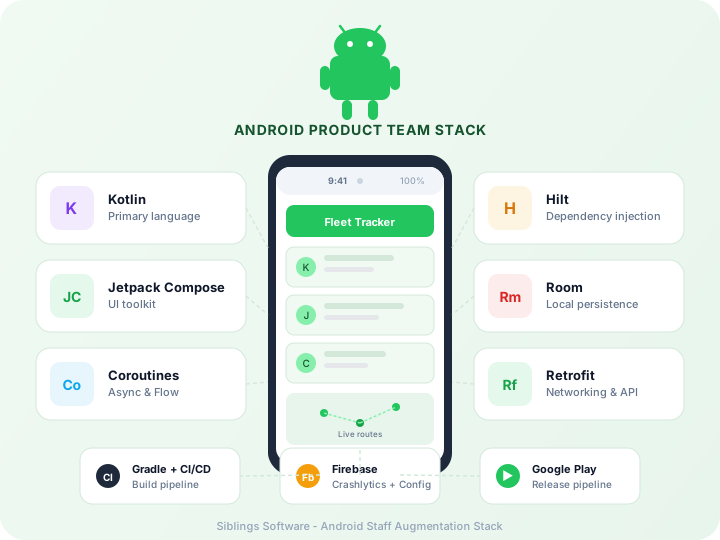
- Kotlin as the primary language, with Java support for legacy modules
- Jetpack Compose and Material 3 for UI, with View interop where needed
- Coroutines and Flow for async work and reactive streams
- Hilt for dependency injection, Room for local persistence
- Retrofit and OkHttp for networking, with offline-first patterns
- Firebase Crashlytics, Analytics, and Remote Config
- Gradle with modularization, build variants, and Managed Devices for testing
For reference, the official Jetpack Compose docs and Kotlin docs reflect the baseline standards our engineers follow.
How Siblings Software runs Android staffing engagements
The work is not just sourcing resumes. It is matching the right level of Android judgment to the actual complexity and debt in your codebase.
- Scope the real gap. We ask what is blocked right now: crash rates, velocity, missing Compose expertise, a stalled Play Store update, or a single engineer who is the bottleneck for every Android decision.
- Match for context, not buzzwords. We screen for applied Kotlin depth, Jetpack fluency, pull-request communication quality, and whether the candidate has worked in teams with real product pressure, not just personal projects.
- Technical interview with your stack in view. You should hear how the engineer would approach your architecture, your build setup, your testing gaps, and your release cadence. Not textbook trivia about Activity lifecycles.
- Onboard into your workflow. Slack, Jira, GitHub, standups, code review norms, deployment rules, and the unwritten decisions that shape how work actually moves through your team.
- Track outcomes weekly. Not "hours used." We care about PRs merged cleanly, crash rate trends, review turnaround, and whether the new person is reducing pressure on the rest of the squad.
What clients usually get wrong when hiring Android developers
The most frequent mistake is optimizing for hourly rate on work that touches a production app used by thousands of people. A cheap Android developer who introduces subtle regressions costs far more than the rate difference.
Another common error: expecting one person to fix architecture debt, improve crash metrics, deliver new features, and mentor junior developers simultaneously. That is three roles, not one. We will tell you if the scope requires a pod instead of a single hire.
A third one: treating Android and iOS as interchangeable. The platforms have different UI paradigms, different testing tooling, and different release processes. An engineer who is strong on one is not automatically strong on both.
Experience behind the process
Siblings Software has staffed product teams since 2019 across healthcare, logistics, fintech, marketplace, and internal enterprise platforms. Our Android placements tend to stick because we filter for engineers who care about product outcomes, not just technical tasks.
We prefer boring operational habits over impressive promises: documented architecture decisions, weekly check-ins, shared review standards, and engineers who can explain why a tradeoff is worth making before writing the code.
Mini case study: Granite Ridge Fleet (composite illustrative)
Granite Ridge Fleet is a composite illustrative US HVAC field-service scenario with 900 technicians and a 94% Android install base.
The situation
Cold start on Samsung A14 was 5.4s, crash-free 97.9%, MIUI push delivery 71%, and target SDK lagged three sprints before cutoff.
What we changed
- Two nearshore Kotlin engineers for twelve weeks.
- Play Release Readiness Test memo and OEM device matrix in sprint zero.
- R8 retuning and dynamic feature modules for inspection photos.
Results
Cold start 5.4s to 2.0s, crash-free 99.6%, MIUI push 94%, target SDK cleared 22 days early. ~USD 11k/month combined.
Headline metrics
Cold start: 5.4s to 2.0s
Crash-free: 97.9% to 99.6%
MIUI push: 71% to 94%
Risks buyers worry about and how we reduce them
These concerns are reasonable. If someone selling you Android developers cannot speak to them specifically, keep looking.
Risk: the developer looks strong on paper but cannot work in your codebase
We screen for applied Kotlin judgment: architecture patterns, Compose state management, testing habits, PR communication, and whether the person has worked in team environments with real delivery pressure, not just solo apps on the Play Store.
Risk: onboarding drags and nobody owns context transfer
We push for explicit onboarding around repos, branch conventions, release cadence, and decision-making norms. Fast starts almost always come from clear ownership on your side, not magic resumes on ours.
Risk: the engagement becomes dependency without knowledge transfer
Our better engagements produce review comments, Architecture Decision Records, and shared patterns that remain useful after the person rolls off. If documentation and pairing are not happening, the setup needs fixing early.
Risk: you pay for a Kotlin specialist and get a Java generalist with a thin Kotlin layer
We are careful about this. Real Kotlin work shows in Coroutine scoping, Flow usage, Compose architecture, sealed class modeling, and how the person structures test data. If they cannot speak to those patterns in a technical interview, the fit is wrong.
Frequently Asked Questions
Most teams review profiles within 3 to 5 business days and onboard within 7 to 10 days with a first meaningful pull request in the first sprint.
Senior Kotlin engineers from Latin America typically run USD 5k to 8.5k per month all-in. US senior rates often start near USD 13k.
Yes. We audit crashes, dependencies, data safety gaps, and target SDK calendars, then stabilize incrementally.
Freelancers fit isolated SDK bumps or accessibility passes. Shared main-module ownership needs embedded staff augmentation.
Yes. Compose for UI, OEM matrices from analytics, and Play Integrity on fraud-sensitive flows.
Staff Kotlin depth first. Even split products route to the cross-platform page before forcing a single-platform hire.
You do. Our engineers join with least-privilege roles. Keys stay with your organization.
Contact us
Tell us about your Android app, where the bottleneck is, and whether you need one engineer, a small pod, or a more managed team setup. We usually reply within one business day.