Hire FinOps Engineers for Your Platform Team
Hire FinOps engineers through Siblings Software when cloud spend grew faster than cost ownership inside engineering. We place senior nearshore FinOps specialists who join your platform rituals, open rightsizing pull requests, and explain unit cost to finance without a slide-only audit.
This page covers what the role does day to day, how we vet candidates with a live billing triage exercise, when a solo hire beats a FinOps pod, monthly pricing bands, timelines, risks, and how staff augmentation compares with freelancers, in-house hiring, and one-off consultancies.
- Shortlists in 3-5 business days; first merged optimization change usually in 12-15 business days.
- Vetting ends with a live Cost Explorer or CUR triage, not a certification quiz.
- Monthly engagements with 30-day notice to scale down. You keep billing ownership and IP.
"The expensive FinOps hire is the one who finds waste in week one and cannot name the next three pull requests that keep the savings."
Reviewed by Javier Uanini, Founder and CEO, Siblings Software. Last reviewed 20 July 2026.
Typical path from intro call to first merged rightsizing or tagging change.
Applicants who pass live billing triage and communication gates.
Usual monthly band for one senior nearshore FinOps engineer.
What FinOps engineers do in real client teams
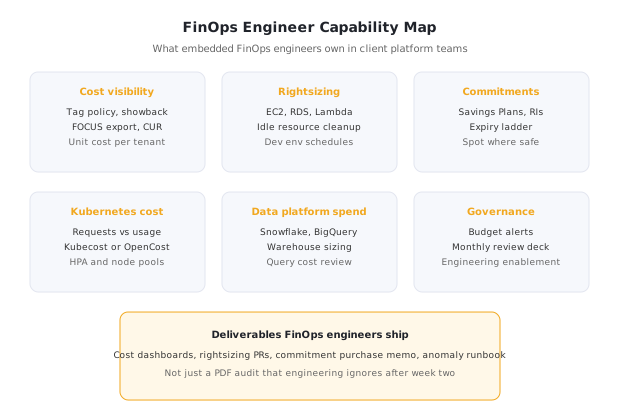
Embedded FinOps engineers sit with platform and finance-aligned stakeholders. They own cost attribution hygiene, rightsizing backlogs, commitment memos, anomaly response, and monthly showback that product leads can act on. Success is measured by attributed spend and savings that survive after month three, not by another dashboard login.
- Cost visibility: Tag policies, CUR or FOCUS exports, and showback by team, service, or tenant.
- Waste removal: Rightsizing EC2, RDS, Lambda memory, EKS requests, and scheduled non-production environments through pull requests.
- Commitment strategy: Savings Plans or Reserved Instance ladders with written assumptions finance can challenge.
- Data platform spend: Snowflake warehouse schedules, BigQuery slot commitments, or similar warehouse lines when they dominate the bill.
- Governance: Anomaly owners, budget alerts that create tickets, and board-ready unit economics.
This is different from a DevOps engineer, who owns CI/CD and on-call. It is different from a Terraform engineer, who owns modules and state. FinOps owns the money path: who spent what, what to stop paying for, and how to prove the change in your repo.
When companies hire FinOps engineers
Most discovery calls map to one of these situations. Yours may combine two.
Cloud bill crossed a board threshold
Leadership tracks monthly AWS or Azure spend. Engineering knows usage grew, but nobody can name which product lines drove the jump.
AI and inference added unpredictable cost
GPU instances, vector storage, and batch inference appear on the invoice without unit economics tied to customer tiers or feature flags.
Kubernetes spend is opaque
EKS or GKE runs fine, but namespace cost is a guess. Teams over-provision requests because chargeback is not trusted.
Commitments expire without a ladder plan
Savings Plans or Reserved Instances roll off next quarter. On-demand share is climbing and finance wants a purchase memo with assumptions.
Platform lead without FinOps bandwidth
A head of platform owns reliability and IaC but cannot also run monthly showback while hiring SREs. Staff augmentation adds execution capacity without a reorg.
Related paths: staff augmentation hub, nearshore developers, platform engineering services.
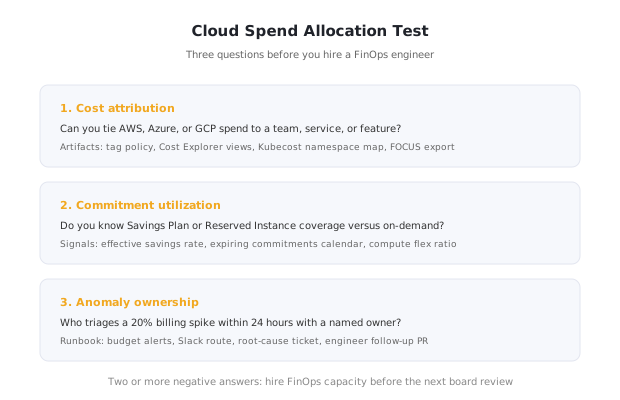
The Cloud Spend Allocation Test
Before we recommend a hire shape, we run three questions. If two answers are negative, you need FinOps capacity before the next budget cycle.
1. Cost attribution
Can you tie spend to a team, service, or tenant without a spreadsheet marathon? Tag policies in CI and FinOps Foundation allocation practices are minimum viable past roughly one million dollars annual run rate.
2. Commitment utilization
Do you know Savings Plan or Reserved Instance coverage versus on-demand before finance asks? Effective savings rate and an expiring-commitments calendar should exist before the next purchase conversation.
3. Anomaly ownership
Who triages a twenty percent billing spike within twenty-four hours with a named owner and a follow-up ticket? Alerts to a list nobody reads do not count.
We use the same test in vetting. Candidates who only describe generic "cloud cost optimization" rarely survive the live exercise where we ask them to rank waste lines from a redacted billing export.
How Siblings vets FinOps engineers
Certifications are easy to collect. We screen for signals that predict whether savings stick after month three.
- Billing triage depth: Walk from a CUR or Cost Explorer view to a resource ID and engineering owner in one conversation.
- Rightsizing with production respect: Downsize with rollback plans and before-and-after utilization charts attached to pull requests.
- Commitment judgment: Write a Savings Plan memo with flex assumptions, not only vendor calculator screenshots.
- Data platform fluency: Snowflake warehouse sizing, BigQuery slots, or similar when warehouse lines dominate.
- Communication: Showback decks finance can read and engineering summaries that name the next three pull requests.
- Red flags: Tool-only backgrounds with no merged infrastructure changes, inability to explain unit cost, or recommending a FinOps SaaS before tagging works.
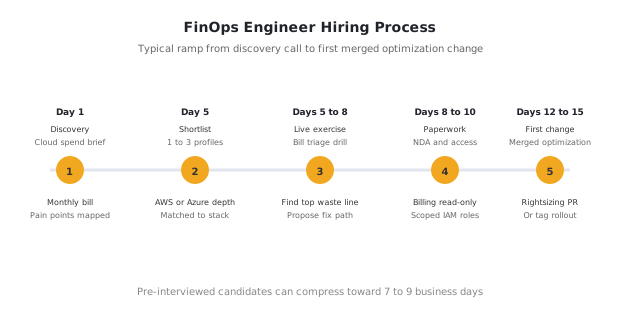
Typical ramp from discovery call to first merged rightsizing or tagging change.
Engagement models and pricing context
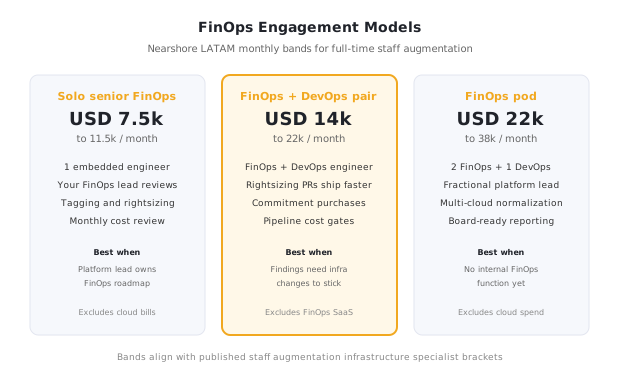
FinOps staff augmentation pricing depends on seniority, cloud stack depth, multi-cloud scope, and whether the engineer also ships infrastructure changes. These bands reflect nearshore LATAM delivery on full-time monthly engagements, above the general $4k-$9k staff augmentation baseline because FinOps specialists are thinner in market than generalist developers.
| Shape | Typical monthly band | Best when |
|---|---|---|
| Solo senior FinOps | USD 7,500-11,500 | Tagging mostly works; platform or finance can review every change. |
| FinOps + DevOps pair | USD 14,000-22,000 | Findings need Terraform or pipeline changes to stick. |
| FinOps pod + fractional lead | USD 22,000-38,000 | Multi-cloud normalization, commitments, and board reporting in parallel. |
Your cloud bills, Kubecost or CloudHealth seats, and billing export storage stay on your accounts. Compare DevOps engineering outsourcing when you want Siblings to own a cost program end to end rather than embed individuals.
Timeline
Discovery day one. Shortlist by day five. Live billing triage before day eight. First merged optimization change around day 12 to 15 when access arrives on schedule.
Staff augmentation vs freelancers vs in-house vs consultancies
| Model | Time to start | Best for | Tradeoff |
|---|---|---|---|
| Staff augmentation (Siblings) | 1-3 weeks | Teams with a platform or finance partner and an ongoing cost backlog. | You keep product and billing direction. |
| Freelance marketplaces | Days to weeks | One-off audits under four weeks. | Weak continuity after the PDF lands. |
| In-house FTE | Often months in US markets | Continuous FinOps ownership year round at high spend. | Recruiting lag and competitive offers. |
| FinOps consultancies | Project kickoff | Fixed-scope assessments. | Findings often stall without embedded engineers to merge changes. |
Example engagement: retail media SaaS with opaque EKS and Snowflake spend
Illustrative scenario based on a composite US retail media SaaS engagement. Numbers are representative, not a published client case study.
Situation. Ashford Retail Media (composite) sells sponsored product placements for mid-market retailers. The platform ran AWS EKS, RDS, and Snowflake. Tags were inconsistent: finance saw one monthly number, engineering guessed by service, and two staging Snowflake warehouses never auto-suspended.
What we did. Siblings placed one senior FinOps engineer and one mid-level DevOps engineer through staff augmentation in fourteen business days. Over eight sprints they enforced a cost-center tag policy in Terraform with CI failures on missing keys, rightsized three RDS instances and two EKS node groups with utilization evidence on each pull request, purchased a Savings Plan ladder with a written flex memo, enabled Snowflake schedules for non-production, and published monthly showback by team.
Illustrative outcomes. Unattributed spend fell from roughly forty percent to under ten percent of the bill. On-demand EC2 share dropped after commitment coverage improved. Staging Snowflake idle time fell. The CFO received unit cost per active advertiser without a manual spreadsheet.
For a published platform reference with observability-heavy engineering, see the NetApp platform engineering case study.
Why this shape
Solo FinOps would have found waste. The DevOps pair made rightsizing and schedules stick in the same repositories product teams already use.
External reference for cost tooling: AWS Cost Management documentation.
Risks and how we reduce them
Savings erosion
Mitigation: Week one pairs on your top three waste lines with named owners so optimizations do not revert after the first month.
Production impact
Mitigation: Rightsizing starts in non-production with rollback notes and utilization charts on every pull request.
Access and billing exposure
Mitigation: Billing read-only roles, scoped IAM, NDAs before CUR access, and no shared root credentials in chat.
Tool sprawl
Mitigation: We flag when a new FinOps SaaS duplicates native cloud cost tools you already pay for.
Knowledge loss at roll-off
Mitigation: Tagging policies, commitment memos, and anomaly runbooks live in your wiki or repository, not a vendor portal.
Frequently asked questions
Buyer questions we answer when teams evaluate FinOps staff augmentation.
Hiring from Argentina? See the Argentina mirror of this page (separate site, same engagement model).
Contact us
Tell us about your monthly cloud spend, tagging state, and FinOps timeline. We will shortlist accordingly.