Hire Terraform engineers for embedded staff augmentation
· Typical time to first merged IaC change: 12–15 business days
Hire Terraform engineers through Siblings Software when your cloud footprint grew faster than your infrastructure-as-code discipline. This page explains what embedded IaC engineers do in client teams, when staff augmentation beats a migration project, how we vet candidates on modules and state management, monthly pricing bands, risks, and when a small IaC pod makes more sense than a solo hire.
Buyers searching for hire Terraform engineers usually need three answers on one screen: who can untangle modules and remote state without breaking production, what it costs per month in plain numbers, and how you avoid the contractor who provisions a demo VPC and disappears before drift detection exists. We staff Terraform engineers from Latin America as full-time employees who overlap US Eastern business hours and join your ceremonies from planning through apply approvals.
Enterprise platform hiring in 2026 is bottlenecked on infrastructure-as-code depth, not cloud console familiarity. Buyers evaluating outsourcing partners now ask what the IaC workflow looks like before they discuss rate cards, because the productivity gap between teams with locked state, reusable modules, and CI plan gates versus teams still clicking in the console is wide enough to affect delivery economics. For CI/CD and on-call breadth, see embedded DevOps engineers; for cluster day-two work, explore Kubernetes developer staff augmentation; for cloud spend attribution and rightsizing after landing zones exist, see FinOps engineer staff augmentation; for timezone context, read nearshore developer hiring.
If you need Siblings to own an entire landing zone build rather than individuals in your standups, compare DevOps engineering outsourcing or platform engineering services from the same leadership group.
"The expensive Terraform hire is not the one who provisions fast. It is the one who merges a root module you cannot split without a weekend state surgery."
Reviewed by Javier Uanini, Founder and CEO, Siblings Software. Last reviewed 30 June 2026.
Prefer numbers before a call? Jump to monthly pricing bands for solo engineers, pairs, and IaC pods.
What Terraform engineers do in your platform team
Infrastructure as code ownership, not another console operator.
A strong Terraform engineer on staff augmentation joins planning with your platform lead and security reviewer, owns module libraries and state hygiene, and documents what happens when a plan fails in production. Day to day that means:
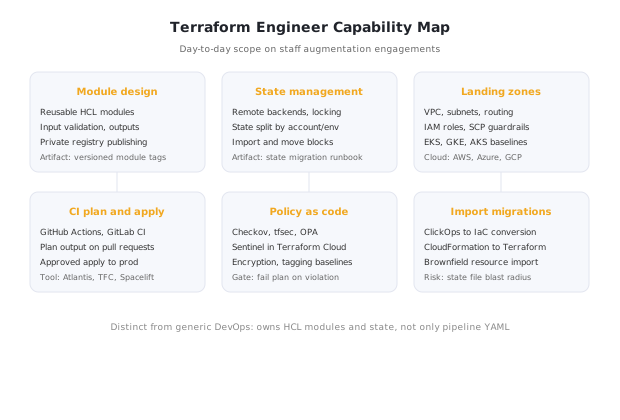
This role differs from a generic DevOps engineer because judgment spans HCL module boundaries, state blast radius, and provider version pins at once. It differs from a Kubernetes developer because success is measured by plan review quality and drift reduction, not pod restart counts. It differs from a cloud architect who only draws diagrams because the deliverable is version-controlled modules merged through your pull request workflow.
When companies hire Terraform engineers
Five situations cover most discovery calls. Yours may combine two.
Multi-account expansion without a module library
Product teams need staging and production in separate AWS accounts. Console clicks got you here, but the next ten accounts need repeatable VPC, IAM, and EKS baselines in HCL.
State file became a single point of failure
One monolithic state file means every engineer plans the entire estate. Applies take forty minutes and nobody wants to touch module boundaries.
SOC 2 or PCI audit flagged ClickOps drift
Auditors want evidence that production matches code. Console changes over the last year are not in any repository. Import and policy gates are overdue.
CloudFormation or ARM templates need a Terraform path
Legacy templates work but new hires do not want to maintain two IaC dialects. A phased import with clear rollback beats a big-bang rewrite.
Platform lead without IaC bandwidth
A head of platform owns Kubernetes and CI/CD but cannot also refactor twelve root modules while running hiring loops. Staff augmentation adds execution capacity without reorganizing the department chart.
The Terraform State Integrity Test
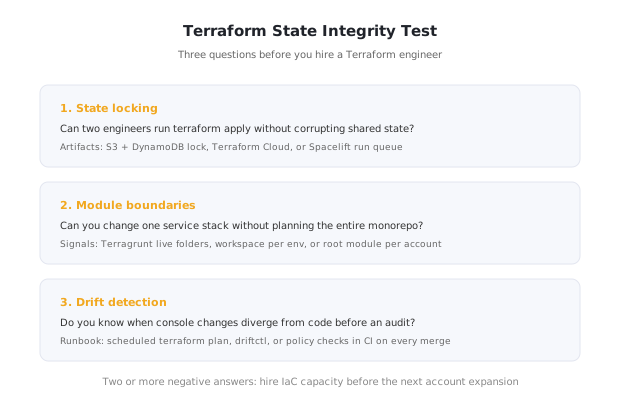
Before we recommend a hire shape, we run three questions we call the Terraform State Integrity Test. If two or more answers are negative, you need IaC engineering capacity before you open another cloud account.
- State locking: Can two engineers run terraform apply without corrupting shared state? Remote backends with locking, such as S3 plus DynamoDB or Terraform Cloud, are minimum viable for any team larger than one.
- Module boundaries: Can you change one service stack without planning the entire monorepo? Terragrunt live folders, workspace-per-environment, or root-module-per-account patterns should limit blast radius.
- Drift detection: Do you know when console changes diverge from code before an audit? Scheduled terraform plan jobs, drift scanners, or policy checks in CI on every merge are the signals we look for.
We use the same test in vetting. Candidates who only describe tutorial VPC examples rarely survive the live exercise where we ask them to split state for a new account without destroying existing resources.
How Siblings vets Terraform candidates
Resume keywords are cheap. We screen for signals that predict whether your landing zone ships in quarter one, not quarter three.
- Module authorship: Can they show a private module others actually consume, with semver tags and changelog discipline? Forked tutorial modules do not count.
- State surgery: Experience with import blocks, moved blocks, and state rm without taking down production. Brownfield scars matter more than greenfield speed.
- CI integration: Plan output posted on pull requests, approved applies to production, and OIDC to cloud roles instead of long-lived keys.
- Policy fluency: Checkov, tfsec, or Sentinel rules that fail plans on open security groups and missing encryption flags.
- Communication: Runbooks for state migration, module upgrade paths, and incident notes that security and finance can read.
- Red flags: Only certification study repos, no production state story, inability to explain blast radius, or treating Pulumi and Terraform as interchangeable without migration experience.
Roughly three in ten applicants pass all gates. Profiles with regulated-industry landing zone experience (payments, healthcare, insurance) take a few extra days to source because the qualified pool is thinner.
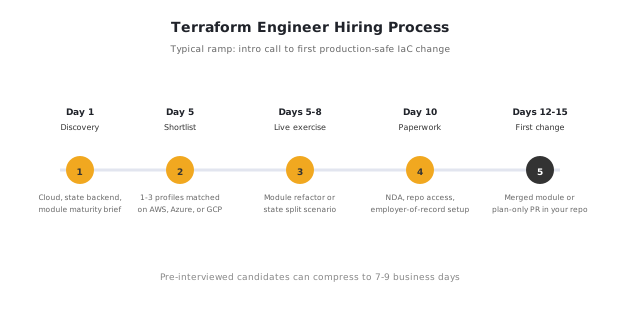
Typical ramp from discovery call to first merged module or plan-only pull request.
Engagement models and pricing context
Terraform staff augmentation pricing depends on seniority, cloud stack depth, multi-account scope, and whether the engineer also owns CI apply gates. These bands reflect nearshore LATAM delivery on full-time monthly engagements, aligned with our published infrastructure specialist brackets:
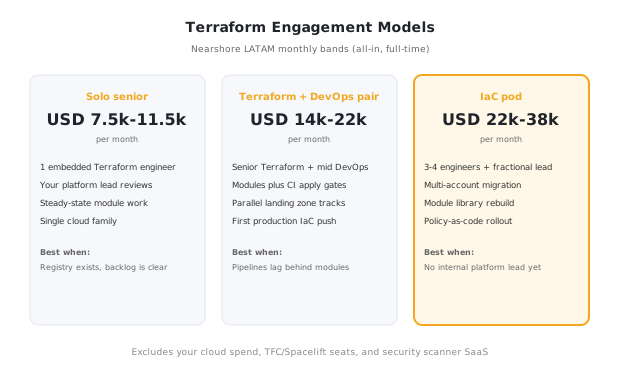
Single senior Terraform engineer
Best when you have a platform lead who can review every change and the module library mostly works. One engineer, your ceremonies, your state backends.
Typical band: USD 7,500–11,500/month.
Terraform plus DevOps pair
Modules and CI apply gates both lag behind roadmap. Common for the first landing zone push or CloudFormation import.
Typical band: USD 14,000–22,000/month.
IaC pod with fractional lead
When you need module library rebuild, policy-as-code rollout, and multi-account migration in parallel while product teams keep shipping. Compare with platform engineering outsourcing when you want Siblings to own delivery end to end.
Typical band: USD 22,000–38,000/month.
Figures align with our published staff augmentation infrastructure brackets. Your cloud accounts, Terraform Cloud or Spacelift seats, and policy scanner SaaS stay on your billing.
Compared to freelancers, in-house hiring, and IaC consultancies
vs. freelance marketplaces
Marketplaces optimize for profile volume. We trade listing speed for engineers who already passed a live module refactor exercise and can join your Slack with a fifteen-day notice window after the minimum term.
vs. in-house FTE
Full-time Terraform hires make sense when IaC ownership is a multi-year commitment. Augmentation fits headcount freezes, bridge roles while recruiting closes, or specialty spikes before audit season. Senior platform roles often sit open for months in US markets.
vs. IaC consultancies
Project firms deliver a landing zone deck and leave. Embedded Terraform engineers work in your repositories, your state backends, and your approval workflow. If you want Siblings to own outcomes, that is a different conversation on our DevOps outsourcing pages.
Example engagement: payment clearing platform
Illustrative scenario based on a composite US fintech clearing platform engagement. Numbers are representative, not a published client case study.
Stonegate Clearing (composite) operates a B2B payment clearing API for regional banks. Their platform team ran three AWS accounts from console clicks: one monolithic Terraform root module in a private repo, no remote state locking, and staging drift that only surfaced during quarterly SOC 2 evidence collection.
Siblings placed one senior Terraform engineer and one mid-level DevOps engineer through staff augmentation in fourteen business days. Over ten sprints they split state by account with S3 plus DynamoDB locking, published six reusable modules for VPC, EKS, and RDS baselines, wired GitHub Actions plan gates with Checkov policy failures blocking merge, and documented import runbooks for twelve brownfield resources. Illustrative outcomes: terraform plan runtime on the largest stack dropped from 38 minutes to 9 minutes after module boundaries, drift incidents found in scheduled plans rather than auditor walkthroughs, first new production account provisioned from code in eleven days instead of three weeks of console work, SOC 2 infrastructure evidence export completed without a remediation letter.
For a published reference with observability-heavy platform engineering, see the NetApp platform engineering case study (eight senior Go engineers on hybrid data-infrastructure SLOs).
What changed for IaC teams in 2025–2026
OpenTofu adoption pushed some teams to evaluate provider licensing and registry mirrors before the next major upgrade. Terraform engineers now often document both HashiCorp and OpenTofu compatibility paths when procurement asks.
OIDC federation to cloud roles replaced long-lived access keys in most mature pipelines. GitHub Actions and GitLab CI assume-role patterns appear in nearly every new engagement brief.
Policy-as-code in plan gates accelerated as security teams stopped accepting post-deploy scans alone. Checkov and OPA in CI are baseline expectations for regulated buyers, not optional nice-to-haves.
AI-assisted HCL generation helps scaffold modules faster, but human review of blast radius and state impact matters more than raw generation speed. We follow HashiCorp Terraform language conventions in module design regardless of which editor assists the first draft.
Risks and how we reduce them
- State corruption risk: Week one includes pairing on a read-only plan in production state so locking and backend access are verified before the first apply.
- Blast radius risk: Module changes start in staging workspaces with explicit moved blocks documented in the pull request.
- Access risk: Least-privilege IAM, NDAs before state backend access, and no production credentials in local .tfvars without your security sign-off.
- Communication risk: LATAM overlap with Eastern through Pacific is real time in Slack. EU-hours coverage is staffed explicitly when you ask in the brief.
- Continuity risk: State migration runbooks, module upgrade notes, and import commands live in your wiki or repo, not a vendor portal.
- Cost risk: We flag over-provisioned resources in plan output early. Landing zones should not ship with oversized NAT gateways nobody questioned.
OUR STANDARDS
What "done" means when you hire Terraform engineers through Siblings.
- State is locked: No shared apply without a remote backend and documented locking strategy.
- Modules are reusable: New accounts and environments consume versioned modules, not copy-pasted root files.
- Plans gate production: Every infrastructure change passes review with visible plan output before apply.
- Honest migration advice: If a brownfield import will cost more than temporary console management, we say so before the sprint starts.
Frequently asked questions
Buyer objections we answer on discovery calls when teams evaluate Terraform staff augmentation.
Hiring from Argentina? See the Argentina mirror of this page (separate site, same engagement model).
CONTACT US
Tell us about your cloud accounts, state backends, and IaC timeline. We will shortlist accordingly.