A senior back-end pod that owns services, data, and the pager
Most companies arriving on this page have already tried the alternatives. One more freelancer did not fix the migration. The agency that built the API will not answer at 02:14. The local hiring pipeline keeps stalling at the senior level. What you actually need is a small, opinionated unit that owns a slice of the back-end from the request envelope to the on-call rotation, and that arrives with the discipline that keeps a production system honest.
Siblings Software has placed back-end pods for US, Canadian, and European product organisations since 2014. A pod arrives with a back-end tech lead who can read your schema before lunch on day one, two senior backend engineers who have shipped at production scale, a database or data engineer who actually likes writing migrations, a DevOps or SRE seat that owns infrastructure-as-code and the rotation, and a QA automation engineer who runs inside the sprint, not after it. If your existing squad just needs a few more hands instead of a full pod, our back-end developer staff augmentation model places vetted seniors in under two weeks.
Reviewed by Javier Uanini, CEO and Engineering Lead at Siblings Software · LinkedIn · GitHub · updated 14 May 2026.
What a back-end development team actually owns
A back-end development team is not the same engagement as a stack-specific squad (a Node team, a Python team, a Go team) and it is not the same as a methodology engagement like an agile development team. The first is "we are hiring engineers who write this language". The second is "we are hiring engineers who run these ceremonies". A back-end pod is "we are hiring engineers who own the half of the system the customer never sees, regardless of which language is on the file".
In practice, that ownership covers seven artefacts. The service contract — OpenAPI, gRPC proto, GraphQL schema — with versioning rules and a deprecation policy. The persistence layer — relational schemas, indexes, partitions, and the migrations that move them safely. The asynchronous backbone — queues, workers, idempotency keys, retry policies. The infrastructure-as-code that defines where the service runs and what it can reach. The observability sidecar — structured logs, RED metrics, traces, dashboards, alerts. The runbooks for the top alerts and the on-call rotation that consumes them. And the data migration playbook for every cutover that touches a column, an index, or a tenant.
Most outsourcing engagements buy you the first two and call it a back-end team. The bill arrives, the API ships, the schema is migrated, and then a P1 incident at 02:00 reveals there is no observability, the runbook is a screenshot in a Slack thread, and nobody can roll back the migration because nobody wrote a reverse script. We treat the seven artefacts above as load-bearing. If you do not see them produced inside the first three sprints, the team is shipping endpoints, not platforms.
For the methodological backbone we treat as load-bearing here, the Twelve-Factor App methodology covers configuration, dependencies, and process discipline; the OWASP Top 10 drives the security baseline every endpoint passes before it ships; and the AWS Well-Architected Framework is the lens we use whenever a discovery week ends and capacity planning starts.
Backend in 2026 — six releases that changed how we staff a pod
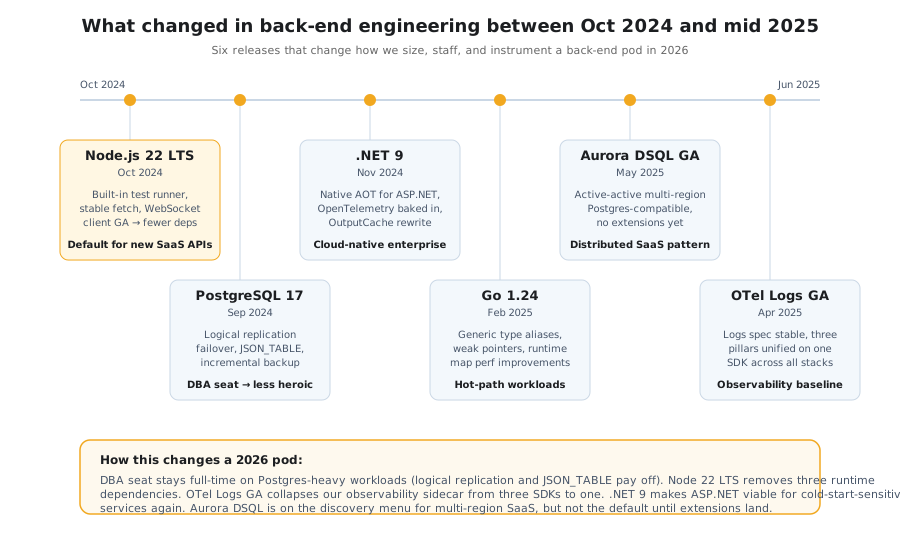
Between October 2024 and mid 2025 the back-end landscape moved in a way that matters to anyone hiring a pod today. Six releases changed what a sprint-zero week actually ships, and they changed which seats we hold full-time on which engagements. This is the short version of the conversation we have with a CTO on a discovery call when "what stack should we be on" is still on the whiteboard.
Node.js 22 LTS retired three middleware dependencies
The built-in test runner reached stable in 22.x, native fetch is no longer behind a flag, and the WebSocket client landed in 22.4. On the pods we ran in the first half of 2025, that pulled three runtime dependencies out of two existing services (a test runner package, a fetch polyfill, and a WebSocket library) and shaved roughly fifteen percent off cold-start on the smaller workloads. Default stack for new SaaS APIs where the same team also owns a React or Next.js surface.
PostgreSQL 17 changed the DBA workflow on logical replication
Logical replication now supports failover and switchover, incremental file-system backup is in core, the memory-pressure tuning improved measurably on the workloads our DBA bench profiled, and JSON_TABLE plus the MERGE WHEN NOT MATCHED BY SOURCE clause made two of our regular extraction patterns shorter. We still hold the DBA seat full-time on any pod past five engineers, but the seat spends less time on heroic shell scripts and more on schema design.
.NET 9 made native AOT a sensible default for ASP.NET
Native AOT in ASP.NET shipped properly in .NET 9 (November 2024) and OpenTelemetry instrumentation is now first-class. On the cloud-native services where cold-start mattered, AOT pulled startup from the 1.2–1.8s band down to 80–200ms in our profiles, which is the difference between AWS Lambda being a viable target and being a politely rejected one. The OutputCache rewrite removed a memory regression we had been working around with a third-party cache module since 2023.
Go 1.24 quietly fixed a class of generic-related bugs
Released February 2025. Generic type aliases unlocked a pattern we had been faking with named-type wrappers for two years, weak pointers removed a class of finalizer hacks, and the runtime map performance work shows up on real workloads as a five to fifteen percent improvement on hot paths. We still field Go pods when the bottleneck is the request lifecycle itself, but the gap to JVM stacks on heavy domain logic narrowed.
Aurora DSQL is on the discovery menu, not the default
AWS shipped Aurora DSQL into general availability in May 2025 as an active-active, Postgres-compatible, multi-region database. The active-active story is real and the latency profile is good. The catch is that extensions are not yet supported, which means anything resting on pgvector, PostGIS, TimescaleDB, or hstore stays on classical Aurora Postgres. We will recommend DSQL when the workload is genuinely multi-region and extension-free; otherwise it is on the watchlist, not the architecture diagram.
OpenTelemetry Logs reached GA — one SDK for three pillars
The Logs specification reached stable in 2025, which finally unifies traces, metrics, and logs on a single SDK and a single collector. On the pods we ran post-GA, our observability sidecar collapsed from three SDKs (per stack) to one. That is a real budget reduction on cross-stack engagements and a faster ramp on the first ten alert runbooks. We track the spec at the OpenTelemetry specification repository when a buyer asks for the exact version we are on.
Two adjacent developments are worth naming because they will shape the next twelve months even though they are not strictly back-end releases. Kubernetes 1.32 brought sidecar containers to GA and Dynamic Resource Allocation for GPU-heavy workloads. And the EU Cyber Resilience Act enters its first enforcement phase in 2026, which means SBOMs and a documented vulnerability handling process are now table stakes on every back-end engagement we sign with an EU buyer, not a security-team afterthought.
The Three-Question Extraction Test — a named decision tool
The single most expensive failure mode we see on inherited back-ends is a service extraction that should never have happened. A team smells legacy, sketches a diagram with five services on it, ships two, and discovers in sprint nine that the third service needs a join the new architecture cannot reach without a roundtrip back into the monolith. The team then either spends three sprints building a read-replica view, or quietly abandons the migration. We have replaced enough of these engagements to know what the avoidable mistake looks like, and we have given the avoidance a name.
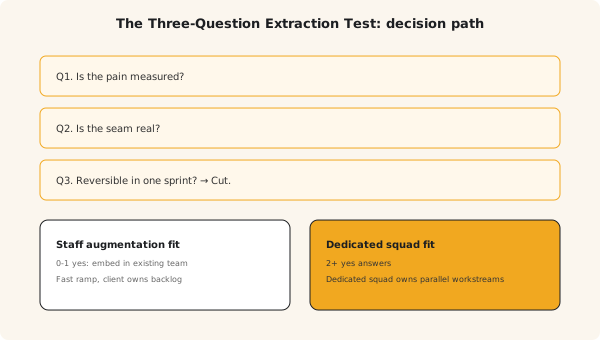
The Three-Question Extraction Test is the checklist a Siblings back-end pod walks before any "let us extract a service" conversation moves past whiteboard stage. It is not novel; it is the discipline of refusing to confuse motion with progress. We published it on this page because too many engagements skip it and the visitors who land here are usually one bad cutover into figuring out why.
Q1. Is the pain measured?
Concretely: fourteen consecutive days of RED metrics (rate, errors, duration) on the offending endpoint, a p95 number you can defend in a sales call, and an answer to "which queries are inside the slow request?" A teammate's anecdote that the API "feels slow on Tuesdays" is not a yes. If the answer is no, we ship observability into the monolith for two sprints and come back to this question with data. About one in three discovery weeks ends here, and that is fine.
Q2. Is the seam real?
A real seam is a bounded context with one writer. If three other services write to the same table the new service would own, the seam is not real, it is a wish. If the new service needs a join the monolith can do but the new architecture cannot, the seam is not real. If you cannot draw the seam on a single sheet of paper without arrows crossing, the seam is not real. The honest yes is rare; the honest yes is also the one that survives a cutover.
Q3. Reversible inside one sprint?
The cutover that cannot be undone is the cutover we refuse to run. A yes here means feature-flagged routing, parity tests running for the full week before traffic moves, a percentage rollout with kill-switch, and a written rollback runbook that any engineer in the pod can execute alone on a Monday morning. We do not take the cutover Monday until we have practised the rollback once in staging with production-shaped data.
Three yeses mean proceed. Any no means stop, instrument, or refactor in place. We use the test on every monolith-to-services conversation, every "let us add a queue" conversation, and every "let us split the relational core" conversation. We have run it on inherited Birchpoint code (described later on this page) and we run it on our own services on the engineering bench. It is not a marketing line; it is the screen between a good Tuesday and a regrettable Wednesday.
Who is on a Siblings Software back-end pod
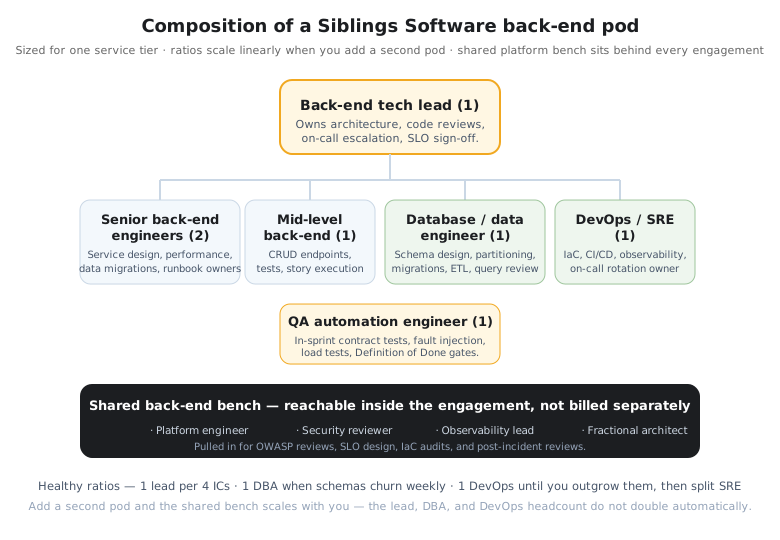
Composition is opinionated. The numbers below come from a decade of running back-end engagements across healthcare, payments, logistics, smart-cities, and SaaS. Smaller pods leave the database or DevOps role floating between engineers, which is where data integrity quietly dies. Larger pods break code-review SLAs and fragment the on-call rotation.
Small service pod (4–5 people)
A back-end tech lead, two senior backend engineers, a part-time DBA or data engineer, and a shared QA automation engineer. Best when one service tier is the bottleneck and your in-house team owns the rest. The DevOps role is fractional, drawn from our shared platform bench.
Full-stack-of-services pod (6–8 people)
A tech lead, two senior and one mid-level backend engineer, one full-time DBA or data engineer, one DevOps or SRE, one QA automation engineer. Best when the team owns three or more services, an asynchronous backbone, and a 24/5 on-call rotation. The default shape for SaaS companies past a few hundred customers.
Multi-pod platform engagement (10–14 people)
Two service pods plus a shared platform team running Kanban on observability, incident response, and shared libraries. Used when the workload spans two or three product surfaces, regulated rollouts, or 24/7 on-call. Includes a fractional architect for cross-pod design reviews.
The roles below are the ones that get cut first by vendors trying to hit a price point and the ones we refuse to remove. A pod without them is not a back-end pod; it is a pile of engineers writing endpoints.
Database or data engineer (1)
Schema design, partitioning, migration strategy, query review, ETL, and replication. Without this seat, every senior engineer becomes a part-time DBA and nobody owns the data model end to end. We refuse engagements that try to rotate three engineers through schema work; the only way to keep migrations reversible is for one person to read every diff.
DevOps or SRE (1)
Infrastructure-as-code, CI/CD pipelines, secrets management, observability wiring, and the on-call rotation. Without this seat, the pod ships into an environment somebody else maintains and pages somebody else answers, which is where the "it works in staging" excuse is born.
QA automation engineer (1)
Contract tests, fault injection, load tests, and the Definition of Done gates in CI. Tests run inside the sprint, not at the end of it. Stories that fail the DoD are not closed at the demo, regardless of optics.
Tech lead (1)
Architecture decisions, code-review SLA, on-call escalation, SLO sign-off, and the hard veto on premature microservices. The lead writes the one-page architectural decision records and owns the conversation about scope, scale, and trade-offs with your engineering leadership.
If your backlog is heavy on a single stack, we blend specialists from our Go development team bench — or any other stack-specific dedicated team — into the pod, so framework decisions are made by people who have lived with the consequences. The shared platform bench sits behind every dedicated development team we field.
Picking the back-end stack — an opinionated map
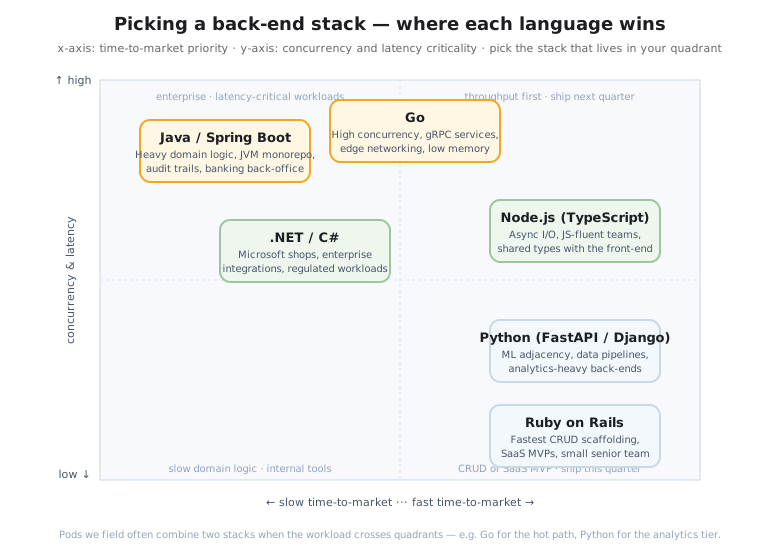
"Which language should the back-end be in" is not a neutral question. Each stack ships with a set of trade-offs that punish you for using it outside its quadrant. The diagram below is the opinionated default we bring to a discovery call. We will argue you out of it whenever the workload demands, but it is the starting frame.
Node.js with TypeScript — the safe default
Async I/O, a JS-fluent talent pool, and shared types with the frontend. Wins for SaaS APIs where the same team also owns a React or Next.js surface. NestJS and Fastify are the frameworks we reach for when the codebase is past the prototype stage; Express is fine until the routing file becomes a folder.
Python — the analytics-adjacent winner
FastAPI for async APIs, Django when you want batteries included, Celery or RQ for background work. Wins when the workload touches ML, ETL, or analytics. Loses on raw concurrency. We pick Python whenever a single service has to live next to a data-science codebase, because the seam is otherwise paid in serialization and translation.
Go — concurrency, gRPC, and small binaries
Wins for high-concurrency services, gRPC fan-out, edge networking, and any workload where memory and cold-start matter. Loses when domain logic is heavy and the team has been writing Spring for ten years. We field Go pods when the bottleneck is the request lifecycle itself and the answer is to do more with less. See the NetApp Go platform engagement for an eight-engineer Go pod we run today.
Java and .NET — the heavy domain stacks
Wins when business logic is dense, audit trails are mandatory, and the rest of the company already runs the JVM or .NET. Spring Boot and ASP.NET Core have the deepest enterprise tooling and the most mature observability story. Loses to lighter stacks on time-to-first-deploy. We pick them when the alternative is rewriting twenty years of accumulated business rules in a smaller language.
Ruby on Rails — CRUD speed for small senior teams
Wins for SaaS MVPs and CRUD-heavy back-offices where five seniors will outship a fifteen-person Java pod for the first eighteen months. Loses on the throughput curve once your top endpoints cross a few thousand requests per second. We default to Rails when the constraint is calendar, not concurrency.
When to pick two stacks
The pods that ship the cleanest stories often run two stacks: Go for the hot path and Python for the analytics tier; Node for the customer-facing API and Java for the integration layer; .NET for the back-office and FastAPI for the ML surface. We prefer one stack until measured pain forces a second; we refuse to add a third without a written record of why.
Who hires a back-end development team
The buyer profiles below cover roughly nine in ten conversations on this page. If you recognize yourself in one, the next call is usually about service contracts and SLOs, not CVs.
CTO replatforming a fast-growing API
The product is past Series A. The monolith ships fine, until it does not, and now two hot endpoints carry sixty per cent of the request volume on a Tuesday morning and nobody can defend the p95. The buyer needs a pod that can baseline performance, extract the hottest domains into services, and leave the monolith behind on a survivable maintenance budget.
Founder building an API-first product
There is no frontend yet, or the frontend is a partner integration. The work is API design, contract testing, and the discipline to ship a v1 that does not need a v2 in six months. The buyer wants a senior pod that has shipped public APIs before and will refuse to skip versioning, deprecation, or rate-limit policy because "we can fix that later".
VP of Engineering modernizing legacy
An eight-year-old Rails monolith, a fifteen-year-old .NET WCF stack, or a Java EE codebase nobody wants to touch. The buyer needs a pod that can read the existing system without contempt, find the seams, and migrate workloads off the legacy core without freezing feature delivery for a year. The risk is over-eagerness, not under-skill.
Operations leader hardening a leaking system
The pager goes off three times a week. Customer support tickets pile up around the same five errors every month. The job is not new features; it is observability, runbooks, error-budget discipline, and the boring work of taking a system from "barely up" to "predictably up". The right pod arrives with an SRE seat and an opinion about SLOs.
Head of Product launching a multi-tenant SaaS
Tenant isolation, row-level security, per-tenant quotas, and the audit-log surface that lets a customer's compliance team accept the product. This is not a frontend problem and it is not solved by adding columns. The buyer needs a back-end pod that has shipped multi-tenant before and will not be surprised by the conversation about noisy neighbours, tenant data exports, and per-tenant SLAs.
How we onboard a back-end pod in two to three weeks
The numbers below are the same ones that appear on every dedicated-team engagement we run. Back-end specifics drop into the same shape; sprint zero is where the runbook for a real production system gets drafted.
Discovery (3–5 days)
Two-hour working session with your engineering lead, a read-only walk through the schema and the top ten endpoints, a written team configuration proposal, and a baseline performance plan with target SLOs.
Team assembly (5–10 days)
Pre-vetted candidates introduced for paired technical sessions. You interview every engineer. The tech lead and DBA candidates run a live schema review against an anonymized sample so you see them think before signing.
Sprint zero (week 2–3)
CI access, environment access, observability wired, structured logs flowing, RED metrics on the top endpoints, OpenTelemetry traces sampled. Definition of Done locked. The runbook for the first three top alerts drafted before any feature work starts.
Sprint one (week 3–4)
First quick wins typically land here: an indexed query that drops p95 by half, an endpoint that finally returns the right HTTP status code, an N+1 in the most-trafficked report. The pod is now operating on the cadence and the SLOs you saw on paper during discovery.
A 2-week satisfaction guarantee covers any seat in the pod. After the first 30 days, scaling down requires 30-day notice; scaling up takes one to two weeks per seat. None of this is unusual — it is the same engagement spine we use across every back-end development outsourcing engagement we run.
Real hiring scenarios we handle every quarter
The five scenarios below cover most of the back-end engagements we sign. The shape of the pod, the first sprint goal, and the headline number we agree to ship against differ by scenario, not by language.
Build a new service tier alongside a monolith
Your existing system runs fine but two domains are now blocking three other teams. We extract those domains into services with strict contracts, behind a feature flag, behind your existing API gateway. The monolith stays. The pod owns the new services, the migrations, the observability, and the deprecation calendar for the legacy endpoints.
Migrate a monolith to services on a calendar
Quarter-by-quarter extraction. The pod runs strangler-fig migrations: new endpoints behind the gateway, traffic routed via percentage shadowing, old endpoints removed once parity tests are green for two weeks. We refuse big-bang rewrites. We document why every quarter.
Scale a fast-growing API past its first cliff
The product is shipping; the inbox is full of latency complaints from your largest customer. The pod baselines performance, finds the queries and indexes that account for most of the budget, introduces the right cache or read replica, and pushes the most concurrent path off the relational core when that is the right answer. Often the cure is six lines of PostgreSQL, not six new services.
Harden a leaking system you inherited
The previous team left no observability, no runbooks, and a CI pipeline nobody trusts. We treat the first two sprints as instrumentation-only: structured logs, RED metrics, error budgets, and the runbook for the top ten alerts. Feature work resumes once the team can answer "what changed at 02:14" in under five minutes.
Stand up a multi-tenant SaaS back-end from scratch
Tenant isolation, row-level security, per-tenant rate limits, audit-log surfaces, and the data export your customer's compliance team is asking for. The pod arrives with the patterns we have seen survive five-year SaaS engagements: hard tenancy keys on every row, a published export contract, paranoid logging on cross-tenant queries, and a separate workload tier for noisy-neighbour endpoints.
Engagement models and what a back-end pod costs
Pricing for a dedicated back-end development team is monthly and predictable. The brackets below are the same ones we publish on the broader dedicated development team page; we do not charge a "back-end premium" because the practice is how we work, not an add-on.
Small service pod
USD 12K–22K / month
Four to five people. Tech lead, two senior backend engineers, part-time DBA, shared QA. DevOps drawn from the platform bench. Best for one service tier or a focused refactor. Initial 3-month commitment, then month-to-month.
Full-stack-of-services pod
USD 24K–42K / month
Six to eight people. Tech lead, two senior plus one mid backend engineers, full-time DBA or data engineer, full-time DevOps or SRE, QA automation. 24/5 on-call rotation included. The default shape for SaaS past a few hundred customers.
Multi-pod platform engagement
USD 45K–60K+ / month
Two service pods plus a shared platform team on Kanban. Ten to fourteen people. Includes a fractional architect, 24/7 on-call coverage, and a quarterly architecture review. For multi-product SaaS, regulated rollouts, and multi-tenant platforms.
A 2-week satisfaction guarantee runs across every seat. Scaling down takes 30 days' notice; scaling up takes one to two weeks per role. If you would rather start project-based and convert to a dedicated cadence later, the small service pod is the bracket that converts most cleanly into a fixed-window engagement before becoming a long-running pod.
Mini case study — rescuing a telematics monolith from itself
Birchpoint Telematics is a US-based commercial-fleet SaaS for refrigerated trucking carriers. Cold-chain compliance, ELD log ingestion, predictive maintenance, and a public partner API used by three insurance underwriters. The product had grown from a Series A node on Heroku into a 14-million-events-per-day Node.js plus PostgreSQL monolith handling about twelve hundred carriers. Over four quarters, p95 on the inspection-history API drifted from 2.6 seconds to 14 seconds, the partner API was returning 502s under regional weather events, and the internal team of three senior backend engineers was burning sprints fighting the same five alerts.
The engagement charter was narrow on purpose. Move the inspection-history API and the cold-chain telemetry ingester off the monolith without halting feature delivery for the eighteen-month roadmap of pending state Department of Transportation integrations. Keep the monolith on Node for the feature work the in-house team was best at. Pick the right second stack for the hot path. Ship the first cutover before the regulatory audit window opened in sprint twelve.
We placed a five-person pod alongside the existing internal team: a Go tech lead, one senior Go backend engineer, one senior data engineer (PostgreSQL plus ClickHouse), one DevOps or SRE engineer, and one QA automation engineer. The first sprint shipped observability into the monolith's two hot endpoints — structured logs, RED metrics, OpenTelemetry traces, and a runbook for the top three alerts — before any extraction work started. The next eight sprints rebuilt the inspection-history service in Go behind the existing API gateway, with strangler-fig routing and parity tests against the monolith. Sprints nine through eleven moved the cold-chain telemetry ingester to a sharded ClickHouse tier with a PostgreSQL system-of-record for the compliance-affecting columns.
Headline numbers over the first eleven sprints: inspection-history p95 14s → 480ms; partner-API 502 rate during regional weather events 6.2% → 0.3%; telemetry ingester sustained throughput on three pods 22k events/sec (against a 6k peak on the monolith); PostgreSQL WAL pressure on the primary down 70% after the ingester moved off the relational core; two state DOT API integrations shipped on the original schedule against a regulatory deadline that was originally projected to slip a quarter. Engagement cost: roughly USD 48K/month for the five-person pod across the eleven sprints. The internal team stayed and shipped feature work on Node throughout; nobody was replaced.
What we would do differently next time: spend two extra discovery days on the data-model split before extracting the first service. We migrated by service first and then realized two endpoints needed a join the new service could not reach without a roundtrip back into the monolith. We worked around it with a read-replica view; we would avoid the round trip entirely if we ran discovery again. For a published case study with disclosed metrics on a comparable Go pod, see the NetApp Go platform engagement.
Back-end pod vs. in-house, freelancers, and agencies
A dedicated back-end pod is one of four ways to add server-side capacity. The trade-offs below are why the same buyer keeps landing on this page after trying the other three.
vs. in-house hiring
Best in the long run, slowest to start. A senior US backend engineer with the right operational fluency takes four to nine months to hire and ramp; a senior DBA with production migration experience takes six to twelve. The pod route gives you a working cadence and an on-call rotation in three weeks. Convert later if it makes sense.
vs. freelance marketplaces
Two senior freelancers can ship endpoints. They cannot share infrastructure ownership. There is no common runbook, no shared on-call, no code-review SLA. You are managing four contracts and a Slack channel pretending to be a tech lead. The first P1 incident is the moment that becomes obvious.
vs. agencies that bolt on a back-end
Agencies that win on frontends and bolt a back-end on are usually weak on long-term infrastructure ownership. They ship the API, hand you the codebase, and disappear before the second migration. The honest signal is whether the agency staffs an SRE seat by default or treats DevOps as a fractional add-on. We have replaced enough of these engagements to know the shape.
vs. body-shop offshore
Body shops sell hours and tickets-marked-done. Predictability is whatever your internal lead can extract from asynchronous status updates. A back-end pod sells a service, an SLO you can defend in a sales call, and a runbook the on-call engineer reads at 02:14. The price gap is real (body shops are cheaper per seat) but the unit you are buying is not the same.
The request lifecycle a back-end pod owns end to end
If a back-end engagement is going to fail, it is usually because one of the boxes below was assumed to be somebody else's problem. The diagram is the shorthand we draw on a whiteboard during discovery to confirm scope.
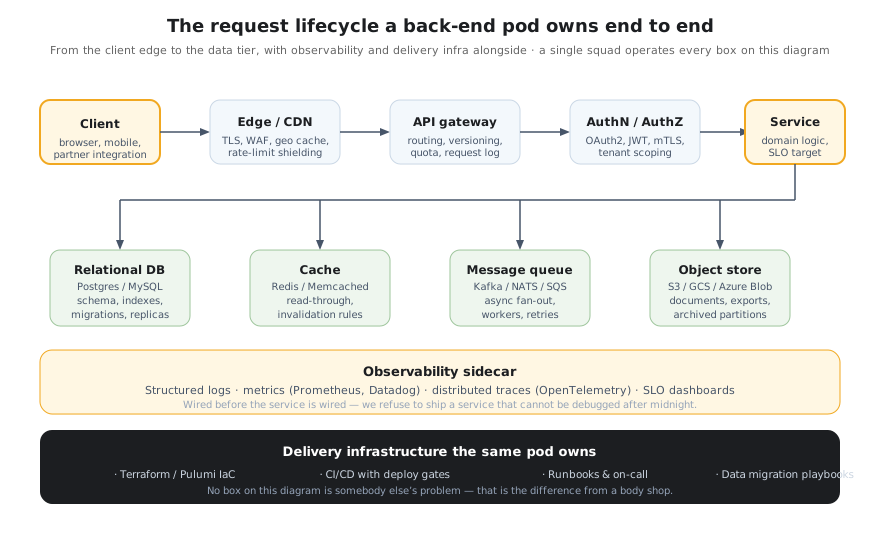
Three principles drive how the pod operates inside the diagram. First, observability is wired before the service is wired; we refuse to ship code that cannot be debugged after midnight. Second, the schema is owned by one person, not rotated through three; reversible migrations are how we sleep. Third, the on-call rotation belongs to the people who wrote the code; that is non-negotiable on long-running engagements and the single biggest reason most outsourced back-ends drift into operational debt.
Risks specific to back-end engagements (and what we do about them)
Generic outsourcing risks — IP ownership, NDAs, time-zone overlap — we treat the same way on every engagement: written into the master agreement, US-style work-for-hire IP, source-controlled deliverables, four-hour daily overlap with US time zones. The risks worth naming on this page are the ones unique to back-end work.
Over-engineering on day one
The most expensive failure mode. A team arrives, smells legacy, and proposes seven services where two would do. Mitigation: every architectural decision has a one-page record, the tech lead has a hard veto on premature microservices, and we measure pain before we add infrastructure.
ORM-coupling and the hidden N+1
The query that runs once in dev and a thousand times in production. Mitigation: the DBA reviews every migration and every query that touches the top ten endpoints; we ship a query-plan baseline before sprint two and re-run it monthly.
Missing observability
"It works on staging" is the symptom; no structured logs, no metrics, no traces is the cause. Mitigation: sprint zero ships RED metrics on the top endpoints and OpenTelemetry traces sampled at a defensible rate. The pod refuses to start feature work without a running dashboard.
No SLOs, no error budget
The team ships features until reliability collapses, then reliability work blocks features. Mitigation: SLOs negotiated in week one with your product lead, error budgets gating risky deploys, and reliability work treated as a first-class story type, not an after-hours favour.
Migration without a rollback path
The cutover that cannot be undone. Mitigation: every migration ships with a written reverse plan, a parity-test suite, and a feature flag wrap. We run the cutover in a staging clone with production-shaped data first, on the same calendar week we run it for real.
Frequently asked questions about hiring a back-end development pod
What is the Three-Question Extraction Test and when do you run it?
It is the three-question checklist a Siblings back-end pod walks before any "let us extract a service" conversation moves past whiteboard stage. Q1: is the pain measured (fourteen days of RED metrics on the offending endpoint and a p95 number you can defend in a sales call)? Q2: is the seam real (a bounded context with one writer, not a join the new service cannot reach without a roundtrip)? Q3: is the cutover reversible inside one sprint? Three yeses mean proceed. Any no means stop. Roughly one in three discovery weeks ends at Q1, and that is fine; speculative complexity is the most expensive kind.
Which back-end stack should we start with in 2026?
Node.js 22 LTS with TypeScript is the safest default for a new SaaS API where the team also owns a frontend; the built-in test runner, stable fetch, and WebSocket client remove three runtime dependencies. Python wins on ML, ETL, and analytics adjacency. Go 1.24 wins for high-concurrency hot paths and gRPC. .NET 9 wins when domain logic is heavy and cold-start matters (native AOT in ASP.NET genuinely shipped). Java with Spring Boot wins when the JVM is already the rest of the company. Ruby on Rails wins when calendar matters more than concurrency.
Who owns the data migration when we move endpoints off our monolith?
The pod, end to end. The database engineer drafts the migration plan, the tech lead reviews it against the system-of-record contract, the senior engineers write reversible scripts behind feature flags, the DevOps engineer runs them in a staging clone with production-shaped data, and the QA automation engineer writes parity tests against the same input. PostgreSQL 17 logical replication failover and incremental backup remove some of the heroics, but the discipline is what keeps the cutover honest. We own the runbook, the rollback, and the on-call window the night the cutover happens.
How do you avoid the over-engineering trap?
Three rules. Every architectural decision needs a written one-page record. We do not introduce a queue, a cache, a service, or a new datastore without a measured pain point. The tech lead has a hard veto on premature microservices. Most companies that ask for ten services would be better served by a well-bounded modular monolith and a Postgres index that someone actually thought about.
Can the pod take on-call rotations for the services they ship?
Yes. We staff a 24/5 on-call rotation by default with two engineers per shift, paired with the DevOps or SRE seat. 24/7 is possible with a second pod or a shared rotation with your in-house team across time zones. We refuse to be on-call for code we did not write or review, because being woken up to debug somebody else's foot-gun is how good engineers leave. Within the first month we co-author runbooks for the top ten alerts, agree on paging severity, and run a tabletop incident before the rotation goes live.
How do you handle observability and SLOs from sprint one?
Observability is wired before the service is wired. Sprint zero ships structured logs, RED metrics on every endpoint the pod owns, and OpenTelemetry traces sampled at a level your wallet will not regret. With OTel Logs reaching GA in 2025, our observability sidecar collapsed from three SDKs to one across Node, Python, Go, and .NET. SLOs are negotiated with your product lead in week one. Error budgets gate risky deploys; if we are out of budget, we stabilize before we ship features.
Can we move from staff augmentation to a full back-end pod later?
Yes, and roughly half our pods follow this path. We start with two or three augmented seniors on your existing squad through the staff-augmentation model, and once they know your domain we layer in the tech lead, the database engineer, the DevOps or SRE, and the QA automation seat. The conversion adds infrastructure around the engineers you already trust; it does not swap them out.
How do you handle data exports and tenant isolation for multi-tenant SaaS?
Hard tenancy keys on every row, paranoid logging on cross-tenant queries, a published export contract, and per-tenant rate limits. We ship the audit-log surface your customers' compliance teams ask for, not the one we hope they will accept. Noisy-neighbour endpoints get their own workload tier so a single tenant cannot starve the others. On Postgres-heavy systems we lean on row-level security in 17; on multi-region SaaS the discovery call now includes a frank conversation about whether Aurora DSQL is the right destination.
OUR STANDARDS
Production code over slideware. Reversible migrations over heroic deploys. Closed runbooks over hopeful Slack threads.
A back-end story is not done until the endpoint has structured logs, RED metrics, an SLO it can defend, a parity test against the previous behaviour, and a runbook line for the alert it can produce. We treat observability as load-bearing infrastructure, not a quarterly project, and we report on the SLOs we agreed to defend, not the velocity we estimated against.
Our Definition of Done is a written checklist with hard gates in CI: code review approved by the tech lead, automated tests passing, OpenAPI or proto contract updated, migration scripts reversible, observability hooks in place, deploy to staging successful, runbook entry written for any new alert path. Until those gates close, the story is not done, regardless of what the board says.
If you’re interested in hiring developers for this capability in Argentina, visit the Argentina version of this page.
CONTACT US
Get in touch and build your idea today.