Hire a Dedicated Go Development Team
You have a backend that needs to handle real concurrency, not a proof of concept. Maybe you are rebuilding a monolith into microservices, or your current system chokes under traffic spikes, or you simply cannot find senior Go engineers fast enough locally. That is usually when teams like yours reach out to us.
At Siblings Software, we assemble dedicated Golang pods that embed into your workflows. These are not contractors you babysit. They join your standups, argue about architecture in your Slack channels, and own delivery alongside your people. Most of our Go teams have shipped billing platforms, real-time data pipelines, and high-throughput APIs for companies in fintech, logistics, health, and SaaS.
Below you will find the specifics most buyers actually care about: what the team looks like, how much it costs, how fast we can start, and honest comparisons against the alternatives. If you want to skip ahead, schedule a discovery call and we will walk you through it live.
Who hires a dedicated Go team (and when it makes sense)
Not every company needs a dedicated pod. Here are the scenarios where it actually pays off, based on the engagements we have run over the past seven years.
You are migrating away from a monolith
Your PHP, Ruby, or Python monolith has hit a wall. Response times are climbing, deployments take hours, and your team is afraid to touch critical paths. A Go squad can decompose the system into focused services incrementally, keeping production stable while replacing components behind feature flags.
You need backend capacity yesterday
Your roadmap has more work than your current team can absorb. Hiring locally takes three to four months when you factor in sourcing, interviewing, negotiating, and onboarding. A dedicated team starts delivering within two to three weeks because the sourcing and vetting is already done on our side.
You are building a new platform from scratch
Greenfield projects need strong opinions early: service boundaries, data ownership, observability strategy, deployment topology. A Go pod with a tech lead shapes those decisions with you instead of leaving architecture to chance. We have seen too many startups bolt on observability after their first outage rather than before it.
Your internal team lacks Go-specific depth
You chose Go for good reasons, but your engineers are still learning concurrency patterns, channel semantics, and profiling with pprof. A dedicated team brings production experience with goroutine leaks, worker pool sizing, and the kind of problems that only show up under load. They can also mentor your existing people along the way.
If none of these match your situation, you might be better served by individual Go staff augmentation or a project-based Go engagement.
Pricing and engagement models
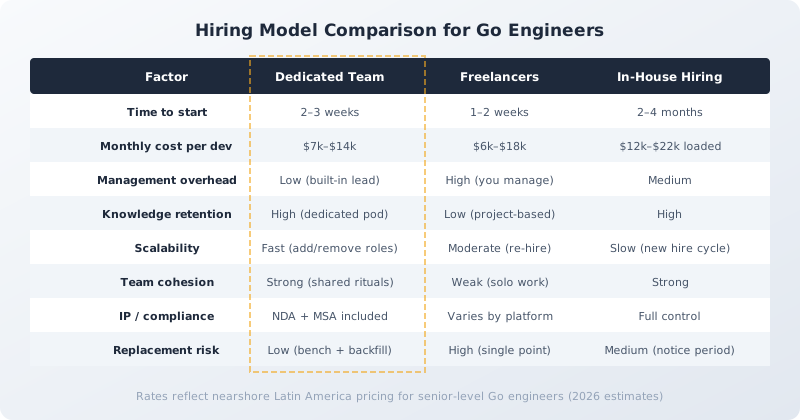
We get asked about cost on every first call, so here are the numbers upfront. These are nearshore rates for Latin America-based teams working in US time zones. Exact pricing depends on seniority mix, engagement length, and scope complexity, but the ranges below cover 90% of our Go team engagements.
Monthly dedicated team
$7,000 – $14,000 per developer per month
Full-time engineers working exclusively on your project. Rate includes management, tooling, and knowledge transfer. Minimum engagement is typically three months so teams can build meaningful context.
- 3-person starter pod: ~$28k – $38k/month
- 4-person pod with tech lead: ~$38k – $52k/month
- 6-person squad with DevOps and QA: ~$55k – $78k/month
Longer engagements (6+ months) typically qualify for volume discounts.
How this compares to alternatives
Hiring a senior Go engineer in the US costs $150k – $220k per year in salary alone, plus benefits, equipment, and recruiting fees (often 20–25% of first-year salary). That is roughly $16k – $22k per month fully loaded.
Freelance Go developers on major platforms charge $50 – $150 per hour depending on experience. At 160 hours per month, that is $8k – $24k, but you manage them yourself, deal with availability gaps, and absorb all the risk if they disappear mid-project.
A nearshore dedicated team sits in between: lower total cost than in-house, more stability than freelancers, and built-in management that reduces your coordination burden.
How we assemble your Go team
The process from first conversation to a team writing production code takes two to three weeks. It has five stages, and you stay involved at every decision point.
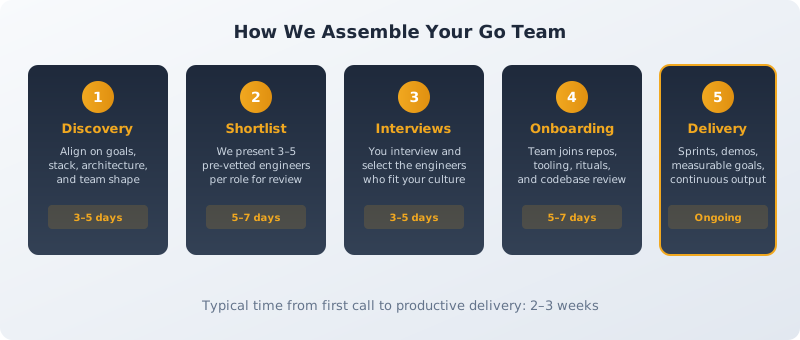
1. Discovery (3–5 days)
We start with a technical deep-dive: your current architecture, the problems you are solving, the stack constraints, team dynamics, and timeline. We co-create a delivery charter that maps outcomes, risks, and the specific roles you need. This is the step that prevents mismatches later.
2. Candidate shortlist (5–7 days)
We present three to five pre-vetted engineers per role. Each candidate comes with a profile showing relevant project history, tech depth, and communication style. You are not reviewing 50 resumes. You are choosing between people we have already validated against your requirements.
3. Your interviews (3–5 days)
You interview the shortlisted engineers using whatever format works for your team: live coding, architecture discussion, pair programming, or just a conversation. We schedule around your availability. You pick the people, not us.
4. Onboarding (5–7 days)
The selected team joins your repositories, gets access to your tooling (Jira, Linear, GitHub, Datadog, whatever you use), and starts a guided codebase walkthrough. We create runbooks for common workflows and set up integration testing. By the end of week one, they are contributing to your backlog.
5. Delivery (ongoing)
Sprints run on your cadence. You get daily standups (or async updates if you prefer), weekly demos, and retrospectives. The tech lead handles code reviews, enforces quality standards, and flags risks early. Scaling up or rotating specialists happens without restarting the hiring cycle.
Collaboration rhythms we default to
- Monday: sprint planning with your product owner
- Wednesday: async Loom update covering progress, blockers, metrics
- Friday: demo and retrospective with stakeholders
We adapt to your tooling and schedule, not the other way around.
What a Go development team includes
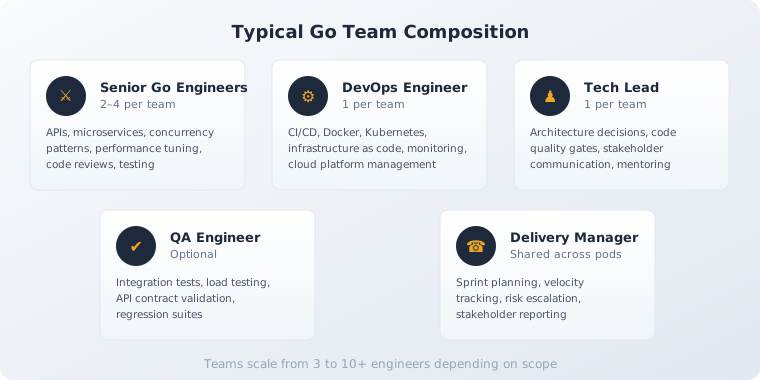
Every pod is shaped around your problem, but most Go teams follow a similar structure. Here is what the roles typically look like and what each person actually does day to day.
Senior Go engineers (2–4)
These are the people writing and reviewing most of the code. They build APIs with Gin or Echo, design concurrent processing pipelines, handle database interactions through GORM or raw SQL, and write integration tests. They have typically shipped Go in production for three or more years and know the difference between reaching for a goroutine and actually needing one.
Tech lead (1)
The tech lead makes architecture calls, runs code reviews, mentors the rest of the pod, and communicates trade-offs to your stakeholders in plain language. They own the technical roadmap and guard against shortcuts that create maintenance debt. In our experience, teams without a strong lead ship slower and accumulate more rework.
DevOps engineer (1)
Handles CI/CD pipelines, container orchestration with Docker and Kubernetes, infrastructure as code, cloud platform configuration (AWS, GCP, or Azure), and monitoring setup. Their job is making sure the code the engineers write actually reaches production reliably and is observable once it gets there.
Optional: QA engineer
Adds dedicated testing capacity for load testing, API contract validation, regression suites, and edge case coverage. Especially useful for teams building payment systems, healthcare backends, or anything where bugs have financial or regulatory consequences.
Optional: Delivery manager
For fully managed engagements, a delivery manager coordinates sprint planning, velocity tracking, risk escalation, and stakeholder reporting. They act as the bridge between your product team and the engineering pod, reducing context-switching for everyone involved.
Technologies our Go teams work with
Frameworks: Gin, Echo, Fiber, Chi, net/http
Communication: gRPC, REST, GraphQL, WebSockets, NATS
Data: PostgreSQL, Redis, MongoDB, Kafka, GORM, sqlx
Infra: Docker, Kubernetes, Terraform, GitHub Actions, GitLab CI
Dedicated Go team vs. freelancers vs. in-house hiring
Every model has trade-offs. The right choice depends on how long you need the capacity, how much management overhead you can absorb, and whether you need team cohesion or just individual output.
Dedicated team (what we offer)
A stable pod that works full-time on your product. Built-in leadership, shared processes, and replacement guarantees. You direct priorities; we handle team health, quality gates, and continuity. Works well for engagements longer than three months where context matters.
Strengths: fast ramp-up, low management overhead, knowledge retention, scalable.
Watch out for: minimum commitment (usually 3 months), less flexibility for one-off tasks.
Freelance Go developers
Good for short, well-scoped tasks where you know exactly what you need. Cheaper per-hour for simple work, but you manage everything: quality, deadlines, communication, availability. Knowledge leaves when the freelancer does, and backfilling mid-project is painful.
Strengths: fast start, lower cost for small scope, flexible commitment.
Watch out for: no built-in QA, no team cohesion, availability risk, management burden.
Hiring Go engineers in-house
The right choice for long-term core competencies. But senior Go talent is hard to source. Expect two to four months to fill a role, $150k – $220k in annual salary (US), plus benefits, equipment, and recruiter fees. Great for steady-state teams, not for projects with uncertain timelines.
Strengths: full control, deep integration, cultural alignment.
Watch out for: time to hire, total cost, difficulty scaling down.
Many of our clients use a hybrid approach: a dedicated Go team handles the bulk of delivery while they gradually build internal Go capacity. We have helped several companies transition work back in-house after 12 – 18 months, including knowledge transfer sessions and documentation handoffs.
Case study: Billing platform rebuild for a SaaS company
The situation: A US-based SaaS company processing usage-based billing for 1,200+ enterprise accounts was stuck on a monolithic Node.js system. Their billing runs took 45 minutes during peak periods, reconciliation errors were costing them roughly $80k per quarter in revenue leakage, and their two-person backend team could not keep up with feature requests from the sales team. They needed to rewrite the billing engine without disrupting invoicing for existing customers.
What we did: We assembled a four-person Go pod: a tech lead with billing domain experience, two senior Go engineers, and a DevOps engineer. The team spent the first two weeks running a discovery phase alongside the client's engineers, mapping every billing workflow, edge case, and integration point. Over the next ten weeks, they rebuilt the billing pipeline as a set of Go microservices using event sourcing with Kafka, gRPC for internal communication, and PostgreSQL for transactional data.
The migration used a strangler fig pattern. New services ran in parallel with the legacy system, processing the same events and comparing outputs. Only after four weeks of consistent results did we begin routing production traffic. The entire cutover happened over a weekend with zero billing disruptions.
Results after 14 weeks
- Billing run time dropped from 45 minutes to under 3 minutes
- Reconciliation errors fell by 94%, recovering an estimated $75k per quarter
- The system now handles 8x the transaction volume on 40% less infrastructure
- The client's internal team inherited clean, documented Go services they could maintain independently
"We had tried hiring Go engineers locally for six months with no luck. Siblings assembled a team in two weeks that understood our billing domain better than most candidates we had interviewed. The migration was the smoothest infrastructure project we have run."
— Director of Engineering, US SaaS company
Team: 1 tech lead, 2 senior Go engineers, 1 DevOps engineer. Stack: Go, Kafka, gRPC, PostgreSQL, Redis, Kubernetes, OpenTelemetry, GitHub Actions.
More client stories
Read how we work with product and engineering leaders across industries in our case studies section, including the NetApp engagement (eight senior Go developers working on cloud infrastructure tooling).
Go projects our teams tackle regularly
These are not hypothetical. They represent the kinds of work our Go pods deliver quarter after quarter.
High-throughput APIs
REST and gRPC endpoints that handle thousands of concurrent requests. Go's goroutine model makes this straightforward at the language level, but getting rate limiting, auth middleware, graceful degradation, and circuit breakers right takes production experience. Our teams have built API layers for payment processors, IoT platforms, and logistics networks.
Microservice migration
Breaking monoliths into well-bounded Go services with clear ownership, inter-service contracts, and distributed tracing. We use the strangler fig pattern to migrate incrementally. The teams handle service discovery, event-driven communication with Kafka or NATS, and backward-compatible rollouts.
Event streaming pipelines
Real-time data ingestion and processing using Kafka, NATS, or Google Pub/Sub. Our Go engineers build consumers that handle backpressure, dead letter queues, and schema evolution. Typical use cases include analytics event collection, audit logging, and cross-system synchronization.
DevOps and platform tooling
CLI tools, internal developer platforms, and infrastructure automation written in Go. The language is dominant in the cloud-native ecosystem (Docker, Kubernetes, Terraform are all Go), and our engineers know how to build tooling that integrates with those systems. The NetApp engagement is a good example of this.
Usage-based billing systems
Metering engines, invoice generators, and reconciliation jobs that process millions of events per hour. These systems demand strong consistency guarantees, idempotency, and careful error handling. Go's explicit error model and performance characteristics make it a natural fit.
IoT and telemetry backends
Handling high-throughput device telemetry, MQTT integration, edge buffering, and fleet management dashboards. Our Go teams have built backends that process over a million messages per hour with delivery guarantees and real-time alerting.
If your project does not fit neatly into one of these categories, that is fine. The common thread is high-concurrency backend work where performance and reliability matter. API development and backend team engagements share a lot of the same DNA.
Risks of hiring an external Go team (and how we handle them)
Outsourcing engineering work has real risks. Pretending otherwise would be dishonest. Here is what can go wrong and what we do to prevent it.
Knowledge silos
The risk: External engineers accumulate knowledge about your system that never transfers back to your team.
How we mitigate: Every engagement includes documentation standards (ADRs, runbooks, decision logs), recorded architecture sessions, and optional knowledge transfer workshops. We also encourage pair programming between our engineers and yours.
Cultural misalignment
The risk: Remote teams feel disconnected from your company culture and priorities.
How we mitigate: Nearshore time zone overlap (US Eastern and Central) means real-time collaboration during your working hours. Teams join your rituals, not the other way around. We select engineers partly on communication style, not just technical skill.
Attrition mid-project
The risk: A key engineer leaves the engagement and you lose momentum.
How we mitigate: We maintain a vetted bench of Go engineers. Shadow pairing and documented playbooks mean a replacement can get productive within one to two weeks. We cover the transition cost. This is one of the biggest advantages over freelancers, where attrition means starting from scratch.
Quality control
The risk: External code does not meet your standards or introduces technical debt.
How we mitigate: Built-in tech leads run code reviews on every pull request. We adopt your linting rules, CI gates, and testing requirements from day one. If you have internal coding standards, we follow them. If you do not, we bring our own (based on the Effective Go guidelines and community best practices).
What clients usually get wrong when hiring Go teams
After seven years of running dedicated team engagements, patterns emerge. These are the mistakes we see most often. Sharing them here because avoiding them saves weeks of frustration on both sides.
Treating the team as a feature factory. Dedicated teams deliver the most value when they own outcomes, not just tickets. Telling a senior Go engineer to "implement this Jira story exactly as written" wastes their judgment. The teams that get the best results share context about why a feature matters and let engineers propose how to build it.
Skipping the discovery phase. Some clients want to start coding on day one. We push back on this because two weeks of discovery prevents months of rework. Architecture decisions made without understanding the domain are almost always wrong. Every team that skipped discovery and came back to us later confirmed they wished they had not.
Over-specifying the tech stack. We have seen requirements like "must use Fiber, GORM, and Redis Streams" before anyone has analyzed the problem. Sometimes those choices are right. Sometimes net/http and sqlx are simpler and more maintainable for the use case. Let the team evaluate options and make a recommendation.
Ignoring observability until the first outage. Go services are fast and lean, which makes it tempting to skip monitoring. But when a goroutine leak silently consumes memory at 3 AM, you want structured logging, distributed traces, and alerting in place. Our teams set this up during onboarding, not after the first incident.
Frequently asked questions
How much does it cost to hire a dedicated Go development team?
For nearshore teams, expect $7,000 – $14,000 per developer per month depending on seniority. A four-person pod (tech lead, two senior engineers, one DevOps) typically costs $38,000 – $52,000 per month all-in. We provide detailed estimates after the discovery call, once we understand your scope and team shape. See the pricing section above for more context.
How quickly can a Go team start working on my project?
Two to three weeks from the first call. The timeline includes discovery (3–5 days), candidate shortlisting and your interviews (5–7 days), and onboarding to your codebase (5–7 days). If you need a single engineer urgently, staff augmentation placements can happen in under a week.
What is the difference between a dedicated team and staff augmentation?
A dedicated team is a self-contained pod with built-in leadership, shared processes, and joint ownership of delivery outcomes. Staff augmentation embeds individual engineers into your existing team structure. Choose a dedicated team when you need an autonomous unit; choose staff augmentation when you have strong internal leadership and just need more hands.
What happens if a Go developer underperforms or leaves?
We maintain a vetted bench and can backfill roles within one to two weeks. Every engagement includes performance review cadences. If someone is not meeting expectations, we replace them at no additional cost during the transition period. Shadow pairing and documentation practices minimize knowledge loss.
Do I manage the team directly?
You direct priorities through your product owner or engineering manager. Our tech lead handles day-to-day technical decisions, code reviews, and quality gates. For fully managed engagements, we also handle sprint planning, velocity tracking, and stakeholder reporting. You always retain full visibility.
Can a Go team integrate with our existing infrastructure and tools?
Yes. Our teams work with whatever tooling you already use: GitHub, GitLab, Jira, Linear, Slack, Datadog, New Relic, Sentry, PagerDuty, LaunchDarkly, and more. They follow your architectural patterns and can integrate Go services with existing systems regardless of the surrounding tech stack.
What about IP ownership, NDAs, and security?
All IP belongs to you. Every engagement includes a master services agreement with IP assignment clauses and NDAs. For clients in regulated industries (fintech, healthcare), we support SOC 2 compliance workflows, audit trails, and access controls. We are happy to work with your legal team on custom terms.
Is Go the right choice for my project?
Go excels at concurrent backend systems, APIs, microservices, CLI tools, and data pipelines. It is less suited for front-end development, mobile apps, or heavy machine learning workloads. If you are not sure, we can assess fit during the discovery call. The official Go website has good resources on the language's strengths and ecosystem. If Go is not the right fit, we also build with Node.js, Python, and Java.
OUR STANDARDS
Go applications that perform under pressure.
Every Go engineer we place has shipped production systems and understands the language beyond syntax. They write idiomatic code following the Effective Go conventions, know when goroutines help and when they create problems, and can profile a slow service with pprof before guessing at the bottleneck. They think in terms of error budgets, not just error handling.
Our teams also stay current with the evolving Go ecosystem. They follow the official Go blog for language updates, participate in the open-source community, and bring lessons from projects across fintech, logistics, health, and SaaS into every new engagement. That cross-pollination of patterns is something you rarely get from engineers who have only worked in one domain.
If you are hiring Go developers in Argentina specifically, visit the Argentina version of this page.
CONTACT US
Tell us what you are building. We will tell you how we can help.