Hire an agile development team that runs real ceremonies
If you are searching for an agile development team to hire, you are usually fixing something. A waterfall vendor that quoted a date and missed it. A stalled internal transformation where retros became status meetings. A roadmap that needs to ship every two weeks instead of every two quarters. The work is not in adopting a label called "agile" — it is in having a squad that already knows the ceremonies, runs them on the calendar, and treats the sprint goal like a real promise.
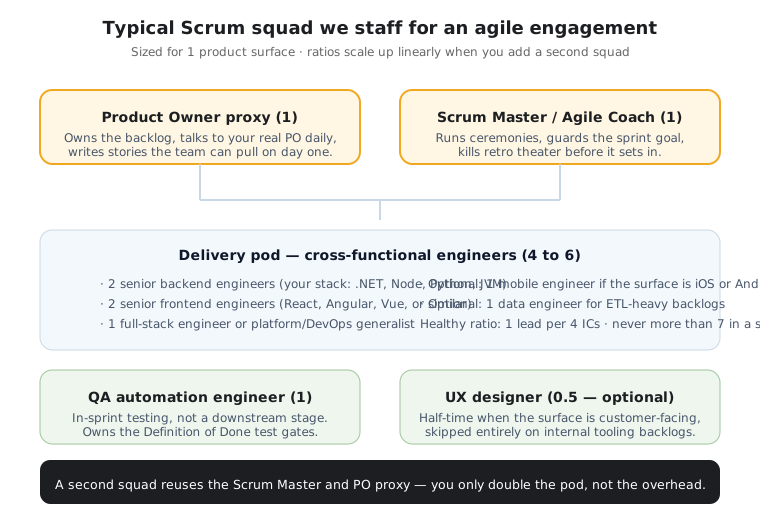
Siblings Software has been staffing agile squads for US, Canadian, and European product organizations since 2014. Every team we send out the door arrives with a Product Owner proxy who can write stories on day one, a Scrum Master or Agile Coach who guards the sprint goal, four to six senior engineers who have shipped this way before, and a QA engineer who tests inside the sprint instead of at the end. If you would rather add individuals to a squad you already run, our agile developer staff augmentation model gets you vetted seniors in under two weeks.
What an agile development team actually delivers (and what it does not)
A dedicated team and an agile team are not the same thing. The first is a contract: senior engineers committed to your roadmap on a monthly retainer. The second is a way of working: a cross-functional squad whose Definition of Done ends every sprint with software that runs in your environment, can be demoed without apologies, and can be released without a heroic merge.
Most "agile" engagements you can buy from an outsourcing vendor are the first dressed up to look like the second. The team has standups, but no sprint goal. There is a retro on the calendar, but the same complaints surface every fortnight and nothing changes. Story points climb every quarter because nobody wants to forecast against a smaller number. The result is a squad that ships, but no faster or more predictably than a traditional development team would have. The agile vocabulary becomes branding, not behaviour.
A real agile development team produces three things you can verify from the outside. A working, deployable increment per sprint, on a cadence you can mark on a calendar. A sprint-goal attainment rate above 80% over a rolling six-sprint window, reported alongside the demo. And a retrospective cadence that produces at most three action items per sprint, each named to a single owner, each closed before the next retro or carried with an explicit reason. If you do not see those three artefacts, the team is doing waterfall in two-week boxes.
For the broader practice and the manifesto behind it, the Atlassian Agile Coach and the official Scrum Guide are the references we treat as load-bearing. Everything below is how we apply them.
Who is on a Siblings Software agile squad
Composition is opinionated. The numbers below come from a decade of running multi-quarter engagements in healthcare, payments, logistics, and SaaS. Larger pods break the standup. Smaller pods leave QA outside the sprint, which is where Definition of Done quietly dies.
Single Scrum squad (6–8 people)
A Product Owner proxy, a Scrum Master, four to six senior engineers across your stack, and one QA automation engineer. Best when one product surface needs predictable delivery, the backlog is reasonably groomed, and your real PO can attend planning and demos.
Scrum + Kanban platform team (10–13 people)
A product squad on Scrum plus a smaller platform team on Kanban for infrastructure, observability, and incident work. The split keeps interrupt-driven work out of the sprint goal. Common for SaaS companies past their first 100 paying customers.
Multi-squad release train (14–22 people)
Two or three product squads sharing a Scrum-of-Scrums or a light SAFe Program Increment cadence. Used when the work touches a release train, a regulator-imposed deadline, or coordinated migrations. Includes a Release Train Engineer role.
Every configuration includes the Scrum Master role, not as a project manager reading tickets aloud, but as a working facilitator who owns the calendar, the cadence, and the conversation about practice. We do not bill it separately and we do not let it drift into a documentation function.
If your backlog is stack-specific, we blend specialists from our React and other technology practices into the squad so framework decisions are made by people who have lived with the consequences. The shared engineering bench sits behind every dedicated development team we field.
The two-week cadence we run, step by step
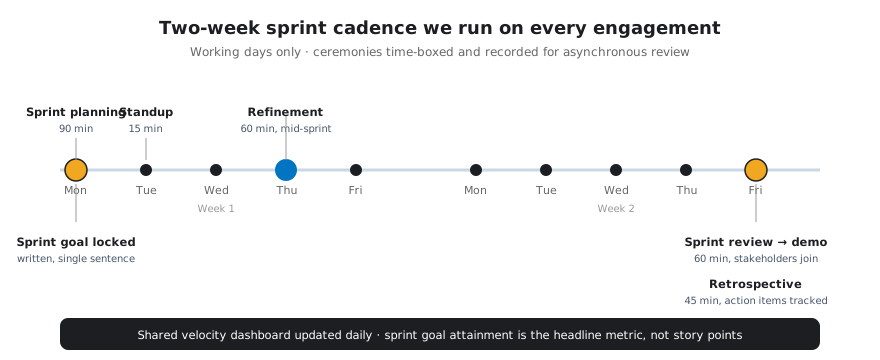
Sprints can be one, two, three, or four weeks. We default to two weeks because a one-week sprint loses a full day to ceremonies and a four-week sprint hides too much risk. The cadence below is what stakeholders mark on the calendar from sprint zero forward.
Day 1 — planning and a single-sentence sprint goal
Ninety minutes. The PO walks the prioritized stories. The team pulls what it can finish, not what it hopes to finish. The sprint goal is one sentence, written down, reviewed at the demo. If the team cannot agree on a single sentence, the sprint is not yet planned.
Mid-sprint — refinement, not status
One hour, around day six. The team grooms the next sprint's stories with the PO so planning is fast. We hard-cap refinement: stories that need more discovery move into a discovery track instead of consuming the meeting.
Day 10 — sprint review with a working demo
Sixty minutes. The team demos working software in your environment, not slides. Stakeholders are invited. If a story cannot be demoed, it is not done, regardless of what the board says.
Day 10 — retrospective with at most three actions
Forty-five minutes after the demo. Three named action items, three named owners, due before the next retro. Retro theater dies when last fortnight's actions have to be shown closed before this fortnight's are opened.
A shared dashboard is updated daily. The headline metric is sprint-goal attainment (binary, sprint by sprint), not story-point velocity. Velocity is a forecasting tool for the team. Stakeholders see goals, demos, and the production deploys that came out of the sprint.
Scrum, Kanban, SAFe, or LeSS — pick before sprint one
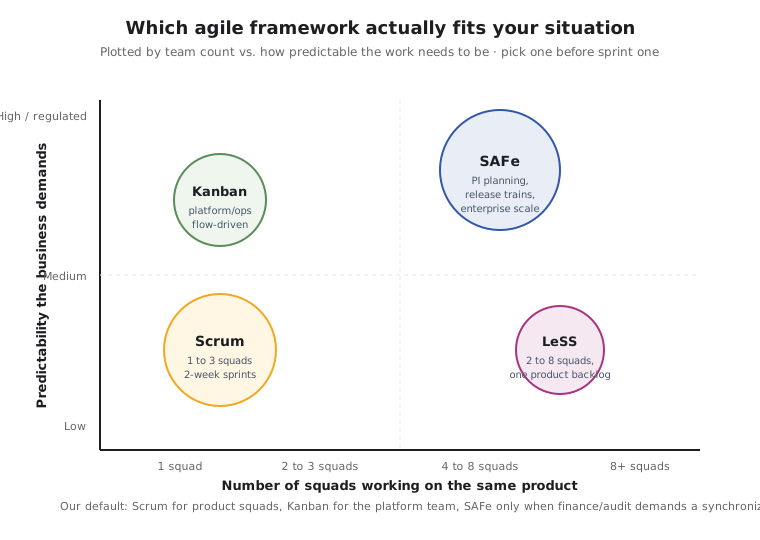
The fastest way to break an agile engagement is to leave the framework choice "to be decided in the first month". Three weeks in, half the team is running Scrum, half is running ad-hoc Kanban, and the retro is about which one is real. We force the decision before sprint zero. Here is how we usually call it.
Scrum is the default
One to three product squads, a real Product Owner, a backlog with at least four sprints of refinable work, and a business that can plan in two-week increments. Scrum is opinionated about ceremonies because the cost of skipping them is higher than the cost of running them.
Kanban for platform, ops, and incident work
Anywhere flow matters more than goals: SRE, on-call rotations, customer-success engineering, internal tooling. Sprint goals do not survive a P1 incident, so we stop pretending they do and run a WIP-limited Kanban board with cycle-time and lead-time targets. The platform team in a blended engagement almost always lives here.
SAFe when finance demands a release train
Four or more squads, a regulator or a board demanding a quarterly Program Increment, dependencies across products that have to be planned together. The Scaled Agile Framework is heavier than most teams admit, so we recommend it only when the alternative is uncoordinated chaos. If you can avoid it for another quarter, avoid it.
LeSS when the backlog is one
Two to eight squads, one product, one backlog, one PO. LeSS preserves the simplicity of Scrum and refuses the layered roles SAFe introduces. We like it for product organizations that grew past one team but have not yet inherited an enterprise audit trail.
An honest opinion: most companies that ask for SAFe actually want LeSS or a Scrum-of-Scrums. They have been told their problem is scale when it is really framework drift inside three squads. We will tell you that on the discovery call instead of waiting for an invoice.
Who hires an agile development team
The buyer profiles below cover roughly nine in ten conversations we have on this page. If you recognize yourself in one, the next paragraph in your sales call is usually about cadence and Definition of Done, not about CVs.
CTO after a failed waterfall project
The vendor quoted a fixed scope and a fixed date, missed both, and now leadership wants visibility every two weeks. The job is not to build new features yet. It is to put the discipline of a sprint goal between the team and the next missed deadline.
VP of Product scaling past one team
One internal squad works well. Adding two more all at once breaks every assumption: shared backlog, shared definition of ready, shared release calendar. The buyer wants a second team that arrives already running ceremonies so the first team is not asked to teach Scrum and ship simultaneously.
Founder replacing a body shop
The current vendor staffs warm bodies, marks tickets done, and provides no narrative. Predictability is zero. Quality is fragile. The buyer wants a squad with a Scrum Master who will own the cadence conversation and a QA engineer who tests inside the sprint, not after it.
Regulated-industry product owner
Healthcare, payments, RegTech, govtech. The team needs to ship under SOC 2, HIPAA, PCI, or KYC obligations and has to demonstrate predictable cadence to auditors and customers. A two-week sprint with a written goal, a recorded demo, and a closed retro is an audit-friendly artefact, which is why agile and regulation are not the opposites people assume.
How we onboard an agile squad in two to three weeks
The numbers below are the same ones that appear on every dedicated-team engagement we run. Agile cadence drops cleanly into them because the cadence itself is what we build during sprint zero.
Discovery (3–5 days)
A two-hour working session with your engineering and product leads, a backlog walkthrough, an agreement on which framework we are running, and a written team configuration proposal.
Team assembly (5–10 days)
Pre-vetted candidates introduced for a paired technical session. You interview every engineer. Scrum Master and PO proxy candidates run a mock planning so you see them facilitate before signing.
Sprint zero (week 2–3)
Definition of Ready and Definition of Done locked in writing. Velocity baseline drawn from the first sprint of refinement. Tooling in your environment. The cadence is on the calendar before the first real sprint starts.
Sprint one (week 3–4)
First working increment shipped to a real environment. Demo recorded. Retro action items captured. The squad is now operating on the cadence you saw on paper during discovery.
A 2-week satisfaction guarantee covers any seat in the squad. After the first 30 days, scaling down requires a 30-day notice; scaling up takes one to two weeks per seat. None of this is unusual — it is the same engagement spine we use across every agile development engagement and broader software outsourcing engagement.
Engagement models and what an agile squad costs
Pricing for a dedicated agile development team is monthly and predictable. The brackets below are the same ones we publish on the broader dedicated development team page; we do not charge an "agile premium" because the practice is how we work, not an add-on.
Single Scrum squad
USD 12K–28K / month
Six to eight people. PO proxy, Scrum Master, four to six senior engineers, one QA. 2-week sprints. Best for one product surface, predictable backlog, monthly board-level reporting. Initial 3-month commitment, then month-to-month.
Scrum + Kanban platform
USD 35K–48K / month
One product squad plus a smaller platform team on Kanban. Total ten to thirteen people. Scrum Master shared. Useful when interrupt-driven platform work was eating the product backlog and nobody noticed for a quarter.
Multi-squad release train
USD 48K–60K+ / month
Two or three product squads, a Release Train Engineer, Scrum-of-Scrums or light SAFe. Fourteen to twenty-two people. For regulated rollouts, migrations, and roadmaps that span multiple product surfaces.
A 2-week satisfaction guarantee runs across every seat. Scaling down takes 30 days' notice; scaling up takes one to two weeks per role. If you would rather start project-based and convert to a dedicated cadence later, see our project-based outsourcing model.
Mini case study — rescuing an audit-driven RegTech rebuild
Thornwell Compliance is a US-based RegTech vendor selling Bank Secrecy Act (BSA), AML, and KYC workflow software to community banks and credit unions. After eleven months of an internal "agile transformation" run by a transformation consultancy, the new VP of Engineering inherited daily standups that had become 25-minute status meetings, retros where the same complaints recycled every fortnight, and story-point inflation that had doubled the average ticket since the previous January. A regulator-mandated KYC rebuild was four months past its internal deadline, with the drop-dead date sixteen weeks away.
We replaced the consultancy contract with two Siblings squads and one shared Scrum Master. A product squad of six (PO proxy, four senior backend engineers on Java/Spring Boot, one QA automation engineer) ran 2-week Scrum on the KYC rebuild. A platform team of three engineers ran Kanban on Postgres performance, observability, and the queue infrastructure that BSA reporting depended on. The Scrum Master was shared across both. A fractional Agile Coach (one day per week, billed inside the squad rate) ran a four-sprint coaching arc with the existing internal team so the new cadence outlived the engagement.
Headline numbers over the first nine sprints: sprint-goal attainment moved from 41% to 86%; story points were retired in week four in favour of ideal-day estimates and a fixed forecasting horizon; escaped defects per release dropped from 12 to 3; the regulator-mandated KYC rebuild shipped in sprint nine, eight weeks before the drop-dead date. Cost: roughly USD 28K/month for the product squad, USD 18K/month for the platform team, USD 6K/month for the shared Scrum Master and fractional coach. The internal team stayed; we did not replace anyone.
What we would do differently next time: lock the framework choice (Scrum for product, Kanban for platform) before the first sprint and refuse to call ad-hoc research "spikes". Untimed spikes drift into discovery work and break the predictability the regulator was waiting on. For a published case study with disclosed metrics, see the Bari wholesale platform engagement on a similar 6-person dedicated cadence.
Agile squad vs. in-house, freelancers, and waterfall agencies
A dedicated agile team is one of four ways to add capacity. The trade-offs below are why the same buyer keeps landing on this page after trying the other three.
vs. in-house hiring
Best in the long run, slowest to start. A senior US engineer with the right ceremonial fluency takes four to nine months to hire and ramp; a Scrum Master takes three to six. The agile-squad route gives you the cadence in three weeks. Convert later if it makes sense.
vs. freelance marketplaces
Two senior freelancers and an internal Scrum Master can ship features. They cannot run a real cadence. There is no shared rhythm, no Definition of Done across the group, no retro that means anything. You are managing four contracts and an interim PMO disguised as a Slack channel.
vs. waterfall agencies
Fixed-scope, fixed-price agencies are honest about being non-agile. The risk shows up at change requests: anything outside the SOW becomes a renegotiation. If your scope is firm and your deadline is six months away, this can be the right answer. If your roadmap moves, you are paying twice.
vs. body-shop offshore
Body shops sell hours and tickets-marked-done. Predictability is whatever your internal lead can wring out of asynchronous status updates. An agile squad sells a cadence and a Definition of Done you can verify. The price gap is real (body shops are cheaper per seat) but the unit you are buying is not the same.
Risks specific to agile engagements (and what we do about them)
Generic outsourcing risks — IP ownership, NDAs, time-zone overlap — we treat the same way we do on every engagement: written into the master agreement, US-style work-for-hire IP, source-controlled deliverables, four-hour daily overlap with US time zones. The risks worth naming on this page are the ones unique to agile.
Fake agile
The label without the practice. Mitigation: a one-sentence sprint goal locked in writing every sprint, sprint-goal attainment reported alongside the demo, and a Scrum Master whose job is to refuse the slide-deck-as-demo trick.
Story-point inflation
The classic drift: every quarter the average ticket is "bigger" so velocity stays flat. Mitigation: story points are private to the team. Stakeholders see goals and demos, not points. We re-baseline the team's reference stories every six sprints.
Retrospective theater
The retro on the calendar with no behavioural change. Mitigation: at most three action items per retro, each with a named owner, each closed before the next retro or carried with an explicit reason. We track the close rate.
PO bandwidth collapse
Your real PO has a day job. The proxy is there to keep the backlog in working order so refinement is real, not improvised. We escalate within 48 hours when the proxy cannot get product decisions, instead of letting the squad ship guesses.
Definition-of-Done erosion
"It works on my machine, ship it." Mitigation: the DoD is a written checklist owned by QA, with hard gates in CI. Stories that fail DoD are not closed at the demo, regardless of the optics. The discomfort is the point.
Frequently asked questions about hiring an agile development team
What is the difference between an agile development team and any other dedicated dev team?
A dedicated team is a contractual arrangement: senior engineers committed to your roadmap on a monthly retainer. An agile development team is a way of working: a cross-functional squad with a PO proxy, a Scrum Master or Agile Coach, and a Definition of Done that ends every sprint with a working, demo-ready increment. Most outsourcing vendors sell the first and call it the second. We staff teams that actually run the ceremonies.
Should we run Scrum, Kanban, SAFe, or LeSS?
Default to Scrum for one to three product squads with a clear backlog and a real PO. Use Kanban for platform, SRE, and incident-heavy work. Move to SAFe only when finance or audit demands a synchronized release train across four or more squads. Reach for LeSS when two to eight squads share a single product backlog. The wrong move is to mix all four because nobody wanted to argue.
How do you stop the team from drifting into fake agile?
Three concrete rules. A one-sentence sprint goal written before planning ends and reviewed at the demo. A retro that produces at most three action items per sprint, each owned by a named person, each closed before the next retro. Story-point velocity stays private to the team; the metric reported to stakeholders is sprint-goal attainment.
Who owns the backlog when you bring in a Product Owner proxy?
Your real PO. The proxy is a backlog editor who works in your tools, attends refinement, and unblocks the team when your PO is in customer meetings. Final say on priorities and trade-offs stays with you. We document this in the engagement charter so there is no ambiguity in week three when the first contested decision arrives.
Can the team plug into our existing Jira, Linear, or Azure DevOps board?
Yes. We work in your tooling: Jira, Linear, Azure DevOps, GitHub Projects, Shortcut, or Asana. We bring opinions on workflow states, Definition of Done check items, and burndown vs. burnup reporting, and we adapt to whatever your stakeholders already read. The first sprint is usually noisy; by sprint three the reports are stable.
How fast can you onboard an agile development team?
Discovery takes three to five days. Team assembly takes another five to ten days. Sprint zero runs in week two or three. Real shippable work usually appears in sprint one, weeks three to four after signature. With a working backlog and CI pipeline already in place, we have moved a team into sprint one in twelve business days.
What happens if the squad and our internal team disagree on practice?
We follow your engineering culture on test coverage, branching, code review etiquette, and definition of ready. We push back on anything that breaks sprint predictability or weakens the Definition of Done. The Scrum Master owns that conversation, escalating to your delivery lead when needed. Disagreement is fine. Quiet drift is not.
Can we move from project-based or staff augmentation into a full agile squad later?
Yes. We routinely start with two or three augmented seniors on your existing squad, then convert to a dedicated agile pod once we understand your domain. The conversion adds the Scrum Master, PO proxy, and QA roles without churning the engineers you already trust.
OUR STANDARDS
Working software over status updates. Sprint goals over story points. Closed retros over open complaints.
A sprint is not done until the increment is in your environment, the demo is recorded, and the retro action items have a named owner. We treat the cadence as load-bearing infrastructure, not a meeting culture, and we report on the goal we said we would meet, not the points we estimated against.
Our Definition of Done is a written checklist with hard gates in CI: code review approved, automated tests passing, observability hooks in place, deploy to staging successful, stakeholder approval at the demo. Until those gates close, the story is not done, regardless of what the board says.
If you’re interested in hiring developers for this capability in Argentina, visit the Argentina version of this page.
CONTACT US
Get in touch and build your idea today.