Microservices Development Services for US Product Teams
Siblings Software provides microservices development services when a US product team must ship independently deployable services on Kubernetes, publish versioned HTTP and event contracts, and keep production traffic safe while the rest of the estate still earns revenue. Buyers are VP Engineering, platform leads, and architects at B2B SaaS, logistics, and fintech companies whose release train still blocks on one database or whose hot path needs scale without over-provisioning every tier. This page covers scope, fit, typical slices, delivery phases, squad shape, pricing inside published bands, comparisons, a labeled example, risks, and questions to ask before discovery.
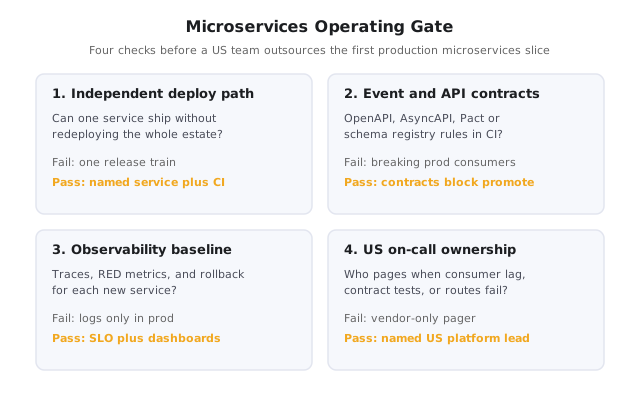
Account work runs from our Miami office. Engineering is delivered from Latin America with daily overlap on US East Coast hours. Before code starts, we run the Microservices Operating Gate in the hero diagram: independent deploy path, event and API contracts in CI, observability baseline, and a named US on-call owner. Patterns align with Microsoft Azure microservices guidance, AWS microservices practices, and the microservices.io pattern catalog. Pulling the first module out of a monolith belongs under application modernization services; ongoing HTTP surfaces under API development and back-end development.
Reviewed by Javier Uanini, Founder and CEO, October 2026.
What the Service Covers
Microservices development services are the engineering work of turning bounded contexts into services your platform team can deploy, observe, and page on without dragging the whole estate through one pipeline. A slice starts with a context map and ownership matrix, continues with OpenAPI and AsyncAPI contracts, transactional outbox publishers, idempotent consumers, Helm or Kustomize manifests with staged rollout notes, gateway routes for a bounded caller set, and contract tests that block promotion when a partner or internal consumer would break.
That work is different from cloud migration services, which inventory workloads and rehearse DNS cutover. Landing on EKS or AKS without service boundaries leaves the same coupling in a new account. It is also different from a greenfield back-end development engagement when there is no production traffic yet. Microservices delivery optimizes for safe decomposition, versioned events, and regression on paths that earn revenue.
When the starting point is still one IIS or Spring deployable, we sequence extraction with application modernization services so strangler milestones stay the product clock. Quality gates pair with QA automation services when API and event suites are large enough to need their own owners. For a published Go and Kubernetes reference, see the NetApp case study.
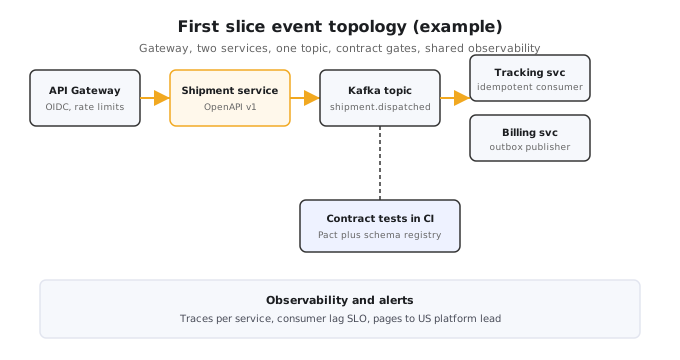
The diagram shows what a buyer receives at each step: signed contexts, schema registry or Pact rules, a canary route with rollback, and repositories that stay in the client's org.
Who It Is For
US product and platform teams where independent deployment would unblock a second squad, event integration is already on the roadmap, and leadership refuses another repository nobody will operate. If nobody can name the first bounded context and the US engineer who pages when a consumer lags, this engagement is the fit.
Logistics and supply chain SaaS
Shipment status, rating, and billing modules share one deployable. Carriers need webhooks while operations still edits in admin. The first slice is track-and-trace events, not a full TMS rewrite.
Fintech and payments adjacency
Capture, settlement, and ledger contexts need separate on-call and schema ownership. Contract tests on money paths run before any strangler route touches production.
Platform teams on Kubernetes
EKS or AKS exists but services still share databases. You need a squad that ships Helm charts, trace propagation, and CI templates your internal developers extend.
API-first product bets
Mobile and partner channels need stable HTTP while admin stays on legacy. Gateway routing lets both coexist during a multi-quarter roadmap.
Hot paths that outgrew the monolith
Catalog search or rating engines need horizontal scale. Extracting one read-heavy context proves independent deploy before finance approves a wider program.
Teams after a stalled mesh slide deck
Architecture reviews promised twelve services; production still has one jar. A bounded slice returns a live route and event contract every sprint.
Typical Project Scenarios
Six situations from US discovery calls. Each is scoped as one slice after the Microservices Operating Gate, not as a multi-year program without production checkpoints.
Stand up shipment events beside a Java monolith
Status updates and carrier webhooks need Kafka topics while order capture stays on Spring. We publish shipment.created and shipment.delivered with schema registry rules, idempotent consumers, and read APIs behind the gateway.
Extract rating from a .NET core without freezing quotes
Pricing rules and tax tables block parallel squads. We move rating to a service with its own database, leave quote creation on the monolith until reconciliation passes, and route partner rating calls through OpenAPI v1.
Replace dashboard queries that hammer OLTP
Operations consoles query production tables and stall releases. A read service or replica-backed API takes dashboard traffic slice by slice with documented schema ownership per context.
Introduce Go services for a concurrency-heavy path
Ingest or telemetry paths need goroutine-friendly workers on Kubernetes. We align with patterns proven on engagements like NetApp while your Java admin tier keeps shipping.
Sequence service boundaries with a hosting move
Leadership wants Azure or AWS in the same fiscal year. Service milestones stay the product schedule and cloud migration services align cutover windows to API and topic stability.
Gate partner launches with contract tests
External integrators cannot survive silent schema drift. Pact or registry checks, synthetic monitors, and QA automation block promotion when events or fields break consumers.
How Delivery Works
Five phases over sixteen to twenty-four weeks for one production context, event contracts, Kubernetes rollout, and paired handoff. That range sits inside the published project duration of one to six months. Discovery follows the site pattern: a few days to align, squad assembly in the following week, and first written artifacts in weeks three and four.
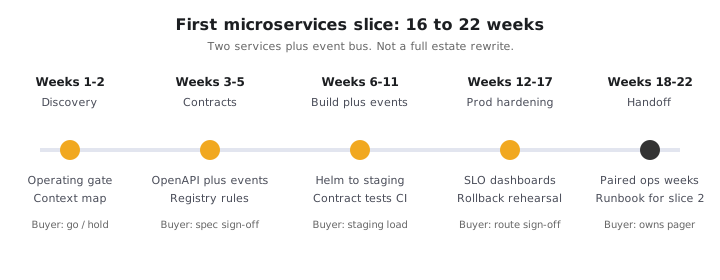
Discovery. Weeks 1 and 2 run the Microservices Operating Gate. The output is a context map, topic and API ownership, and a named US on-call owner. If any check fails, we write the missing answer before opening service repositories.
Contracts. Weeks 3 to 6 produce OpenAPI and AsyncAPI drafts, versioning rules, and Pact or registry policies. Security reviews start when partners will hold sandbox keys.
Build and staging. Weeks 7 to 12 implement services behind flags, outbox publishers, consumer lag alerts, and Helm rollouts in staging. Finance or operations reviews sample events before production promotion.
Production routing. Weeks 13 to 18 shift a bounded caller or consumer set. Gateway changes, synthetic checks, and rollback notes are reviewed by the client owner. The legacy path remains system of record until write criteria pass.
Handoff. Weeks 19 to 24 are paired. Your engineers ship the next small change under review. Runbooks cover the following context, topic ACLs, and how to replay a consumer. After that, the squad can continue as a dedicated development team or close as project-based outsourcing.
Sprints stay on your cadence: two weeks, a demo, and a retro. The Miami account lead joins when a route or schema decision needs a buyer in the room.
Team Composition
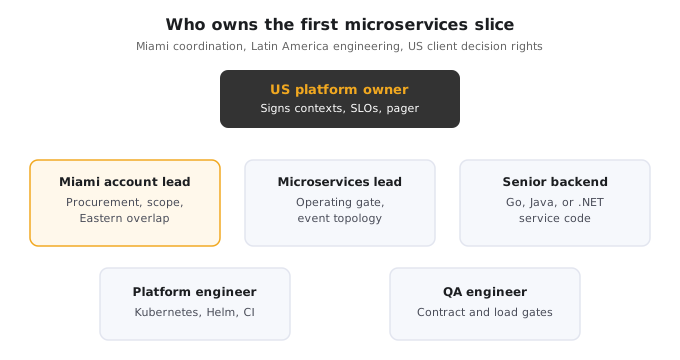
A first slice is usually four engineers plus a Miami account lead and a part-time platform owner from your side. The microservices tech lead and the senior backend engineer decide whether rollback and consumer replay work when lag spikes during US business hours. Cutting those roles to lower a quote is how a broken schema ships on Friday night.
The platform engineer is heavier during Helm and observability weeks. QA owns contract tests and synthetic checks on revenue paths. Your US owner signs contexts and SLOs. If you only need one senior inside an existing squad, use hire back-end developers instead of a full slice team. Browse the software outsourcing company hub and all services directory for adjacent offerings.
Project, dedicated team, or staff augmentation, depending on how many contexts you want this squad to own.
Pricing and Engagement Models
Figures below sit inside the published company bands: projects USD 15,000 to 120,000, dedicated teams USD 12,000 to 60,000 per month, staff augmentation USD 4,000 to 9,000 per month per developer. Microservices work uses the upper part of those bands because the first slice includes discovery, event topology, contract suites, and Kubernetes hardening. Multi-context programs continue as a dedicated team rather than an oversized fixed bid.
Project-based
One slice: operating gate, one or two services, event integration, contract tests in CI, observability baselines, and handoff. Sixteen to twenty-four weeks. USD 50,000 to USD 140,000 after discovery, driven by consumer count, compliance scope, and whether shared data must split.
Dedicated team
The same squad keeps shipping contexts, extending topics, and owning incident response. USD 24,000 to USD 52,000 per month for four to six people. Thirty days notice to scale down, same as other dedicated engagements.
Staff augmentation
One or two seniors inside your squad when architecture is already yours. USD 6,000 to USD 9,000 per month per engineer, top of the published staff-augmentation band. Two-week satisfaction guarantee applies.
Compared With In-House Hiring, Freelancers, and Agencies
Outsource a slice when
- You need one production context and stable events in a quarter, and hiring a platform-minded lead will take longer than that.
- Your product team knows the domain and needs help with outbox patterns, contract governance, and Helm rollouts.
- Procurement wants a written Microservices Operating Gate before an enterprise review of coupling risk.
- Consumer lag or Pact failures need same-day pairing with a US owner in the loop.
Keep it in-house when
- A mature platform group already runs domain mapping and only needs a short spike on one topic.
- The estate is a handful of stateless services with separate databases and traces already wired.
- A vendor playbook requires a single cutover you cannot roll back per route or consumer group.
Freelancers can scaffold a service quickly. They rarely stay through production routing, consumer replay, and paired weeks when your team takes the pager. A large consultancy can staff a program. Ask whether the people who wrote the context map merge the gateway change. Miami coordination plus Latin America engineering is how we staff that overlap for US buyers. See case studies and the nearshore development model. The English page on our Argentina site covers the same service from a Cordoba delivery angle: microservices development from Argentina.
Illustrative Scenario: Ridgeline Logistics
Composite example for evaluation. Not a published client. No outcome metrics are claimed.
The situation
Ridgeline Logistics is a fictional US freight broker. Shippers book loads in a Java Spring monolith on Kubernetes. Carrier assignment, GPS milestones, and customer invoicing share tables and a nightly settlement batch. Large retail shippers want shipment.status webhooks and a rating API while operations still edits exceptions in admin. The VP Platform in Dallas has one release train and a board question about whether a service mesh is required before the webhook RFP starts.
Nobody has listed which topics touch revenue versus operations dashboards. Leadership wants shipment events live first, invoicing stays on the monolith until reconciliation is quiet, and a US engineer owns the pager before external keys ship.
What the slice would include
A project inside the sixteen-to-twenty-four-week window. Miami runs scope with the Dallas lead. The engineering squad is a microservices tech lead, a senior backend engineer, a platform engineer during Helm weeks, and a QA engineer.
- Operating gate: shipment tracking is the first context, Kafka topics shipment.booked and shipment.delivered are owned by Ridgeline platform, three carrier consumers are named, and the Dallas lead owns the pager.
- Tracking service with OpenAPI v1, outbox publishers, idempotent consumers, and Helm charts with staged rollout and rollback notes.
- Pact or registry rules in CI so a breaking event field blocks promotion.
- RED dashboards and trace sampling coordinated with DevOps engineering alert routes.
- Handoff runbooks for rating slice two and optional application modernization if invoicing modules still need strangler extraction.
The point of the example is the sequence: carrier webhooks go live, settlement stays on the monolith, and leadership judges the next context from production events, not from a roadmap slide.
Risks and How They Are Reduced
Hidden coupling blocks the first context. A batch job locks rows the new service needs. The context map in weeks 1 and 2 is supposed to find that. The pilot fails in staging if it does not.
Consumers process duplicates or miss events. Mitigation is idempotent handlers, outbox publishers, replay runbooks, and lag alerts reviewed with the US owner before peak traffic.
The gateway sends traffic to the wrong backend. Auth scopes and rate limits are reviewed with the route change. A synthetic check runs per route. Rollback is rehearsed before the canary.
Schemas drift and break integrators. AsyncAPI and OpenAPI stay the source of truth. Contract tests run in CI. Deprecation dates are agreed with partner-facing owners.
The pager hits the wrong team. The operating gate names the US owner. Runbooks live in the service repo. Paired weeks are the practice period before advisory hours.
Cluster work overrides the product schedule. When a data-center exit is in the same year, service milestones stay the product clock and cloud migration aligns windows to topic stability. Platform engineering and DevOps engineering pick up portals and pipelines after boundaries exist.
Questions US buyers ask before discovery
Frequently Asked Questions
A first slice delivers a signed Microservices Operating Gate, a context map with data ownership per service, one or two production services on Kubernetes with Helm or Kustomize, OpenAPI and AsyncAPI contracts with consumer-driven tests in CI, event publishers with idempotent consumers, RED metrics and trace sampling, gateway or mesh routing for a bounded caller set, and runbooks your US platform owner extends. Monolith extraction stays on application modernization when the problem is strangler routing from a single deployable; this engagement targets service platforms where independent release and event integration are already the goal.
Services ship in Java Spring Boot, Go, or .NET on Kubernetes. HTTP uses OpenAPI; async integration uses Kafka, Amazon SQS, or Azure Service Bus to match the estate. We use transactional outbox, idempotent consumers, and orchestrated sagas only when compensation steps are explicit. Contract tests use Pact or schema registry checks in CI. Reference architecture aligns with Microsoft Azure microservices guidance, AWS microservices practices, and the microservices.io pattern catalog. Gateways, mesh, and observability follow what your platform team already operates via platform engineering and DevOps engineering engagements.
The Microservices Operating Gate asks four questions: whether one service can deploy without redeploying the whole estate, whether OpenAPI, AsyncAPI, and contract tests block promotion, whether traces and RED metrics exist before traffic moves, and which US engineer owns the pager when a consumer lags or a schema change breaks a partner. We pick the smallest context with a named downstream consumer and a database boundary leadership will defend. Shared reporting and cross-cutting auth usually wait until orders, billing, or shipment status has a stable event contract. Missing gate answers are written in discovery before any repository opens.
Discovery through one production context with events, contract tests, Kubernetes rollout, and paired handoff usually lands in sixteen to twenty-four weeks inside the published one-to-six-month project window. Weeks 1 to 2 cover the operating gate and context map. Weeks 3 to 6 cover API and event contracts. Weeks 7 to 12 cover staging services and consumer rehearsals. Weeks 13 to 18 cover production routing and synthetic checks. Weeks 19 to 24 cover handoff. Partner certification, SOC evidence on external APIs, or a shared schema that cannot split stretch the later weeks.
A bounded first slice typically lands between USD 50,000 and USD 140,000 inside the published project band because discovery, event topology, contract suites, and Kubernetes hardening take more calendar than a single REST feature. Dedicated squads for ongoing service delivery run USD 24,000 to USD 52,000 per month inside the published dedicated-team band. Senior staff augmentation sits at USD 6,000 to USD 9,000 per month per engineer via hire back-end developers. We confirm pricing after the operating gate, not from a generic rate card.
You do. Service repositories, Helm charts, OpenAPI and AsyncAPI files, topic ACLs, schema registry rules, gateway routes, and CI suites land in your org. Paired weeks let the US platform owner rehearse rollback and consumer replay before we drop to advisory hours. Cluster upgrades and pipeline ownership continue under DevOps engineering. Internal portals and golden paths after boundaries exist are platform engineering. We do not retain production credentials after handoff.
Account coordination, procurement, and executive reviews run from Miami at 1110 Brickell Ave with Eastern and Central overlap. Engineering is delivered from Latin America on the same business-day window. Microservices programs need same-day decisions when a Pact build fails, a Kafka consumer falls behind during US peak, or a Helm rollback must finish before markets open. The two-week satisfaction guarantee and thirty-day notice to scale down apply to dedicated and staff-augmentation shapes the same way they do on other Siblings engagements.
Related Services