LLM Guardrails Development Services
Production AI fails in policy, not in demos. A copilot that leaks customer data, an agent that calls the wrong API, or a chatbot that answers outside its domain will stall enterprise rollout faster than a latency regression. This page explains how Siblings Software outsources LLM guardrails development as engineering work: policy layers, tool mediation, escalation queues, red-team suites, and audit trails your security team can defend.
This is for CTOs, CISO delegates, and ML platform leads evaluating a complete delivery partner, not a policy PDF from a consultancy. If you have not mapped adversarial attack paths yet, see LLM red teaming development. If you need quality regression suites before any policy tightens, see LLM evaluation engineering. If the immediate gap is tracing and incident response, see AI agent observability development. If you are shipping autonomous agents with tool access, see AI agents development.
Siblings Software is a software outsourcing company based in Miami with engineering teams in Argentina. We have shipped production AI systems since 2014 across B2B SaaS, finance, healthcare, and insurance software.
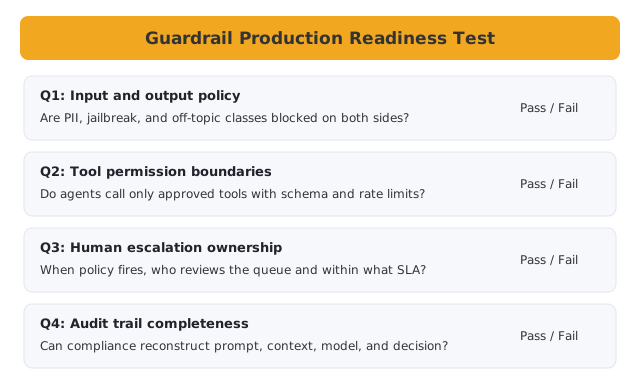
What LLM Guardrails Development Covers
LLM guardrails are the runtime controls that sit around model inference: input filters, output validators, tool permission gates, human escalation paths, and immutable audit logs. The work is not a one-time prompt edit. It is policy-as-code, gateway integration, adversarial test suites, and runbooks that survive model upgrades and auditor questions.
That is different from static application security scanning. AI code security protects repositories. Guardrails protect what happens when a user or agent talks to a model in production. It is also different from observability alone: traces show what occurred; guardrails decide what may occur.
We map controls to frameworks buyers already reference, including the OWASP Top 10 for LLM Applications and the NIST AI Risk Management Framework, without turning the engagement into a slide deck.
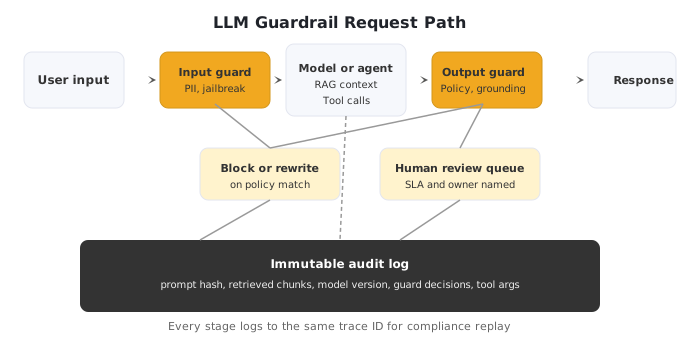
Guardrails belong on the request path, not in a Confluence page your agents never read.
Who This Service Is For
Teams that already have AI in production or are one security review away from launch, and need defensible controls before the next enterprise contract or regulator call.
Regulated B2B SaaS
Finance, insurance, and healthcare products where customer-facing copilots must not leak PII or give advice outside licensed scope.
Agent platforms with tools
Multi-step agents that read tickets, query databases, or trigger workflows where over-privileged tool access is the real risk.
Customer support AI
High-volume chat and email automation where jailbreak attempts, toxic output, and wrong refunds create reputational damage in minutes.
Enterprise procurement gates
Vendors blocked on security questionnaires that ask for guardrail architecture, audit logs, and human review SLAs, not model names.
Internal platform teams
Central AI platform groups that need one guardrail layer every product squad inherits instead of twelve different prompt hacks.
EU AI Act readiness
Teams preparing high-risk AI documentation where logging, human oversight, and technical controls must map to auditable evidence.
Typical Project Scenarios
Five situations that show up when legal or security joins the AI roadmap meeting.
Demo-to-production gap
The copilot impressed executives in a sandbox. Security blocked launch because PII from ticket history could appear in answers and no one owned the review queue. We run the Guardrail Production Readiness Test, then ship input redaction, output policy, and named escalation owners before cutover.
Agent with loose tool access
An internal agent can call CRM, billing, and email APIs because prototyping was faster that way. We implement tool mediation with schema validation, allowlists, rate limits, and logged denials so agents cannot exfiltrate or mutate data outside role scope.
Policy changes without regression tests
Legal asked for stricter medical advice boundaries. Engineering tightened prompts. Customer satisfaction dropped with no alert. We pair policy edits with red-team suites in CI, aligned with LLM evaluation engineering when scored rubrics are required.
Missing audit trail
Compliance wants to reconstruct what the model saw and why it answered. Logs store only the final string. We add trace IDs, prompt hashes, retrieved chunk references, model versions, and guardrail decision codes exportable to your SOC workflow.
Gateway bypass paths
One product squad calls OpenAI directly while another uses the platform gateway. Policies diverge. We consolidate inference behind one mediation layer and document exceptions with time-bound waivers.
Workflow automation without LLM governance
Operations automated intake with LLM extraction but skipped guardrails on the workflow automation side. We extend the same policy pack to structured extraction steps and human review queues.
How Delivery Works
Ten to twelve weeks for one customer-facing surface and one internal agent or workflow. Every policy change ships behind adversarial regression so legal gains do not become support incidents.
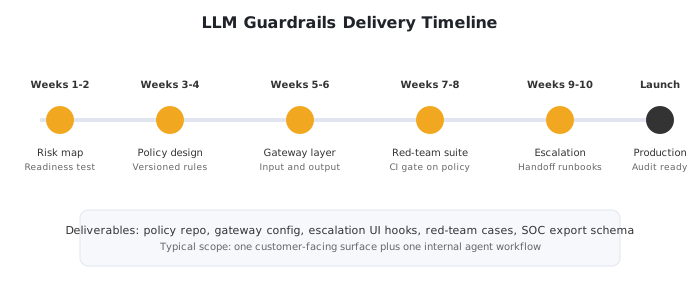
Risk mapping runs the Guardrail Production Readiness Test with security, product, and platform stakeholders. If Q4 fails, we fix logging before policy work.
Policy design translates legal and product rules into versioned policy definitions: blocked classes, redaction rules, grounding requirements, and tool allowlists. Policies live in git, not in a shared Google Doc.
Gateway integration wires input and output guards on the inference path. Parallel execution keeps latency within agreed budgets for chat and batch flows.
Red-team suite adds jailbreak, injection, and data-exfil cases to CI. Failed runs block release, similar to how eval gates work on quality regressions.
Escalation workflows connect policy hits to named review queues with SLAs. Product defines what gets auto-blocked versus queued for human approval.
Handoff delivers runbooks, rollback steps, and audit export schemas. Your team owns thresholds after launch. Retainer tuning is available when regulations or model releases shift risk.
Team Composition
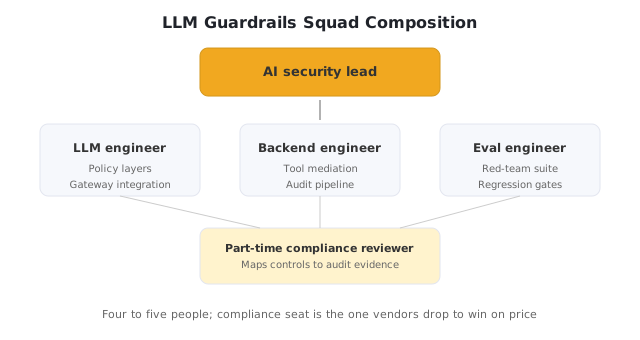
A four- to five-person squad is the usual shape. The compliance reviewer and red-team engineer are the roles vendors skip to win on price. They are also the roles that keep a policy tightening from becoming a silent quality collapse or an audit finding.
For ongoing policy maintenance across multiple product lines, the same squad can run as a dedicated AI development team. For one security-minded engineer inside your platform group, staff augmentation on an existing AI squad is often the better entry point.
Project delivery, dedicated squad, or embedded specialist depending on how much of the guardrail platform you want us to own.
Pricing and Engagement Models
Project-based
Fixed scope for one guardrails pass: risk map, policy repo, gateway integration, red-team suite, escalation hooks, audit export. Typical duration ten to twelve weeks. Budget bands align with published project-based outsourcing of USD 15k to 120k; regulated multi-workflow products often land in the USD 25k to 120k band after discovery.
Dedicated team
Ongoing squad maintaining adversarial suites, onboarding new workflows to shared policy packs, and reviewing quarterly control evidence with your security team. USD 12k to 60k per month for four to five people depending on workflow count and compliance scope.
Staff augmentation
Embed one or two engineers when you own architecture and need hands on gateway code, policy repos, or red-team automation. USD 4k to 9k per month per engineer on standard brackets; AI security specialists often run toward the top of that band.
Compared With In-House Hiring, Freelancers, and Agencies
Outsource when
- Launch is blocked on guardrail architecture and you cannot hire AI security plus LLM engineering in one hiring cycle.
- Multiple squads bypass shared controls and security wants one mediation layer this quarter.
- You need adversarial test suites and audit exports before an enterprise security review or regulator meeting.
- Agents with tool access need permission design your application team has not done before.
Keep it in-house when
- You already operate a mature AI platform with centralized guardrails and red-team cadence.
- The workload is an internal prototype with no external users and no compliance deadline.
- A single senior engineer can wire provider-native guardrails for one chat surface in a sprint.
Guardrail SaaS dashboards can flag violations. They rarely own the code in your gateway, agent runtime, or escalation UI. Freelancers can patch one endpoint. They rarely document rollback across customer tiers and tool permissions.
Illustrative Scenario: Bridgeway Actuarial Policy Copilot
The following is a composite illustrative scenario, not a published client case study.
The situation
Bridgeway Actuarial sells commercial insurance analytics software to regional carriers. They built a policy Q&A copilot that drafts coverage summaries from uploaded endorsements and internal rate manuals. Sales loved the demo. Security paused enterprise rollout when test users saw policyholder addresses and claim notes surface in answers meant for generic underwriting guidance.
Engineering had prompt instructions telling the model not to leak data, but no input redaction, no output classifier, and no queue when confidence dropped. Tool access to the document store was read-only yet unscoped by customer tenant.
What we would deliver
A twelve-week project with a five-person squad: AI security lead, LLM engineer, backend engineer, eval and red-team engineer, and part-time compliance reviewer.
- Tenant-scoped retrieval with explicit deny rules on claimant and policyholder fields.
- Input and output guard layers on the inference gateway with PII redaction and off-topic blocking.
- Human review queue with four-hour SLA for answers flagged as low grounding or high sensitivity.
- Red-team suite in CI with jailbreak and injection cases tied to policy releases.
- Audit export schema mapping guard decisions to SOC evidence fields.
Expected outcomes in a scenario like this: enterprise security review unblocked, named owners for escalation, and reproducible evidence for carrier procurement questionnaires without freezing the product roadmap.
Risks and How We Reduce Them
False sense of safety from prompts alone. Mitigation: policy-as-code on the request path plus red-team cases that fail CI when prompts are the only control.
Latency creep from serial guard checks. Mitigation: parallel classifiers, provider-native guards where appropriate, and documented latency budgets per surface.
Over-blocking hurts conversion. Mitigation: shadow mode before enforce mode, human queues for ambiguous cases, and product sign-off on block rates.
Tool permission sprawl. Mitigation: allowlists per agent role, schema validation on arguments, and logged denials reviewed weekly.
Audit logs that omit context. Mitigation: trace IDs linking prompts, chunks, model versions, and guard codes; compliance reviewer signs off on export fields.
Policy drift across squads. Mitigation: single gateway default, exception registry with expiry dates, and quarterly control review in the handoff runbook.
Questions buyers ask before the first discovery call
Frequently Asked Questions
AI code security scans repositories and pull requests for vulnerabilities in AI-generated application code. LLM guardrails protect runtime behavior: what users can send, what models can answer, which tools agents may call, and what gets logged for auditors. Most production teams need both, but they are different engineering workstreams with different owners.
Evaluation engineering measures answer quality against golden datasets and regression suites. Guardrails enforce policy at inference time: block PII leaks, jailbreak attempts, off-topic content, and unauthorized tool actions before or after the model responds. Eval suites often feed guardrail thresholds, but guardrails are the enforcement layer, not the scoring layer.
We fit your stack. Common patterns include a gateway middleware layer, provider-native guardrails on AWS Bedrock or Azure, open frameworks such as NeMo Guardrails or Guardrails AI, and custom policy-as-code rules in your API service. We do not mandate one vendor. If you already run Langfuse or Helicone, we extend those traces with guardrail decision events rather than rip them out.
Ten to twelve weeks for one customer-facing surface and one internal agent workflow. Weeks one and two run the Guardrail Production Readiness Test and map risks to controls. Policy design and gateway integration land in weeks three through six. Red-team suites and escalation workflows finish before production cutover. Multi-tenant products with separate policy packs per customer run longer.
Project-based guardrails work typically lands in the USD 25k to 120k band on siblingssoftware.com project brackets, depending on workflow count, agent tool surface, and compliance scope. Dedicated squads for ongoing policy tuning run USD 12k to 60k per month. We confirm scope after reviewing your architecture and the readiness test results.
Yes, when designed as parallel checks rather than serial bottlenecks. Lightweight classifiers and provider-native guardrails can evaluate input while the primary model plans. Output policies gate the final response. We document latency budgets per workflow and refuse designs that add hundreds of milliseconds to interactive chat without a business sign-off.
You do. Policy definitions, gateway configuration, red-team cases, escalation runbooks, and audit export schemas ship to your repositories. We document rollback for every policy change. Managed policy tuning is optional if you want us to maintain adversarial suites as models and regulations change.
Contact Us
Schedule a call to walk through the Guardrail Production Readiness Test.