Hire Full-Stack Developers for Your Software Team
Hire full-stack developers through Siblings Software when you need senior engineers embedded in your team without running a full recruiting process. We help CTOs, engineering managers, and founders add full-stack capacity for backlog delivery, migrations, and production support, with screening focused on cross-stack debugging and vertical feature ownership.
This page explains what the role covers in real teams, how we vet candidates, typical engagement models, timelines, pricing factors, and when staff augmentation fits versus freelancers, in-house hiring, or a dedicated squad. We place nearshore engineers into product teams that ship TypeScript end-to-end: React or Next.js on the frontend, Node.js or NestJS on the backend, PostgreSQL, Redis, and AWS or GCP underneath.
- Curated shortlists in 3-5 business days; first meaningful pull request on real code by day eight.
- Roughly three in ten applicants pass our five-stage vetting including a live vertical-slice exercise.
- Monthly engagements with 30-day notice to scale up or down. No bench fees, no resume floods.
"A full-stack hire who cannot explain why a React Server Component boundary belongs where it does is not senior enough for the backlog you are trying to clear."
Reviewed by Javier Uanini, Founder and CEO, Siblings Software. Last reviewed 10 August 2026.
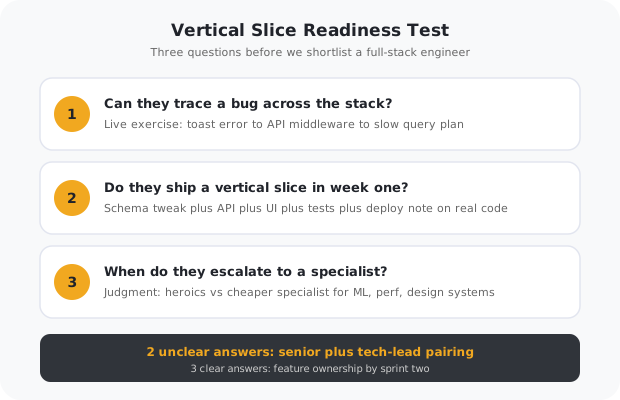
We name the framework because buyers remember it in intake calls. Three answers decide whether sprint zero is pipeline work or feature delivery.
Full-stack engineers on our bench today who cleared the vertical-slice screen in the last six months. About 60% senior, 30% mid-level, 10% tech-lead profiles.
Median time from brief call to first vetted profile for TypeScript + React + Node stacks. Longer for niche pairings like Elixir or Rails + Vue.
Typical daily overlap our LATAM engineers keep with US Eastern and Central hours for pairing, design reviews, and incident response.
Who hires full-stack developers through staff augmentation, and why
This is a transactional query. The buyer is comparing speed, vetting depth, and coordination overhead, not reading a technology tutorial.
Good fit for full-stack augmentation
- A Series A or B SaaS team that outgrew its two-person engineering bench but cannot wait three months for local senior hires.
- A product org modernizing a monolith while still shipping features. One engineer who owns the vertical slice avoids the frontend-vs-backend blame loop.
- A VP Engineering covering attrition: two engineers on parental leave and a billing module that touches both PostgreSQL row-level security and a Next.js admin console.
- A fintech or healthtech team with compliance constraints where audit trails and UI state must change in the same pull request.
- A team running experiments (pricing, onboarding, feature flags) where calendar time matters more than perfect layer specialization.
Usually not the right move
- You need a one-week CSS fix on a marketing site. A freelancer is faster and cheaper.
- You have no internal product owner or engineering lead to set priorities and review architecture decisions.
- Your problem is novel ML model serving or HFT latency, not a product feature spanning API and UI.
- You want a vendor to own the entire roadmap with QA and PM bundled in. See our dedicated full-stack development team instead.
- You already run eight parallel squads with deep specialization and a mature design system. Adding generalists increases coordination tax.
For broader role coverage, see our hire software developers hub, or compare delivery models on our staff augmentation overview. When sprint ceremonies need reinforcement alongside full-stack delivery, see hire agile developers.
What a full-stack developer actually does day-to-day when embedded with your team
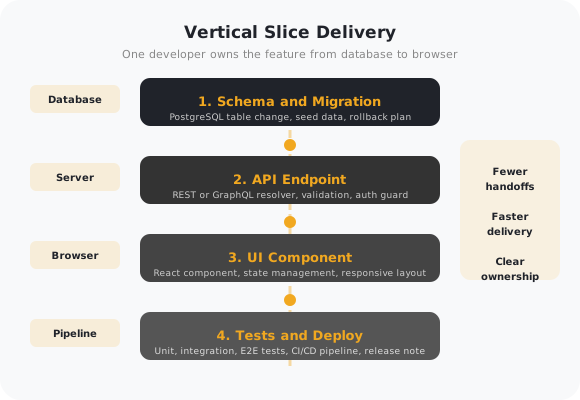
Monday through Friday they live in your repository. On a productive week they close a vertical slice: database schema tweak, API contract change, UI state update, test pyramid update, and a deployment note your SRE can skim before approving release. On a rough week they are the person who connects a failing Playwright test to a race condition in your event queue, then writes the post-mortem before anyone else realizes there was a problem.
They join your standups, review Figma with design, co-create acceptance criteria with product, and write the architecture decision records your future hires will thank you for. They use your Slack channels, your branching model, and your definition of done. They are not building a parallel universe in a vendor repo.
We stay honest about boundaries. Nobody masters every datastore and edge runtime equally. What you get is someone who can navigate the entire path, escalate when a specialist would be cheaper than heroics, and keep production empathy in the same head that writes JSX.
The Vertical Slice Readiness Test (before we shortlist anyone)
Three questions decide whether sprint zero is environment and pipeline work or feature delivery. We run this in discovery and again in the live vetting exercise.
Q1: Cross-stack trace
Can they follow a production error from browser toast through API middleware to a slow query plan? Roughly two in five candidates who pass our resume screen fail here on the live exercise.
Q2: Week-one slice
Will they ship schema + API + UI + tests on real code in the first week, not a sandbox todo app buried away from your CI gates?
Q3: Escalation judgment
Do they know when to pull in a database specialist, a design-system owner, or an ML engineer instead of spending three sprints on heroics?
Vetting signals we refuse to skip on full-stack shortlists
Generic "full-stack" resumes do not survive our gates. Every candidate clears five stages: technical screen, live vertical-slice challenge, pair programming with our engineering lead, reference checks, then your interview.
- Production debugging: We ask for a real incident they traced across layers, not a LeetCode puzzle.
- Testing habits: Meaningful coverage on the slice they ship in the exercise, not a checkbox unit test on a getter.
- Written trade-offs: Pull request descriptions that explain "why" beat whiteboard architecture theater.
- Stack match, not stack vanity: We screen against your repo patterns: App Router vs Pages, NestJS modules vs Express routers.
- Pairing on your tooling: Candidates walk your CI config and a real ticket before you spend executive interview time.
- Product empathy: They ask "why are we building this?" before estimating story points.
Need nearshore developers with the same vetting bar? Our LATAM bench shares this process. For platform and infrastructure depth alongside application work, see how we pair full-stack aug with platform engineering engagements.
Typical rates and engagement models for full-stack staff augmentation
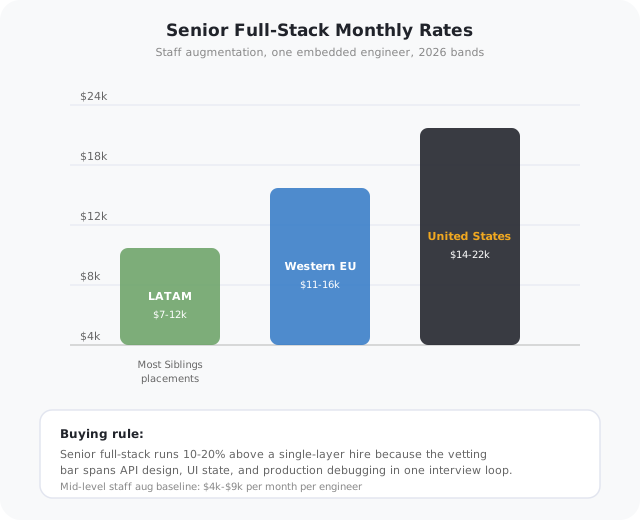
These ranges reflect engineers who ship vertical slices, not generalists who skim every layer. Mid-level staff augmentation on this site typically runs $4,000-$9,000 per month per engineer; senior full-stack sits above that band because the interview loop spans API design, UI architecture, and production debugging in one pass.
| Region | Mid-level | Senior | What you usually get |
|---|---|---|---|
| Latin America | $5-7k / month | $7-12k / month | Strongest value when US overlap matters. Most of our active full-stack placements live here. |
| United States | $12-16k / month | $14-22k / month | Best when on-site collaboration or niche compliance is non-negotiable. |
| Western Europe | $9-12k / month | $11-16k / month | Mature market, less daily overlap with US East Coast standups. |
Engagements are monthly with 30-day notice to scale. No hidden bench fees. If a vendor quotes senior full-stack at mid-level single-layer rates, ask what their vetting exercise actually tests.
How clients usually buy
One embedded engineer. Joins your sprint cadence, owns stories end-to-end, reports to your engineering lead.
Pod extension. Two full-stack developers plus fractional QA automation when you need guardrails on critical flows.
Bridge while recruiting. Augment for 6-12 months while your internal pipeline closes permanent hires; we document context for handoff.
Compare with project-based delivery on our full-stack development outsourcing page when you want us to manage the roadmap.
Staff augmentation vs Upwork vs in-house vs dedicated team
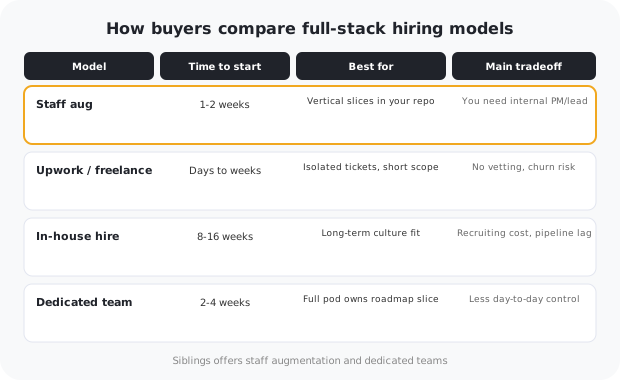
Most buyers are not choosing between a "good" and a "bad" model. They are choosing the least painful structure for the deadline, the talent market, and how much control they need over priorities.
| Model | Time to start | Best for | Main tradeoff |
|---|---|---|---|
| Staff augmentation (Siblings) | 1-2 weeks | Teams with a backlog, an engineering lead, and a need for vertical-slice ownership inside existing rituals. | You still need internal product direction. We improve execution; we do not invent the roadmap. |
| Upwork / freelance marketplaces | Days to weeks | Isolated tasks under four weeks with a clean scope boundary. | No structured vetting, high churn, weak institutional knowledge transfer. |
| In-house hire | 8-16 weeks | Core long-term roles that define engineering culture for years. | Recruiting cost, pipeline lag, competitive offers in the US full-stack market. |
| Dedicated outsourced team | 2-4 weeks | Self-contained pod with delivery manager owning a workstream end-to-end. | Less day-to-day control over individual priorities and ceremony design. |
Many clients use staff augmentation and in-house hiring together: two augmented engineers maintain sprint velocity while internal recruiting closes permanent seats. The augmented developers document context so internal hires inherit full stack knowledge, not a mystery module.
Case study: Copperlane RevOps cut merge-to-production lead time by 62% in eleven weeks
Composite details anonymized; outcomes reflect cross-stack ownership we optimize for in B2B SaaS.
Situation. Copperlane RevOps, a Series B revenue-operations platform selling to mid-market B2B sales teams, had outgrown a patchwork of contractors. Their Next.js admin console drifted from Node.js APIs because nobody owned both layers. Customer success spent half the week mediating "frontend vs backend" tickets. Local senior hiring quoted a six-month pipeline.
What we did. We embedded two senior full-stack developers for eleven weeks. TypeScript-first, one leaning UI and accessibility, one leaning API performance and PostgreSQL query tuning. They worked US Eastern hours, used Copperlane's AWS accounts, and treated SOC 2 logging requirements as a first-class feature.
- Stack: Next.js App Router, Node.js services, PostgreSQL with row-level security, OpenTelemetry, feature flags on risky flows.
- Shipped: consolidated pipeline dashboard replacing three legacy mini-apps, idempotent webhooks for CRM integrations, release checklist customer success could follow without engineering.
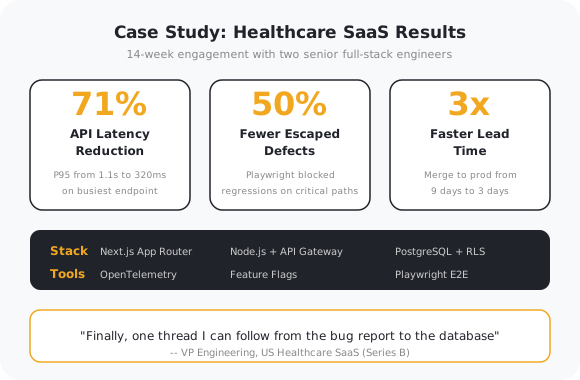
Measurable outcomes
- P95 API latency on the busiest endpoint: 940 ms to 310 ms.
- Escaped production defects per release: down 48% after Playwright guarded critical flows.
- Merge-to-production lead time: ~8 days to ~3 days for standard user stories.
"Finally one thread from the bug report to the database without three status meetings."
VP Engineering, B2B RevOps SaaS (Series B)
For a published client story with similar cross-functional delivery, see our BinSensors case study on smart-cities platform scaling.
What changed for full-stack teams between 2025 and 2026
If your last full-stack hire was eighteen months ago, the interview bar and the production stack moved. These are the developments we screen against today.
- React 19 and Next.js 15 made Server Components and streaming the default mental model. Engineers who only know client-side SPA patterns struggle on App Router codebases. We screen for RSC boundaries and caching semantics using the react.dev docs, not blog summaries.
- Node.js 22 LTS (October 2024) changed default fetch, test runner maturity, and watch-mode behavior. Our backend exercise includes at least one Node 22-specific API choice when your runtime is current.
- PostgreSQL 17 improved logical replication failover. That matters when your full-stack engineer owns both the schema migration and the read-replica cutover plan.
- AI-assisted coding is in every repo. We screen for judgment under Copilot and Claude Code: can they reject a plausible diff and write the test the model skipped? Raw output volume is not seniority.
When your roadmap includes AI features that ship through the same Next.js surface as the rest of the product, our AI development practice covers model integration; this page covers the engineer who owns the full feature slice including the UI that exposes it.
Risks of hiring full-stack developers externally, and how we mitigate them
Vendor creates a parallel codebase
Mitigation: Engineers commit to your org, your branching model, your review gates. Code lives in your repositories from day one. If the engagement ends, you keep every line.
"Full-stack" means shallow everywhere
Mitigation: The Vertical Slice Readiness Test rejects candidates who cannot trace production issues across layers. We escalate to specialists when depth beats heroics.
Knowledge walks out when the contract ends
Mitigation: ADRs, Loom walkthroughs, and structured handover sprints. Optional shadowing so your internal hires inherit context, not a mystery module.
Security and compliance gaps
Mitigation: NDA and least-privilege access before repo access. Pipelines aligned with OWASP Top 10 remediation. Background checks available for regulated environments.
How onboarding and collaboration actually works
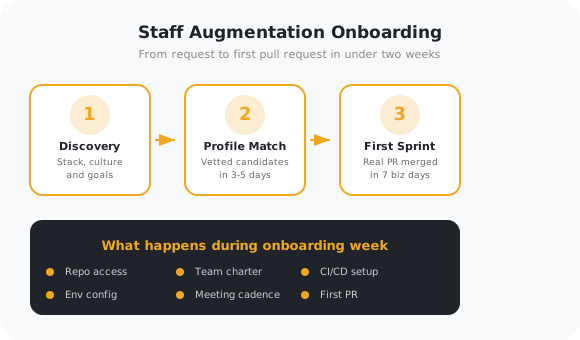
Week one is access, risk assessment, and a real win, not a toy task in a sandbox. Repository access, environment configuration, your definition of done, and a first pull request that touches meaningful production code. We capture working agreements in a short team charter so PM, design, and infrastructure know who owns what from day one.
Day-to-day we bias toward async notes with links, weekly demos with stakeholders, and PR descriptions that answer "why." We track DORA metrics where you want accountability: deployment frequency, lead time for changes, change failure rate, mean time to recovery.
Most squads overlap US Eastern or Central business hours. When you need follow-the-sun coverage, we structure handoffs with written context so incidents do not turn into games of telephone.
Frequently Asked Questions
OUR STANDARDS
Full-stack craftsmanship, no shortcuts.
We write code that ages well. Peer reviews on every pull request, measurable quality gates, and architecture decisions that favor long-term clarity over short-term hacks. Every PR includes context about the reasoning behind the change, relevant tests, and a rollback plan.
Transparency is non-negotiable. You see cycle times, DORA metrics, and roadmap progress in the same dashboards we use internally. When it is time to transition ownership, we leave playbooks and video walkthroughs that keep your product shipping long after we roll off. See our Relay Works full-stack case study for a recent Next.js and PostgreSQL recruiter platform.
If you are interested in hiring full-stack developers in Argentina, visit the Argentina version of this page.
CONTACT US
Tell us about your stack and backlog. We will match you with engineers who ship vertical slices.