Hire JavaScript Developers for Product Engineering Teams
Buyers searching "hire JavaScript developers" usually need engineers who navigate both browser and Node runtimes in a brownfield codebase. Not someone who learned one SPA framework in a bootcamp and never touched module boundaries, build tooling, or production debugging.
Siblings embeds senior JavaScript engineers who work in your ESLint config, your bundler, and your deployment pipeline. We staff squads modernizing jQuery islands, Node services, and hybrid TypeScript/JavaScript repos across eCommerce and logistics products.
- Curated shortlists in 3-5 business days; first meaningful pull request by day eight.
- Roughly three in ten applicants pass our five-stage vetting including a live exercise.
- Monthly engagements with 30-day notice to scale. No bench fees.
"Listing React on a resume is not the same as understanding why your checkout breaks under Safari's ITP rules."
Reviewed by Javier Uanini, Founder and CEO, Siblings Software. Last reviewed 16 June 2026.

JavaScript engineers on our bench with recent production Node or browser work.
Median brief-to-shortlist for JavaScript-heavy stacks without niche legacy constraints.
Applicants pass all vetting gates including the Runtime Judgment live exercise.
When companies hire JavaScript developers through staff augmentation
Buyers compare speed, vetting depth, and coordination overhead. These scenarios cover most discovery calls.
Good fit
- Monolith with mixed JS/TS modules needing incremental modernization.
- eCommerce checkout with browser-specific payment edge cases.
- Node API team short on senior engineers during peak season.
- Legacy jQuery admin beside a React shell needing careful seams.
Usually not the right move
- Greenfield TypeScript-only product where every file is already strict. Hire TypeScript specialists.
- Pure native mobile with no shared JS tooling.
- One-day script fix. Use a freelancer.
Related: hire TypeScript developers hire Node.js developers hire front-end developers JavaScript development outsourcing.
What JavaScript developers do day-to-day when embedded with your team
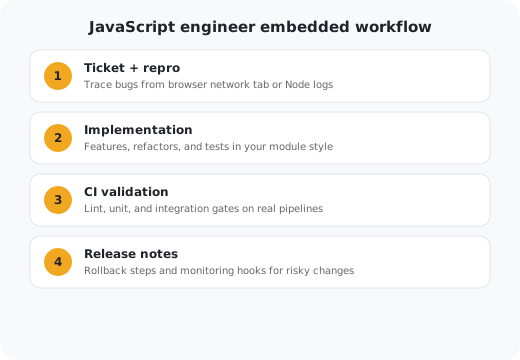
JavaScript engineers join your ceremonies, read your ADRs, and ship in the same pull requests as the rest of the squad. They document module boundaries, add tests at the cheapest seam, and pair with platform engineers when build tooling needs changes.
They join standups, refine tickets with product, review pull requests, and document decisions your future hires will need. They use your Slack, branching model, and definition of done.
The Runtime Judgment Test
Three questions decide whether sprint zero is environment work or feature delivery. We run this in discovery and again in live vetting.
Q1: Can they debug across browser and Node?
Module format, fetch cookies, and event-loop stalls
Q2: Do they modernize without big-bang rewrites?
Incremental ESM migration and strangler patterns
Q3: Can they read your build pipeline?
Webpack, Vite, or esbuild config and CI cache behavior
How Siblings vets JavaScript developers
We reject keyword-stuffed resumes quickly. The live exercise uses production-shaped problems from your brief.
- Runtime fluency: Event loop, promises, and async stack traces in Node or browser devtools.
- Module systems: CommonJS interop, dynamic import, and package.json export maps.
- Testing: Jest or Vitest with meaningful assertions on business logic.
- Security basics: XSS prevention, CSP awareness, and safe DOM manipulation.
Typical rates and engagement models
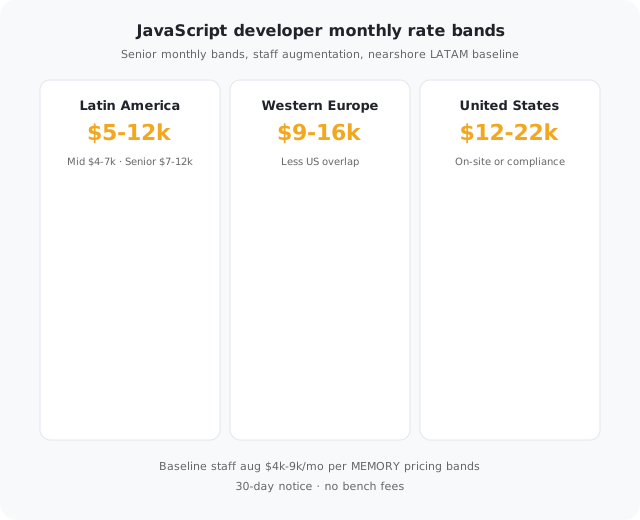
JavaScript staff augmentation aligns with the published $4,000-$9,000 per month baseline for mid-level engineers and $7,000-$12,000 for senior profiles with Node plus browser depth.
| Region | Mid-level | Senior | Notes |
|---|---|---|---|
| Latin America | $4-7k / month | $7-12k / month | Strongest value with US overlap. |
| United States | $12-16k / month | $14-22k / month | On-site or niche compliance. |
| Western Europe | $9-12k / month | $11-16k / month | Less daily US East overlap. |
How clients usually buy
Single embedded engineer. Owns JS-heavy stories in your sprint.
Modernization pair. Two engineers when migration and feature work run in parallel.
Bridge squad. Cover attrition while recruiting permanent hires.
Staff augmentation vs freelancers vs in-house
| Model | Time to start | Best for | Tradeoff |
|---|---|---|---|
| Staff augmentation (Siblings) | 1-2 weeks | Teams with backlog and an engineering lead. | You keep product direction. |
| Freelance marketplaces | Days to weeks | Isolated tasks under four weeks. | Weak vetting and institutional knowledge. |
| In-house hire | 8-16 weeks | Core long-term culture roles. | Recruiting lag and competitive offers. |
Case study: Tideline Commerce stabilized checkout scripts in eight weeks
Composite scenario; numbers represent hybrid browser/Node ownership in headless commerce.
Situation. Tideline Commerce, a US headless checkout vendor, ran JavaScript payment adapters across Shopify, BigCommerce, and custom storefronts. Safari ITP and third-party cookie changes broke saved-card flows for enterprise merchants.
What we did. Two senior JavaScript engineers embedded for eight weeks, one browser-focused, one Node webhook-focused, US Central overlap.
Stack. Vanilla JS adapters, Node middleware, Redis idempotency keys, structured logging.
- Shipped. Unified payment adapter interface, ITP-safe token refresh, webhook replay tooling.
- Checkout script load failures on Safari: 12% to 1.8%.
- Webhook duplicate charges per million orders: 340 to 41.
- Merchant onboarding time for a new adapter: 11 days to 4 days.
"Our adapters finally behave the same in Safari and Chrome."
Director of Engineering, headless commerce SaaS
Published reference: Sur Technology Holdings case study.
What changed for JavaScript teams in 2025 and 2026
- Node.js 22 LTS: Default fetch and test runner maturity affect how we screen backend JS engineers.
- ESM-by-default packages: More npm packages ship ESM-only; interop skills matter on brownfield repos.
- Browser privacy APIs: ITP, CHIPS, and partitioned cookies change payment and analytics integrations.
Related specialist page: hire Node.js developers. External reference: MDN JavaScript.
Risks of hiring JavaScript developers externally, and how we mitigate them
Framework tourists
Mitigation: Runtime Judgment Test filters candidates who only scaffolded SPAs.
Silent global state
Mitigation: We require explicit module boundaries in week-one PRs.
Missing observability
Mitigation: Structured logs and error tags before large refactors.
Vendor repo isolation
Mitigation: All code commits to your organization from day one.
Frequently Asked Questions
Profiles in 3-5 business days; embedded in roughly two weeks with first production PR around day eight.
Yes. We match on your split. Many engagements need both runtimes in one engineer.
Use this page when your repo is mixed JS/TS or JS-only. Use TypeScript when strict typing is non-negotiable on every file.
Typically $4,000-$9,000 mid-level and $7,000-$12,000 senior nearshore LATAM per month.
Five-stage process with a live Runtime Judgment exercise on module and async bugs.
Yes. We staff incremental migration work with characterization tests first.
Handover docs, test coverage on touched modules, and optional overlap with incoming hires.
OUR STANDARDS
JavaScript craftsmanship, no shortcuts.
JavaScript changes touch customers immediately. We require tests, rollback notes, and peer review before merging payment or auth paths.
See our Viking case study for a recent delivery reference.
CONTACT US
Tell us about your runtime mix, bundler, and modernization goals.