Hire TypeScript Developers for React, Node.js, and NestJS Teams
If you searched for "hire TypeScript developers," you are probably not looking for someone who can add a few type annotations. You need an engineer who can step into a live product, understand where type safety actually matters, and help your team ship without turning the migration into its own project.
Siblings Software works with SaaS, fintech, logistics, healthcare, and marketplace teams that need senior TypeScript capacity fast. Since 2019, we have embedded nearshore developers into product squads that run on React, Node.js, NestJS, shared schema packages, and CI pipelines where broken types are not theoretical. They break production, block releases, and slow onboarding.
- Shortlists typically land in 3 to 5 business days, with onboarding in 1 to 2 weeks.
- The most common stack we support is React + TypeScript + Node.js + NestJS, often with shared validation and API contracts.
- Engagements are usually monthly and dedicated, which makes cost and velocity easier to plan than ad hoc contracting.
The strongest hires usually understand the whole delivery path, not just one layer of the codebase.
Typical time to a curated shortlist once scope, seniority, and stack are clear.
Common daily overlap for North American teams working with Latin American engineers.
The minimum internal ownership you need for staff augmentation to work well.
What companies are usually trying to solve when they hire TypeScript developers
This is a commercial investigation query with strong transactional intent. Buyers are comparing cost, risk, and speed, not reading a tutorial.
Good fit for staff augmentation
- Your React frontend and Node.js or NestJS backend already exist, but feature delivery is slipping because the team is stretched.
- You are migrating from JavaScript and need someone who can introduce types gradually without freezing releases.
- You need a senior individual contributor faster than your internal hiring loop can produce one.
- Your product has enough complexity that shared types, DTOs, validation, and code review discipline matter every week.
- You want an engineer inside your sprint rituals rather than a detached vendor working behind a wall.
Usually not the right move
- You only need a one-off fix on a small admin tool. A freelancer is probably cheaper and simpler.
- You do not have an internal product or engineering owner who can set priorities and review work.
- Your main issue is not TypeScript skill. It is missing product direction, missing QA, or vague requirements.
- You want a full squad with delivery ownership, QA, and PM included. In that case, a dedicated TypeScript development team is often the better model.
- You are hoping TypeScript alone will fix a weak architecture, unstable requirements, or a neglected release process. It will not.
If your backlog is broader than TypeScript alone, it is common to combine this role with React developers, Node.js developers, or a single full-stack developer who can own a feature from UI to API.
Typical rates and engagement models
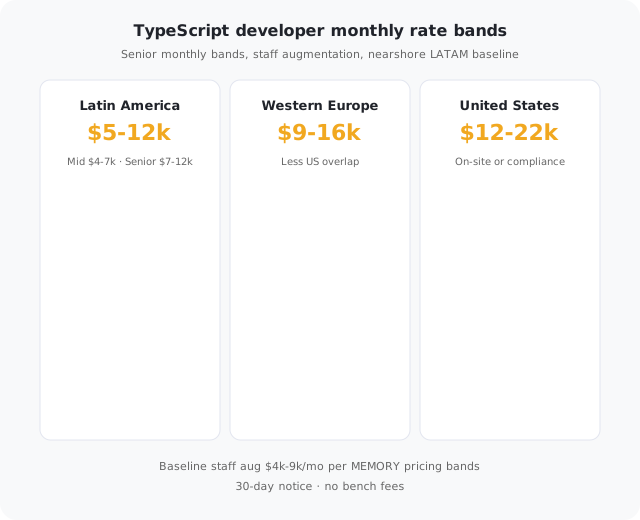
These ranges are not bargain-bin freelancer numbers. They reflect developers who can work in English, join an existing product team, and contribute in modern TypeScript stacks.
| Region | Mid-level | Senior | What you usually get |
|---|---|---|---|
| Latin America | $40-$60/hr | $60-$90/hr | Strong value when you need overlap with North America and want product engineers rather than task takers. |
| United States | $85-$120/hr | $120-$180/hr | Best for roles that demand highly local domain context, on-site work, or very niche leadership. |
| Western Europe | $65-$95/hr | $90-$130/hr | Solid market for mature product engineering, usually with less schedule overlap for US teams. |
A practical buying rule: if the work touches shared contracts, billing logic, auth, or core product flows, shop for seniority first and hourly rate second. Cheap TypeScript gets expensive when it creates silent contract drift between frontend and backend.
How clients usually buy
Dedicated full-time engineer. Best when the person will live in your sprint cadence, own backlog, and collaborate daily.
Fractional senior support. Useful for architecture review, migrations, or codebase cleanup when your in-house team still owns delivery.
Pod extension. One TypeScript engineer plus QA or frontend/backend support when a single hire will not unblock the roadmap.
At Siblings Software, most TypeScript engagements are monthly rather than pure hourly. Buyers still compare hourly ranges, but monthly pricing is easier to budget and discourages noisy time tracking conversations.
Staff augmentation vs freelancer vs in-house vs agency
Most buyers are not choosing between "good" and "bad." They are choosing the least painful model for the work in front of them.
| Model | Best for | Time to start | Main tradeoff |
|---|---|---|---|
| Staff augmentation | Existing product teams that need delivery capacity, senior guidance, or migration help without losing control of the roadmap. | Usually 1 to 2 weeks | You still need internal ownership. This model improves execution, not product direction. |
| Freelancer | Small, isolated tasks with a clean scope and minimal product dependency. | Sometimes same week | Great for contained work, weak for shared ownership, handoff, and long-term continuity. |
| In-house hire | Core long-term roles when you want internal retention, management depth, and domain knowledge to compound over years. | Often 2 to 5 months | Slowest route and the highest total employment cost once recruiting, benefits, and onboarding are included. |
| Project agency | Defined projects where you want scope, delivery management, and accountability packaged together. | Usually 2 to 4 weeks | Less embedded with your internal team, and not ideal when priorities change every sprint. |
Our blunt opinion: if the developer needs to touch your main repo, join standups, explain tradeoffs in pull requests, and stay aligned with product priorities, staff augmentation is usually the right answer. If the task is a contained cleanup or short-lived integration, a freelancer may be the smarter buy.
The stack and scenarios we see most often
The page intent is not "TypeScript in general." It is usually about shipping product work in a modern web stack where types are supposed to reduce operational drag.
React frontends that need stricter contracts
Teams come to us when their component library, forms, and API hooks grew fast and the codebase now leaks any, duplicated DTOs, and silent runtime mismatches.
That is where a senior TypeScript engineer helps your React team regain confidence without rewriting the UI from scratch.
Node.js and NestJS backends with real business rules
Pricing logic, permissions, billing workflows, and event-driven services get messy quickly. Good TypeScript in the backend is not decoration. It is a way to make contracts explicit before bugs show up in production.
We often place engineers who can work across Node.js services, NestJS modules, testing, and validation layers.
Shared types across the whole product
The real payoff comes when the same definitions drive frontend props, API payloads, and backend validation. That is why our most common delivery pattern is a shared contracts package plus stricter CI checks.
When one engineer needs to own both sides of the feature, clients often choose to hire full-stack developers with strong TypeScript depth.
Real hiring scenarios
- A B2B SaaS team needs one senior engineer to stabilize a React dashboard and a NestJS API before an enterprise rollout.
- A marketplace wants to migrate checkout, auth, and admin reporting from JavaScript to strict TypeScript without pausing weekly releases.
- A product-led startup needs a full-stack TypeScript developer who can ship across React, Node.js workers, database queries, and CI.
- A scale-up has solid mid-level developers but no one with enough judgment to define types, review contracts, and stop architecture drift.
How we keep the stack honest
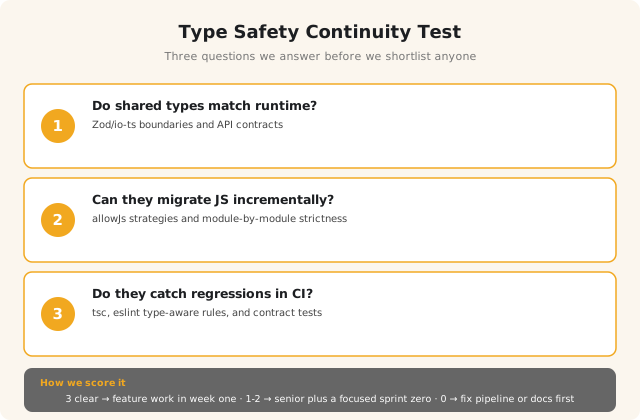
We care less about someone claiming "7 years of TypeScript" and more about whether they can work in the tools that make a typed codebase sustainable: the TypeScript docs, NestJS docs, and typescript-eslint standards that keep CI and reviews consistent.
That sounds basic, but many teams discover too late that their "TypeScript hire" was really a JavaScript developer who tolerated the compiler. Those are different things.
How Siblings Software runs these engagements
The work is not just sourcing. It is matching the right level of judgment to the amount of product ambiguity and codebase debt you actually have.
- Scope the real gap. We ask what is blocked right now: migration, velocity, architectural consistency, or a missing owner in the React and Node.js handoff.
- Match for context, not buzzwords. We screen for TypeScript depth, framework fit, pull-request communication, and whether the person has worked in teams with real product pressure.
- Interview with your stack in view. You should hear how the engineer would handle your
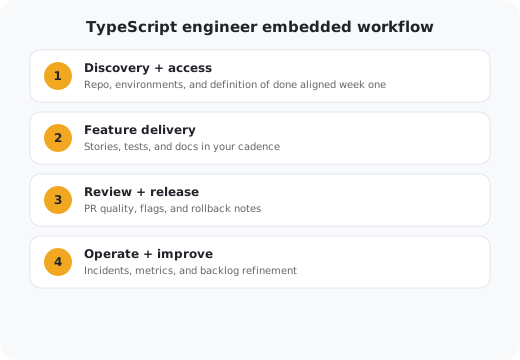
tsconfig, shared types, validation, testing, and release cadence, not just textbook trivia. - Onboard into your workflow. Slack, Jira, GitHub, standups, code review, deployment rules, and how decisions get made. This is where many bad engagements quietly fail.
- Track outcomes weekly. Not "hours used." We care about tickets closed cleanly, review quality, defect patterns, and whether the new person is reducing pressure on the rest of the team.
What clients usually get wrong
The most common mistake is hiring for syntax instead of responsibility. Another one is expecting a single developer to fix architecture debt, team process, and roadmap chaos at the same time. A third is optimizing too hard for hourly rate on work that touches core product flows. That decision usually comes back as slower reviews, awkward handoffs, and bugs nobody can explain.
Experience signals that matter
Siblings Software has staffed product teams since 2019 across SaaS, fintech, logistics, healthcare, and internal platforms. The strongest recurring pattern is simple: buyers who define ownership clearly ramp faster and keep people longer.
We also prefer boring operational habits over flashy promises: documented decisions, weekly check-ins, shared review standards, and engineers who can explain why a tradeoff is worth making.
Mini case study: two TypeScript hires, one messy release train
Client details are lightly anonymized, but the shape of the problem is real and common.
The situation
A logistics SaaS company with roughly 35 employees had a React operations dashboard, a Node.js order service, and a newer NestJS pricing API. The product worked, but every Thursday release came with the same ritual: a long Slack thread, two quick hotfixes, and somebody discovering that the frontend and backend had drifted again on payload shape.
The engineering manager did not want a massive rewrite. He wanted one senior engineer who could tighten contracts in the backend and one full-stack TypeScript developer who could work across the dashboard and the API boundary without turning the roadmap upside down.
What we changed
Siblings Software placed one senior NestJS and TypeScript backend engineer and one React and TypeScript full-stack developer in eight business days. Over the first ten weeks, they focused on a small number of high-value changes:
- Moved order-status and pricing payloads into a shared contracts package.
- Reworked two unstable dashboard flows where the UI had been compensating for inconsistent API responses.
- Added runtime validation around the pricing endpoints instead of trusting type definitions alone.
- Tightened CI so type drift and missing contract updates failed the pipeline before release day.
What happened next
Release noise dropped within the first month. The internal team stopped treating Thursday as a recovery exercise. More importantly, onboarding improved because new developers could follow the types instead of reverse-engineering intent from old tickets and Slack history. The client kept one engineer on a longer engagement and later expanded the scope to reporting modules.
Results after the first quarter
Fewer contract-related bugs. The same payload mismatch stopped showing up in multiple parts of the product.
Cleaner reviews. PR comments shifted away from "what shape is this?" and toward actual product decisions.
Faster handoff. Frontend and backend engineers were no longer maintaining private interpretations of the same workflow.
Less wasted senior time. The engineering manager stopped being the human adapter between React and Node.js tickets.
Why this felt different
It was not a heroic rewrite. It was a focused cleanup with enough product judgment to choose the right contracts first. That is usually what good TypeScript staffing looks like in practice.
If you need the provider to own a larger roadmap instead of extending your internal team, our TypeScript development outsourcing service or a dedicated TypeScript team may be a better fit.
The risks buyers worry about, and how we reduce them
These concerns are reasonable. If a vendor cannot speak to them specifically, keep looking.
Risk: the developer looks strong on paper but cannot work in your codebase
We screen for applied TypeScript judgment: strictness tradeoffs, shared contracts, testing habits, PR communication, and framework fluency in the stack you actually use.
Risk: onboarding drags and nobody owns context transfer
We push for explicit onboarding around repos, branch rules, release cadence, and decision makers. Fast starts almost always come from clear ownership, not magic resumes.
Risk: the engagement becomes dependency without knowledge transfer
Our better engagements include review comments, documentation, and shared patterns that remain useful after the person rolls off. If that is not happening, the setup needs fixing.
Risk: you pay for TypeScript and get a generic JavaScript generalist
We are careful about this. Real TypeScript work shows up in API boundaries, validation, build rules, test data, and review language. If the person cannot explain those choices, the fit is probably wrong.
Frequently asked questions
These are the concerns we hear most from engineering managers, CTOs, and product teams buying TypeScript capacity for live products.
Still comparing options?
If you are deciding between one embedded engineer, a broader squad, or a more managed engagement, we can tell you where staff augmentation helps and where it does not. That conversation is usually more useful than another generic capability deck.
Contact us
Tell us what you are building, where the TypeScript bottleneck is, and whether you need one engineer, a pod extension, or a more managed team setup. We usually reply within one business day.