Case study · Dedicated nearshore squad
Viking Services
How Siblings Software built Viking Services' payment operations dashboard
Merchant onboarding was stretching to twelve business days because operations lived in disconnected tools and duplicate data entry. Viking needed one console that portfolio managers would open before coffee, not another report buried in a shared drive.
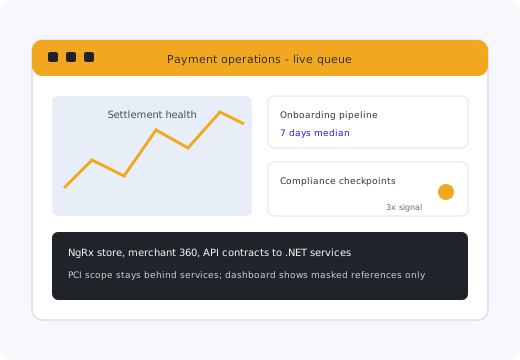
Viking Services, a Minnesota-based payment processing specialist, partnered with Siblings Software to modernize the experience. Together we designed and shipped an Angular-powered administration console that gives analysts real-time visibility into transactions, compliance alerts, and settlement health.
It was a six-week pilot-to-production rollout on top of Viking's existing .NET and SQL Server estate — no ground-up rewrite, no flag day. The headline outcome everyone felt on day one: a dashboard that became the first tab each morning, plus a design system Viking could reuse across the rest of the roadmap.
- Industry: Merchant services & payments
- Engagement model: Dedicated nearshore product squad with project-based scope
- Team: Product manager, UX/UI designer, 2 Angular engineers, QA automation specialist
- Core services: Outsourced development team and Angular development outsourcing
- Related model: Nearshore developers when you need individuals instead of a full squad
Reviewed by Maximiliano Tomassi, Senior Frontend Developer, Siblings Software · LinkedIn
Engagement snapshot
- 42% faster onboarding cycle for new merchants
- 3x increase in actionable compliance alerts surfaced per week
- 98% dashboard adoption across internal account teams within the first month
- 6-week pilot to production rollout without disrupting daily operations
Who is Viking Services?
Viking Services supports independent sales organizations and midsize merchants across the Midwest with next-generation payment processing. Their operations team juggles underwriting, risk, and settlement troubleshooting for hundreds of merchants. To scale without sacrificing service quality, Viking needed a smarter way to orchestrate data from their legacy back-office tools into a single source of truth.
The leadership team asked Siblings Software to partner with their architects and deliver a modern front-end that would sit on top of their existing APIs. The mandate was clear: improve transparency for merchants and internal agents, surface compliance flags sooner, and create space for future roadmap items such as predictive revenue forecasting.
It is the type of engagement that separates payments programs that ship from the ones that drift — the data already existed, the controls already existed, and what was missing was the surface a human could act on at 8:30 in the morning.
Project objectives
- Centralize merchant insights and KYC documentation in a responsive interface.
- Streamline onboarding workflows to eliminate duplicate data entry.
- Improve visibility into settlement delays and chargeback patterns.
- Integrate PCI DSS compliance checkpoints without slowing agent productivity.
The payment console readiness test
Three questions we still ask when an ISO says they have “too many tools and not enough morning clarity.”
1. Is the back-end reality already right?
If risk and settlement logic are solid but invisible, you probably need a console, not a rewrite. Viking passed this test.
2. Can PCI stay out of the browser?
If the answer is no, we pause wireframes and fix service boundaries first. The dashboard only ever saw masked references.
3. Will agents live in this UI daily?
If yes, NgRx, accessibility, and automation are not resume fluff; they are production hygiene. That is why QA had a dedicated seat.
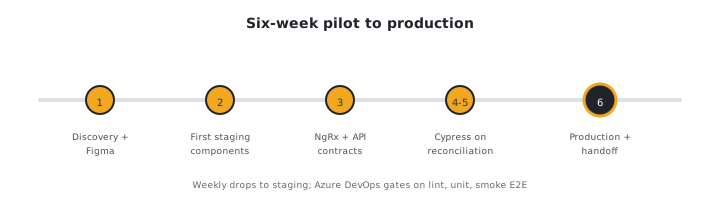
At Siblings, discovery for a scoped squad usually still fits the 3-5 day window; placing the five seats typically hits our 5-10 day assembly band. This engagement still rounded to six end-to-end weeks because payments break on edge cases, and we would not trade away Cypress depth on reconciliation paths to manufacture a shorter timeline on a slide.
The situation we walked into
Viking's operations leaders had a roomful of tools doing the right work in isolation, and no surface that pulled them together. Risk lived in one system, KYC documents in another, settlement state in a third, chargeback dispute notes in a shared drive. Every one of those tools had been the right call when it was bought; the cost only became visible when the team grew past the point where one analyst could remember the path through all of them.
- Disparate homegrown tools made it hard for Viking analysts to read merchant health at a glance.
- Compliance staff were checking PCI DSS checkpoints on manual spreadsheets, which raised the chance of a missed alert during a busy week.
- Onboarding hand-offs between sales and operations required duplicate data entry that consistently delayed activation.
- Leadership lacked consolidated KPIs to plan staffing for the next phases of growth.
How we approached it
- Discovery sprints: we co-led joint interviews with Viking's merchant success team, prototyped the critical workflows in Figma, and validated usability with real data instead of stand-in fixtures.
- Incremental delivery: Angular components were built in parallel with API contract hardening on Viking's .NET side, which meant weekly releases into staging instead of one big-bang reveal.
- Quality foundations: Cypress scripts guarded the complex reconciliation paths first, and the QA automation specialist owned the regression suite from day one rather than hand-testing the long tail.
- Knowledge transfer: we ran enablement sessions and paired engineering with Viking's internal developers so the dashboard would not be a black box on day 43.
We embedded accessibility from the outset following WCAG 2.1 AA guidelines, which mattered because operations teams use these tools every day for hours at a time.
What we delivered
The dashboard is a single Angular 15 workspace organized around the work an operations analyst actually does in a day: review the queue, clear flagged items, move new merchants through onboarding, and explain settlement timing to a merchant on a phone call. Behind the surface, NgRx holds the cross-module state so the same merchant looks consistent whether the analyst opened it from a chargeback alert or from the onboarding tab. We stay current with the Angular roadmap for new engagements; this codebase shipped before signals-first became the headline default, and that is a deliberate migration conversation for a later phase, not a six-week pilot.
- Merchant 360 view consolidating risk profile, KYC documents, processing history, and chargeback timeline.
- Onboarding workflow with automated document validation, e-signature prompts, and a progress board that replaced the email chain.
- Compliance alert center surfacing PCI DSS checkpoints as states the team could action, with audit trails of who reviewed what and when.
- Settlement and reconciliation views with anomaly highlights instead of static reports.
- Executive KPI surface blending transaction volume, chargebacks, and SLA adherence for staffing and capacity planning.
- A reusable design system Viking now extends across the rest of their digital roadmap.
How we worked together
Cadence and rituals
The squad ran two-week sprints with a demo and retro at the end of each one and a shared velocity dashboard Viking's leadership could read without translation. Discovery happened in week one alongside the first standups, not before them. By week two, real Angular components were landing in Viking's staging environment, and the team could point at the screen during a stakeholder review instead of describing what was coming.
Ownership and overlap
Every sprint had a Viking architect on the standups for the modules they owned on the .NET side. Our two Angular engineers paired with Viking's internal developers, not just our own. That overlap was the reason the API contracts hardened in pace with the dashboard rather than weeks behind it.
Quality on the inside
Cypress suites covered the reconciliation paths first because that was where regression risk lived, then expanded outward as features stabilized. Azure DevOps pipelines gated every build on lint, unit tests, and the smoke E2E suite, and the QA seat owned the test data lifecycle in staging so engineers were not improvising fixtures on a Friday afternoon.
Knowledge handoff
From the first sprint we wrote architecture decisions down so a Viking engineer joining a year later would be able to read them. Pairing sessions were calendared, not optional. By the time the dashboard went current, the design system, NgRx state model, and component library were ones Viking's own engineers could extend without us in the room.
Outcomes that moved the needle
- New-merchant onboarding cycle dropped 42%, from twelve business days to seven, after document validation and e-signature prompts replaced the manual chain.
- 3x increase in actionable compliance alerts surfaced per week, because PCI checkpoints stopped living in spreadsheets.
- 98% dashboard adoption across internal account teams within the first month — the kind of number that only moves when the tool is actually faster than the workflow it replaced.
- 35% drop in payment reconciliation escalations after the anomaly views replaced static reports.
- Live executive KPIs blending transaction volume, chargebacks, and SLA adherence, which Viking used to plan staffing for the next two growth phases.
- A reusable design system that became the foundation for phases two and three of the digital roadmap.
In Viking's words
“Siblings Software felt like an extension of our operations team. They understood the regulatory nuances of payment processing and still moved quickly. The dashboard has already become the first tab our analysts open each morning.”
Director of Operations, Viking Services
The engagement was sized and run inside our broader software outsourcing company playbook for dedicated nearshore squads, with the same delivery shape we use today for Angular development outsourcing programs.
What we would carry into the next engagement like this
Every project is also a lesson, and the Viking engagement reinforced two patterns we now treat as defaults on payments work.
Treat the existing back-end as a feature, not a bug
Viking's risk and settlement logic on the .NET side already encoded years of hard-won regulatory and operational decisions. Replacing it would have moved the program off the calendar without changing the outcome a buyer cared about. Layering Angular on top, with API contract hardening done sprint by sprint, was the cheaper and safer path. We default to that pattern now whenever a client has a working ledger, a working risk model, and a frustrating front door.
Compliance should be a workflow, not a screen
Surfacing PCI DSS checkpoints as workflow states the operations team could action — with audit trails of who reviewed what and when — was the change that lifted compliance signal volume by 3x without adding headcount. We carry that into every payments dashboard now: alerts have owners, alerts have outcomes, and the audit trail is something a regulator or a partner can actually follow.
Where Siblings Software is positioned today around this work
If your roadmap looks like Viking's — an existing back-end you trust and a front door that has not kept up — we run this engagement as a focused dedicated squad or as embedded staff augmentation, depending on whether you want the delivery lead on our side or yours.
Dedicated squad
A product manager, designer, two or three engineers, and dedicated QA running on a project-based scope. The same shape that delivered Viking's dashboard. See hire an Angular development team for how the dedicated-team version is sized.
Staff augmentation
If you already have a delivery lead and design system and you only need senior Angular hands inside your squad, we place individual specialists. See hire Angular developers for how the per-engineer placement model works.
Adjacent services
The same delivery shape covers Angular development outsourcing on greenfield SaaS, front-end development outsourcing on legacy modernization, staff augmentation when you need individuals, and end-to-end programs as a software outsourcing company.
Services & capabilities
- Product discovery & UX prototyping
- Angular component engineering
- API contract collaboration with Viking's .NET team
- Automated testing & release management
- Knowledge transfer and enablement
Technology stack
- Angular 15 & TypeScript
- NgRx state management
- Bootstrap 5 & Tailwind-inspired utilities
- RESTful integrations with .NET and SQL Server
- Azure DevOps pipelines & Cypress automation
Frequently asked questions
Seven questions buyers ask once they have read the metrics — the follow-up objections from the second and third calls, mirrored here verbatim.
Ready to build your own payments dashboard?
Whether you are modernizing an existing merchant portal or designing a brand-new experience, our team brings deep fintech context, disciplined delivery, and a human approach to collaboration. We frequently help payment facilitators, ISVs, and marketplaces launch compliant, high-performing platforms their customers actually want to log into.
Talk to us about your roadmap — we can usually spin up a discovery session within a few days and help you scope the first release with confidence.
Key resources
- See all of Siblings Software services
- Hire software developers (staff augmentation overview)
- Download the Viking case study (PDF)
For more similar cases from Argentina, visit the Argentina case study for this project.
CONTACT US
Last updated: May 2026