Hire React Developers for Your Software Team
If you searched "hire React developers," you probably need someone who can own feature slices in your existing component library, not a tutorial author who lists hooks on a resume. Siblings places senior nearshore React engineers into product squads shipping TypeScript, hooks, context, and modern data-fetching patterns.
We match against your repo: App Router vs Pages, Redux vs Zustand vs TanStack Query, your design tokens, and your CI gates. Since 2014 we have staffed React roles across B2B SaaS, fintech dashboards, and healthtech portals where accessibility and performance regressions were blocking releases.
- Curated shortlists in 3-5 business days; first meaningful pull request by day eight.
- Roughly three in ten applicants pass our five-stage vetting including a live exercise.
- Monthly engagements with 30-day notice to scale. No bench fees.
"A React hire who treats every page as a client component is not senior enough for the App Router backlog you are clearing."
Reviewed by Javier Uanini, Founder and CEO, Siblings Software. Last reviewed 16 June 2026.
React engineers on our bench who cleared the Component Boundary screen in the last six months.
Median time from brief to first vetted profile for React 18+ and TypeScript stacks.
Typical daily overlap our LATAM React engineers keep with US Eastern standups.
When companies hire React developers through staff augmentation
Buyers compare speed, vetting depth, and coordination overhead. These scenarios cover most discovery calls.
Good fit
- Series A SaaS rebuilding a dashboard while design system v2 lands in parallel.
- Fintech team migrating Pages Router to App Router without freezing feature work.
- Healthtech portal where WCAG regressions block enterprise renewals.
- Squad short two senior UI engineers after attrition before a conference launch.
Usually not the right move
- One-week marketing landing page with no component library. A freelancer is faster.
- No internal design tokens or Figma-to-code contract. React devs will invent styles.
- Native mobile is the product surface. See our React Native or Swift pages instead.
Related: hire TypeScript developers hire Gatsby developers hire front-end developers staff augmentation React development outsourcing.
What React developers do day-to-day when embedded with your team
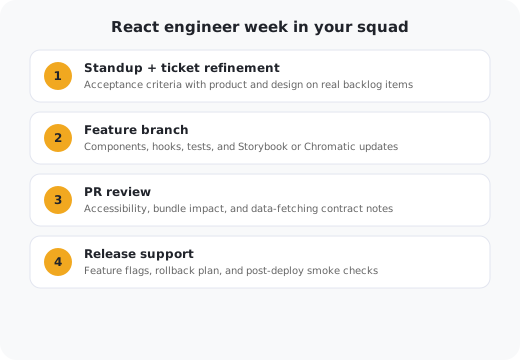
Embedded React developers live in your repository. They co-own feature folders, write tests beside components, participate in design critiques, and document prop contracts for shared UI. They use your lint rules, your Chromatic or Percy gates, and your definition of done.
They join standups, refine tickets with product, review pull requests, and document decisions your future hires will need. They use your Slack, branching model, and definition of done.
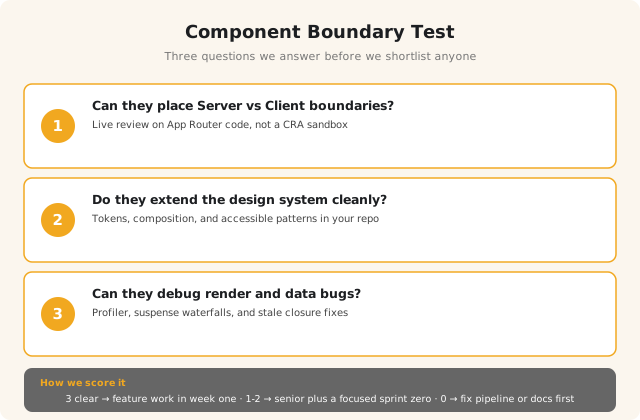
The Component Boundary Test
Three questions decide whether sprint zero is environment work or feature delivery. We run this in discovery and again in live vetting.
Q1: Can they place Server vs Client boundaries?
Live review on App Router code, not a CRA sandbox
Q2: Do they extend the design system cleanly?
Tokens, composition, and accessible patterns in your repo
Q3: Can they debug render and data bugs?
Profiler, suspense waterfalls, and stale closure fixes
How Siblings vets React developers
Generic React resumes fail our gates. Every candidate clears five stages including a live component exercise in a repo shaped like yours.
- State and data fetching: TanStack Query, Redux Toolkit, or your chosen pattern with error boundaries that match production.
- Testing: Testing Library habits, meaningful coverage on the slice they ship, not snapshot theater.
- Performance: Memoization judgment, code-splitting, and bundle-size awareness on real routes.
- Accessibility: Keyboard flows, ARIA when needed, and color-contrast checks on shared components.
Typical rates and engagement models
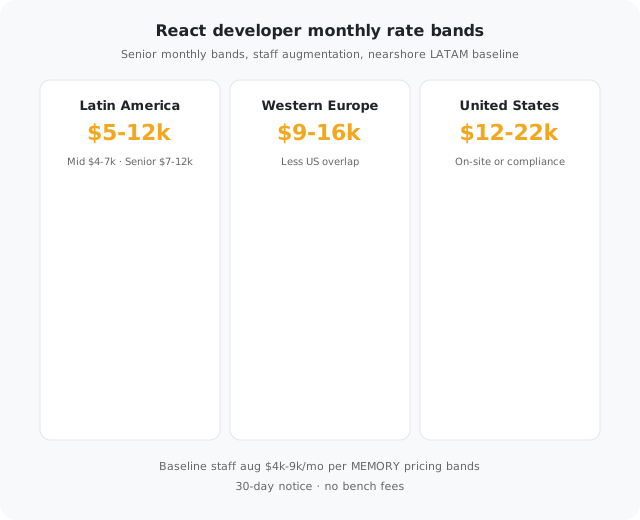
Senior React engineers through Siblings typically run $5,000-$12,000 per month for nearshore LATAM talent, aligned with the $4,000-$9,000 staff augmentation baseline plus a UI depth premium when TypeScript and design-system work are in scope.
| Region | Mid-level | Senior | Notes |
|---|---|---|---|
| Latin America | $4-7k / month | $7-12k / month | Strongest value with US overlap. |
| United States | $12-16k / month | $14-22k / month | On-site or niche compliance. |
| Western Europe | $9-12k / month | $11-16k / month | Less daily US East overlap. |
How clients usually buy
One embedded React engineer. Joins your sprint cadence and owns UI stories end-to-end.
UI pair. Two React developers when you are migrating routes while shipping features.
Bridge while recruiting. Augment for 6-12 months while internal hiring closes permanent seats.
Staff augmentation vs freelancers vs in-house
| Model | Time to start | Best for | Tradeoff |
|---|---|---|---|
| Staff augmentation (Siblings) | 1-2 weeks | Teams with backlog and an engineering lead. | You keep product direction. |
| Freelance marketplaces | Days to weeks | Isolated tasks under four weeks. | Weak vetting and institutional knowledge. |
| In-house hire | 8-16 weeks | Core long-term culture roles. | Recruiting lag and competitive offers. |
Case study: Keystone Analytics cut dashboard time-to-interactive by 41% in nine weeks
Composite details anonymized; outcomes reflect React ownership we optimize for in B2B analytics.
Situation. Keystone Analytics, a Series B revenue-analytics platform, had a React 17 dashboard with prop-drilling across twelve nested contexts. Customer success reported slow filter interactions and accessibility failures on enterprise deals.
What we did. We embedded two senior React engineers for nine weeks: TypeScript-first, one leaning design-system migration, one leaning data-grid performance. They worked US Eastern hours in Keystone's monorepo with Storybook and Playwright gates.
Stack. React 18, TanStack Query, internal design tokens, Vite build, feature flags on risky chart refactors.
- Shipped. Consolidated filter bar, virtualized data grid, WCAG fixes on the top five customer workflows.
- Time-to-interactive on the main dashboard: 4.1s to 2.4s on median hardware.
- Accessibility violations on audited routes: 47 to 6.
- Escaped UI regressions per release: down 38% after Playwright guarded filters.
"Finally filters feel instant without a full-page reload."
VP Product, B2B analytics SaaS (Series B)
Published reference: Bari case study.
What changed for React teams between 2025 and 2026
- React 19: Actions, useOptimistic, and refined Suspense defaults changed how we screen form and streaming patterns.
- Next.js 15: App Router is the default mental model. Candidates who only know create-react-app struggle on modern codebases.
- React Compiler: Automatic memoization is rolling out. We screen for engineers who understand when the compiler helps vs hides bugs.
Related specialist page: hire Next.js developers. External reference: react.dev.
Risks of hiring React developers externally, and how we mitigate them
Parallel component library in a vendor repo
Mitigation: Engineers commit to your org from day one. Code lives in your repositories.
Shallow hook knowledge
Mitigation: The Component Boundary Test rejects candidates who cannot explain stale closures in effects.
Design drift
Mitigation: We require token usage and design review attendance in week one.
Knowledge loss at roll-off
Mitigation: Storybook docs, Loom walkthroughs, and structured handover sprints.
Frequently Asked Questions
We share one to three vetted profiles within 3-5 business days after a 30-minute brief. First meaningful pull request on real code usually lands by day eight. Most engagements embed in standups within two weeks.
Yes. Most profiles ship TypeScript daily and have recent App Router or Pages Router experience. We match your stack rather than forcing a greenfield preference.
Upwork optimizes for listing speed. We run a five-stage screen including a live component exercise and reference checks. Roughly three in ten applicants pass all gates.
Senior React engineers typically run $5,000-$12,000 per month nearshore LATAM, $9,000-$16,000 Western Europe, and $12,000-$22,000 US-based. Mid-level starts near the $4,000-$9,000 baseline.
Yes. We staff engineers who extend tokens, document components in Storybook, and pair with design on accessibility acceptance criteria.
Choose React augmentation when UI depth, design-system fidelity, and frontend performance are the bottleneck. Choose full-stack staff augmentation when stories routinely span API and UI with few specialists available.
Structured handover: documentation, recorded walkthroughs, and optional shadowing with incoming hires so your team maintains every component we shipped.
OUR STANDARDS
React craftsmanship, no shortcuts.
We treat UI craftsmanship as production infrastructure: peer review on every pull request, accessibility checks on shared components, and rollback plans on risky visual changes.
See our Relay Works case study for a recent delivery reference.
CONTACT US
Tell us about your React version, design system, and backlog. We will match engineers who respect your component boundaries.