Hire a React Development Team That Integrates with Yours
React runs a huge share of the production web. If your product depends on it and your roadmap is moving faster than your team can deliver, you have probably considered hiring externally. The question is not whether React talent exists. It is whether you can find engineers who understand your product context, not just the framework.
At Siblings Software, we assemble dedicated React teams that plug into your engineering org. Not freelancers you manage. Not an agency that disappears after handoff. An embedded team with a delivery lead, senior engineers, and QA that joins your standups, ships in your repositories, and cares about your users.
We have done this for SaaS platforms, fintech dashboards, wholesale e-commerce portals, and internal tools since 2013. Most of our clients are US-based companies that need capacity they cannot hire locally—without the six-month ramp-up. If you would rather add individual developers instead of a full team, our React staff augmentation model gets you vetted engineers in under two weeks.
Why React and Next.js Define the Modern Frontend
React is not just popular. It won. With tens of millions of weekly npm downloads and adoption by Meta, Airbnb, Stripe, and thousands of startups, it has become the standard for building interactive user interfaces. But the real shift happened when Guillermo Rauch and the team at Vercel built Next.js on top of React.
Next.js turned React from a client-side library into a full-stack framework. Server-side rendering, static generation, API routes, middleware, server components, and the App Router made React the foundation for production-grade applications, not just single-page apps. Then Vercel made deployment effortless: push to Git, get a preview URL, merge to main, production is live. That deploy-on-merge workflow changed how teams ship software.
It also changed what you need from a React team. Your engineers now have to understand edge functions, incremental static regeneration, caching strategies, and how the deployment platform affects architecture decisions. Writing JSX components is table stakes. Shipping a performant, SEO-friendly, AI-ready application on the modern React stack takes a different kind of depth.
And here is the part most people miss: with AI reshaping how software gets built—from Vercel's v0 to AI-assisted coding tools—React and Next.js have become the primary target for AI-generated UI code. The ecosystem around them (TypeScript, Tailwind CSS, shadcn/ui) is where most AI tools produce their best output. If you are building with AI in the loop, React is where you want to be. The React team you hire today is not just building interfaces—they are building the foundation that AI tools extend.
Our engineers work with the React core documentation as a living reference, stay close to the Next.js release cycle, and deploy production workloads on Vercel regularly. This is not a skill we picked up last year. We have been building with React since version 15 and with Next.js since before the App Router existed.
What a Dedicated React Team from Siblings Software Looks Like
We do not operate as a body shop. Every engagement starts with understanding your product, your codebase, and where you are stuck. From there, we configure a team that makes sense for your situation.
Feature Pod (3 people)
Two senior React/TypeScript engineers and one QA engineer. Best for teams that have a clear backlog and need execution speed. The pod owns a specific product surface—the checkout flow, the reporting dashboard, or whatever needs dedicated attention—and ships independently.
Platform Squad (4–5 people)
Senior React engineers plus a front-end architect. Focused on design system governance, shared component libraries, performance optimization, and developer experience. This is the team you want when your React codebase has grown faster than your standards.
Full Product Team (5–7 people)
React engineers, a backend developer (Node.js or .NET), QA, and a product manager. For greenfield products or major rewrites where you need the whole stack covered without pulling engineers off your existing product.
Every configuration includes a delivery lead. Not a project manager reading tickets aloud—someone who tracks sprint health, manages capacity, handles stakeholder reporting, and resolves blockers before they slow the team down. This role is included in our pricing, not billed separately.
Want to pair React with mobile? We staff blended teams that include React Native engineers so product logic, analytics, and design stay consistent across web and mobile. For broader capability, explore our dedicated development team model.
From Discovery Call to Sprint One
1. Discover (Week 1)
A 60-minute call with your engineering and product leads. We walk through your stack, deployment setup, testing practices, team rituals, and the specific problems you need solved. Within 48 hours, you receive a team configuration proposal with roles, seniority, and estimated timeline.
2. Curate (Week 1–2)
You receive profiles of pre-vetted React engineers who have solved similar challenges. You interview them directly. We also run a live technical pairing session so you see how they think and communicate under realistic conditions—not just whiteboard puzzles.
3. Onboard (Week 2–3)
Our delivery lead runs the onboarding: tool access, repo setup, security protocols, NDA execution, and introductions. By the end of week three, the team is writing production code in your repositories and attending your standups.
4. Optimize (Ongoing)
Every quarter, we review cycle times, defect escape rates, velocity trends, and business metrics. If something is off—team composition, process, communication cadence—we adjust. This is not set-and-forget outsourcing.
Pricing: What a Dedicated React Team Actually Costs
Transparency matters. Here is how our pricing works for 2026:
- 3-person feature pod: Starting at $28,000/month. Two senior React engineers, one QA engineer, and a delivery lead included.
- 4–5 person platform squad: $38,000–$48,000/month depending on seniority mix and whether you need a front-end architect.
- Full product team (5–7 people): $55,000–$80,000/month depending on backend stack and whether product management is included.
For context: a single senior React developer in the US costs $160,000–$220,000/year in salary alone, plus 25–35% in benefits, recruiting fees, and overhead. That is roughly $17,000–$25,000/month for one person. Our three-person pod costs about the same as a single senior US hire—and you get three engineers plus delivery management.
We price with monthly retainers and a 30-day out clause. No long-term lock-ins. We would rather earn your business month over month than trap you in a contract. The first month includes heavier discovery and onboarding investment, so we ask for a three-month initial commitment. After that, it is month-to-month.
Hiring Model Comparison
Every option has tradeoffs. Freelancers work for short, well-defined tasks—a Shopify integration, a landing page, a prototype. But for sustained velocity over months, they create management overhead: you become the project manager, the QA lead, and the architect. Knowledge walks out the door when the contract ends.
In-house hiring gives you the most control, but senior React developers in the US take 45–90 days to hire and command $180K+ salaries. If your need is urgent or uncertain about permanence, that path is expensive and slow.
A dedicated outsourced team sits in the middle. Exclusive engineers working on your product, without the recruiting burden, benefits overhead, or multi-month commitment. The risk is vendor quality—which is exactly why the vetting process and delivery lead matter so much. Our teams are in Latin America, which means 4–6 hours of direct US timezone overlap. Standups happen in real time.
When Hiring an External React Team Makes Sense
Not every company needs this. Here are the situations where outsourcing a React team works best, based on what we have seen across dozens of engagements:
Your roadmap is outpacing your team
You have six months of backlog and three months of runway. Hiring internally will not close the gap fast enough. A pod that is productive in three weeks changes the math entirely.
You are rewriting a legacy frontend
Moving from jQuery, Angular 1.x, or aging class-component React to a modern stack with hooks, TypeScript, and Next.js. This is intensive but temporary—a dedicated squad can own it without disrupting your core team's feature work.
You need a design system built or governed
Your components are inconsistent across products. You need a team to build a shared library, define patterns in Storybook, and enforce standards. Our front-end development teams do exactly this.
Your AI product needs a React frontend
Building AI features—chat interfaces, model output dashboards, admin tools for agents—React with Next.js is the fastest path from prototype to production. Server-side rendering for SEO, streaming responses, real-time updates. Our teams have shipped these. Pair them with a Next.js development team for full coverage.
Looking for project-based help instead of a standing team? Our project-based outsourcing might be a better fit.
Case Study: Bari Distributor Wholesale Portal
Bari Distributor is a food and beverage wholesaler serving 2,000+ retail clients across Argentina. Their ordering system was a mix of phone calls, spreadsheets, and a 2015-era web application that could not handle their catalog of 5,000+ SKUs. Pages took 8–12 seconds to load during promotional periods, and their sales reps were losing orders to competitors with better digital tools.
We assembled a four-person team: one tech lead, two senior React engineers, and one QA automation engineer. The stack was React with TypeScript, Next.js for server-side rendering on public-facing catalog pages, and integration with Bari's existing .NET Core backend.
In four months, we delivered a responsive ordering portal with real-time inventory synchronization, offline-capable cart functionality for sales reps with unreliable connectivity, and a reusable component library that Bari's internal team continued building on after our engagement wound down.
- Order processing time: Dropped 32%.
- Customer service tickets: Decreased 24% post-launch.
- Promotional traffic: Portal handled 3x traffic spikes without performance degradation.
The delivery lead ran weekly demos with Bari's commercial director—not just engineering. Business stakeholders could flag usability issues before they became support tickets. Read the full story in our Bari case study.
What the client said
"Siblings Software was the only partner who could keep up with the pace of our merchandising team. Their React engineers proactively flagged UX friction and shipped fixes before we even asked. The weekly demos with our commercial team changed how we think about product development."
— Product Director, Bari Distributor
Risks You Should Know About
We would rather tell you what can go wrong than pretend outsourcing is risk-free.
Knowledge concentration
If only the outsourced team understands a part of your codebase, you are dependent on them. We mitigate this with paired programming sessions, architecture decision records, and a documentation-first approach. Everything lives in your repositories. When an engagement ends, your internal team has full context.
Communication gaps
Even with timezone overlap, cultural and communication styles differ. Our delivery lead acts as a translation layer—not just for language (our engineers speak fluent English), but for work culture expectations and communication norms. We default to over-communication early and calibrate from there.
Quality variance
Not every developer performs the same way in every context. We run quarterly performance reviews and replace underperformers proactively. You are never stuck with someone who is not delivering. Our retention rate across dedicated teams is above 90%, but when a change is needed, we handle it fast.
Scope drift in standing teams
Without clear objectives, a dedicated team can drift. We tie every sprint to measurable outcomes and review them monthly. If the team is not delivering value relative to cost, we course-correct or wind down honestly. We have ended engagements when the fit was not right—it is better for both sides.
What Decision-Makers Usually Get Wrong
After staffing over 40 dedicated development teams across React, Angular, Node.js, and TypeScript, we have noticed patterns in what goes sideways. Three of them come up repeatedly:
Hiring for framework, not for product
A developer who knows React syntax but has never shipped a product end-to-end will struggle in your environment. We screen for product thinking, not just technical chops. Can they reason about user flows? Do they push back on requirements that do not make sense? Those matter more than knowing every hook.
Underinvesting in onboarding
Some clients treat onboarding as a formality—hand over repo access and expect output by day three. The teams that ramp fastest dedicate a real onboarding week: architecture walkthrough, codebase tour, intro to the domain. It feels slow, but it pays off within the first sprint.
Optimizing for the cheapest hourly rate
The $25/hour React developer from a low-cost market might take three times longer than a $65/hour senior who has built similar systems. Total cost of ownership matters. We price for senior engineers because we have seen what happens when teams cut corners on seniority: rework, tech debt, and missed deadlines.
Frequently Asked Questions
What React stack do your engineers use?
Modern React with hooks, TypeScript, and functional components. Primarily Next.js (App Router and Pages Router) for frameworks, with Remix and Gatsby experience for specific cases. State management depends on complexity—React Query for server state, Zustand or Redux Toolkit for client state. Testing with Jest, React Testing Library, and Playwright.
Can your team deploy to Vercel?
Yes. Most of our React and Next.js projects deploy to Vercel. We work with edge functions, ISR, preview deployments, and caching. We also deploy to AWS (Amplify, CloudFront + S3), Azure, and self-hosted infrastructure when that is what you need.
How do you handle IP and confidentiality?
Standard NDA before any project details are shared. All code is written in your repositories. Engineers use your tool stack—GitHub or GitLab, Jira or Linear, Slack or Teams. We do not retain copies of your code or proprietary information.
What if we need to scale the team?
Adding engineers takes one to two weeks. Scaling down requires 30-day notice. We design teams to be modular so that removing or adding a member does not create knowledge gaps.
How is this different from staff augmentation?
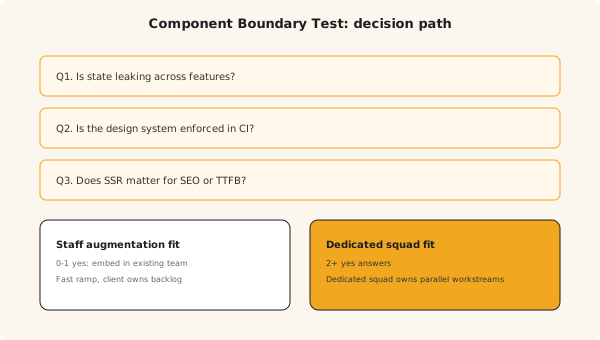
Staff augmentation gives you individual developers who plug into your existing team structure. A dedicated team comes with its own delivery lead, QA, and processes—it operates as a self-managing unit. If you have strong engineering management and just need more hands, staff augmentation fits better. If you need an autonomous squad, a dedicated team is the right model.
Do your teams work only with React?
We specialize in React, but dedicated teams often include backend engineers (Node.js, Python, .NET) and mobile developers (React Native). If you need a broader skill mix, explore our full-stack development teams or JavaScript development teams.
If you are hiring React developers in Argentina specifically, visit the Argentina version of this page.
CONTACT US
Get in touch and build your idea today.