Hire a Dedicated React Native Development Team
A dedicated React Native team is a full pod, tech lead, senior engineers, QA, and a delivery lead, that owns your iOS and Android roadmap as one accountable unit instead of adding individual contractors to your backlog.
Siblings Software assembles these pods for product teams that need sustained ownership of a React Native codebase: New Architecture migrations, native module work in Swift and Kotlin, release governance across the App Store and Google Play, and a QA practice that runs inside the sprint. Monthly retainers run USD 12,000 to 60,000 depending on team size, with a tech lead and delivery lead included at every tier. This page covers what the pod owns day to day, when a dedicated team fits better than staff augmentation, how the team is structured, a first 30 day plan, governance, quality standards, pricing, an example engagement, and answers to common buyer questions. If you only need one or two engineers embedded in your existing team, see our React Native staff augmentation page instead.
Reviewed by Javier Uanini, Founder and CEO · updated 2026-07-03.
What a dedicated React Native team owns
The pod carries the parts of a React Native codebase that need sustained attention: keeping the app current on Hermes and the New Architecture (Fabric and TurboModules replacing the legacy bridge), profiling performance issues that trace back to JSI or the JavaScript thread, authoring native modules in Swift and Kotlin when a vendor SDK has no community wrapper, and owning the release pipeline through Fastlane or EAS so builds reach TestFlight and the Play Console without depending on one laptop.
On the process side, the team runs its own sprint cadence, owns the Definition of Done for mobile-specific work such as device matrix coverage, crash-free session targets, and bundle size budgets, and takes responsibility for App Store and Google Play compliance: App Tracking Transparency wording, Play data safety forms, background mode justifications, and target SDK deadlines. Your product owner still sets priorities; the pod's tech lead owns how the work gets built and shipped.
When a dedicated React Native team makes sense
A dedicated pod fits a specific set of situations more than a generic "we need more developers" request:
- Your roadmap spans multiple quarters on both iOS and Android with one product owner and a shared release train, so the work needs continuity rather than a rotating cast of contractors.
- The app carries React Native version debt, still on the legacy bridge, Hermes disabled, or several majors behind, and the migration is a multi-sprint program that competes with the feature roadmap rather than a two-week task.
- Your internal engineers are strong on web or backend but nobody owns mobile release mechanics, store compliance, or the native module layer full time.
- The backlog needs a QA seat and a delivery lead, not just one more senior engineer added to an already-stretched internal team.
If you already run sprint ceremonies internally and just need extra senior hands, staff augmentation is usually faster to start and less expensive per seat. If the scope is fixed and short, such as a single store resubmission or a bounded feature, project-based outsourcing fits better than an ongoing pod. The dedicated development team model on this page fits multi-quarter roadmaps where one pod owns outcomes across sprints.
The Bridge Burn Test
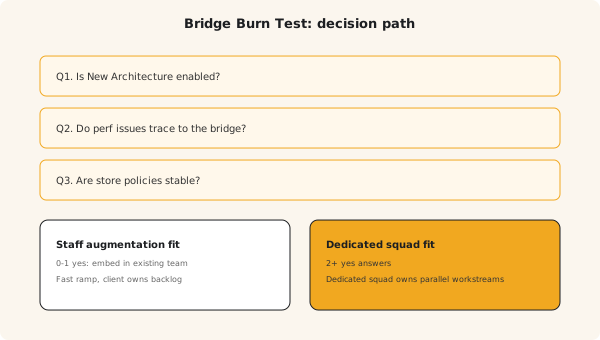
Before a discovery call, run these three questions internally. Two or three answers pointing toward sustained ownership usually mean a dedicated pod fits; fewer usually mean staff augmentation or a narrower fixed-scope engagement fits better first.
Q1. Is the New Architecture enabled?
Fabric and TurboModules change how native modules are written and how views render. Most apps still on the legacy bridge need this mapped before a team size gets committed.
Q2. Do performance issues trace to the bridge or JSI?
If profiling shows the JavaScript thread or bridge serialization as the bottleneck, the fix is native module work, not another round of JavaScript optimization.
Q3. Have store submissions been predictable?
Privacy Manifest requirements on iOS and Play data safety forms on Android are sprint-zero work. Recent rejections or delays point to a gap that needs a dedicated owner.
Team composition
A typical pod: a React Native tech lead, two senior React Native engineers, one native iOS or Android engineer for module work that cannot stay in JavaScript, a QA automation engineer running Detox or Maestro against a real device matrix, and a part-time mobile DevOps engineer maintaining Fastlane or EAS pipelines, signing certificates, and staged rollouts.
Lean pod (4 people)
Tech lead plus two seniors and shared QA. USD 12K to 22K per month.
Standard pod (6 to 8 people)
Full leadership stack plus a native specialist and mobile DevOps. USD 24K to 42K per month.
Program (10 plus people)
Multiple pods with a shared platform bench. USD 45K to 60K plus per month.
See also our React Native development outsourcing service page and the sibling mobile dedicated team offering for apps that mix React Native with native iOS and Android surfaces.
Your first 30 days
Days 1 to 5
Discovery, repo and CI read, a New Architecture and Hermes status audit, and a written team proposal with sprint-zero goals.
Days 6 to 12
Interviews, Apple Developer team and Play Console access, signing and provisioning handoff, and a Definition of Done that includes the device matrix.
Days 13 to 21
Sprint zero completes: CI green on a real device matrix, crash reporting wired, and first PRs merged to a staging or internal-track build.
Days 22 to 30
Sprint one delivery against an agreed goal, first TestFlight or Play internal-track release, and a weekly demo and retro.
External references we use in sprint zero include reactnative.dev, the React Native New Architecture overview, and the Apple App Store Review Guidelines.
Governance
Your product owner owns priorities. Our delivery lead runs sprint planning, standups, and stakeholder updates. The tech lead owns architecture decisions, code review service levels, and production readiness sign-off. Decisions get written up as short architecture decision records inside your repository, not in a vendor-only wiki.
Apple Developer Program membership, Play Console access, distribution certificates, provisioning profiles, and upload keys stay under your organization throughout the engagement; our engineers join as members of your developer teams. Escalation path: engineer to tech lead to delivery lead to your engineering director within one business day. IP is work-for-hire under US-style agreements, and source code lives in your org from day one. We join your Slack, Jira or Linear, and on-call rotation when scoped.
Quality standards
Definition of Done includes peer review, Detox or Maestro end-to-end tests against a real device matrix, updated native module documentation, crash and performance monitoring hooks, and a staging or internal-track build before any release candidate. QA automation runs inside the sprint alongside feature work, so a release does not wait on a testing pass that only starts after code freeze.
For React Native engagements we align mobile-specific security practices with the OWASP Mobile Application Security Verification Standard, run dependency scanning in CI, and track escaped defects and sprint goal attainment on a shared dashboard. Stories that fail an agreed quality gate stay open until they pass it.
Pricing
Dedicated React Native pods bill monthly within the USD 12,000 to 60,000 band. The main cost driver is team size and how much native module or New Architecture migration work the app needs, more than the base React Native rate:
Small pod
USD 12K to 22K / month
Four to five people. Initial three-month commitment, then month to month.
Standard pod
USD 24K to 42K / month
Six to eight people with full leadership and QA.
Program
USD 45K to 60K+ / month
Multi-pod engagements with platform support.
Every tier includes a two-week satisfaction guarantee. Scaling down requires 30 days notice after the initial period.
Dedicated team, staff augmentation, freelancers, or in-house
Dedicated React Native team (this page). A pod with its own delivery lead, USD 12K to 60K per month. Fits multi-quarter roadmaps and sustained ownership of the mobile codebase.
Staff augmentation. One or two engineers under your engineering manager, roughly USD 4K to 9K per month per developer. Fits when you already run sprint rituals and need senior hands rather than delivery ownership. See React Native staff augmentation.
Freelancers or marketplaces. Fastest to start and often the cheapest hourly rate, but there is no shared QA, no delivery lead, and continuity depends on one person staying available. Reasonable for small, well-scoped fixes; risky for a New Architecture migration or a store compliance program that runs for months.
In-house hiring. Best for long-term ownership and institutional knowledge, but sourcing React Native engineers with real native module experience in a single local market can take two to four months per seat. Many teams run a dedicated pod while an in-house search is open, then hand off ownership once hires land.
Risks and how we reduce them
- New Architecture migration stalls mid-sprint. We audit Fabric, TurboModule, and JSI status in week one, before committing a sprint plan, so surprises surface in discovery instead of sprint three.
- Native module bus factor. At least two engineers on the pod can read and modify the Swift and Kotlin native modules, so migration work does not stop when one person is out.
- Store rejections blocking a release date. Sprint zero ships the current Privacy Manifest entries and Play data safety form before feature work starts, not after the first rejection.
- Handoff risk if the engagement ends. Source code, CI configuration, and native module documentation live in your repository from day one, so there is no separate vendor-owned codebase to migrate back.
Example engagement
Illustrative scenario based on a composite live-events ticketing pattern. Names and figures are representative, not a published client case study.
Parkside Ticketing (composite) runs an event ticketing app on React Native with wallet passes and Bluetooth beacon check-in. The app was still on the legacy bridge with Hermes disabled, and a proposed native rewrite had stalled twice in planning.
A six-person Siblings pod migrated the app to the New Architecture and rebuilt the Bluetooth beacon module as a TurboModule. After an early Apple rejection on pass signing, the team re-sequenced the wallet pass work as a native spike ahead of the UI sprints instead of after them. Illustrative outcomes over twelve sprints: crash-free sessions moved from the high nineties into the high 99s, checkout completion improved as cold start times dropped, and the migrated release cleared both stores without a resubmission. Engagement cost was in the mid twenties per month for the six-person pod.
For published engagement references, see the Siblings Software case studies hub.
Frequently Asked Questions
Run the Bridge Burn Test above during discovery. Two or three answers pointing toward sustained ownership usually mean a pod with a delivery lead and QA fits better than adding individuals. If you already run sprint ceremonies internally and just need senior hands, staff augmentation is typically faster to start and less expensive per seat.
The Bridge Burn Test is the three-question self-diagnostic we ask buyers to run before a discovery call: whether the New Architecture is enabled, whether performance issues trace back to the bridge or JSI, and whether store submissions have been predictable. Two or three answers pointing toward sustained work signal a dedicated pod; fewer signal staff augmentation or a narrower fixed-scope engagement.
Discovery takes three to five days, interviews run five to seven days, and sprint zero starts in week two or three. Most pods merge their first production-bound changes and ship a TestFlight or Play internal track build by week four.
Lean pods run USD 12,000 to 22,000 per month. Standard pods with full leadership and QA run USD 24,000 to 42,000. Multi-pod programs run USD 45,000 to 60,000 or more. Every tier includes delivery leadership and a two-week satisfaction guarantee.
You do. Apple Developer Program membership, Play Console access, distribution certificates, provisioning profiles, and upload keys stay under your organization. Our engineers join as members of your developer teams rather than holding release infrastructure on a separate account.
Your product owner sets priorities. Our tech lead owns architecture decisions, code review service levels, and release readiness sign-off. The delivery lead runs ceremonies and weekly status reporting.
Adding seats usually takes one to two weeks once a role is agreed. Scaling down requires 30 days notice after the initial commitment period.
OUR STANDARDS
A visible New Architecture status beats a status update that says "still investigating."
Every React Native engagement ships with a documented Fabric and TurboModule migration status, weekly demos, and honest reporting on the crash-free and release metrics we agree to in discovery.
If you are interested in hiring developers for this capability in Argentina, visit the Argentina version of this page.
CONTACT US
Get in touch and build your idea today.