Hire a Dedicated Angular Development Team
Most companies that come to us for an Angular team have already tried the solo-freelancer route. They found someone technically sharp, but that person worked in isolation, missed context on the product side, and eventually drifted. What they actually needed was a small, cross-functional squad that understood the roadmap, not just the code.
That is what we build here at Siblings Software. Our dedicated Angular development teams combine senior TypeScript engineers, a QA specialist, a delivery lead who speaks product, and (when you need it) a UX researcher who validates flows with real users before a single line hits the IDE. The squad plugs into your sprint rituals, your Slack channels, your CI/CD pipelines, and starts shipping within the first two weeks.
48-hour shortlists
Curated Angular profiles matched to your stack, seniority needs, and working style.
Full US overlap
LATAM-based engineers who are online when you are. No 12-hour reply delays.
We have been doing this since 2016, and the teams that work best are the ones where the outside squad genuinely cares about the product outcome. Our delivery managers track sprint health, stakeholder sentiment, and velocity trends, not just hours logged. Weekly demos keep marketing, sales, and engineering on the same page.
This page is specifically about full squads (tech lead, seniors, QA, UX). If you only need one or two Angular engineers embedded in your existing team, check our Angular developer staffing page instead. Same vetting standards, different engagement structure.
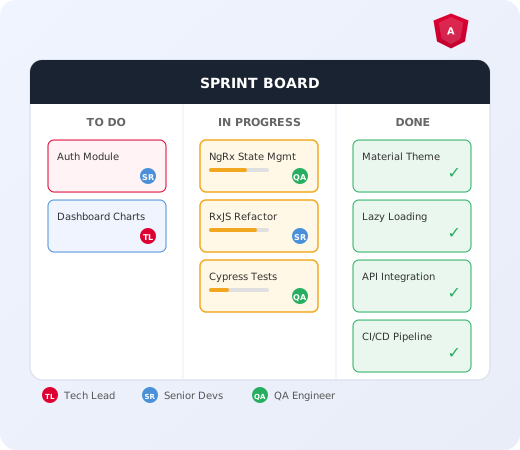
Why Angular for Enterprise Front-Ends?
There is a reason Angular keeps showing up in regulated industries, complex internal tools, and products where dozens of developers touch the same codebase. It is opinionated by design. That means less time arguing about folder structure or state management conventions and more time building features that move the business forward.
TypeScript from Day One
Unlike frameworks where TypeScript is an afterthought, Angular was built on TypeScript from the ground up. For large teams, that translates into fewer runtime surprises, better refactoring support, and onboarding that does not require a week of tribal knowledge transfer. Our engineers use strict mode and custom lint rules to catch issues before they hit staging.
Dependency Injection That Scales
Angular's DI system is something you do not appreciate until your app has forty services and three micro-frontends sharing auth. We have seen teams on other frameworks bolt on DI libraries after the fact; it never feels right. Angular gives you that architecture out of the box, and our leads know how to structure providers so testing stays fast even as the codebase grows.
Signals and Standalone Components
Angular's recent move to signal-based reactivity and standalone components has dramatically simplified how we structure new modules. No more NgModule boilerplate. Our teams have migrated three client codebases to standalone components in the past year, each time cutting build times by 15 to 25 percent.
We follow the official Angular style guide as a baseline and add project-specific conventions during the launch sprint. That way, your internal developers can maintain the code after we hand off without deciphering custom patterns.
Case Study: Fintech Compliance Dashboard
Anonymized under NDA. Metrics from production. Named references available on request.
The Problem
A mid-sized financial services firm in the northeastern United States had a compliance team of fourteen analysts reviewing wire transfers, KYC documentation, and AML flags through a patchwork of spreadsheets and a legacy ASP.NET WebForms app. The review cycle for a single flagged transaction averaged 38 minutes. Auditors were breathing down their neck, and the existing vendor had just missed a third consecutive deadline.
What We Did
We deployed a five-person Angular squad: a tech lead with ten years of financial software experience, two senior engineers, a QA automation engineer, and a part-time UX researcher. The team built a single-page compliance dashboard on Angular 17 with NgRx for state management, Angular Material for the component library, and role-based route guards wired to the firm's Azure AD tenant.
The UX researcher spent the first three weeks sitting (virtually) with analysts during actual review sessions, watching where they lost time. That research shaped everything from the tab layout to the keyboard shortcuts we added for power users.
Results After 16 Weeks
- Average transaction review time dropped from 38 minutes to 11 minutes.
- Analysts reviewed 3.2x more cases per day without adding headcount.
- Zero critical defects reported in the first 90 days of production use.
- The firm passed an OCC audit two months after launch with the new tooling cited positively in the examiner's report.
The key was not just Angular skill. It was the squad understanding the domain well enough to anticipate what analysts needed before they asked. That kind of product empathy is hard to get from a staffing agency that just matches keywords on a resume.
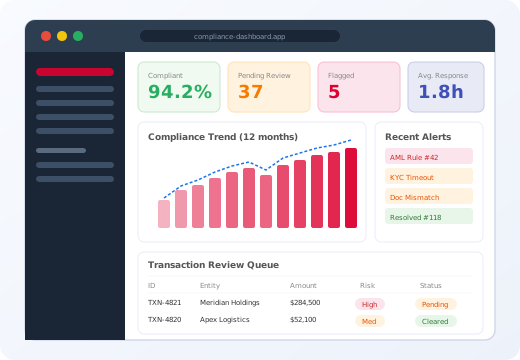
For a public, named case study with technical detail, see our ITSYSTEMS field service portal or the Binsensors IoT dashboard write-up.
Real Client Win: ITSYSTEMS Field Service Portal
ITSYSTEMS manages field technicians across three Latin American countries. Their internal backend team was stretched thin, and the existing paper-based workflow for documenting site visits was creating delays that frustrated both technicians and operations managers. They asked us to take the front end off their plate entirely.
What the squad delivered
- Embedded a bilingual Angular squad (tech lead, two seniors, QA, UX researcher) working directly with the operations director on a two-week sprint cadence.
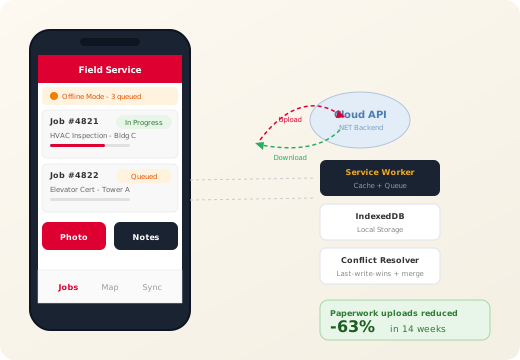
- Built an offline-ready Angular PWA with device camera integration that technicians could use in basements, parking garages, and rural areas with spotty connectivity. Paperwork uploads dropped by 63% in 14 weeks.
- Introduced contract testing between the Angular front end and the .NET API, which shortened backend deployment approvals from five days to under 24 hours.
- Launched a technician feedback loop: the UX researcher interviewed field workers every other sprint and fed insights directly into the backlog.
The full technical breakdown is in our ITSYSTEMS case study.
What Actually Makes Our Angular Teams Different
Not just technical skill. Product empathy, honest communication, and a genuine stake in your outcomes.
We Start With Outcomes, Not Resumes
Before we write code, we sit down with your product owner and map out what success looks like in 30, 60, and 90 days. What metrics should move? What does the team on the other side of the Zoom call actually need from us? We have found that spending two days on this upfront saves two sprints of misalignment later.
For example, when we kicked off the fintech dashboard project, the initial ask was "rebuild the compliance UI." After the discovery sessions, we realized the real goal was cutting review time in half. That reframing changed how we prioritized features and what we measured.
You Pick the People
We do not assign whoever is available. After discovery, we shortlist Angular engineers whose experience maps to your domain and working style. You interview them using your process (or ours, if you prefer). If someone is not the right fit after 30 days, we replace them at no extra cost.
Need a principal architect who has built design systems at scale? Or a senior dev who gets excited about accessibility and analytics? We have both. You control the squad composition and can adjust it quarter by quarter as the roadmap evolves.
Nearshore, Not Offshore
Our Angular engineers work from Buenos Aires, Montevideo, Medellin, and Lisbon. That means real overlap with U.S. business hours, not a 1 AM standup. Pair programming, whiteboard sessions, and incident responses happen live. We have noticed our clients value this more than almost anything else: when a production issue hits at 2 PM Eastern, your team is there.
Angular Craftsmanship
Our squads work with Angular 16 through 19, standalone components, signal-based reactivity, RxJS, and Angular Material. We pair those with Cypress and Playwright for E2E testing, Jest for unit tests, and pragmatic documentation so your internal team can iterate confidently after handoff. We contribute back to Angular community discussions on GitHub and stay current through Angular meetups.
Security and Compliance
We follow SOC 2-aligned processes from day one. Threat modeling workshops happen during the launch sprint, not as an afterthought. CI/CD gates enforce linting, test coverage thresholds, and dependency vulnerability scans on every pull request. For regulated industries, we layer in OWASP guidelines, GDPR controls, and whatever internal policies your security team requires.
Featured Case Study: Binsensors Smart Waste Platform
When Binsensors came to us, they did not need a new coat of paint. They needed route supervisors in municipal governments to actually trust the data coming from thousands of fill-level sensors deployed across city streets. The legacy dashboard was slow, the alert system cried wolf too often, and nobody on the client side had the Angular bandwidth to fix it.
What Changed
We deployed a six-person Angular team led by an engineer who had previously shipped logistics apps for two LATAM municipalities. He understood the politics and operational constraints that shape how route supervisors make decisions, and that made all the difference.
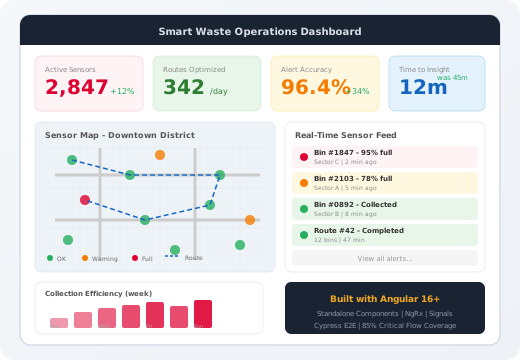
- Refactored 40+ live dashboard screens into Angular 16 standalone components over 10 weeks without interrupting analytics feeds or breaking existing bookmarks.
- Introduced NgRx and signal-based patterns for the alert engine. Alert accuracy jumped 34% because the UI could now debounce and correlate sensor readings instead of firing on every threshold breach.
- Cut time-to-insight for operations teams from 45 minutes to 12 minutes per route by redesigning the map view and adding one-click drill-downs.
- Delivered Cypress regression suites covering 85% of critical flows and spent two sprints coaching the client's QA team to extend them independently.
"They talked to our field managers every week and reflected what they heard in the UI. That was exactly what we had been missing." — Binsensors product owner
Full story in our Binsensors case study.
Angular Team Technical Capabilities
From architecture decisions to release management, our squads handle the full product lifecycle so your internal team can focus on strategy.
Front-End Architecture
Standalone components, module federation for micro-frontends, monorepo setups with Nx, and design system governance. We have built shared component libraries used across five Angular apps simultaneously for a single client.
Reactive State Management
NgRx, signals, NGXS, or plain RxJS, depending on what fits your complexity level. We also integrate Apollo for GraphQL, REST adapters, and offline-first caching strategies using IndexedDB and service workers.
Quality Engineering
Jest and Karma for unit tests, Cypress and Playwright for E2E, visual regression testing with Percy, and contract testing with Pact. Every PR runs through automated quality gates before a human reviewer even looks at it.
Cloud and DevOps
Containerized Angular builds on Docker, automated deployments to AWS, Azure, or GCP, monitoring dashboards in Datadog or Grafana, and SRE practices that keep release confidence high and rollback times low.
PWAs and Offline-First Architecture
When your users work in the field, on factory floors, or in buildings with poor Wi-Fi, you cannot build an app that just fails silently when the connection drops. We pair Angular's router and service workers with explicit sync rules: what queues locally, what waits for connectivity, and how conflicts resolve when two people edit the same record. That approach is how the ITSYSTEMS field portal stayed reliable in basements and parking garages, not just on conference-room Wi-Fi.
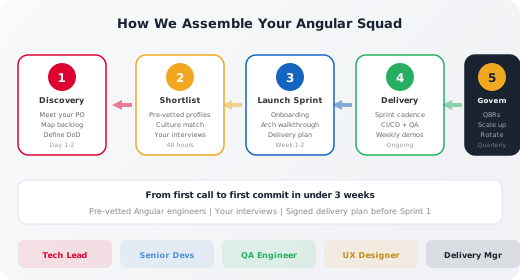
How We Assemble Your Angular Squad
We have refined this process across dozens of engagements. It is designed to get a production-ready team in place fast while making sure the fit is right for both sides.
1. Discovery and Product Immersion (Day 1-2)
We meet with your product owner and engineering leadership to understand what you are building, who uses it, and what "done" means for the next quarter. We review your backlog, your tech stack, your compliance requirements, and the pace you need. This shapes the squad profile: how many seniors, whether you need a dedicated QA, whether UX research should be part of the mix.
2. Talent Shortlist in 48 Hours
We present pre-vetted Angular engineers who match your seniority, domain experience, and time-zone requirements. Each profile includes a technical summary, a project history, and an English communication assessment. You interview them using your standard process. No pressure to accept anyone who does not feel right.
3. Launch Sprint (Week 1-2)
The team runs a focused onboarding sprint: repo walkthroughs, architecture conventions, Definition of Ready alignment, and a first small delivery to prove the pipeline works end to end. By the end of week two, the squad has merged its first PRs and attended its first retro with your team.
4. Continuous Delivery
From here, it is steady sprint cadence. We integrate with your git workflows, CI/CD pipelines, and ceremonies. You get velocity reports, release notes, and weekly health checks that cover quality metrics, blockers, and stakeholder risks. No surprises.
5. Governance and Growth (Quarterly)
Every quarter, we run a business review with your leadership: roadmap alignment, product analytics impact, squad health scores, and composition adjustments. Need to scale up for a launch? Add a DevOps specialist for an infrastructure push? Rotate a senior who has been on the project for a year and wants a new challenge? We handle it.
Engagement Models and Time to Value
Dedicated Squads
Best for product rewrites, new platform launches, and multi-quarter roadmaps where continuity matters. Fixed monthly rate, predictable velocity, and long-term team stability. This is our most popular model for enterprise Angular work.
Ramp-up: 2 to 3 weeks
Team Augmentation
Embed Angular specialists alongside your internal engineers to accelerate a specific feature track or cover a skill gap. Monthly commitments with the flexibility to adjust headcount each quarter.
Ramp-up: 1 to 2 weeks
Project Pods
Outcome-based engagements for well-defined backlogs: a migration from AngularJS to Angular 18, a design system rollout, or a compliance module build. We provide delivery leadership and QA oversight with a fixed scope and timeline.
Ramp-up: 3 to 4 weeks
Need cross-technology capabilities beyond Angular? Explore our Angular development outsourcing services for complementary backend, mobile, and cloud expertise.
Building Angular-powered storefronts or customer portals? Pair this squad with our dedicated eCommerce development teams to cover merchandising, checkout, and payment integration work.
Sample Angular Squad Setup
Here is how we typically structure a squad for a product team building a customer-facing dashboard or internal tool. The exact composition depends on your backlog, but this gives you a sense of scale and roles.
Squad Lineup
- Angular Tech Lead: Owns architecture decisions, runs code reviews, mentors mid-level developers, and acts as the technical bridge to your internal team.
- 2 Senior Angular Engineers: Own feature delivery, write clean TypeScript, and pair-program with your developers to keep knowledge flowing in both directions.
- QA Automation Engineer: Builds and maintains Cypress, Playwright, and contract test suites. Defines quality gates tied to your Definition of Done.
- Product Designer (optional): Validates user flows through prototype testing before development starts. Especially valuable for consumer-facing products.
- Delivery Manager: Keeps ceremonies running, tracks velocity and stakeholder risks, and owns the weekly status report. The person you call when something feels off.
30-60-90 Day Milestones
- Days 1 to 30: Joint discovery, architecture spike, first feature shipped to staging with analytics instrumentation. QA framework established.
- Days 31 to 60: Core feature track delivered to production. Automated test coverage reaches agreed threshold. Accessibility audit completed.
- Days 61 to 90: Performance optimization pass, advanced features (personalization, reporting, integrations), and preparation for internal handover or continued engagement.
Need backend or mobile alongside the Angular squad? We plug in cross-functional pods from our outsourced development team program.
Industries Where Our Angular Teams Deliver
Angular's structured architecture makes it particularly well-suited for complex, data-heavy applications. Here are the verticals where our teams have the deepest experience.
Fintech and Payments
Compliance dashboards, real-time transaction monitors, customer onboarding flows, and PCI-compliant portals. The fintech case study on this page came from exactly this vertical.
Healthcare
HIPAA-aligned telehealth portals, patient journey trackers, clinical analytics reporting, and purchasing systems. We understand the audit and access-control requirements that come with handling PHI.
Logistics and IoT
Fleet management dashboards, sensor analytics platforms, route optimization tools, and control towers. The Binsensors engagement is a good example of what this looks like in practice.
Media and EdTech
Interactive learning platforms, video streaming dashboards, CMS tooling, and content management workflows. These projects tend to demand strong UX and performance optimization skills.
Looking for flexible team setups across multiple business units? See how we structure multi-disciplinary squads in our outsourced development team services overview.
Frequently Asked Questions About Hiring Angular Teams
How do you maintain code quality across the squad?
Every pull request goes through peer review and automated quality gates (linting, test coverage, dependency scans) before merging. We agree on style guides, branching models, and Definition of Done during the launch sprint. The tech lead runs weekly code health reviews and flags technical debt before it compounds.
Can the Angular team work with our backend stack?
Yes. Our squads regularly collaborate with .NET, Java, Python, and Node.js backends. We establish API contracts early (typically OpenAPI specs and Pact contract tests) so the front-end and back-end teams can ship independently. For the ITSYSTEMS project, this approach cut backend deployment approvals from five days to under 24 hours.
What happens if a developer is not the right fit?
We run performance checkpoints during the launch sprint and at 30, 60, and 90 days. If expectations are not met on either side, we replace the person quickly and at no additional cost. In practice this happens rarely (maybe once in every fifteen engagements) because the vetting and interview process catches misalignment early.
Do you support onsite visits or hybrid collaboration?
Our default model is remote-first, which is how we deliver the best cost-to-quality ratio. That said, we can schedule onsite discovery sprints, quarterly planning workshops, or kickoff visits when it makes strategic sense. Our operations team handles travel logistics for engagements that need face-to-face time.
Can the team help migrate from AngularJS to modern Angular?
Absolutely. We have migrated three AngularJS codebases to Angular 16+ over the past two years. The process involves incremental migration using the Angular upgrade module, running both frameworks side by side until all routes are ported. It is not glamorous work, but it is something our seniors have done enough times to avoid the common pitfalls.
How do you handle intellectual property?
All code is yours from the moment it is written. We sign IP assignment agreements and NDAs as standard practice before any work begins. Source code lives in your repositories, and our engineers use your credentials and VPN. When the engagement ends, there is nothing to "transfer" because you have owned it all along.
Ready to Build Your Angular Team?
Share your roadmap, and we will curate a squad that feels like an extension of your internal engineering group. No boilerplate proposals. No generic resumes. Just people who fit your product, your culture, and your pace.
What happens after you reach out
- 15-minute discovery call focused on your priorities, tech stack, and timeline.
- Curated Angular candidate profiles delivered within 48 hours.
- Launch sprint plan covering onboarding, velocity targets, and success metrics.
Want to explore before committing?
Read our Binsensors case study for a public example of Angular team delivery, or compare engagement models in our project-based outsourcing guide.
When you are ready, the form below connects you directly with our delivery leads.
If you are interested in hiring Angular developers based in Argentina, visit the Argentina version of this page.
CONTACT US
Get in touch and build your idea today.