Hire a dedicated eCommerce development team
A dedicated eCommerce development team is a nearshore pod that owns the storefront, the checkout, the ERP and OMS integration layer, and the peak-season runbook under one delivery lead—not a rotating bench of theme developers. If that is what you need, sprint one typically lands in about twelve business days on a focused storefront pod (USD 18K–30K/month) or a full integration-layer pod (USD 32K–42K/month) when NetSuite, SAP, punchout, or Black Friday readiness is in scope.
Most buyers land here after a bad agency split: the Shopify partner ships the theme, a systems integrator quotes the ERP adapter separately, and nobody owns the runbook when checkout fails at 11pm on Cyber Monday. Siblings Software staffs commerce pods with an eCommerce tech lead, senior storefront and backend engineers, a dedicated integration engineer we refuse to remove from integration-layer engagements, QA automation on checkout regression, and an optional CRO engineer when conversion is the goal. If your squad already runs the program and you only need two more senior hands, start with our eCommerce developer staff augmentation route—roughly two in five of our pods convert from that path within five months.
Reviewed by Javier Uanini, Founder and CEO, Siblings Software — ten years staffing commerce engagements across DTC, B2B distribution, and headless replatforms. Last reviewed 1 June 2026.
If you are reading this page, here is what we put on it
Twelve sections, in the order a buyer actually decides.
- The Commerce Pod Fit Test — pod vs. staff augmentation
- Mid-2026 hiring snapshot — platforms, ramp time, conversion rate
- What an eCommerce team actually owns
- The Replatform Test — before you spend a quarter on a migration
- Picking the platform — an opinionated map
- Who is on a Siblings Software eCommerce pod
- Who hires an eCommerce development team
- How we onboard in two to three weeks
The Commerce Pod Fit Test — when a dedicated team beats staff augmentation
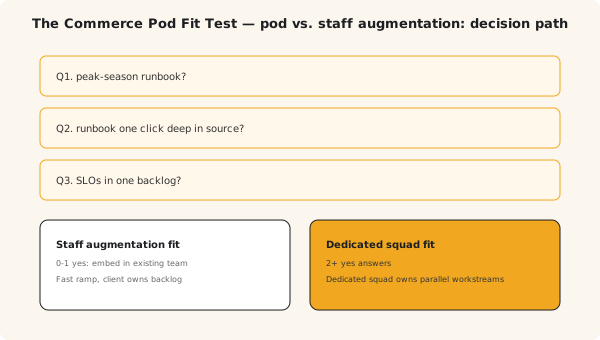
The most expensive commerce mistake we see is signing a pod contract when two augmented seniors would have been enough—or adding three freelancers when the integration layer needed a named owner. We run three questions on every discovery call before recommending a model. Two or three yes answers means a dedicated eCommerce pod; zero or one means staff augmentation and we will say so out loud.
Q1 — Integration scope
Does the backlog span the storefront and at least one of ERP sync, OMS fulfilment, payment rotation, B2B punchout, or the peak-season runbook? Pure PDP and theme work rarely justifies a six-seat pod. We have turned away pod contracts where the buyer only needed a Hydrogen storefront refresh on healthy integrations.
Q2 — Peak on-call
Do you need a named 24/5 or 24/7 rotation through your revenue peak with a runbook one click deep in source control? Freelancers and augmented individuals can ship features; they rarely share a paging calendar. Roughly one in three inbound requests in the first half of 2026 were runbook-only engagements with no feature roadmap.
Q3 — Single delivery lead
Is one tech lead accountable for checkout, integration adapters, Core Web Vitals gates, and merch-facing SLOs in a single backlog? Split vendors—Shopify agency plus SI plus an internal PM—almost always fail this question. That is when a pod under one delivery lead beats three contracts.
eCommerce pod hiring snapshot — mid-2026
The numbers below come from commerce engagements we signed or converted between January and May 2026. They move with peak season—one new dedicated-team signature can shift a platform-mix row eight to twelve points in a given month—but they answer the questions buyers ask before the first call: which platforms we actually staff, how fast sprint one lands, and how often augmentation becomes a pod.
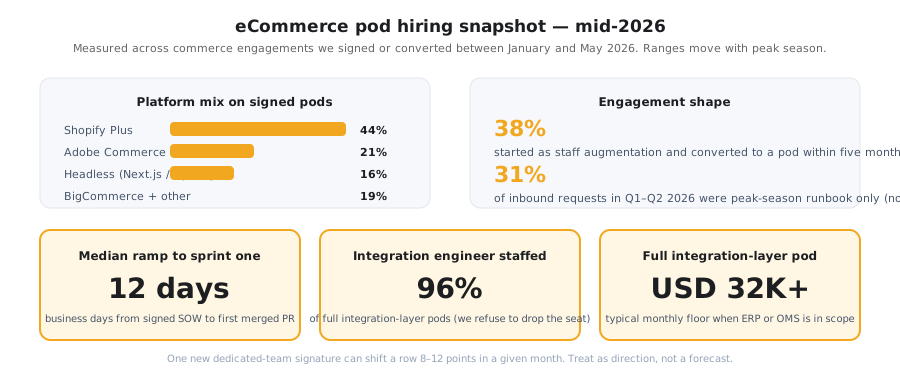
Three patterns worth naming. First, Shopify Plus still leads signed pods, but headless share climbed four points year over year as Checkout Extensibility matured. Second, the integration engineer seat is staffed on ninety-six percent of full integration-layer pods—the four exceptions were storefront-only rescue engagements with a written scope cap. Third, the median ramp to sprint one dropped from fifteen business days in 2024 to twelve in H1 2026 because sprint zero now includes observability and runbook scaffolding as non-negotiable gates, not optional add-ons.
What an eCommerce development team actually owns
An eCommerce development team is not the same engagement as a stack-specific squad (a Node team, a Next.js team, a PHP team) and it is not a generic dedicated development team with a Shopify subscription. The first is "we are hiring engineers who write this language." The second is "we are hiring engineers who happen to like commerce." An eCommerce pod is narrower and more opinionated: "we are hiring engineers who own the storefront experience, the checkout flow, the integrations the demo decks always skip, and the runbook your business cannot afford to miss on Black Friday."
In practice, that ownership covers eight artefacts. The storefront and content surface — PDP, PLP, cart, header, search, content blocks, the design system that lets the merchandising team launch a campaign without filing a ticket. The checkout flow — Shop Pay, custom checkout extensions where the platform allows it, payment-method rotation, fraud-rule integration, address validation, taxes and shipping. The integration layer — ERP, OMS, PIM, CDP, marketing automation, loyalty, subscriptions, returns hub, fulfilment to a 3PL or in-house warehouse. The B2B surface where it exists — account hierarchy, per-company price lists, quote workflow, punchout, net-terms, draft orders, approvals. The headless API layer when one is in scope — storefront API, search service, content fetchers, persisted queries, edge cache rules. The performance and Core Web Vitals envelope, including the INP metric that replaced FID in March 2024 and now catches the long input-blocking tasks the old metrics missed. The observability story — structured logs, RED metrics per surface, real-user monitoring, error budgets per channel. And the peak-season runbook the on-call engineer can find in a single click at 11pm.
Most outsourcing engagements buy you the first artefact and call it an eCommerce team. The bill arrives, the storefront refresh ships, the checkout still loses 30% of carts to the third-party payment iframe, and nine months later the wholesale side is patching ERP CSV imports by hand. We treat the eight artefacts above as load-bearing. If you do not see the integration layer and the runbook produced inside the first three sprints, the team is shipping themes, not a commerce program.
For the standards we treat as load-bearing on every engagement: web.dev Core Web Vitals is the storefront performance baseline every PR is judged against; Shopify developer docs sets the contract for any custom app or storefront API integration; Baymard Institute research is the checkout-UX checklist we run before any A/B test ever ships.
The Replatform Test — four questions before you spend a quarter on a migration
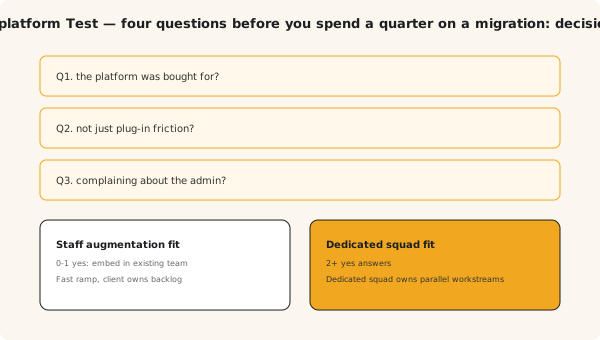
Of the eCommerce engagements we ran in 2025, roughly four in ten arrived asking for a replatform and left the discovery call with an eight to twelve sprint plan to fix the storefront they were already on. The buyer's narrative on the call is usually some variation of "the platform is holding us back." The honest diagnostic is whether anything that requires a replatform has actually changed about the business. We use four questions in writing before recommending a migration. Three or four yes answers means replatform with a calendar; three or four no answers means fix in place.
Q1 — Quadrant shift
Has your channel mix or your SKU complexity moved enough to leave the quadrant the platform was bought for? A pure DTC brand on Shopify Plus that never crossed 50K SKUs and is now adding wholesale on a separate marketing-led portal has moved quadrants. A B2B distributor on Adobe Commerce whose catalog grew from 80K to 95K SKUs has not. The most expensive replatforms we have rescued were the ones the buyer started because the admin looked dated, not because the business outgrew the platform.
Q2 — Integration ceiling
Are ERP, OMS, PIM, or B2B workflow needs hitting the platform's structural ceiling, or is the irritation actually plug-in friction? Eighty-five corporate punchouts on cXML, multi-step approval workflows across legal, finance, and procurement, and a real-time inventory feed measured in seconds — those are ceilings. A flaky NetSuite CSV importer that drops every Friday at 7pm is not a ceiling; it is a Friday-evening cron job worth fixing on its own.
Q3 — Velocity cost
Is the merchandising team measurably losing revenue to platform delays, or do they just complain about the admin? The honest version of this answer comes from a written log of campaigns that slipped, with attached revenue impact. If the merch lead can produce that log on the spot, the answer is yes. If the answer is "it feels slow," the answer is no — and the right fix is a design-system rebuild on the existing storefront, not a replatform.
Q4 — Peak runway
Will the cutover land at least six weeks before the next high-revenue peak, with a parallel-run period and a written rollback flag? Black Friday in late November, the holiday quarter for retail, the back-to-school quarter for B2B office supply — if the cutover lands inside the change freeze window, the answer is no, regardless of how strong the other three are. We refuse to flip the switch on a Tuesday in November.
If the answer set is mixed, the call is usually a smaller change: a B2B Edition migration on Shopify Plus instead of an Adobe rebuild, a headless storefront on the existing backend instead of a full backend swap, a search-engine swap, an ERP refactor, a checkout extensibility upgrade. We will tell you that on the discovery call, including when the recommendation is "do not replatform; we will fix the storefront in eight sprints instead."
Picking the platform — an opinionated map
"Shopify Plus or Adobe Commerce or BigCommerce or custom?" is not a neutral question. Each platform ships with trade-offs that punish you for using it outside its quadrant. The diagram below is the opinionated default we bring to a discovery call. We will argue you out of it whenever the workload demands, but it is the starting frame.
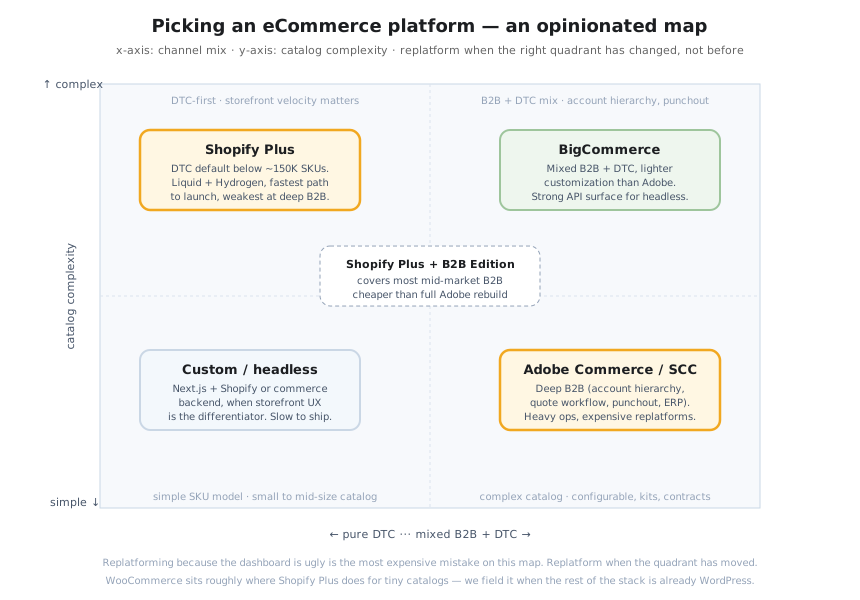
Shopify Plus — the DTC default below 150K SKUs
Wins for DTC brands that value storefront velocity, fast theme iteration, and a checkout funded by Shopify's own optimisation team. Liquid plus Hydrogen plus the Storefront API covers most of what teams used to build from scratch, and Checkout Extensibility (the model that replaced legacy checkout.liquid in August 2024) finally made checkout customisation safe for upgrades. Loses on deep B2B without B2B Edition (and even with it, multi-step approval workflows still strain the model), at catalogs above a few hundred thousand SKUs with deep configuration, and on storefront experiences that demand more than the theme system allows.
BigCommerce — the mixed B2B and DTC middle ground
Wins when the catalog is mid-range, the API surface matters more than the theme ecosystem, and the buyer wants a path to headless without the operational weight of Adobe. BigCommerce's API-first posture pairs cleanly with a Next.js storefront, and the B2B Edition covers most mid-market wholesale shapes. Loses on storefront design ecosystem maturity (the theme marketplace is thinner than Shopify's) and on checkout customisation freedom. We field BigCommerce when buyers explicitly want a single platform across DTC and B2B without paying Adobe-level run costs.
Adobe Commerce / Salesforce Commerce Cloud — deep B2B and complex catalogs
Wins when account hierarchy, per-company catalogs, multi-step approval workflows, punchout, ERP-tight coupling, or six-figure-SKU complexity is non-negotiable. Loses on operational weight (the team you need to run it is bigger), on cost-of-ownership at smaller catalog sizes, on Adobe Commerce 2.4.7+ pulling every install onto PHP 8.3 and Composer 2.7 (a forcing function we ran into on every Adobe engagement in 2025), and on the speed at which the merchandising team can iterate without an engineer. We field Adobe or Salesforce Commerce Cloud when the B2B side is the business, not the side project.
Custom / headless — storefront UX as the differentiator
Wins when the storefront experience is the brand, the team budget includes a real search and content engineer, and the commerce backend (Shopify, BigCommerce, commercetools, or a custom service) can sit invisibly behind a Next.js or Hydrogen storefront. Loses on launch speed (always slower to ship than the platform-native theme), on the ongoing cost of owning your own search and content stack, and on plug-in compatibility (most of the marketplace assumes a platform-native storefront). We refuse to recommend headless when the buyer has not budgeted for the parts of the stack the demo decks always skip.
Replatform when the quadrant has changed, not before
The most expensive replatforms we have seen happened because the dashboard looked dated, not because the business outgrew the platform. The honest diagnostic lives in the four-question Replatform Test above. If only one quadrant has moved, the answer is usually a smaller change: a B2B Edition migration, a headless storefront on the existing backend, an ERP refactor, a search-engine swap.
Who is on a Siblings Software eCommerce pod
Composition is opinionated. The numbers below come from running commerce engagements across DTC apparel, beauty, food and beverage, B2B distribution, marketplaces, home and lifestyle, and regulated health-adjacent retail. Smaller pods leave the integration seat unstaffed, which is where ERP and OMS sync quietly drifts into a Friday-night spreadsheet exercise. Larger pods that skip the QA seat ship checkout regressions to production every other release.
Focused storefront pod (4–5 people)
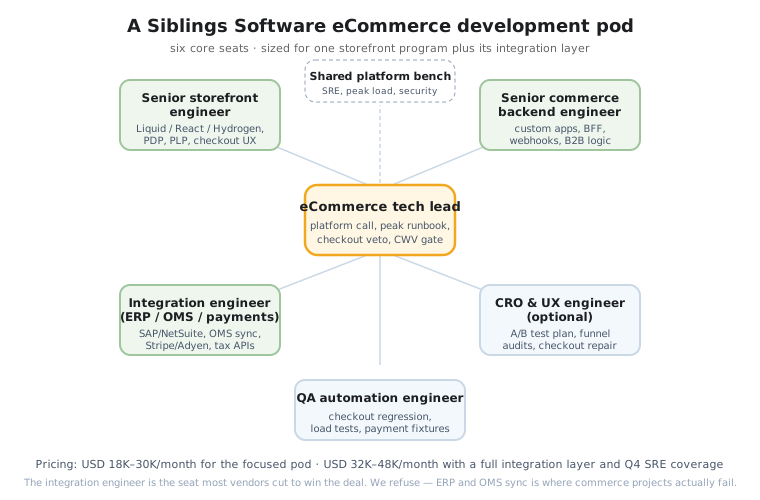
An eCommerce tech lead, a senior storefront engineer, a senior commerce backend engineer, a part-time integration engineer, and a shared QA automation engineer. Best when the storefront is the bottleneck, the integration layer is already healthy, and the buyer wants quick wins on conversion and CWV.
Full integration-layer pod (6–7 people)
A tech lead, two senior storefront engineers, a senior commerce backend engineer, a full-time integration engineer, a QA automation engineer, and an optional CRO and UX engineer. The default shape when ERP, OMS, payments, or B2B logic is in scope alongside the storefront work.
Multi-storefront platform engagement (8–12 people)
Two product pods plus a shared platform team running Kanban on the headless API layer, the search service, the OMS connectors, and the peak-season runbook. Used when the company runs three or more storefronts (DTC, B2B, an EU subsidiary, a marketplace) and needs a single integration policy across surfaces.
The roles below are the ones vendors cut first to win the deal and the ones we refuse to remove. A pod without them is not an eCommerce pod; it is a pile of theme developers with a roadmap.
Integration engineer (ERP, OMS, payments, tax)
Owns the SAP, NetSuite, Brightpearl, or Microsoft Dynamics adapter; the OMS sync to a 3PL or in-house warehouse; the payment provider rotation across Stripe, Adyen, PayPal, Klarna, and any regional gateway; the tax engine integration with Avalara, TaxJar, or Vertex; and the shipping APIs from EasyPost, ShipStation, or carrier-direct. Without this seat, the wholesale side and the finance reconciliation slowly become someone's weekend job.
eCommerce tech lead
Owns the platform call, the checkout veto, the CWV gate (LCP, CLS, and INP), the peak-season runbook, and the architecture decision records that keep the next year of changes from undoing this one. Writes the one-page replatform memo when one is needed, and has the hard authority to refuse a "small" merchandising request that would burn the LCP budget.
QA automation engineer
Owns the checkout regression suite (the one that catches the broken Apple Pay button before a customer does), the load-test plan against ten times peak, the payment provider fixtures across the supported gateways, and the synthetic monitors that page on a real failed transaction. Without this seat, regressions ship to production until the day the war room opens.
CRO and UX engineer (when conversion is the goal)
Sits between the merch team and the engineers. Runs the funnel teardowns, the Baymard-checklist UX reviews, the test-plan sequencing (we will not start with an A/B test until the funnel is stable enough to learn from), and the post-launch readouts that convert "we shipped a feature" into "we moved a number." We kill roughly one in three test proposals at the planning stage because the projected sample never reaches the minimum detectable effect worth acting on.
If your stack leans on a specific framework, we blend specialists from our React development team, Next.js development team, or back-end development team bench into the pod, so headless and integration decisions are made by people who have lived with the consequences.
Who hires an eCommerce development team
The buyer profiles below cover roughly nine in ten conversations on this page. If you recognize yourself in one, the next call is usually about the platform call, the integration layer, and the peak-season runbook — not CVs.
DTC founder scaling past Shopify limits
Annual revenue is in the eight figures, the storefront is on Shopify Plus, the merchandising team has out-grown the theme system, and the founder wants to know whether the answer is a Hydrogen storefront, a Next.js head, a Shopify Plus B2B Edition migration, or a heavier replatform. The buyer wants a pod that has shipped all four shapes and will tell them which one matches the business, not the conference talk.
B2B distributor needing punchout and ERP integration
The catalog has tens or hundreds of thousands of SKUs, customer accounts roll up to corporate hierarchies, the largest accounts integrate via cXML or OCI punchout, and the ERP (SAP, NetSuite, Microsoft Dynamics, Epicor) is the system of record. The buyer wants a pod that can ship account hierarchy, quote workflow, net terms, and ERP-driven price and inventory sync without making procurement re-train its buyers.
Retailer replatforming off Magento 1 (or off custom)
The platform is end-of-life or the original founder team has moved on, the integration layer is a chain of cron jobs, and the buyer needs a calendar-driven replatform that does not break peak season. The pod we ship runs the data migration, the URL redirect strategy, the SEO continuity work, the payment provider re-onboarding, and the parallel-run period. We refuse to flip the switch on a Tuesday in November.
Peak-season team that lost forty-five minutes last Black Friday
The platform is fine, the brand is healthy, and the leadership team would rather not run last year's checkout-down audit again. The pod treats the first six sprints as observability, capacity, and runbook work: load tests at ten times peak, payment-failover drills, fraud rules review, change freeze policy, and a dress rehearsal during a low-traffic Monday. The headline metric is checkout uptime through peak; everything else is secondary.
How we onboard an eCommerce pod in two to three weeks
The numbers below match every dedicated-team engagement we run. Commerce specifics drop into the same shape; sprint zero is where the storefront repo, the integration adapters, and the runbook skeleton are first touched.
Discovery (3–5 days)
Two-hour working session with your eCommerce owner and head of merchandising, a read-only walk through the storefront repo and the top ten apps or extensions, a checkout funnel teardown using session replays, an audit of the integration layer, and a written team configuration proposal.
Team assembly (5–10 days)
Pre-vetted candidates introduced for paired technical sessions. You interview every engineer. The tech lead and integration candidates run a live storefront and ERP review on an anonymized sample, not a coding kata, so you see them think about commerce trade-offs before signing.
Sprint zero (week 2–3)
CI access, storefront repo cloned, integration adapters scaffolded, observability wired with structured logs and per-surface RED metrics, real-user CWV monitoring (LCP, CLS, INP) on every page template, the first three runbook entries drafted, and the peak-season calendar agreed end-to-end. Across the engagements we ran in 2025, sprint-zero observability alone produced a median LCP improvement around thirty percent before any feature work shipped.
Sprint one (week 3–4)
First quick wins typically land here: a render-blocking app embed retired, an LCP regression on the PDP closed, a checkout-step bug that was costing 2% of carts fixed, an ERP price-sync edge case patched, a Shop Pay rollout audited. The pod is now operating on the cadence and SLOs you saw on paper during discovery.
A 2-week satisfaction guarantee covers any seat in the pod. After the first 30 days, scaling down requires 30-day notice; scaling up takes one to two weeks per seat. None of this is unusual — it is the same engagement spine we use across every eCommerce development outsourcing engagement we run.
Real hiring scenarios we handle every quarter
The seven scenarios below cover most of the commerce engagements we sign. The shape of the pod, the first sprint goal, and the headline number we agree to ship against differ by scenario, not by platform.
Replatform from Magento 1 (or legacy custom) to Shopify Plus
The platform is end-of-life, the integration layer is fragile, and the buyer wants the cutover behind them before the next peak. The pod runs the data migration, the URL redirect plan, the SEO continuity work, the payment provider re-onboarding, the loyalty and subscription transfer, and a parallel-run period. We refuse to cut over inside a six-week window of Black Friday or any high-revenue holiday.
Headless migration onto an existing backend
The commerce backend (Shopify, BigCommerce, commercetools) stays. The storefront moves to Next.js or Hydrogen because the brand experience demands it. The pod ships the headless storefront with proper persisted queries, edge caching rules that match merchandising velocity, a search service that does not melt under autocomplete load, and a plan for the apps and extensions that will not survive the move.
Payment provider switch (or addition)
Stripe to Adyen because expansion into Europe needs local methods. PayPal added because the demographic skews older. Klarna added because the cart sizes have grown into BNPL territory. The pod ships the rotation behind a feature flag, runs the fraud-rules tuning that always follows a provider change, repairs the analytics attribution that breaks the day a new provider lands, and validates the finance reconciliation against the first month of live transactions.
ERP / OMS integration rebuild
The current ERP sync is a chain of nightly CSV jobs, the OMS lags inventory by hours, and finance reconciliation takes a person a day per week. The pod replaces the CSV chain with event-driven sync (webhooks from the platform, message queue inside, idempotent writes into the ERP), brings the OMS to near real-time, and ships the dashboards finance has been asking for.
B2B program on Shopify Plus B2B Edition
The DTC side is healthy, the wholesale side is bleeding orders to a custom portal that drifts from the ERP, and Shopify Plus B2B Edition has closed enough of the Adobe gap to be worth the migration. The pod ships customer accounts mapped to company hierarchies, per-company catalogs and price lists, quote workflow on a custom app, punchout via cXML or OCI, net-terms via draft orders plus a finance approval gate, and ERP-driven SKU and price sync.
Core Web Vitals (including INP) and conversion remediation
The brand is fine, the platform is fine, the funnel is leaking at every step. The pod runs a two-week audit (PSI, CrUX field data with INP since it became a Core Web Vital in March 2024, Baymard checklist, session replays), retires the LCP regressions caused by render-blocking app embeds, replaces the third-party tag pile with a budgeted tag manager, fixes the long INP tasks coming from over-eager analytics, rebuilds the leaking checkout step, and only then starts an A/B test plan that will produce stable enough numbers to learn from.
Black Friday / Cyber Monday runbook engagement
The platform is fine, the brand is healthy, leadership wants the runbook the on-call engineer can find at 11pm. The pod runs the ten-week readiness shape (capacity baseline, payment-failover drill, load test at ten times peak, dress rehearsal, change freeze, war-room operations) and stays through the post-mortem so the next year starts from a written record, not a memory.
Internationalization and multi-storefront launch
The brand is going multi-region: a US flagship, a UK storefront, an EU storefront with VAT and local payment methods, a marketplace presence on Amazon or TikTok Shop. The pod ships the storefront fork strategy (Shopify Markets where it fits, separate stores where it does not), the localized pricing and tax engine, the regional fulfilment routing, the hreflang and SEO plan, and the runbook each region's customer-service team can follow.
Engagement models and what an eCommerce pod costs
Pricing for a dedicated eCommerce development team is monthly and predictable. The brackets below sit inside the broader dedicated development team range; we lean to the higher end of the dedicated bracket on full integration-layer engagements because the integration and QA seats are non-negotiable on a real commerce program.
Focused storefront pod
USD 18K–30K / month
Four to five people. eCommerce tech lead, senior storefront engineer, senior commerce backend engineer, part-time integration engineer, shared QA. Best when the storefront and CWV are the bottleneck and the integration layer is already healthy. Initial 3-month commitment, then month-to-month.
Full integration-layer pod
USD 32K–42K / month
Six to seven people. Tech lead, two senior storefront engineers, senior commerce backend engineer, full-time integration engineer, QA automation, optional CRO and UX engineer. The default shape when ERP, OMS, payments, B2B logic, or peak-season readiness is in scope alongside the storefront work.
Multi-storefront platform engagement
USD 42K–48K+ / month
Two product pods plus a shared platform team on Kanban for the headless API layer, the search service, the OMS connectors, and the peak-season runbook. Eight to twelve people. Includes a fractional security architect, 24/7 on-call coverage during peak, and a quarterly architecture review across surfaces.
A 2-week satisfaction guarantee runs across every seat. Scaling down takes 30 days' notice; scaling up takes one to two weeks per role. If you would rather start project-based and convert to a dedicated cadence later, the focused storefront pod is the bracket that converts most cleanly into a fixed-window engagement — typically a 12-to-16-week replatform or a Q4 readiness program — before becoming a long-running pod. Project-based engagements typically run between USD 15K and USD 120K depending on scope.
What 2025–2026 changed for eCommerce programs
Most of the commerce playbook from 2022 still works. Six things that changed in 2024 and 2025 are now non-negotiable on an engagement we ship; we put them on the discovery call so the pod is not surprised in sprint three.
INP replaced FID as a Core Web Vital (March 2024)
Interaction to Next Paint catches the long input-blocking JavaScript tasks that FID quietly missed. The two storefront archetypes that broke first were the ones with heavy product personalisation widgets on the PDP and the ones with over-eager analytics tag managers. We bake INP gates into sprint zero now, not into the post-launch CWV remediation pass.
Shopify Checkout Extensibility replaced legacy checkout.liquid (August 2024)
If your store still has checkout.liquid customisations in source control, the upgrade is no longer optional. Custom checkout extensions live in checkout UI extensions, web pixels for tracking, and Shopify Functions for the discount and shipping logic that used to be inline JavaScript. Most of the work is rebuilding the customisation; the rest is unwinding the third-party app dependencies that assumed the old model.
Shopify Plus B2B Edition closed most of the Adobe gap
Account hierarchies, per-company catalogs and price lists, draft orders for net terms, and the Catalog API are now first-class. Combined with a quote-workflow custom app and a cXML punchout partner, B2B Edition covers most mid-market wholesale shapes that used to default to Adobe Commerce. We have moved four mid-market distributors off Adobe to Shopify Plus B2B Edition in the last 18 months and have recommended against the move twice when the multi-step approval workflow was load-bearing.
Adobe Commerce 2.4.7+ forced PHP 8.3 and Composer 2.7
Every Adobe install we touched in 2025 needed the PHP version bump, the Composer 2.7 migration, and a third-party module audit because half the marketplace had not caught up to Composer 2 plug-in requirements. The work is straightforward; the surprise is how many third-party modules quietly stopped being maintained two years before the merchandising team noticed.
PCI DSS 4.0 is mandatory
The 4.0 transition closed in March 2024 and 4.0.1 was issued the same year; by 2026 every payment provider audit assumes you are compliant. Practically, this means script-loading rules on the checkout page (Requirement 6.4.3 / 11.6.1), tighter authentication on admin and API access, and a written, regularly tested incident response plan. Most stores already had the controls; the piece that catches teams out is the script-loading inventory because the merchandising team installed three of those tags last quarter without telling the engineering team.
AI-native PDP search became the default
Klevu, Algolia AI, Constructor.io, Shopify Magic, and the AI tier inside most enterprise search vendors moved from "experimental add-on" to "default install" through 2024 and 2025. The expectation now is semantic search, vector recall on long-tail queries, autocomplete tuned per-vertical, and merchandiser-friendly ranking levers. The pod ships the search project as a named workstream, not a configuration tab on a vendor dashboard.
Real-time inventory webhooks replaced nightly CSVs as the merchant baseline
Five years ago a nightly CSV from the ERP was an acceptable inventory feed; in 2025 it is the reason your "in stock" badge sells out and the customer service team eats the chargebacks. Event-driven sync (webhooks from the platform, message queue inside, idempotent writes into the ERP, near-real-time reconciliation) is the baseline we ship on every integration-layer engagement, including the small ones. CSV jobs survive only as a fallback path for the partner systems that genuinely cannot emit events, and even those get a queue and a dead-letter rail so the merch team is not chasing a missing import on a Sunday.
Shopify Editions Summer 2025 unified DTC and B2B admin
Sidekick for B2B, unified commerce reporting, and tighter Markets tooling pushed more mid-market distributors to evaluate Shopify Plus B2B Edition before committing to another Adobe rebuild. The pod work is rarely the admin UI—it is rewiring the ERP catalog sync and punchout connectors to match the new Catalog API assumptions without a Friday-night CSV regression.
Google Merchant Center feed enforcement tightened in H1 2026
Structured data, shipping labels, and return-policy attributes now fail silently in Merchant Center before they fail loudly in Ads. We treat feed health as an integration-layer artefact with contract tests on the PIM export, not a marketing spreadsheet. See Google's product data specification for the current required fields.
Mini case study — rebuilding a B2B-and-DTC supply distributor
Pinepoint Trade Supply is a US-based industrial distributor selling MRO supplies (maintenance, repair, operations) to mid-size manufacturers. About 70% of revenue runs through a B2B catalog with around 85 corporate accounts on cXML punchout, account hierarchies several levels deep, contract pricing, and ERP-driven inventory. The remaining 30% is a public DTC catalog that started as a marketing site and grew into a meaningful channel after a wave of small-shop customers found the brand through search. The platform was a heavily-customised Adobe Commerce 2.4 install behind a NetSuite ERP, with a chain of nightly CSV jobs handling the price and inventory sync. PDP p95 had drifted from 1.6 to 5.2 seconds over four quarters. Checkout abandonment on the DTC side was 71%. The B2B punchout connector took roughly three weeks to deploy per new corporate account because half of the configuration lived in someone's notes and the other half in a phpStorm project on a former contractor's laptop.
The engagement charter was narrow on purpose. Keep Adobe Commerce on the B2B side because the account hierarchy and quote workflow were not worth re-platforming. Move the DTC storefront to a headless Next.js head against the existing Adobe backend so the brand could iterate without dragging the B2B catalog. Replace the CSV chain with event-driven sync into NetSuite. Rebuild the punchout connector as a documented, source-controlled service. Stand up a unified PIM (Akeneo) so SKU attributes, contract pricing tiers, and channel availability lived in one place. Bring the storefront LCP back under 2.5 seconds on real-user traffic. Stand a written peak-season runbook up before Q4.
We placed a six-person pod alongside the existing internal team of three engineers: an eCommerce tech lead, two senior storefront engineers (one Next.js, one Hydrogen-experienced for the cross-pollination), one senior commerce backend engineer on the Adobe side, one integration engineer on NetSuite and the punchout rebuild, and one QA automation engineer, with a fractional CRO and UX engineer on the DTC funnel work. Sprint zero shipped observability into the storefront and the Adobe backend, RED metrics per surface, real-user CWV (including INP) on every page template, and a draft of the peak-season runbook. Sprints one through four shipped the headless DTC storefront in shadow and ran 50% of organic DTC traffic through it for the last sprint of the four. Sprints five through eight rebuilt the punchout connector and migrated the largest five corporate accounts to it. Sprints nine through twelve replaced the CSV chain with event-driven sync into NetSuite. Sprints thirteen and fourteen ran the peak-season dress rehearsals.
Headline numbers across the first fourteen sprints: PDP p95 5.2s → 1.1s; DTC checkout abandonment 71% → 49%; CWV LCP on the DTC storefront 4.8s → 1.8s on real-user data; B2B punchout connector deployment time per new corporate account 3 weeks → 4 days; ERP sync lag from a price change in NetSuite to a visible price on the storefront 4 hours → 6 minutes; Black Friday peak throughput 3x the prior year on the same infrastructure footprint without a scale-up incident; DTC conversion uplift +18% over the eight weeks after the headless storefront went current. Engagement cost ~USD 38K/month for the six-person pod across the fourteen sprints, with the CRO engineer on a fractional retainer; the internal team stayed and shipped Adobe-side feature work throughout. Nobody was replaced.
What we would do differently next time: spend an extra discovery week on the PIM data model before writing any storefront code. We migrated SKU attributes into Akeneo while the storefront work was already running, which created a two-sprint dependency where the DTC team was waiting on attributes that the B2B side had not finished consolidating. For a published case study with disclosed metrics on a real B2B platform, see Bari's wholesale portal.
eCommerce pod vs. Shopify agencies, freelancers, in-house, and integration consultancies
A dedicated eCommerce pod is one of five ways to add commerce capacity. The trade-offs below are why the same buyer keeps landing on this page after trying the other four.
vs. Shopify (or Adobe) agencies
Platform agencies are excellent at the platform-native shape (themes, app marketplace, the certified workflow). They are usually weaker at the integration layer, the headless storefront, and the peak-season runbook because those live outside the certification scope. The diagnostic question is whether the agency staffs an integration engineer by default. If "integration" is a separate quote, you are about to pay twice for one project.
vs. freelance marketplaces
Two senior freelancers can ship features. They cannot share ownership of a runbook. There is no shared peak-season calendar, no shared integration repo, no shared on-call. You are managing four contracts and a Slack channel pretending to be a tech lead. The first checkout incident inside the change-freeze window is the moment that becomes obvious.
vs. in-house hiring
Best in the long run, slowest to start. A senior eCommerce engineer with platform fluency, integration scars, and CWV instincts takes four to nine months to hire and ramp; a senior integration engineer who has shipped three ERP cutovers is rarer still. The pod route gives you a working cadence, a published runbook, and an on-call rotation in three weeks. Convert later if the program is large enough to absorb permanent headcount.
vs. integration consultancies
Integration consultancies are great at writing the connector that ingests somebody else's ERP. They are usually weak at building the storefront the customer actually shops in. The skill set is adjacent but not identical. The diagnostic question is whether the consultancy ships the storefront work themselves or hands it to a partner. If the answer is the latter, you are managing two vendors and one finger-pointing exercise during peak.
Peak-season readiness — the ten-week runbook we ship
Black Friday is not a deadline you fix on the day. It is a calendar your team works backwards from. The shape below is the discipline we have run against for ten Q4s; the longest gap between a stage and a paid pod is when the team waits to see whether the marketing plan changes, which it always does.
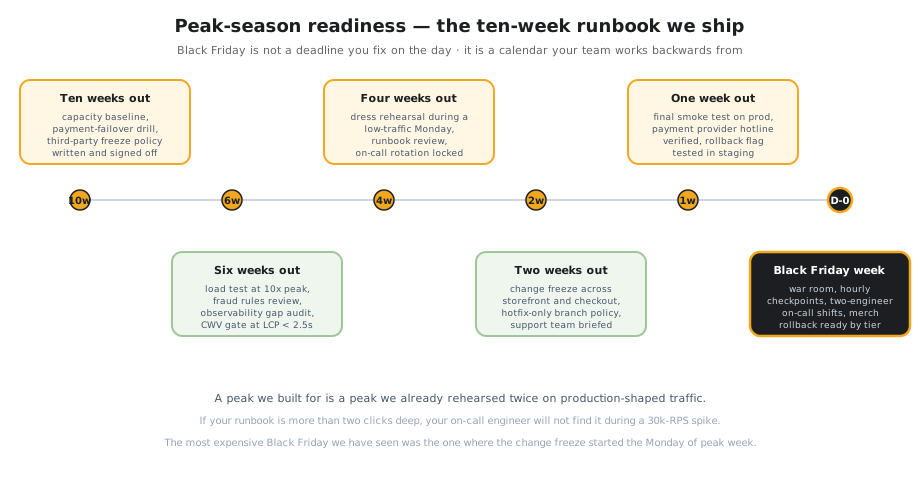
Two principles drive the calendar. First, every checkpoint is a written artefact, not a meeting. The capacity test produces a number, the failover drill produces a video, the dress rehearsal produces an updated runbook. Second, the change freeze is real. Hotfix branches only, named approvers, a written rollback path for every deploy. The single most expensive Black Friday we have worked on since 2020 was the one where the change freeze started the Monday of peak week.
What a headless commerce architecture actually wires
If a headless engagement is going to fail, it is usually because one of the boxes in the diagram below was assumed to be somebody else's problem. Search and content engineering are the two most-skipped boxes; payments and the OMS are tied for the most-underestimated. The diagram is the shorthand we draw on a whiteboard during discovery to confirm scope.
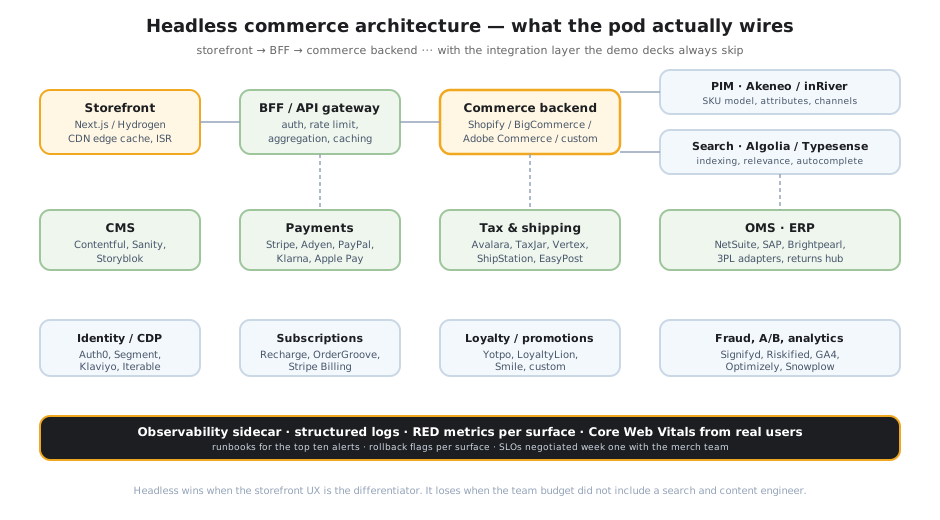
Three principles drive how the pod operates inside the diagram. First, the headless storefront is a product surface, not a technical demo — the merchandising team must be able to launch a campaign without filing a ticket, or the headless decision was wrong. Second, the BFF and gateway carry the integration burden, not the storefront; we keep authentication, rate limits, persisted queries, and aggregation in the BFF so the storefront stays cacheable. Third, the observability sidecar covers every surface in the diagram; partial coverage is a 03:00 page waiting for an excuse to fire.
Risks specific to commerce engagements (and what we do about them)
Generic outsourcing risks — IP ownership, NDAs, time-zone overlap — we treat the same way on every engagement: written into the master agreement, US-style work-for-hire IP, source-controlled deliverables, four-hour daily overlap with US time zones. The risks worth naming on this page are the ones unique to commerce work.
Peak-season fragility
The store that runs cleanly at 200 RPS and folds at 2,000. Mitigation: capacity test at ten times the prior year's peak in sprint two, payment-failover drill in sprint four, dress rehearsal in sprint eight, change freeze two weeks before peak. The runbook lives in source control and is one click deep, not a sub-folder of a Confluence page.
Payment-failure mean recovery time
The provider goes down, the cart goes with it, and the team finds out from Twitter. Mitigation: a documented failover route to a secondary provider behind a feature flag, synthetic monitors that page on a real failed transaction, a payment provider hotline saved in the runbook, and a war-room script with named approvers for the failover decision. We aim for under three minutes from first failed transaction to traffic on the secondary.
Missing fraud rules
The chargebacks land thirty days after the campaign that triggered them, by which point the team has moved on. Mitigation: fraud-rule review as a pre-launch gate (Signifyd, Riskified, or in-platform), per-region rule sets, velocity checks on new accounts, manual-review thresholds tied to order value, and a quarterly chargeback retro that updates the rules instead of complaining about them.
Plug-in spaghetti
The storefront has fifty third-party apps, half of which the merchandising team forgot they installed. Mitigation: an allow-list with a written reason for every install, custom logic moves out of the platform admin and into source-controlled apps, an upgrade calendar published the day a major platform release lands, and an upgrade rehearsal against a production-shaped staging clone.
Headless without a search budget
The storefront ships, autocomplete is "good enough" with a free tier, and three months later the search team is the bottleneck. Mitigation: search engineering is named on the team configuration before headless is even on the table; Algolia, Typesense, Klevu, or a self-hosted alternative is budgeted; the indexing pipeline lives in source with reindex tooling that does not require waking up the on-call.
A/B test theater
The team runs ten tests a quarter, none of which reach significance, and the leadership deck calls every one a "win." Mitigation: we will not start an A/B test plan until the funnel is stable enough to learn from; minimum-detectable-effect math is published with every test; tests below the MDE are killed at the planning stage; the readout is a decision, not a slide.
Frequently asked questions about hiring an eCommerce development team
When does an eCommerce pod actually beat hiring a Shopify or Adobe agency?
Whenever the work crosses the platform-native boundary. Platform agencies are excellent at themes, the certified app marketplace, and the workflow they were trained on. They are usually weak on the integration layer, the headless storefront, and the on-call rotation through peak season because those live outside the certification scope. The diagnostic question we ask buyers on the discovery call is whether the agency staffs an integration engineer by default. If ERP, OMS, or payment work is scoped as a separate quote with a different lead, the buyer is about to pay twice for one program. A pod is the right call when the work spans the storefront and at least one of the seven other artefacts a real eCommerce program owns.
Should we replatform, or fix the storefront we already have?
Of the eCommerce engagements we ran in 2025, roughly four in ten arrived asking for a replatform and left with an eight to twelve sprint plan to fix the storefront they were already on. We run the four-question Replatform Test above before recommending a migration: quadrant shift, integration ceiling, velocity cost, and peak runway. Three or four yes answers means replatform with a calendar; three or four no answers means fix in place. The most expensive replatforms we have rescued were the ones the buyer started because the admin looked dated, not because the business outgrew the platform.
What is the realistic Black Friday peak readiness runway?
Ten weeks if you want a runbook your on-call engineer can find at 11pm. Six weeks if you accept skipping the second load test. Four weeks is rescue territory and we will tell you so on the discovery call. Inside the ten-week shape we run a capacity baseline, a payment-failover drill, a load test at ten times peak, an INP and LCP gate, a dress rehearsal during a low-traffic Monday, a change freeze two weeks out, and a final smoke test the week of peak. The single most expensive Black Friday we have worked on since 2020 was the one where the change freeze started the Monday of peak week.
Who actually owns the ERP, OMS, payment, and tax integrations on the squad?
A dedicated integration engineer does, and we refuse to remove that seat to hit a price point. ERP and OMS sync is where commerce projects fail more often than the storefront. The integration engineer owns the SAP, NetSuite, Brightpearl, or Microsoft Dynamics adapter; the OMS sync to a 3PL or in-house warehouse; the payment provider rotation across Stripe, Adyen, PayPal, Klarna, and any regional gateway; the tax engine integration; and the shipping APIs. The DevX of those connectors lives in source control with contract tests gating every PR, not in a vendor portal that loses configuration when a contractor's laptop dies.
Can the squad ship a B2B catalog with account hierarchy, punchout, and net-30 terms on Shopify Plus?
Yes. Shopify Plus B2B Edition has closed most of the gap that used to send mid-market distributors to Adobe Commerce, and the 2024 to 2025 platform updates pushed the Catalog API and the Markets B2B feature far enough that it is now the default we recommend on the mixed-channel quadrant. The pattern: customer accounts mapped to company hierarchies; per-company catalogs and price lists; quote workflow on a custom app; punchout via cXML or OCI through PunchOut2Go; net-terms via draft orders plus a finance approval gate; ERP-driven SKU and price sync. Where Shopify Plus still loses is multi-step approval workflows across legal, finance, and procurement, and catalogs above a few hundred thousand SKUs.
How do you fix Core Web Vitals (now including INP) on a storefront that is already live?
We start with measurement, not theory. A two-week audit covers PageSpeed Insights and CrUX field data with INP since it became a Core Web Vital in March 2024, a Baymard-checklist UX review of the PDP, PLP, cart, and checkout, a tag bloat audit, and a checkout funnel teardown with session replays. The first three sprints typically retire the LCP regressions caused by render-blocking app embeds, replace the largest hero image strategy with AVIF or WebP, fix the long INP tasks coming from over-eager analytics, move third-party scripts behind a tag manager with consent and load-time budgets, and rebuild the checkout step that is actually losing the order.
How do you stop the plug-in spaghetti that breaks every Shopify or Magento upgrade?
Three rails. Every third-party app is reviewed against a written allow-list before install; if its functionality lives in two of our existing apps, we delete one. Custom logic moves out of the platform admin and into source-controlled apps and metafields, with deploy pipelines and review gates. An upgrade calendar is published the day a major platform release lands (Adobe Commerce 2.4.7-p3 or 2.4.8 forced PHP 8.3 and Composer 2.7 on every install we touched in 2025), and the upgrade is rehearsed against a production-shaped staging clone before it touches the live store.
Can the pod take on-call rotations during peak season?
Yes. We staff a 24/5 on-call rotation by default with two engineers per shift, and 24/7 during the change-freeze window through Black Friday weekend and the December peak. We refuse to take an SLO we did not write the runbook for. Within the first month we co-author runbooks for the top ten alerts, agree paging severity per surface, and run a tabletop incident before the rotation goes live.
When should we hire a dedicated eCommerce pod instead of staff augmentation?
Run the Commerce Pod Fit Test above. If two or three answers are yes—integration scope beyond the storefront, a named peak on-call rotation, or a single delivery lead accountable for checkout plus ERP plus CWV in one backlog—a dedicated pod is the right model. Zero or one yes means add one or two augmented seniors instead; we route you to staff augmentation on the discovery call when that is the honest answer. Roughly thirty-eight percent of our pods converted from augmentation within five months once the integration layer or peak runbook became load-bearing.
Can we move from staff augmentation to a full eCommerce pod later?
Yes. We routinely start with two or three augmented seniors on your existing squad through our staff-augmentation model and convert to a dedicated pod once we know your domain. The conversion adds the eCommerce tech lead, the integration engineer, the QA seat, and the optional CRO and UX engineer without churning the engineers you already trust.
Who you are talking to
This page is reviewed by Javier Uanini, founder and CEO of Siblings Software. He has been staffing software engagements out of Miami and Latin America since 2014. The recommendations on this page reflect the commerce engagements he has signed, scoped, or stepped into during peak season for ten consecutive Q4s. The Commerce Pod Fit Test, the Replatform Test, the eight artefacts a real eCommerce pod owns, and the ten-week peak-season runbook are all drawn from engagements we have run, not from a content brief.
If you would rather start the conversation with a delivery lead instead of an account manager, that is the default. Discovery calls are run by an eCommerce tech lead who has shipped the kind of work on the page above. We do not staff a sales engineering layer between you and the engineers; you talk to the people who would do the work.
More on how we are organised: about Siblings Software, the Argentina office where most of our engineers sit, and the case studies hub for published engagement details.
OUR STANDARDS
Capacity tests over confidence. Rollback drills over good intentions. Published peak-season runbooks over hopeful planning.
A commerce story is not done until the spec is updated, the integration sync is green, the checkout regression suite passes, the CWV dashboard shows the new template inside the LCP and INP budget, the runbook covers the alert path it can produce, and the merch team has the rollback flag in their dashboard. We treat the peak-season runbook as load-bearing infrastructure, not a quarterly project, and we report on the merchandising-facing SLOs we agreed to defend, not the velocity we estimated against.
Our Definition of Done is a written checklist with hard gates in CI: code review approved by the eCommerce tech lead, automated tests passing, checkout regression green, integration adapter contract test green, CWV budget respected on the impacted templates (LCP, CLS, and INP), deploy to staging successful, runbook entry for any new alert path, rollback flag verified. Until those gates close, the story is not done, regardless of what the marketing calendar says.
If you’re interested in hiring developers for this capability in Argentina, visit the Argentina version of this page.
CONTACT US
Get in touch and build your idea today.