Hire Vue.js Developers for Vue 3 and Nuxt Codebases
Siblings embeds senior Vue.js engineers into your squad when the backlog is brownfield: Options API leftovers, Vuex modules you cannot freeze, or Nuxt routes that must ship without pausing feature work. Product and engineering leaders use this page to compare vetting depth, rate bands, and how augmentation differs from a dedicated Vue pod.
Since 2014 we have staffed Vue roles for B2B SaaS, ops consoles, and seasonal release calendars in Latin American time zones with US overlap. Engineers join your repositories, extend your design tokens, and document Pinia and router decisions your next hire will inherit.
- Curated shortlists in 3-5 business days; first meaningful pull request by day eight.
- Roughly three in ten applicants pass our five-stage vetting including a live exercise.
- Monthly engagements with 30-day notice to scale. No bench fees.
"Vue 3 seniority is measured by incremental migration skill, not greenfield SFC demos."
Reviewed by Javier Uanini, Founder and CEO, Siblings Software. Last reviewed 9 November 2026.
Engagements delivered since 2014 across staff augmentation and dedicated teams.
Typical window from brief to first vetted Vue profiles for brownfield repos.
Applicants who pass all five vetting gates, including the live Composition API exercise.
When companies hire Vue.js developers through staff augmentation
Buyers compare speed, vetting depth, and coordination overhead. These scenarios cover most discovery calls.
Good fit
- Agtech ERP with Vue 2 roots and seasonal release pressure.
- Vue.js backlog with calendar pressure and internal lead in place.
- Compliance or peak-season scope needing senior depth without new FTE headcount.
- Attrition bridge while recruiting permanent hires.
Usually not the right move
- Undefined backlog with no engineering lead to prioritize.
- One-week cosmetic fix. A freelancer is faster.
- Need a full vendor-owned pod. See dedicated team pages for Vue.js.
Related: hire front-end developers staff augmentation hire nearshore developers hire software developers.
What Vue.js developers do day-to-day when embedded with your team
Embedded Vue.js developers join standups, refine tickets with product, and ship in your repositories. On a typical sprint they might extract a composable from an Options API screen, add Vitest coverage around a Pinia store action, or tune lazy routes in Nuxt without blocking your release train. They follow your branching model, respect your ESLint and Vue compiler rules, and leave pull request notes that explain migration trade-offs for the next engineer.
The Composition API Readiness Test
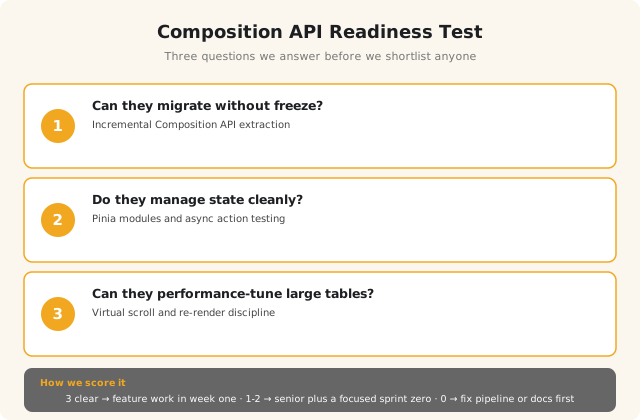
Three questions decide whether sprint zero is environment work or feature delivery. We run this in discovery and again in live vetting.
Q1: Can they migrate without freeze?
Incremental Composition API extraction
Q2: Do they manage state cleanly?
Pinia modules and async action testing
Q3: Can they performance-tune large tables?
Virtual scroll and re-render discipline
Nuxt 3 vs Vite SPA: who we staff from your brief
Vue hiring fails when the job description mixes SEO-facing Nuxt work with authenticated SPA work. We separate those lanes before shortlisting.
Nuxt 3 augmentation
Server routes, hybrid rendering, Nitro adapters, and content modules. We screen for useAsyncData caching choices and error boundaries on marketing plus app shells.
Vite SPA augmentation
Vue Router guards, code-splitting, and API-coupled dashboards. We screen for large table performance, dialog focus traps, and token refresh flows without full page reloads.
Migration pair
When you run compat builds, we can place two engineers: one on incremental Composition API extraction, one on build pipeline and test stability until compat comes out.
Compare delivery models: dedicated Vue.js team, Vue.js development outsourcing, and hire React developers when the backlog is split across frameworks.
Vuex to Pinia handoffs we expect before day one
Store migration is where resume keywords lie. We ask candidates to walk through how they retired a Vuex module without a big-bang freeze.
- Dual-write window: Pinia store mirrors Vuex state until router-level features switch.
- Typed actions: Actions return promises your existing components can await during the transition.
- Test seams: Vitest covers store logic without mounting entire SFC trees.
- Devtools discipline: Engineers document which Vuex modules remain and who owns the next extraction.
Authoritative reference: Vue.js state management guide (Pinia as the recommended store for Vue 3).
How Siblings vets Vue.js developers
We screen Vue.js candidates with a live exercise shaped like your backlog, not generic whiteboard trivia.
- Production debugging: Real incidents and logs, not puzzle questions.
- Testing discipline: Meaningful coverage on the slice they ship in the exercise.
- Communication: Pull requests that explain why, not only what.
- Stack match: We screen against your Vue.js patterns, not our preferences.
Typical rates and engagement models
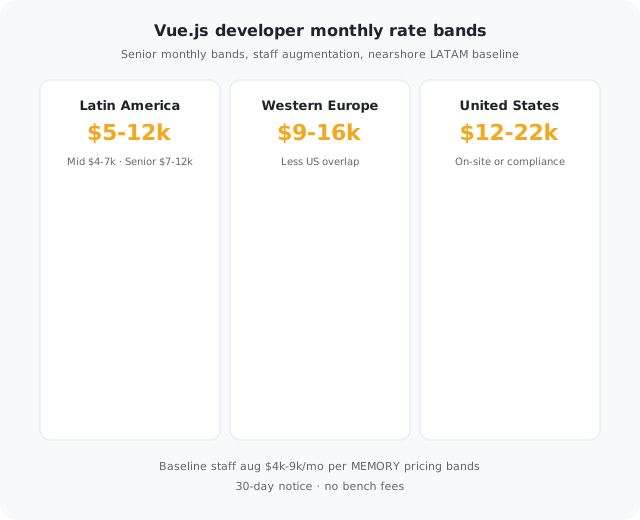
Senior Vue.js engineers typically run $5,000-$12,000 per month nearshore LATAM, within or slightly above the $4,000-$9,000 staff augmentation baseline depending on niche depth.
| Region | Mid-level | Senior | Notes |
|---|---|---|---|
| Latin America | $4-7k / month | $7-12k / month | Strongest value with US overlap. |
| United States | $12-16k / month | $14-22k / month | On-site or niche compliance. |
| Western Europe | $9-12k / month | $11-16k / month | Less daily US East overlap. |
How clients usually buy
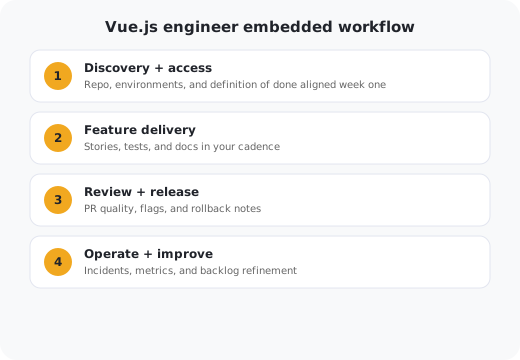
One embedded engineer. Joins your sprint cadence and owns stories.
Pair. Two engineers for migration plus feature parallel work.
Bridge. 6-12 month augmentation while internal hiring completes.
Staff augmentation vs freelancers vs in-house
| Model | Time to start | Best for | Tradeoff |
|---|---|---|---|
| Staff augmentation (Siblings) | 1-2 weeks | Teams with backlog and an engineering lead. | You keep product direction. |
| Freelance marketplaces | Days to weeks | Isolated tasks under four weeks. | Weak vetting and institutional knowledge. |
| In-house hire | 8-16 weeks | Core long-term culture roles. | Recruiting lag and competitive offers. |
Example engagement: Farmstead ERP Vue 3 migration (composite)
Illustrative scenario based on common Vue staff augmentation patterns.
Situation. Agtech ERP on Vue 2 with seasonal release pressure and inventory grids that stalled product demos.
What we did. Two embedded Vue engineers paired with the internal lead: incremental Composition API extraction, Pinia modules beside legacy Vuex, and Playwright smoke gates on checkout-critical flows.
What to evaluate on calls like this. Whether engineers commit to your org from week one, how they document store cutovers, and whether handover materials survive attrition on your side.
For published delivery references see Viking Services (front-end outsourcing) and the case studies index.
"We shipped the harvest release without a framework freeze."
Product Director, agtech SaaS (composite quote)
Need a vendor-owned pod instead? See hire Vue.js development team.
Vue 3 hiring checklist for 2025 and 2026 backlogs
These are the repo signals we ask about in the first brief. They separate maintainers from tutorial-level SFC authors.
- Script setup vs Options API: Can the candidate migrate one screen per sprint without disabling your test suite?
- Nuxt or Vite baseline: Which build tool owns your production artifacts today, and who maintains Nitro or Vite plugins?
- Design-system bindings: Vuetify, PrimeVue, or in-house tokens: we match component libraries already in your package.json.
- TypeScript strictness: Pair with TypeScript staff augmentation when shared types span Vue and Node services.
Related: hire front-end developers. External references: Vue.js documentation, Nuxt documentation.
Risks of hiring Vue.js developers externally, and how we mitigate them
Parallel vendor codebase
Mitigation: Engineers commit to your org from day one.
Resume keyword mismatch
Mitigation: The Composition API Readiness Test rejects shallow profiles.
Knowledge loss at roll-off
Mitigation: Documentation, walkthroughs, and optional shadowing.
Security gaps
Mitigation: NDA and least-privilege access before repository clones.
Frequently Asked Questions
One to three vetted profiles in 3-5 business days; embedded in roughly two weeks with first production PR around day eight.
Vue 3 with Vite or Nuxt 3, TypeScript when your repo already uses it, Pinia or staged Vuex retirement, Vitest plus Playwright or Cypress on your CI. We staff to your package manager, router, and design-system bindings rather than forcing a greenfield stack.
Five-stage vetting with a live exercise and reference checks. Roughly three in ten applicants pass.
Typically $4,000-$9,000 mid-level and $7,000-$12,000 senior nearshore LATAM per month; US and EU bands higher.
Choose Nuxt augmentation when SEO, server routes, or hybrid rendering drive the backlog. Choose Vite SPA engineers when the product is authenticated-only, Electron-wrapped, or API-coupled without public HTML routes. We can pair one of each when you are mid-migration.
Augmentation when you have an engineering lead and backlog; dedicated teams when you want Siblings to own a workstream end-to-end.
Structured handover so your team can maintain and extend everything we shipped.
OUR STANDARDS
Vue.js craftsmanship, no shortcuts.
We hold Vue.js engineers to the same bar as internal seniors: peer review, tests on critical paths, and honest release advice.
See our Viking Services case study for a published front-end delivery reference.
CONTACT US
Tell us about your Vue.js stack, backlog, and timeline.