Add senior React Native engineers to your mobile team without burning a quarter on recruiting
React Native is no longer the experimental choice. Meta, Microsoft, Shopify, Discord, and a long tail of marketplaces and fintechs ship production apps on it every week. The skill that has not scaled with the framework is the senior engineer who can move comfortably between TypeScript, a Swift TurboModule, a Kotlin foreground service, and an Apple reviewer’s rejection notice without panicking. This page is for buyers who already know they want React Native and need a useful, non-marketing answer about how to staff it.
Siblings Software has been embedding mobile specialists into product teams since 2014, with more than 250 engagements across SaaS, fintech, healthcare, marketplaces, ticketing, logistics, and consumer apps. Our React Native engineers work from Argentina, Brazil, Colombia, and Mexico, so North American teams get four to six hours of real overlap on standups, pair-programming, and on-device debugging — not the async-only handoffs you get from offshore-only vendors who cannot join your release call.
- Two or three vetted profiles inside 3 to 5 business days once the stack and seniority brief are clear.
- Most placements are React Native 0.74 or later, Hermes, TypeScript, and the New Architecture; we also staff older 0.6x apps mid-migration.
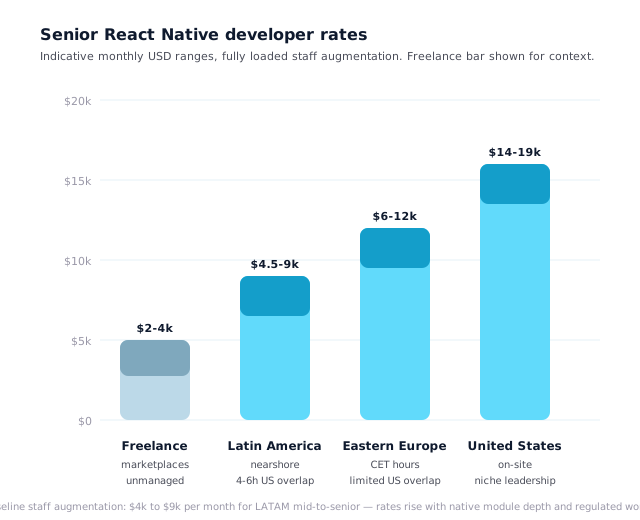
- Monthly engagements between $4.5k and $9k per engineer for nearshore mid-to-senior. US senior rates start near $14k.
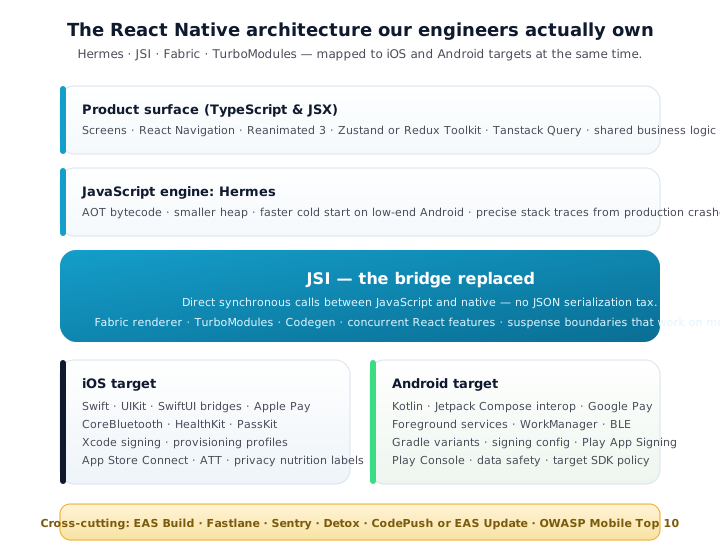
A productive React Native hire crosses the bridge in both directions — not just the JavaScript half.
Median mobile experience across the senior engineers we shortlist for production React Native, Swift, and Kotlin work.
From your first call to a merged pull request and a TestFlight or internal-track build when access reviews overlap cleanly.
Total Siblings Software engagements since 2014 across mobile, web, AI, eCommerce, and platform engineering.
What hiring React Native developers through staff augmentation actually means
Three terms get used interchangeably online — staff augmentation, dedicated team, project outsourcing — but they describe very different deals. Here is where React Native staff augmentation lives on the spectrum.
Where it sits
Staff augmentation places one or more vetted React Native engineers inside your sprint cadence. They commit to your repository, attend your standups, sit in your Slack, and pick up tickets from your backlog. You keep the product roadmap, the architecture decisions, and the release calendar; we handle hiring, vetting, onboarding logistics, payroll, equipment, replacements, and the occasional 9pm pairing session when an Apple review goes sideways.
The contrast with project outsourcing is ownership. A project agency owns the deliverable. With staff augmentation, you own the outcome and we own the engineer’s availability and quality.
What it is not
- Not a freelancer marketplace. Profiles are pre-screened against your stack; you do not have to triage forty bids on Upwork from "React + mobile" generalists.
- Not a managed pod. If you want a Tech Lead, mobile QA, and a Delivery Manager bundled with the engineer, look at our dedicated development teams model instead.
- Not body-shopping. We screen for product judgment, store discipline, and code quality, not headcount.
- Not project-based delivery. If you have a fixed scope and want a vendor to own the v1 launch end-to-end, project-based outsourcing is the cleaner fit.
If you would rather hand the entire mobile roadmap over instead of extending your existing team, our hire React Native development team page covers the dedicated-team model. For the full-service framing across mobile platforms, see our React Native development outsourcing hub.
Who actually buys React Native staff augmentation
The buyer changes the engagement. Four profiles show up most often, with the conversation each one usually starts with.
CTO at a fintech or marketplace going mobile-first
The web product is mature, the API is fine, and the mobile app is the conversion bottleneck. Often a Series A or B SaaS where the iOS app shipped first as an MVP and Android lagged by a year. Looks for one senior who can take the mobile codebase seriously while the web team keeps shipping. Frequently pairs the work with our React developers on the web side so business logic and types stay shared.
Mobile product lead with a stagnating React Native app
The app shipped two years ago on RN 0.66, Hermes is off, the New Architecture has not been touched, and the team has quietly been adding screens on the legacy bridge. Crash-free sessions are slipping. Wants a senior who has run the migration before, plus enough store experience to keep releases unblocked while it happens.
Founder at a marketplace or consumer app pre-Series A
Two engineers, an early TestFlight, and a target launch window. Wants real React Native judgment without the cost of two full-time hires. The conversation is usually about scope: what to ship in v1, what native features can wait, and how to avoid getting trapped in Expo’s managed workflow if a custom Bluetooth or PassKit module shows up in the roadmap. Often combined with our TypeScript engineers for shared types across web and mobile.
Head of engineering at a cross-platform consumer app
An app already in the App Store and Play with mid-six-figure monthly active users. Looking for senior engineers who can ship incremental performance wins on low-end Android, hold the line on app size, and keep crash-free sessions above 99.5%. Knows React Native is not a magic compiler — expects engineers who can drop into Swift or Kotlin when JSI cannot save them.
Rates, engagement models, and what gets billed
These ranges are not lowest-bidder marketplace numbers. They reflect React Native developers who communicate in English, work inside product teams, ship to the stores under your name, and have merged real production code in the last two years.
| Region | Mid-level | Senior | What you usually get |
|---|---|---|---|
| Latin America (nearshore) | $4.5k–$6.5k / mo | $7k–$9k / mo | Best value when you need real US-timezone overlap and engineers who join your sprint cadence rather than parallel-shipping in isolation. Most of our placements live here. |
| Eastern Europe | $5k–$7k / mo | $8k–$12k / mo | Mature pool. Overlap with US Pacific and Mountain teams is more limited; works well for European product teams or async-tolerant ones. |
| United States | $10k–$13k / mo | $14k–$19k / mo | Worth it when you need on-site presence, deep US domain context, App Review Board liaison work, or a very specific technical lead. |
| Freelance marketplaces | $2k–$4k / mo | varies wildly | Tempting on paper. Useful for bounded one-off work; weak for shared store ownership, replacement guarantees, or anything that depends on continuity across releases. |
Practical advice: if the React Native work touches payments, biometric auth, background location, or HealthKit-style regulated data, do not optimize for the cheapest rate. A junior who mishandles ATT, breaks a foreground service classification, or exposes signing keys in an EAS log will cost more in the first incident than the rate difference saves over six months.
Three engagement shapes we see most
One full-time React Native engineer. The default. The developer joins your sprint, attends standups, owns backlog items just like a permanent hire, and stays through the release cycles your roadmap actually depends on.
Fractional senior support. Useful for a New Architecture migration, a performance audit, a store-rejection cleanup, or mentoring a junior team. Works only when you have a clear internal owner who can act on the recommendations between sprints.
Pod extension. One React Native engineer plus a backend or QA engineer when a single hire will not unblock the roadmap. We assemble these from the same nearshore bench so timezones line up and pairing is real.
All three are billed monthly. Hourly accounting tends to push everyone toward defensive timekeeping; monthly billing keeps the focus on shipped releases.
Staff augmentation vs freelancer vs in-house vs two native teams
Most React Native hiring decisions are not about finding "the best." They are about choosing the least painful option for the work you actually have this quarter. Two native teams is the comparison the others rarely admit you should run.
| Model | Best for | Time to start | Main tradeoff |
|---|---|---|---|
| Staff augmentation | Existing mobile teams that need more capacity, a New Architecture migration, store discipline, or senior oversight without losing control of the roadmap. | 1 to 2 weeks | You still need internal ownership. This model boosts execution; it does not replace product direction. |
| Freelancer | Contained tasks with clean scope: a single screen, a one-off Detox suite, a small native module, an app-icon refresh, an ATT compliance pass. | Sometimes same week | Fast for isolated work, weak for shared ownership. Continuity disappears the moment the task ends, which is a problem when the App Store rejects the next release. |
| In-house hire | Core long-term mobile leads where compounding domain knowledge over 18 to 36 months is the actual goal. | 3 to 5 months | Slowest path and highest total cost. The senior React Native pool in the US is finite and contested. Closing an offer with the right native module experience still takes time. |
| Two native teams (Swift + Kotlin) | Apps where 30%+ of the surface is platform-specific or performance-critical (high-end games, AR, custom video). | 4 to 8 months | Doubles your headcount, doubles your release calendar, doubles the chance of feature parity drift. Worth it for very narrow product categories; rarely the right call for the typical SaaS or marketplace. |
Our honest take: if your app is a SaaS, marketplace, fintech client, or consumer companion to a web product, React Native through staff augmentation is the right answer. If the app is a flagship experience where every dropped frame is visible to the customer — a 3D editor, a real-time video studio, a high-end game — consider the two native teams route, and pair them with a small iOS developer and Android developer via Kotlin placement instead.
Common React Native hiring scenarios we see most
The intent behind "hire React Native developers" varies. Here are the four patterns we staff for nearly every month, with the questions we ask up front.
New Architecture migration on an existing app
Apps stuck on RN 0.66 to 0.71 with the legacy bridge, JSC instead of Hermes, and a couple of community modules that never got TurboModule wrappers. Sitting there is a quiet liability: 0.76 is the architecture the framework now defaults to, and Apple keeps tightening target SDK and privacy requirements. We run the migration incrementally per platform behind a flag, keep the test suite green at every checkpoint, and time the cutover to a low-traffic week. Reference: the official React Native architecture documentation publishes the full pillar set, but applying it inside a real codebase is a different exercise.
v1 launch with limited mobile leadership
The most frequent ask from earlier-stage teams. Two product engineers, a mature web product, and a target launch in a quarter or two. We staff one senior who can own the mobile architecture while the existing team focuses on features. The engineer chooses Expo or bare CLI based on the actual native module roadmap, sets up EAS Build or Fastlane, configures Sentry, and ships TestFlight and internal-track builds within the first month so the wider team has a real device target on day one. The React Native documentation and Expo documentation set the patterns; the senior engineer applies judgment about when to follow them.
Native module work the JS layer cannot solve
Bluetooth peripherals, biometric auth, foreground services for delivery and dispatch apps, Apple Pay and Google Pay, HealthKit, PassKit, custom camera pipelines, BLE beacons. We screen for engineers who write Swift and Kotlin TurboModules, expose them through Codegen, and design clean JSI surfaces — not engineers who reach for the first npm package on GitHub regardless of maintenance status.
Store rejection and policy hardening
App Tracking Transparency wording, background mode justifications, foreground service categories on Android 14+, data safety form drift, target API level deadlines, privacy nutrition labels, and the very specific phrasing Apple wants in permission strings. Our developers have shipped through both stores often enough to spot a soon-to-be-rejected build in code review. Reference frame: Apple’s own App Store Review Guidelines still set the bar; the engineer applies them inside your app instead of treating them like a checklist.
How Siblings Software runs React Native engagements
The hard part is not finding someone who has shipped a React Native app. It is matching the right level of judgment to the codebase complexity, store posture, and team dynamics you actually have.
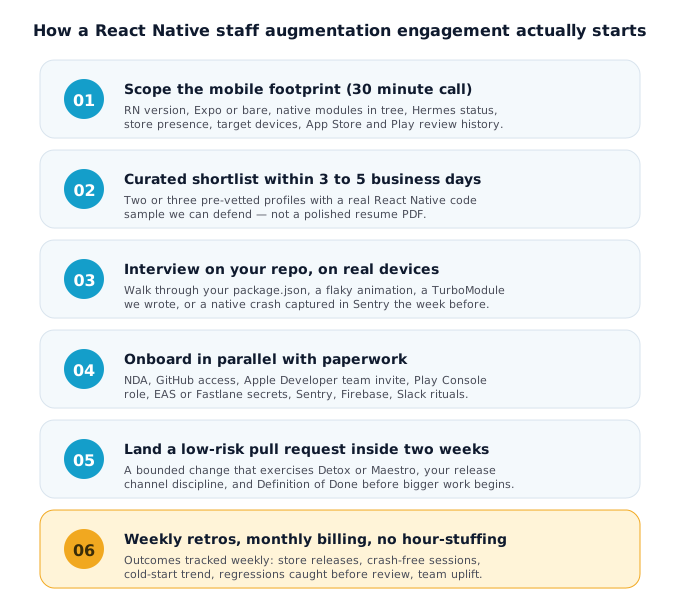
- Scope the real gap. What is blocked — a New Architecture migration, slow feature delivery on Android, missing senior oversight, a store submission that keeps getting rejected, a flaky background location service? We push for specifics in the first call so the shortlist matches the work, not the keywords.
- Match for context, not resume keywords. We screen for React Native depth, native module experience in Swift and Kotlin, pull-request communication, testing habits with Detox or Maestro, and whether the engineer has shipped through the App Store more than once on a real release calendar.
- Interview on your terms. The candidate should walk through your
package.json, youriosandandroidfolders, your release pipeline, and a piece of code that worries you — not solve textbook trivia in a sandbox unrelated to mobile. - Onboard in parallel with paperwork. NDA, GitHub access, Apple Developer team invite, Play Console role, EAS or Fastlane secrets, Sentry, Firebase, observability dashboards, and Slack rituals all happen during the first week so the engineer can pick a low-risk story by day three.
- Track outcomes weekly, not hours. We review tickets closed cleanly, store releases shipped, crash-free sessions, cold-start trend on low-end Android, regressions caught before App Review. Hours-tracked dashboards rarely tell you any of that.
What clients usually get wrong
The most common mistake is hiring for "React Native experience" when the real gap is mobile fluency. React Native looks like React. The release calendar, signing model, background execution rules, and review process do not. Engineers who never shipped past TestFlight freeze the first time Apple kicks back a build for ATT wording.
Second mistake: under-scoping the native module roadmap. "We just need a React Native dev" turns out to mean an app with PassKit, biometric auth, BLE peripherals, and Stripe Terminal. The right hire for that is a senior who writes Swift and Kotlin, not a JavaScript developer who calls native code "out of scope."
Third: testing only on simulators and a single Pixel. Mid-range Androids, three-year-old iPhones, real cellular networks, and patchy GPS are where mobile apps get judged. Our engineers test on real devices because production users do.
Experience signals that predict success
Across more than 250 Siblings Software engagements since 2014, the variable that consistently separates a good React Native hire from a frustrating one is rarely raw technical skill. It is whether the engineer has lived through a release cycle: a Friday rejection, a 1.x.x hotfix, a CodePush or EAS Update rollback, a foreground service class change forced by Google Play, an ATT wording rewrite the Monday before launch.
Clients who define ownership clearly — who reviews PRs, who escalates store rejections, who decides architecture trade-offs — ramp faster and keep developers longer. Clients who hire and then disappear tend to relearn that lesson the expensive way.
Real proof beats marketing. Our public BinSensors smart-cities IoT case study shows how a long-running engagement looked when fleet-edge constraints — intermittent connectivity, hardware integration, real route data — were the actual product, not a backdrop. Mobile staff augmentation taps into the same engineering muscle one engineer at a time.
Mini case study: Stagepost Tickets and a New Architecture deadline before a festival season
A composite drawn from a recent live-events engagement. Names changed; the technical shape is real.
The situation
Stagepost Tickets is a US-based live-events ticketing and resale marketplace running a React Native app on iOS and Android. The codebase started life on RN 0.62 in 2020 and had been bumped twice, painfully, to 0.69 in 2022. Six internal engineers split between web and mobile, one Stripe Terminal integration for venue partners, and an Apple/Google Wallet pass flow that was the single most-used feature on event days. The pressure: an annual festival cycle starting in twelve weeks, a 50% MAU spike forecast on top of an already saturated peak, and three issues the team already knew about — a custom Bluetooth beacon module written against the legacy bridge, a queue:work-style background sync that was silently dropping ticket-transfer events on Android 14, and a 4.1-second cold start on the lowest-end Android segment that finance had told the CMO to fix before paid acquisition resumed.
The internal team had been planning the New Architecture migration for nine months without finishing it. The CTO needed RN 0.76, Hermes on both platforms, Fabric and TurboModules everywhere, plus a clean release through both stores within ten weeks — with no festival weekend hotfix.
What we changed
Siblings Software placed two senior React Native engineers with prior New Architecture migrations, plus fractional support from a mobile architect two days a week. First merged pull request landed on day eleven. Over the next nine weeks the work tracked to a clear sequence:
- Bumped RN to 0.74 first behind a feature flag, before touching the architecture. Ran the existing Detox suite at every commit; cleared 47 deprecation warnings and removed three packages that no longer compiled before letting the branch merge.
- Enabled Hermes on Android first (iOS was already on it), captured a Sentry baseline, and confirmed cold-start improvement on three real low-end Android handsets the QA lead kept on her desk for exactly this purpose.
- Migrated to RN 0.76 over two long weekends, then spent a sprint stabilising Reanimated 3, gesture handler, and the Stripe Terminal native bridge under Fabric so the venue-partner team did not lose a day to broken animations.
- Rewrote the Bluetooth beacon module as a Kotlin TurboModule and a Swift TurboModule with a shared TypeScript surface generated through Codegen. Replaced the silent background sync with a foreground service on Android that survived Android 14’s stricter classification rules.
- Rewrote the Apple/Google Wallet pass flow with explicit error states, retry logic, and a backfill job that replayed the last six weeks of failed transfers and surfaced 1,400 silently lost passes to a review queue inside the support tool.
What happened
The festival cycle closed on time with RN 0.76 in production, no store-related incidents during peak. Cold start on the lowest-end Android segment dropped from 4.1 seconds to 2.5 seconds — roughly a 38% improvement — mostly from Hermes and Fabric, with a smaller win from a smarter splash strategy. Crash-free sessions held above 99.4% across the festival weekend. App Store and Play approvals came on first submission; the previous two releases had been rejected for ATT wording and foreground service classification respectively. Stagepost kept one of the engineers on for another four months to extend the same TurboModule discipline to their gate-scanning hardware integration. The CTO’s phrase in the retro: “The migration was the smaller win. The bigger win is that the wallet pass bug nobody noticed for six weeks would not have shipped in the first place if a senior had been reviewing those PRs.”
Results after the first quarter
Festival cycle cleared. RN 0.76 with the New Architecture in production on the original timeline; no store-related incidents during peak.
Cold start. Lowest-end Android segment dropped from 4.1s to 2.5s (~38%) after Hermes plus Fabric.
Crash-free sessions. Held above 99.4% across the festival weekend on both platforms.
Data debt repaid. 1,400 silently lost wallet passes identified, surfaced, and replayed through a reviewable queue.
Team uplift. Internal engineers raised PR-comment quality measurably; defect rate on background sync and wallet code dropped in the next two release windows.
Why this engagement worked
It was not a rewrite. It was an audited, sequenced upgrade run by seniors who had survived the same migration twice before and had clear ownership over each batch. The CTO reviewed pull requests personally, removed access blockers fast, and kept the rest of the roadmap on the existing team. That triangle — specific problem, clear ownership, senior judgment — is what makes staff augmentation work for React Native.
If you would rather hand the whole roadmap over instead of extending your team, our dedicated React Native development team model bundles a tech lead and delivery management with the engineers.
Risks buyers raise, and how we close them
These concerns are reasonable. If a vendor cannot answer them with specifics, keep looking.
Risk: native dependency upgrades break the build
The single most-feared event on a React Native project. A pod-install fails, a Gradle plugin disappears, a community module drops support for the architecture you just enabled. We mitigate it with a concrete upgrade discipline: lock React Native and Expo SDK versions explicitly, pin native modules with known good versions, run a CI build on a fresh checkout every night, and keep an "upgrade canary" branch one minor version ahead of main. Most upgrade pain is not technical — it is the absence of this discipline.
Risk: performance regressions on low-end Android
The most common production complaint after launch. Hermes off, JS bundle too large, image cache misconfigured, list virtualization wrong, animations on the JS thread instead of UI thread. We test on actual mid-range Androids on real cellular networks, set up Sentry performance monitoring, gate releases on cold-start budgets, and treat regressions as bugs rather than tradeoffs. The React Native source on GitHub documents the perf primitives; the senior engineer applies them.
Risk: App Store and Play review delays before a launch window
Apple and Google review apps differently and unpredictably. The fix is not panic. It is a release branch ten days ahead of the launch, a TestFlight and internal-track build trail that reviewers can interrogate, ATT wording reviewed by someone who has had it bounced, and a foreground service classification that matches what the app actually does. Our seniors have a checklist long enough that "store-related delay" is rarely the rate-limiting factor on a launch.
Risk: dependency without knowledge transfer
Good engagements leave artifacts the internal team can maintain: review comments, runbooks, ADRs, Detox or Maestro coverage on the critical paths, and TurboModule patterns codified in PR templates. We track this actively. If your team cannot maintain the native bridges and release pipeline when the engineer rolls off, the setup needs fixing before that day arrives, not after.
React Native hiring questions we hear most
From CTOs, mobile product leads, and engineering managers evaluating React Native staff augmentation. None of the boilerplate FAQs — just the questions buyers actually send before signing a contract.
Still comparing options?
If you are deciding between one embedded React Native engineer, a broader pod, a dedicated team, or two native squads, a 30-minute call with us is more useful than another capability deck. We will tell you where staff augmentation helps and where it does not for your specific situation.
Contact us
Tell us what your React Native project looks like, where the bottleneck is, and whether you need one senior engineer, a pod extension, or a different engagement model. We usually reply within one business day.