Hire a Nearshore Development Team That Works in Your Timezone


Most offshore outsourcing failures aren't caused by bad engineers. They're caused by the 12-hour feedback gap that turns every code review into a two-day email thread and every sprint planning session into a monologue recorded at midnight.

A nearshore development team from Latin America eliminates that gap entirely. Your LATAM engineers are online when your New York or Chicago team is online. Pull requests get reviewed before lunch, not overnight. When a production incident hits at 2 PM Eastern, someone picks up the call within minutes.

At Siblings Software, we've been assembling nearshore pods from our Miami headquarters since the company started. Not rotating benches of anonymous contractors—stable squads of senior engineers, QA analysts, delivery leads, and designers who learn your domain, attend your standups, and stay long enough to remember why that billing module has a particular edge case. Our longest engagement ran 24 months with the same team members from start to finish.

Nearshore development team collaborating across US and Latin America timezones

Talk with a nearshore specialist

Why LATAM Nearshore Outperforms Offshore and Onshore for US Companies

We've onboarded clients who came to us after failed offshore engagements in Eastern Europe and South Asia. The pattern was always the same: individually talented engineers, but the compounding friction of timezone gaps, cultural mismatches, and handoff delays eroded velocity sprint after sprint. Here's what changes with a nearshore team in Latin America.

Same-day feedback loops

When your team in New York pushes a PR at 10 AM, your LATAM engineers review it by noon. Architecture decisions, deployment approvals, and bug triages happen in real time. One client told us their cycle time dropped 35% in the first quarter simply because reviews stopped sitting in a queue overnight.

Cultural and language alignment

Our engineers are fluent in English, familiar with US business norms, and share similar holiday schedules. They've worked with American startups and enterprises before. That cultural overlap eliminates the "lost in translation" problems that derail sprint planning and stakeholder demos—particularly around ambiguous product requirements.

Travel-friendly proximity

A four-hour flight from Miami to Buenos Aires or Bogotá makes in-person sprint kickoffs, architecture workshops, and quarterly reviews practical. Several of our clients fly their nearshore leads to headquarters once per quarter. It strengthens trust in ways video calls simply can't replicate.

Latin America's engineering talent pool has expanded significantly in recent years. Stack Overflow's Developer Survey consistently shows strong participation from Brazil, Argentina, Colombia, and Mexico, while platforms like Platzi are training hundreds of thousands of engineers annually. The depth of senior talent available for nearshore engagements has never been higher.

What a Dedicated Nearshore Team from Siblings Software Looks Like

We don't match keywords on résumés and call it a team. Every pod is assembled around your product's needs, with roles that complement what you already have in-house. Here are the three tiers most clients start with.

Starter Pod (3 people)

Two senior engineers plus one QA analyst. Best when you have a tech lead and product owner in-house and need raw execution capacity with quality assurance built in. This is how most engagements start before scaling.

From ~$24K/mo

Growth Squad (5 people)

A delivery lead, three engineers (backend, frontend, or full-stack), and one QA. The delivery lead manages sprint health, runs demos, and is your single point of accountability. This is our most popular configuration.

$40K–$55K/mo

Full Product Team (7+ people)

Engineers, QA, UX/UI designer, DevOps specialist, and a delivery lead. Built for teams that need to own a product area semi-independently—think a new product line, a platform migration, or an acquisition integration. Add a fractional product manager if you need one.

$60K–$75K/mo

Need individual nearshore engineers embedded in your existing team instead of a full pod? That's our nearshore staff augmentation model—same talent pool, different structure.

From Discovery Call to Sprint One

Most outsourcing vendors promise "fast ramp-up" but wing it. We don't. Our onboarding is a repeatable, documented process that gets your nearshore team shipping production code in the first sprint.

Nearshore team hiring process: discover, assemble, onboard, optimize

Step 1: Discovery & risk mapping

A 48-hour deep dive. Architecture walkthrough with your tech lead, backlog prioritization with your PM, and a risk assessment that identifies the three things most likely to slow the team down. We address blockers before sprint 1 starts.

Step 2: Team assembly & interviews

We shortlist 2–3 candidates per role within 5–7 days. You interview everyone. If someone doesn't click in the first sprint, we swap them at no additional cost. You decide who's on your team—always.

Step 3: Security & onboarding

Access provisioning, encrypted device checks, VPN/MFA enforcement, Git workflow alignment, CI/CD pipeline setup, and coding standards calibration. If you have SOC 2 or HIPAA requirements, we calibrate to those from day one.

Step 4: First sprint delivery

Ship production-ready work in sprint one. Not a throwaway ticket—a real feature or fix that passes code review, QA, and your deployment pipeline. Followed by a retro and metrics snapshot to tune the next sprint.

Pricing: What a Nearshore Team from LATAM Actually Costs

Nearshore pricing sits between offshore rates and US onshore costs. The sweet spot for most US companies is that you pay 40–60% less than hiring locally while keeping the timezone overlap that offshore simply cannot offer.

  • 3-person pod (2 senior engineers + QA): ~$24,000–$32,000/month
  • 5-person squad (delivery lead + 3 engineers + QA): ~$40,000–$55,000/month
  • 7+ person product team (full cross-functional): ~$60,000–$75,000/month

These are fully loaded rates. They include recruiting, retention programs, management overhead, tooling, and our delivery infrastructure. No hidden fees for onboarding, ramp-down, or knowledge transfer.

For comparison: a single senior full-stack engineer in the US costs $150K–$200K per year in salary alone, before benefits, office, and management. Three of those is $450K–$600K/year. Our 3-person nearshore pod costs $288K–$384K/year with QA included.

Hiring Model Comparison

Comparison of freelancers, in-house hiring, and nearshore dedicated teams by cost, speed, and management

When Hiring a Nearshore Team Makes Sense

Not every situation calls for a nearshore pod. Here are the four scenarios where we see the strongest ROI, based on hundreds of engagements across fintech, healthcare, SaaS, and logistics.

You need to ship faster but can't hire fast enough

Your roadmap is longer than your recruiting pipeline. US engineering hiring takes 3–6 months per position. A nearshore team is writing code in your repos within three weeks, and you skip the recruiting overhead entirely.

Your offshore team isn't delivering on time

The 12-hour gap is killing your velocity. Code reviews take a full day, sprint planning is a recorded monologue, and every deployment needs overnight babysitting. Nearshore fixes the timezone problem while keeping the cost advantage.

You're launching a new product line or platform

You need a self-contained team that can own a product area from day one without pulling engineers off your core platform. A nearshore pod with its own delivery lead operates semi-independently while staying tightly integrated through shared ceremonies.

Compliance requirements rule out fully offshore

Some clients in fintech and healthcare need their engineers in similar timezones and jurisdictions for regulatory reasons. LATAM nearshore satisfies those constraints while keeping costs well below US onshore rates. Our teams work under NDA and follow SOC 2-aligned security practices.

Case Study: HighSide Secure Collaboration Platform

A 24-month nearshore partnership with a Washington D.C. security company.

The challenge

HighSide builds encrypted collaboration tools for government agencies and regulated enterprises. Their engineering team in Washington D.C. needed to extend DevOps and Python capabilities without slowing down an aggressive compliance certification timeline. Hiring locally for those roles was taking 4–6 months per position—too slow given the roadmap pressure from their investors and government clients.

What we delivered

We embedded two senior specialists from our nearshore practice directly into HighSide's team. They joined the same Slack channels, attended every ceremony, and reported to the CTO alongside in-house engineers. Our engineers modernized Kubernetes workloads, implemented automated deployment guardrails, and contributed to the Python services that powered HighSide's desktop and cloud suites.

Results

  • 24+ months of continuous partnership with consistent release cadence
  • Both developers ranked among the top performers in HighSide's engineering org
  • 90%+ retention—the same engineers who started stayed through the entire engagement
  • Modernized Kubernetes infrastructure with automated guardrails that reduced deployment failures

Read the full story: HighSide case study.

HighSide secure collaboration platform logo

Risks You Should Know About

Nearshore outsourcing is not without trade-offs. We'd rather be upfront about the risks than pretend they don't exist.

Talent competition in LATAM is real

Senior engineers in Argentina, Colombia, and Brazil are in high demand. Retention is harder than it was five years ago. We counter this with above-market compensation, career development plans, and a culture that keeps our retention above 90%—but it's a real cost we build into pricing, not a risk we ignore.

Knowledge transfer takes intentional effort

A nearshore team won't absorb your domain by osmosis. You need to invest time in the first two weeks: architecture walkthroughs, pair programming sessions, access to documentation. We run a structured onboarding playbook for exactly this reason, but clients who skip the discovery phase always regret it.

Currency and economic volatility

LATAM currencies can be volatile. We price in USD and absorb currency risk on our end, so your monthly rate stays predictable. But you should know that economic conditions in the region do affect the talent market—both positively (deeper senior pools) and negatively (sudden compensation pressure).

Not all providers are the same

The nearshore market in Latin America ranges from world-class agencies to body shops that recycle the same developers across clients. Due diligence matters. Ask for retention data, talk to references, and demand transparency on who actually works on your project. We publish our retention numbers because they're real.

What Decision-Makers Usually Get Wrong About Nearshore

After years of running nearshore engagements, we've seen the same mistakes enough times to call them out.

Treating nearshore as a cost play only

Yes, nearshore saves money compared to US onshore. But if the only metric you track is hourly rate, you'll pick the cheapest vendor, get junior engineers disguised as seniors, and end up paying more in rework and delayed releases. The value of nearshore is speed plus cost, not cost alone.

Skipping the onboarding investment

Some clients hand off Jira credentials on day one and expect output by day three. That never works. Two weeks of structured onboarding—architecture walkthroughs, pair programming, security provisioning—pays for itself within the first month. The teams that ramp fastest are the ones whose clients invest the most in the first 10 days.

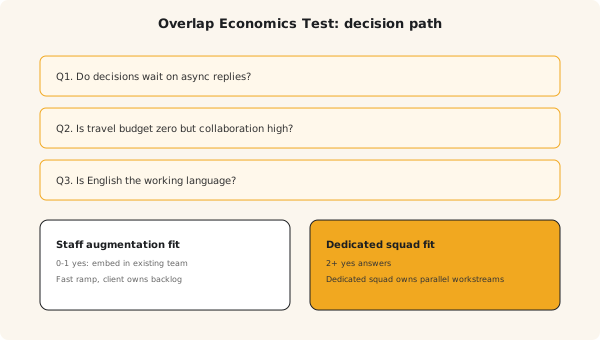
Hiring a "team" when you need staff augmentation

A dedicated team makes sense for 6+ month engagements where you need a squad with its own delivery cadence. If you just need two extra engineers for a three-month push, staff augmentation is the better model. Choosing wrong costs you in management overhead and underutilized capacity.

Technology Coverage

Our nearshore talent pool covers the full stack. Here's what our teams have shipped in production for US clients:

Front-end & mobile

Back-end & APIs

Infrastructure & data

  • AWS, Azure, GCP
  • Docker, Kubernetes, Terraform
  • PostgreSQL, MongoDB, Redis, Kafka

Looking for a technology-specific team? Browse our dedicated team pages for the exact stack you need.

Frequently Asked Questions

How much does a nearshore team from LATAM cost per month?

A 3-person pod starts at roughly $24,000/month. A 5-person squad with a delivery lead runs $40,000–$55,000/month depending on seniority and stack. These are fully loaded rates—recruiting, retention, management, and tooling are all included. No hidden onboarding fees.

How quickly can a nearshore team start writing production code?

Most teams start shipping by the end of week two. We run a structured onboarding playbook covering security provisioning, Git workflows, coding standards, and a first-sprint delivery target. By week three, the team owns features end-to-end and participates in architecture discussions.

What's the difference between nearshore and offshore teams?

Nearshore teams operate within 1–3 hours of your timezone, enabling same-day code reviews and real-time collaboration. Offshore teams sit 8–12 hours apart, turning every feedback loop into a 24-hour delay. For US companies, LATAM nearshore teams share working hours, cultural context, and similar holiday schedules. If you want to explore our offshore option, see offshore development team.

Can I interview and approve team members?

Yes. We shortlist 2–3 candidates per role and you interview each one. You decide who joins. If someone isn't the right fit during the first sprint, we replace them at no extra cost. You're never locked into a team member you didn't choose.

What roles can a nearshore team include beyond engineers?

Our pods include software engineers, QA analysts, UX/UI designers, DevOps and SRE specialists, data engineers, scrum masters, and fractional product managers. We assemble cross-functional squads that mirror high-performing in-house teams so you get delivery capability, not just coding hours.

How do you handle quality assurance and security?

Every engineer follows SOC 2-aligned practices: MFA, VPN-only access, encrypted devices, auditable Git workflows, and mandatory code reviews. QA analysts maintain automated regression suites (Cypress, Playwright, or Selenium) and run exploratory testing every sprint. We track cycle time, defect escape rate, and deployment frequency and share metrics with you weekly.

Nearshore Team vs. Staff Augmentation vs. Project-Based

We offer three engagement models. Choosing the right one depends on how much structure you need and how long the engagement will last.

Dedicated nearshore team

A self-contained pod—engineers, QA, delivery lead—that owns a product area. Best for 6+ month engagements where you need a squad that builds deep domain knowledge and operates semi-independently.

You're on this page.

Staff augmentation

Individual senior engineers who embed in your existing team. Best when you have a tech lead and PM but need 1–3 extra hands for a specific milestone. Flexible month-to-month commitment.

Explore staff augmentation

Project-based outsourcing

Hand us a defined scope and timeline. We plan, execute, and deliver end-to-end while keeping you in the loop at every sprint. Best for well-scoped initiatives with a clear finish line.

Explore project-based

How We Operate: Standards and Accountability

We measure what matters: cycle time, defect escape rate, deployment frequency, and talent retention. Every quarter we run a business review with your leadership to show where the team improved and where we're investing next. If a metric isn't trending in the right direction, we fix it this sprint, not next quarter.

Our delivery leads have managed nearshore engagements for fintech companies with PCI-DSS requirements, healthcare platforms under HIPAA, and SaaS products serving tens of thousands of daily active users. They've seen enough production incidents, compliance audits, and messy backlog grooming sessions to know the difference between "done" and "done right."

For distributed team management best practices, we draw from Atlassian's distributed team playbook and apply those patterns to every engagement we run.

Schedule a call

If you're interested in hiring a nearshore development team through our Argentina office, visit the Argentina version of this page.

Contact Our Nearshore Specialists

Share your roadmap and we'll map the team that can deliver it.